Biology GCSE / OCR Gateway A / Paper 1
 Call Kai
 Learn
Learn Practice Test
 Spaced Repetition
 Match
Match Flashcards
 Knowt Play
1/49

There's no tags or description
Looks like no tags are added yet.
Name | Mastery | Learn | Test | Matching | Spaced | Call with Kai | Chat |
|---|
No analytics yet
Send a link to your students to track their progress
50 Terms
What is the difference between eukaryotes and prokaryotes?
-Eukaryotes are complex cells (plants and animals)
-Prokaryotes are smaller and simpler cells (bacteria)
What sub-cellular structures do animal cells have?
Nucleus
-contains DNA, controls the cell's activities
Cytoplasm
-where chemical reactions happen, (gel-like substance)
Mitochondria
-where energy is released from respiration, contains enzymes needed for the reactions involved
Cell Membrane
-controls what goes in and out of the cell, holds the cell together, contain receptor molecules for cell communication
What sub-cellular structures do plant cells have?
Plant cells contain all of the sub-cellular structures of animal plants but also have a few extra
Cell Wall
-gives support to the cell, made of cellulose
Chloroplasts
-Contains green substance chlorophyll where photosynthesis occurs
What sub-cellular structures are present in prokaryotic cells?
Chromosomal DNA
-1 long circular chromosome that controls the cell's activities and replication
Plasmids
-small loops of extra DNA that aren't part of the chromosome, they contain genes for things like drug resistance and can be passed between bacteria
Cell Membrane
-controls what goes in and out of the cell, holds the cell together
What is resolution?
Resolution is how well a microscope distinguishes between two points that are close together.
What is the formula for magnification?
Image size / Actual size
eyepiece lens magnification
MULTIPLIED
objective lens magnification
Why do we need to take a thin slice of a specimen before using a microscope?
To allow light to go through it, which will help us see the sub-cellular structures clearly
Why do we need to stain some specimen before using a microscope?
If the specimen is transparent or colourless, a drop of stain will help us identify what is what. Different stains are used to highlight different structures.
e.g: Methylene blue for DNA
how has electron microscopy increased our understanding of how cells work?
Gives us more detail of what we are viewing and allows us to see much smaller things
What is a chromosome?
A coiled up piece of DNA that has genes that code for traits.
How is DNA structured?
DNA is made up of 2 strands forming a DOUBLE HELIX.
The strands are made up of smaller nucleotides (monomers) making DNA a polymer
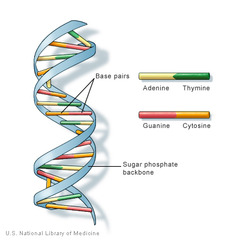
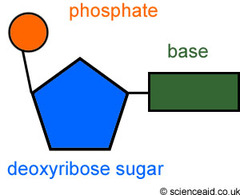
What makes a nucleotide?
Sugar
Phosphate Group
Base
Each DNA nucleotide has the same sugar and phosphate group but the base on each nucleotide is the only part of the molecule that varies (G/C/A/T)
What are complementary base pairs for DNA?
G (good)
C (cats)
A (are)
T (tigers)
What is an enzyme?
A biological catalyst
-a substance that speeds up the rate of reaction without being used up
-lowers activation energy
What factors affect enzyme activity?
-Temperature
-pH
-substrate concentration
-enzyme concentration
Explain the mechanism of enzyme action? (lock and key diagram)
Enzymes have high specificity for their substrates
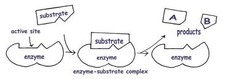
What does it mean for an enzyme to be denatured?
The shape of its active site is changed so that it can no longer bind to its substrate. The optimum levels of temperature and pH levels have been exceeded
What is the rate of reaction?
How fast the reactants are changed into products
How can you investigate enzyme activity?
What is respiration?
Respiration is the process of transferring energy from the breakdown of glucose
It is an EXOTHERMIC reaction, as it transfer hear out
What are the two types of respiration?
Aerobic and Anaerobic
What are the differences between anaerobic and aerobic respiration?
Aerobic (plenty of oxygen)
-glucose+oxygen = carbon dioxide+water
-c6h12o6 + 6O2 = 6CO + 6H2O
-32ATP made
Anaerobic
-glucose=ethanol+carbon dioxide (plants)
-glucose=lactic acid (animals)
-2ATP made
Why is important to breakdown biological molecules?
They fuel respiration
Carbohydrates/Proteins/Lipids can be broken down so that energy can be transferred to ATP through respiration, the energy stored in ATP is then available for the cell
What is the structure of carbohydrates?
Carbohydrates (polymers) are made up of simple sugars (monomers)
-contain (carbon/hydrogen/oxygen)
What is the structure of proteins?
Proteins (polymers) are made up of amino acids (monomers)
-contain (carbo/hydrogen/oxygen/nitrogen)
What is the structure of lipids?
Lipids (fats + oils) are made from glycerol and three fatty acids
-contain (carbon/hydrogen/oxygen)
NOT POLYMERS because they don't form a long chain of repeating units
Where are these biological molecules broken down?
Carbohydrates
-mouth + small intestine
Proteins
-stomach + small intestine
Lipids
-small intestine
What is photosynthesis?
Green plant and algae trap light from the sun using its energy to make glucose
It is an ENDOTHERMIC reaction
Reaction happens in chloroplasts
What is the formula for photosynthesis?
6CO2 + 6H2O --> C6H12O6 + 6O2
carbon dioxide + water= glucose + oxygen
What are photosynthetic organisms?
.The producers of biomass for life on earth
-life processes depend on photosynthesis
How can we investigate the rate of photosynthesis?
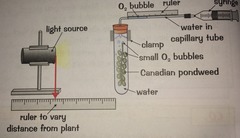
Pondweed experiment
-oxygen production shows the rate of photosynthesis
-the faster the oxygen production, the faster the rate of photosynthesis
1)pondweed left to photosynthesise in a set amount of time, oxygen released is collected in the capillary tube
2)at the end the syringe is used to draw the gas bubble in the tube up alongside a ruler
The length of the gas bubble is measured and is proportional to the volume of O2 produced
What factors affect the rate of photosynthesis?
-Light intensity
-Carbon Dioxide concentration
-Temperature
How does light intensity affect the rate of photosynthesis?
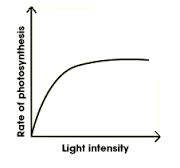
How does carbon dioxide concentration affect the rate of photosynthesis?
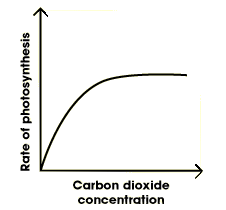
How does temperature affect the rate of photosynthesis?
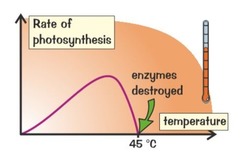
What is a limiting factor?
A factor that limits the rate of a reaction
What is diffusion?
The movement of particles from an area of high concentration to an area of low concentration
What is active transport?
The movement of particles from an area of low concentration to an area of high concentration using ATP released during respiration
What is osmosis?
The net movement of water molecules across a partially permeable membrane from an area of high water concentration to an area of low water concentration
Why are new cells needed?
For growth and repair
What are the processes of mitosis?
Prophase
-before the cell divides, the DNA forms X-shaped chromosomes
Metaphase
-the chromosomes line up at the centre of the cell and the cell fibres pull them apart
Anaphase
-membranes form around each of the sets of chromosomes, these become the nuclei of the two new cells
Telophase
-the cytoplasm divides
What is the cell cycle?
the series of events that cells go through as they grow and divide.
Gap Phase 1
-cell grows and new cell structures and proteins are made
Synthesis
-cell replicates its DNA, so that when it splits during mitosis the two new cells will contain identical DNA
Gap Phase 2
-cell keeps growing and proteins needed for cell division are made
Mitosis
(SEE DOWN BELOW)
Why is cell differentiation important?
So that cells can become specialised for a particular function and carry out this function in the most efficient way
Are stem cells differentiated or undifferentiated?
Stem cells are undifferentiated. Depending on what instructions they are given, they can divide by mitosis to become new cells, which then differentiate
Where are stem cells found?
In early human embryos or the bone marrow of adults
In plants, stem cells are found in areas that are growing - roots + shoots
What is the function of stem cells?
To replace damaged cells
To help in the growth and development of organisms
What is the difference between embryonic and adult stem cells?
Embryonic stem cells
-Found in early human embryos
-Can turn into any kind of cell
-Important for growth + development of organisms
Adult stem cells
-Found in bone marrow of adults
-Cant turn into any cell type, only from the tissue they originally come from
-Used to replace damaged cells
How are plant stem cells different to animal stem cells?
They act like embryonic stem cells but unlike human stem cells they can divide to generate any type of cell for as long as the plant lives
e.g: the unspecialised cells can become specialised and form tissues like xylem and phloem
What factors affect the movement of substances?
Surface Area to Volume Ratio
(diffusion/osmosis/active transport is higher in cells with a larger surface area to volume ratio)
Temperature
(hotter = more energy = move faster)
Concentration Gradient
(substances move in and out of a cell faster if there's a big difference in concentration between the inside and outside of the cell)
Why is exchanging substances more difficult in bigger and more complex organisms?
It is more difficult to exchange substances as diffusion across the outer membrane is slower.
-some cells are deep inside the organism (distant)
-larger organisms have lower