Valve Disease

0.0(0)
Studied by 0 people
call kaiCall Kai
Locked
learnLearn
examPractice Test
spaced repetitionSpaced Repetition
heart puzzleMatch
flashcardsFlashcards
GameKnowt Play
Card Sorting

1/38

encourage image

There's no tags or description

Looks like no tags are added yet.

Last updated 1:18 PM on 9/12/26
Name
Mastery
Learn
Test
Matching
Spaced
Call with Kai
Chat

No analytics yet

Send a link to your students to track their progress

39 Terms

1
New cards

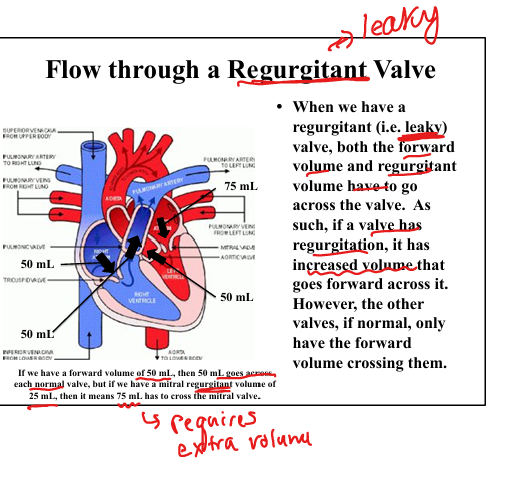
How does stenosis alter valve function compared to regurgitation?

Stenosis narrows the valve opening → same stroke volume must pass through a smaller cross‑sectional area → velocity increases and a pressure gradient forms with higher proximal pressure .

Regurgitation creates a leak → forward volume + regurgitant volume must cross the valve → increases chamber filling volume and preload depending on valve location .

knowt flashcard imageknowt flashcard image


<p>Stenosis narrows the valve opening → same stroke volume must pass through a smaller cross‑sectional area → velocity increases and a pressure gradient forms with higher proximal pressure . </p><p>Regurgitation creates a leak → forward volume + regurgitant volume must cross the valve → increases chamber filling volume and preload depending on valve location .</p><img src="https://assets.knowt.com/user-attachments/85c20274-d4e6-4623-b6ab-b73a847780c4.png" data-width="50%" data-align="center" alt="knowt flashcard image" style="display: block; width: 50%; margin-left: auto; margin-right: auto;"><img src="https://assets.knowt.com/user-attachments/66da22ac-b0ab-4f0c-af61-bde7653c315a.png" data-width="50%" data-align="center" alt="knowt flashcard image" style="display: block; width: 50%; margin-left: auto; margin-right: auto;"><p></p>
2
New cards

Why does a stenotic valve create a pressure gradient?

Because the proximal chamber must generate higher pressure to push normal stroke volume through a narrowed orifice, producing a measurable gradient used to quantify severity (e.g., AS mean PG > 40 mmHg) .

knowt flashcard image


<p>Because the proximal chamber must generate higher pressure to push normal stroke volume through a narrowed orifice, producing a measurable gradient used to quantify severity (e.g., AS mean PG &gt; 40 mmHg) .</p><img src="https://assets.knowt.com/user-attachments/e3399289-f241-48b2-abe4-099576bc0c48.png" data-width="50%" data-align="center" alt="knowt flashcard image" style="display: block; width: 50%; margin-left: auto; margin-right: auto;"><p></p>
3
New cards

How does regurgitation change ventricular loading conditions?

Regurgitation increases diastolic filling volume (mitral/tricuspid) or systolic forward volume (aortic/pulmonic), raising preload and eventually afterload as the ventricle must eject both forward and backward volumes .

knowt flashcard imageknowt flashcard imageknowt flashcard image


<p>Regurgitation increases diastolic filling volume (mitral/tricuspid) or systolic forward volume (aortic/pulmonic), raising preload and eventually afterload as the ventricle must eject both forward and backward volumes .</p><img src="https://assets.knowt.com/user-attachments/23d50929-f16c-4cb1-80c2-d57021361c06.png" data-width="50%" data-align="center" alt="knowt flashcard image" style="display: block; width: 50%; margin-left: auto; margin-right: auto;"><img src="https://assets.knowt.com/user-attachments/70666c92-fcd7-499d-aecb-955c30a42171.png" data-width="50%" data-align="center" alt="knowt flashcard image" style="display: block; width: 50%; margin-left: auto; margin-right: auto;"><img src="https://assets.knowt.com/user-attachments/b06c0229-85ed-4fdf-a989-56a6b4d26ef7.png" data-width="50%" data-align="center" alt="knowt flashcard image" style="display: block; width: 50%; margin-left: auto; margin-right: auto;"><p></p>
4
New cards

What are the most common causes of aortic stenosis?

Degenerative calcific disease (most common), bicuspid aortic valve(inc risk for aortic aneurysm), and rheumatic disease (leaflet tip fusion) .

knowt flashcard imageknowt flashcard imageknowt flashcard image


<p>Degenerative calcific disease (most common), bicuspid aortic valve(inc risk for aortic aneurysm), and rheumatic disease (leaflet tip fusion) .</p><img src="https://assets.knowt.com/user-attachments/128106c5-5c06-407a-ad3c-9a12d21f9a48.png" data-width="50%" data-align="center" alt="knowt flashcard image" style="display: block; width: 50%; margin-left: auto; margin-right: auto;"><img src="https://assets.knowt.com/user-attachments/9f041878-09b6-4767-9b7d-64068bf02e9d.png" data-width="50%" data-align="center" alt="knowt flashcard image" style="display: block; width: 50%; margin-left: auto; margin-right: auto;"><img src="https://assets.knowt.com/user-attachments/edcc738b-44db-4052-adb1-bbb0a60119b8.png" data-width="50%" data-align="center" alt="knowt flashcard image" style="display: block; width: 50%; margin-left: auto; margin-right: auto;"><p></p>
5
New cards

What are the most common causes of aortic regurgitation? (Acute vs Chronic)

Acute: aortic dissection, endocarditis.

Chronic: bicuspid valve, ascending aortic aneurysm, annular dilation, rheumatic disease, paravalvular leak after TAVR .

knowt flashcard image


<p>Acute: aortic dissection, endocarditis. </p><p>Chronic: bicuspid valve, ascending aortic aneurysm, annular dilation, rheumatic disease, paravalvular leak after TAVR .</p><img src="https://assets.knowt.com/user-attachments/b1b0aa64-0ab6-4f29-b5a4-fd1eebfccd3c.png" data-width="50%" data-align="center" alt="knowt flashcard image" style="display: block; width: 50%; margin-left: auto; margin-right: auto;"><p></p>
6
New cards

What are the most common causes of mitral regurgitation? (Acute vs Chronic)

Acute: papillary muscle rupture, chordae rupture, endocarditis. Chronic: MVP, annular calcification, LV dilation, myxomatous degeneration, HOCM, rheumatic disease .

knowt flashcard image


<p>Acute: papillary muscle rupture, chordae rupture, endocarditis. Chronic: MVP, annular calcification, LV dilation, myxomatous degeneration, HOCM, rheumatic disease .</p><img src="https://assets.knowt.com/user-attachments/5034eac6-a487-43de-a16b-803e58ffe21a.png" data-width="50%" data-align="center" alt="knowt flashcard image" style="display: block; width: 50%; margin-left: auto; margin-right: auto;"><p></p>
7
New cards

What are the most common causes of mitral stenosis?

Rheumatic heart disease (most common), mitral annular calcification in elderly patients

knowt flashcard image


<p>Rheumatic heart disease (most common), mitral annular calcification in elderly patients </p><img src="https://assets.knowt.com/user-attachments/27dbfe5d-811a-423d-845f-376c44743930.png" data-width="50%" data-align="center" alt="knowt flashcard image" style="display: block; width: 50%; margin-left: auto; margin-right: auto;"><p></p>
8
New cards

What are the most common causes of tricuspid regurgitation?(Primary vs Secondary)

Primary: endocarditis, Ebstein’s anomaly, chordae rupture.

Secondary: RV dilation, carcinoid heart disease, rheumatic disease, pacemaker lead trauma .

knowt flashcard image


<p>Primary: endocarditis, Ebstein’s anomaly, chordae rupture. </p><p>Secondary: RV dilation, carcinoid heart disease, rheumatic disease, pacemaker lead trauma .</p><img src="https://assets.knowt.com/user-attachments/dc0c11e9-ef70-47af-85da-24226779ce7d.png" data-width="50%" data-align="center" alt="knowt flashcard image" style="display: block; width: 50%; margin-left: auto; margin-right: auto;"><p></p>
9
New cards

What are the most common causes of pulmonic stenosis?

Congenital pulmonic stenosis, Noonan syndrome, and as part of Tetralogy of Fallot .

knowt flashcard image


<p>Congenital pulmonic stenosis, Noonan syndrome, and as part of Tetralogy of Fallot .</p><img src="https://assets.knowt.com/user-attachments/9376652b-787d-49a1-bac8-f9e27c91a240.png" data-width="50%" data-align="center" alt="knowt flashcard image" style="display: block; width: 50%; margin-left: auto; margin-right: auto;"><p></p>
10
New cards

How does the LV respond to aortic stenosis?

LV hypertrophies concentrically to reduce wall stress (pressure × radius / wall thickness) and generate higher systolic pressure to overcome the stenotic valve .

knowt flashcard imageknowt flashcard image


<p>LV hypertrophies concentrically to reduce wall stress (pressure × radius / wall thickness) and generate higher systolic pressure to overcome the stenotic valve .</p><img src="https://assets.knowt.com/user-attachments/cd807bd3-9fa9-4b7f-87c2-2439a34a386a.png" data-width="50%" data-align="center" alt="knowt flashcard image" style="display: block; width: 50%; margin-left: auto; margin-right: auto;"><img src="https://assets.knowt.com/user-attachments/aecaceb2-0c97-4a73-9214-c58834471c6e.png" data-width="50%" data-align="center" alt="knowt flashcard image" style="display: block; width: 50%; margin-left: auto; margin-right: auto;"><p></p>
11
New cards

Why is severe aortic stenosis preload‑dependent?

Contractility is maxed and afterload cannot be reduced(bc already stenotic)

knowt flashcard imageknowt flashcard image


<p>Contractility is maxed and afterload cannot be reduced(bc already stenotic)</p><img src="https://assets.knowt.com/user-attachments/af6504eb-a16a-44ec-8da4-255d9f3e0829.png" data-width="50%" data-align="center" alt="knowt flashcard image" style="display: block; width: 50%; margin-left: auto; margin-right: auto;"><img src="https://assets.knowt.com/user-attachments/5f65c503-8b1a-4430-b964-1d9544d3a0c7.png" data-width="50%" data-align="center" alt="knowt flashcard image" style="display: block; width: 50%; margin-left: auto; margin-right: auto;"><p></p>
12
New cards

How does the LV respond to chronic aortic regurgitation?

LV dilates (eccentric hypertrophy), increases wall thickness, increases preload and afterload due to large forward + regurgitant volumes, eventually leading to systolic dysfunction .
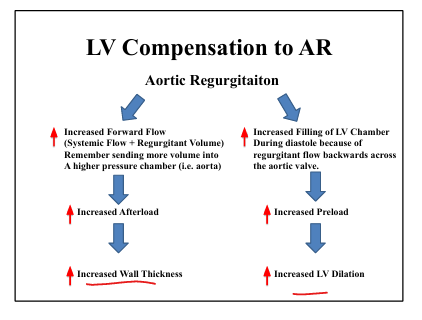
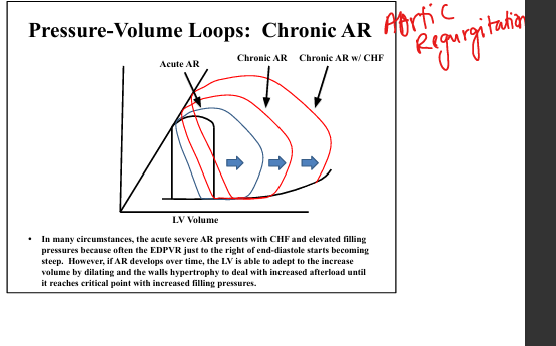
knowt flashcard imageknowt flashcard image


<p>LV dilates (eccentric hypertrophy), increases wall thickness, increases preload and afterload due to large forward + regurgitant volumes, eventually leading to systolic dysfunction .</p><img src="https://assets.knowt.com/user-attachments/503cab31-4553-4730-a15b-bfd7e89c9d12.png" data-width="50%" data-align="center" alt="knowt flashcard image" style="display: block; width: 50%; margin-left: auto; margin-right: auto;"><img src="https://assets.knowt.com/user-attachments/060d8d15-47de-49a2-b06c-1fea5c63652b.png" data-width="50%" data-align="center" alt="knowt flashcard image" style="display: block; width: 50%; margin-left: auto; margin-right: auto;"><p></p>
13
New cards

How does the LV respond to acute aortic regurgitation?

LV cannot dilate quickly → steep EDPVR → markedly elevated LVEDP → reduced coronary perfusion pressure → global ischemia and cardiogenic shock .
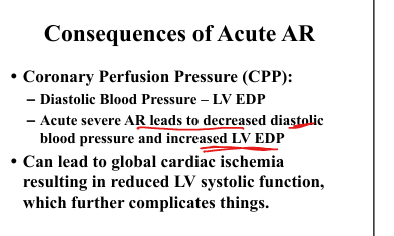
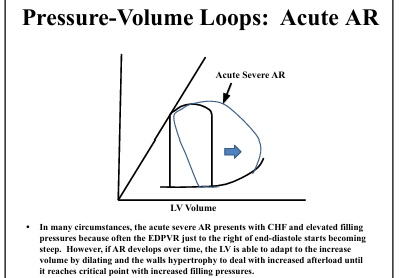
knowt flashcard imageknowt flashcard image


<p>LV cannot dilate quickly → steep EDPVR → markedly elevated LVEDP → reduced coronary perfusion pressure → global ischemia and cardiogenic shock .</p><img src="https://assets.knowt.com/user-attachments/2282e8c2-0db2-4d82-8ff3-a3f11b07fc82.png" data-width="50%" data-align="center" alt="knowt flashcard image" style="display: block; width: 50%; margin-left: auto; margin-right: auto;"><img src="https://assets.knowt.com/user-attachments/8adc8197-50fe-48ba-b17e-aa2e54f6effe.png" data-width="50%" data-align="center" alt="knowt flashcard image" style="display: block; width: 50%; margin-left: auto; margin-right: auto;"><p></p>
14
New cards

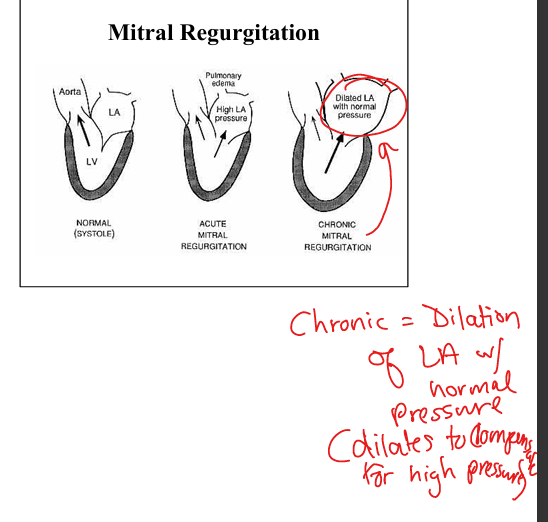
How does the LV respond to mitral regurgitation and vice versa?

LV dilates due to increased diastolic filling which will pull and dilate mitral annulus leaving leaflets unable to close

knowt flashcard imageknowt flashcard imageknowt flashcard image


<p>LV dilates due to increased diastolic filling which will pull and dilate mitral annulus leaving leaflets unable to close</p><img src="https://assets.knowt.com/user-attachments/4ce9d65f-2794-4fc1-bfbe-67330a8a8b84.png" data-width="50%" data-align="center" alt="knowt flashcard image" style="display: block; width: 50%; margin-left: auto; margin-right: auto;"><img src="https://assets.knowt.com/user-attachments/2a421073-4c9e-4b85-bde6-0cfde716e070.png" data-width="50%" data-align="center" alt="knowt flashcard image" style="display: block; width: 50%; margin-left: auto; margin-right: auto;"><img src="https://assets.knowt.com/user-attachments/205efc75-ea45-4759-9d86-ae4069dedb0b.png" data-width="50%" data-align="center" alt="knowt flashcard image" style="display: block; width: 50%; margin-left: auto; margin-right: auto;"><p></p>
15
New cards

How does the RV respond to mitral stenosis?

MS elevates LA pressure → pulmonary hypertension → RV pressure overload → RV failure because the RV bears the brunt of MS .

knowt flashcard image


<p>MS elevates LA pressure → pulmonary hypertension → RV pressure overload → RV failure because the RV bears the brunt of MS .</p><img src="https://assets.knowt.com/user-attachments/69719aa4-6220-4850-9557-7018ca9700ec.png" data-width="50%" data-align="center" alt="knowt flashcard image" style="display: block; width: 50%; margin-left: auto; margin-right: auto;"><p></p>
16
New cards

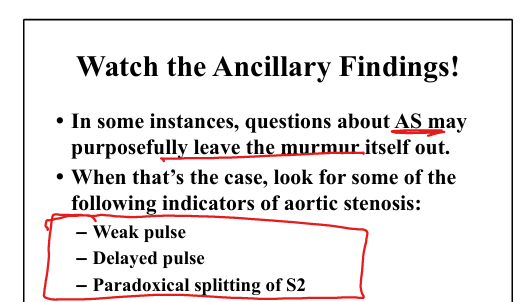
Ancillary Findings/Indicators of Aortic Stenosis on tests

Weak pulse, Delayed pulse, Paradoxical splitting of S2
knowt flashcard image


<p>Weak pulse, Delayed pulse, Paradoxical splitting of S2</p><img src="https://assets.knowt.com/user-attachments/46e07d31-91ef-4cbe-9ce8-2213c295ab13.png" data-width="50%" data-align="center" alt="knowt flashcard image" style="display: block; width: 50%; margin-left: auto; margin-right: auto;"><p></p>
17
New cards

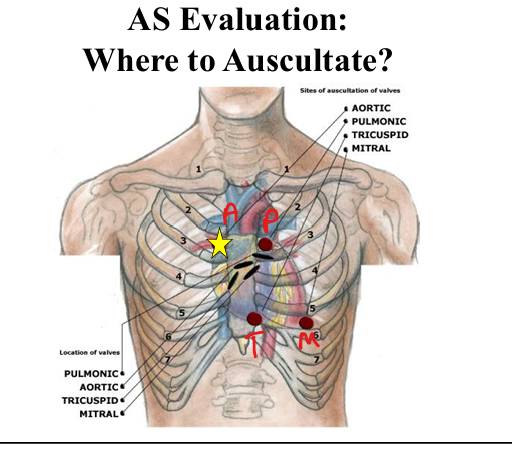
Which murmurs correlate with aortic stenosis?

Harsh crescendo‑decrescendo(starts soft grows louder then becomes softer) systolic murmur at RUSB radiating to carotids

knowt flashcard imageknowt flashcard image


<p>Harsh crescendo‑decrescendo(starts soft grows louder then becomes softer) systolic murmur at RUSB radiating to carotids</p><img src="https://assets.knowt.com/user-attachments/9ff5a7e2-1656-4e4c-b31f-b7b1177f2150.png" data-width="50%" data-align="center" alt="knowt flashcard image" style="display: block; width: 50%; margin-left: auto; margin-right: auto;"><img src="https://assets.knowt.com/user-attachments/699a3b6a-5bc3-48ce-9ccf-ce7dfc1586ab.png" data-width="50%" data-align="center" alt="knowt flashcard image" style="display: block; width: 50%; margin-left: auto; margin-right: auto;"><p></p>
18
New cards

Which murmurs correlate with aortic regurgitation?

Diastolic decrescendo murmur at RUSB or Erb’s point

knowt flashcard image


<p>Diastolic decrescendo murmur at RUSB or Erb’s point</p><img src="https://assets.knowt.com/user-attachments/6949bee8-62ae-4402-adb8-f75de4bbc480.png" data-width="50%" data-align="center" alt="knowt flashcard image" style="display: block; width: 50%; margin-left: auto; margin-right: auto;"><p></p>
19
New cards

Which murmurs correlate with mitral regurgitation?

Holosystolic(blowing noise characteristic of leaking) murmur at the apex radiating to axilla

knowt flashcard image


<p>Holosystolic(blowing noise characteristic of leaking) murmur at the apex radiating to axilla</p><img src="https://assets.knowt.com/user-attachments/83c4de9b-7274-4175-8062-67bf0a135963.png" data-width="50%" data-align="center" alt="knowt flashcard image" style="display: block; width: 50%; margin-left: auto; margin-right: auto;"><p></p>
20
New cards

Which murmurs correlate with mitral stenosis?

Diastolic murmur with opening snap at apex

knowt flashcard imageknowt flashcard image


<p>Diastolic murmur with <strong>opening snap</strong> at apex</p><img src="https://assets.knowt.com/user-attachments/bf95d089-59ec-4fb4-abd3-567735374d82.png" data-width="50%" data-align="center" alt="knowt flashcard image" style="display: block; width: 50%; margin-left: auto; margin-right: auto;"><img src="https://assets.knowt.com/user-attachments/944ee52c-9c70-462c-9530-cb43edd58fd0.png" data-width="50%" data-align="center" alt="knowt flashcard image" style="display: block; width: 50%; margin-left: auto; margin-right: auto;"><p></p>
21
New cards

Which murmurs correlate with tricuspid regurgitation?

Holosystolic murmur at LLSB that increases with inspiration (Carvallo’s sign) due to increased RV filling .

knowt flashcard imageknowt flashcard image


<p>Holosystolic murmur at LLSB that increases with inspiration (Carvallo’s sign) due to increased RV filling .</p><img src="https://assets.knowt.com/user-attachments/6566e7d7-a833-42d3-aa25-611c9670a627.png" data-width="50%" data-align="center" alt="knowt flashcard image" style="display: block; width: 50%; margin-left: auto; margin-right: auto;"><img src="https://assets.knowt.com/user-attachments/ef8f0341-ecd8-401f-98fd-ffac16312f0b.png" data-width="50%" data-align="center" alt="knowt flashcard image" style="display: block; width: 50%; margin-left: auto; margin-right: auto;"><p></p>
22
New cards

Which murmurs correlate with pulmonic stenosis?

Systolic ejection murmur at LUSB that increases with inspiration due to right‑sided volume changes .

knowt flashcard imageknowt flashcard image


<p>Systolic ejection murmur at LUSB that increases with inspiration due to right‑sided volume changes .</p><img src="https://assets.knowt.com/user-attachments/4275c3df-876d-49f7-b343-15e5400edd9d.png" data-width="50%" data-align="center" alt="knowt flashcard image" style="display: block; width: 50%; margin-left: auto; margin-right: auto;"><img src="https://assets.knowt.com/user-attachments/eff022e9-1bd7-497a-8159-fded4501d550.png" data-width="50%" data-align="center" alt="knowt flashcard image" style="display: block; width: 50%; margin-left: auto; margin-right: auto;"><p></p>
23
New cards

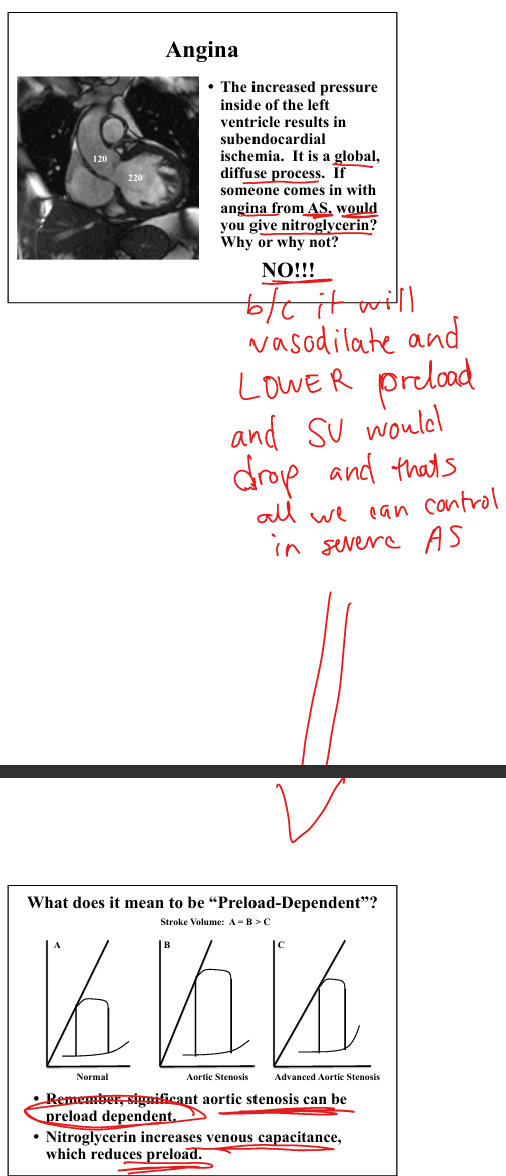
Should you give nitroglycerin to someone with angina from Aortic Stenosis? Why/Whynot?

NO, because it will vasodilate and lower preload and SV would drop as a result which is the only thing we can control in severe Aortic Stenosis
knowt flashcard image


<p>NO, because it will vasodilate and lower preload and SV would drop as a result which is the only thing we can control in severe Aortic Stenosis</p><img src="https://assets.knowt.com/user-attachments/8882fe30-e2dc-4a65-9f92-bb129ae356a3.png" data-width="50%" data-align="center" alt="knowt flashcard image" style="display: block; width: 50%; margin-left: auto; margin-right: auto;"><p></p>
24
New cards

What benchmarks indicate intervention for aortic stenosis?


Symptomatic severe AS (angina, syncope, CHF), valve area <1 cm², mean gradient >40 mmHg → requires valve replacement

knowt flashcard imageknowt flashcard image


<p></p><p><strong>Symptomatic severe AS</strong> (angina, syncope, CHF), valve area &lt;1 cm², mean gradient &gt;40 mmHg → requires valve replacement</p><img src="https://assets.knowt.com/user-attachments/59006f94-1bf0-403d-a400-ad4efc7197ca.png" data-width="50%" data-align="center" alt="knowt flashcard image" style="display: block; width: 50%; margin-left: auto; margin-right: auto;"><img src="https://assets.knowt.com/user-attachments/f26a8d57-3da7-4276-b2a2-8fce78439323.png" data-width="50%" data-align="center" alt="knowt flashcard image" style="display: block; width: 50%; margin-left: auto; margin-right: auto;"><p></p>
25
New cards

What benchmarks indicate intervention for aortic regurgitation?

Symptoms (CHF, shock), LV EF <50%, or severe LV dilation indicating hemodynamically significant AR → valve replacement recommended .

knowt flashcard image


<p>Symptoms (CHF, shock), LV EF &lt;50%, or severe LV dilation indicating hemodynamically significant AR → valve replacement recommended .</p><img src="https://assets.knowt.com/user-attachments/286211d8-b31e-4300-a50e-4a13be833756.png" data-width="50%" data-align="center" alt="knowt flashcard image" style="display: block; width: 50%; margin-left: auto; margin-right: auto;"><p></p>
26
New cards

What benchmarks indicate intervention for mitral regurgitation?

Symptoms or LV EF <60% (because EF appears falsely preserved), or LV dilation → surgical repair/replacement .

knowt flashcard imageknowt flashcard image


<p><strong>Symptoms or LV EF &lt;60% (because EF appears falsely preserved),</strong> or LV dilation → surgical repair/replacement .</p><img src="https://assets.knowt.com/user-attachments/78b6e74e-f344-4170-a9e6-9160bf971c32.png" data-width="50%" data-align="center" alt="knowt flashcard image" style="display: block; width: 50%; margin-left: auto; margin-right: auto;"><img src="https://assets.knowt.com/user-attachments/577701de-d047-4167-8785-07553ca8e125.png" data-width="50%" data-align="center" alt="knowt flashcard image" style="display: block; width: 50%; margin-left: auto; margin-right: auto;"><p></p>
27
New cards

What benchmarks indicate intervention for mitral stenosis?

Symptomatic MS → balloon valvuloplasty if suitable

knowt flashcard image


<p>Symptomatic MS → balloon valvuloplasty if suitable</p><img src="https://assets.knowt.com/user-attachments/3dc21a92-9ee8-44a8-b90e-d2951421545c.png" data-width="50%" data-align="center" alt="knowt flashcard image" style="display: block; width: 50%; margin-left: auto; margin-right: auto;"><p></p>
28
New cards

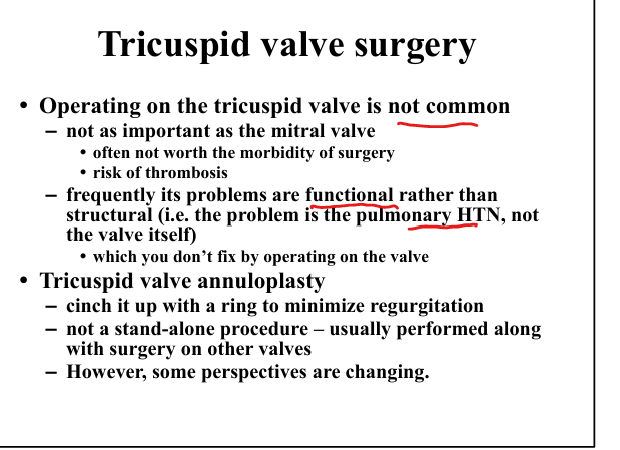
What benchmarks indicate intervention for tricuspid disease?

Usually treat underlying cause (pulmonary HTN, RV dilation)
knowt flashcard image


<p>Usually treat underlying cause (pulmonary HTN, RV dilation)</p><img src="https://assets.knowt.com/user-attachments/b0e1d38b-91ce-4d32-b783-b8d9a211d8d4.png" data-width="50%" data-align="center" alt="knowt flashcard image" style="display: block; width: 50%; margin-left: auto; margin-right: auto;"><p></p>
29
New cards

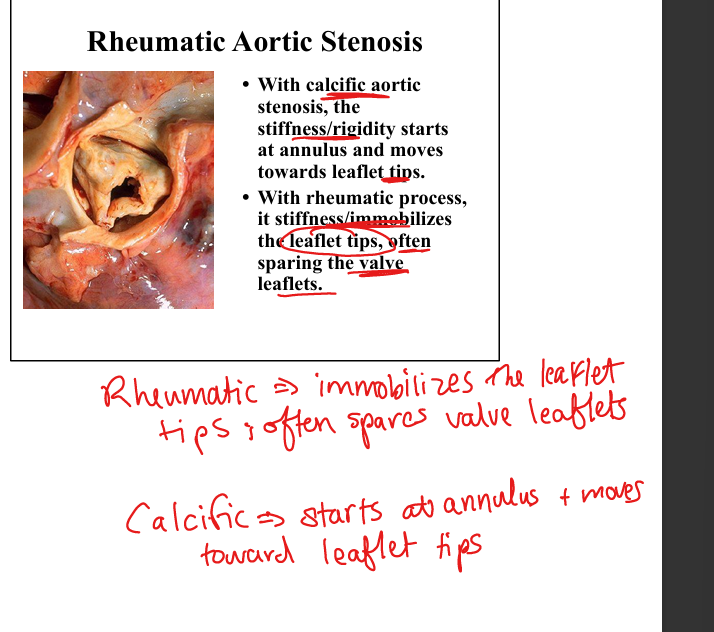
Differentiating betweem Rheumatic and Calcific aortic stenosis

Rheumatic→immobilizes the leaflet tips; often spares valve leaflets

Calcific→starts at annulus and moves up towards leaflet tips

knowt flashcard image


<p>Rheumatic→immobilizes the leaflet tips; often spares valve leaflets</p><p>Calcific→starts at annulus and moves up towards leaflet tips</p><img src="https://assets.knowt.com/user-attachments/e2360b86-efcf-4174-95b7-763bbb982052.png" data-width="50%" data-align="center" alt="knowt flashcard image" style="display: block; width: 50%; margin-left: auto; margin-right: auto;"><p></p>
30
New cards

Williams Syndrome heart issue

Supravalvular Aortic Stenosis
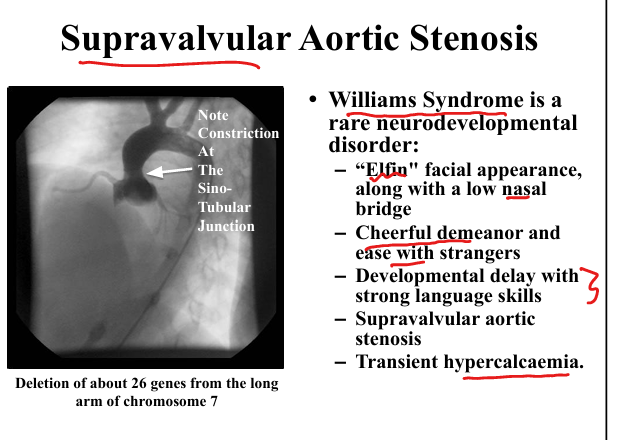
knowt flashcard image


<p>Supravalvular Aortic Stenosis</p><img src="https://assets.knowt.com/user-attachments/2e43ca72-19fd-4f5b-be29-512ed7e3f3be.png" data-width="50%" data-align="center" alt="knowt flashcard image" style="display: block; width: 50%; margin-left: auto; margin-right: auto;"><p></p>
31
New cards

Why can bicuspid aortic valve be dangerous?

Can lead to early aortic stenosis due to abnormal, turbulent flow(increased endothelial injury) + greater risk for developing ascending aortic aneurysm

knowt flashcard imageknowt flashcard image


<p>Can lead to early aortic stenosis due to abnormal, turbulent flow(increased endothelial injury) + greater risk for developing ascending aortic aneurysm</p><img src="https://assets.knowt.com/user-attachments/1327a4cb-3ec7-4ed9-a51b-4403715397a5.png" data-width="50%" data-align="center" alt="knowt flashcard image" style="display: block; width: 50%; margin-left: auto; margin-right: auto;"><img src="https://assets.knowt.com/user-attachments/cb049407-7878-4608-8ebf-12b8cbd6d38b.png" data-width="50%" data-align="center" alt="knowt flashcard image" style="display: block; width: 50%; margin-left: auto; margin-right: auto;"><p></p>
32
New cards

Syncope and Aortic Stenosis

MAP= CO x SVR: If aortic stenosis is severe enough, then there can be a maximum limit of CO which can go through aortic valve»therefore if you increase demand via exercise or activity, the CO cannot increase and there is a drop in BP leading to syncope

knowt flashcard image


<p>MAP= CO x SVR: If aortic stenosis is severe enough, then there can be a maximum limit of CO which can go through aortic valve»therefore if you increase demand via exercise or activity, the CO cannot increase and there is a drop in BP leading to syncope</p><img src="https://assets.knowt.com/user-attachments/11b2fabf-7df5-487d-9cce-af031e1372dd.png" data-width="50%" data-align="center" alt="knowt flashcard image" style="display: block; width: 50%; margin-left: auto; margin-right: auto;"><p></p>
33
New cards

Heyde’s Syndrome

Occurs due to severe aortic stenosis increasing blood velocity resulting in increased shear stress on blood»vWF unravels as if injury occurred»vWF gets depleted quickly and bleeding dramatically increases.

TLDR: aortic stenosis>higher velocity>more damage>less vWF>bleeding
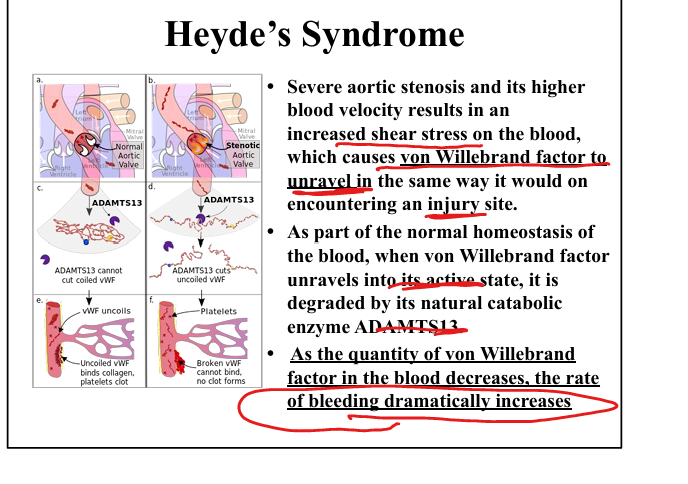
knowt flashcard imageknowt flashcard image


<p>Occurs due to severe aortic stenosis increasing blood velocity resulting in increased shear stress on blood»vWF unravels as if injury occurred»vWF gets depleted quickly and bleeding dramatically increases. </p><p>TLDR: aortic stenosis&gt;higher velocity&gt;more damage&gt;less vWF&gt;bleeding</p><img src="https://assets.knowt.com/user-attachments/aa0e3d1a-2e24-4fa2-b912-2796b07de5df.png" data-width="50%" data-align="center" alt="knowt flashcard image" style="display: block; width: 50%; margin-left: auto; margin-right: auto;"><img src="https://assets.knowt.com/user-attachments/39d7c81f-a44c-46ab-b057-fd1d6c197b2a.png" data-width="50%" data-align="center" alt="knowt flashcard image" style="display: block; width: 50%; margin-left: auto; margin-right: auto;"><p></p>
34
New cards

Myxomatous Degeneration

Breakdown of connective tissue»can occur in connective tissue of valve. Seen in Marfan’s Syndrome and/or EDS

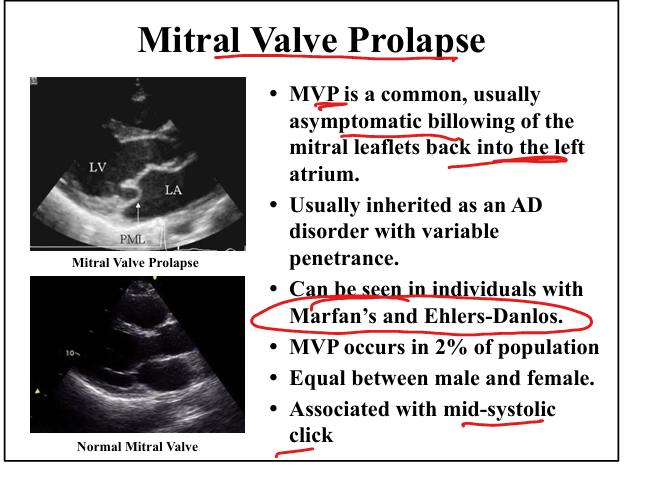
knowt flashcard imageknowt flashcard image


<p>Breakdown of connective tissue»can occur in connective tissue of valve. Seen in Marfan’s Syndrome and/or EDS</p><img src="https://assets.knowt.com/user-attachments/fd861ceb-a02c-4857-9d5f-de979678e74b.png" data-width="50%" data-align="center" alt="knowt flashcard image" style="display: block; width: 50%; margin-left: auto; margin-right: auto;"><img src="https://assets.knowt.com/user-attachments/0bfc0f2e-56d6-4e6c-8b85-b91b30b0e726.png" data-width="50%" data-align="center" alt="knowt flashcard image" style="display: block; width: 50%; margin-left: auto; margin-right: auto;"><p></p>
35
New cards

How can Hypertrophic Cardiomyopathy lead to Mitral Regurgitation?

As left ventricle thickens, it can distort the mitral valve by sucking the anterior leaflet into the LV outflow tract

knowt flashcard image


<p>As left ventricle thickens, it can distort the mitral valve by sucking the anterior leaflet into the LV outflow tract</p><img src="https://assets.knowt.com/user-attachments/012ac1e0-c944-49a1-a040-ead72cbc19ca.png" data-width="50%" data-align="center" alt="knowt flashcard image" style="display: block; width: 50%; margin-left: auto; margin-right: auto;"><p></p>
36
New cards

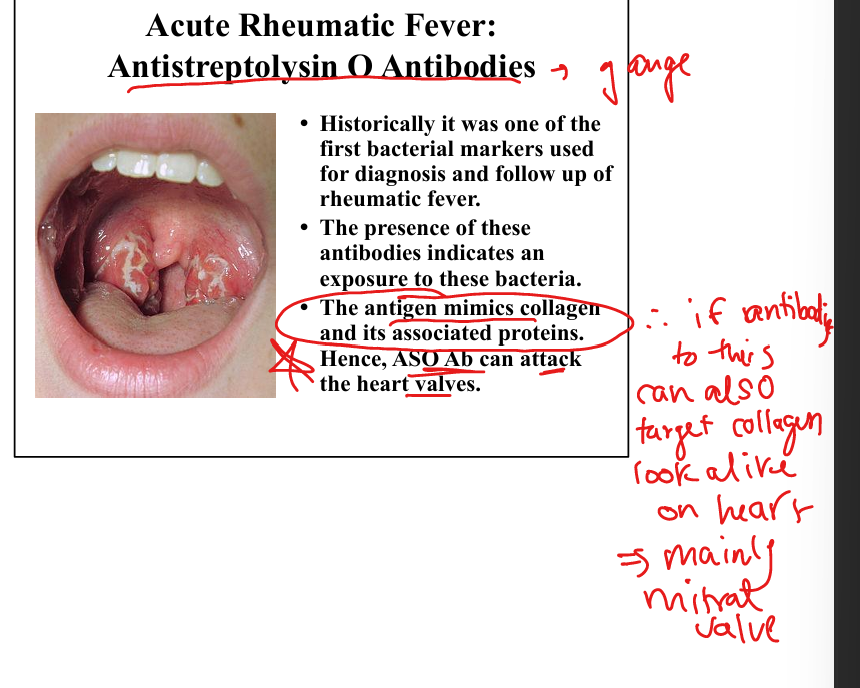
Acute Rheumatic Fever: Cause? Associated with?

Group A Strep (pyogenes) infection, acutely Aschoff bodies present(fibrinoid necrosis) that later form scar tissue including in heart and on valves»causes Mitral Stenosis. The reason it attacks heart valves is because the Strep A antigen mimics collagen and its associated proteins so our autobodies attack it AND our own collagen which is present on heart valves(Mitral most common) leading to fibrosis+stenosis
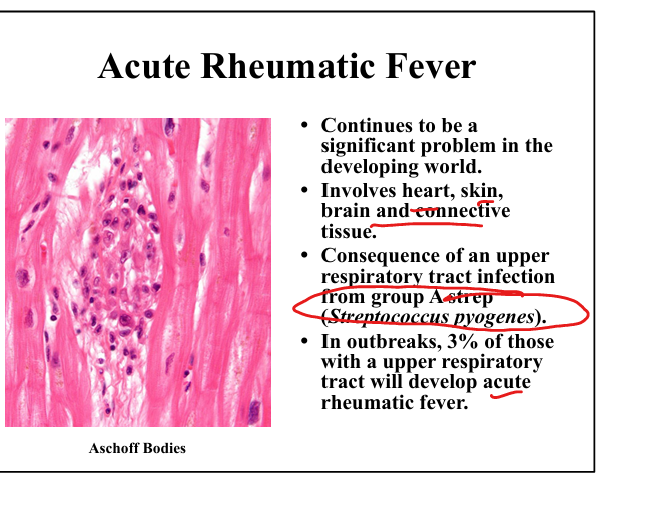
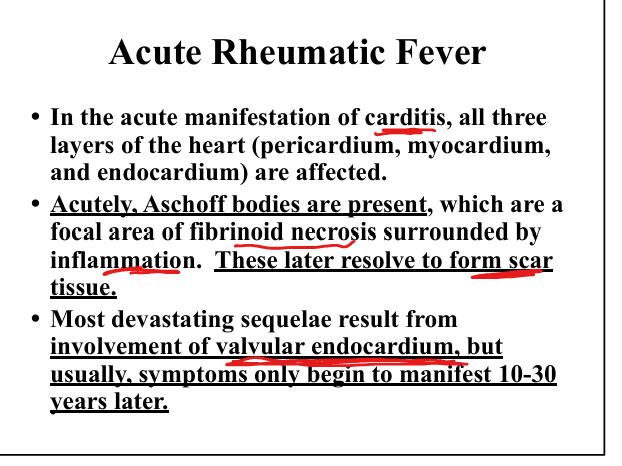
knowt flashcard imageknowt flashcard imageknowt flashcard image


<p>Group A Strep (pyogenes) infection, acutely Aschoff bodies present(fibrinoid necrosis) that later form scar tissue including in heart and on valves»causes Mitral Stenosis. The reason it attacks heart valves is because the Strep A antigen mimics collagen and its associated proteins so our autobodies attack it AND our own collagen which is present on heart valves(Mitral most common) leading to fibrosis+stenosis</p><img src="https://assets.knowt.com/user-attachments/951a9d56-fa57-4da1-9c43-7fceaadcbd14.png" data-width="50%" data-align="center" alt="knowt flashcard image" style="display: block; width: 50%; margin-left: auto; margin-right: auto;"><img src="https://assets.knowt.com/user-attachments/bbcf0a2c-13c6-4397-8e5e-e63014dd48e6.png" data-width="50%" data-align="center" alt="knowt flashcard image" style="display: block; width: 50%; margin-left: auto; margin-right: auto;"><img src="https://assets.knowt.com/user-attachments/474bfca3-6576-4914-8b0a-8adc06479679.png" data-width="50%" data-align="center" alt="knowt flashcard image" style="display: block; width: 50%; margin-left: auto; margin-right: auto;"><p></p>
37
New cards

Opening snap at LV apex think

Mitral stenosis with rheumatic disease
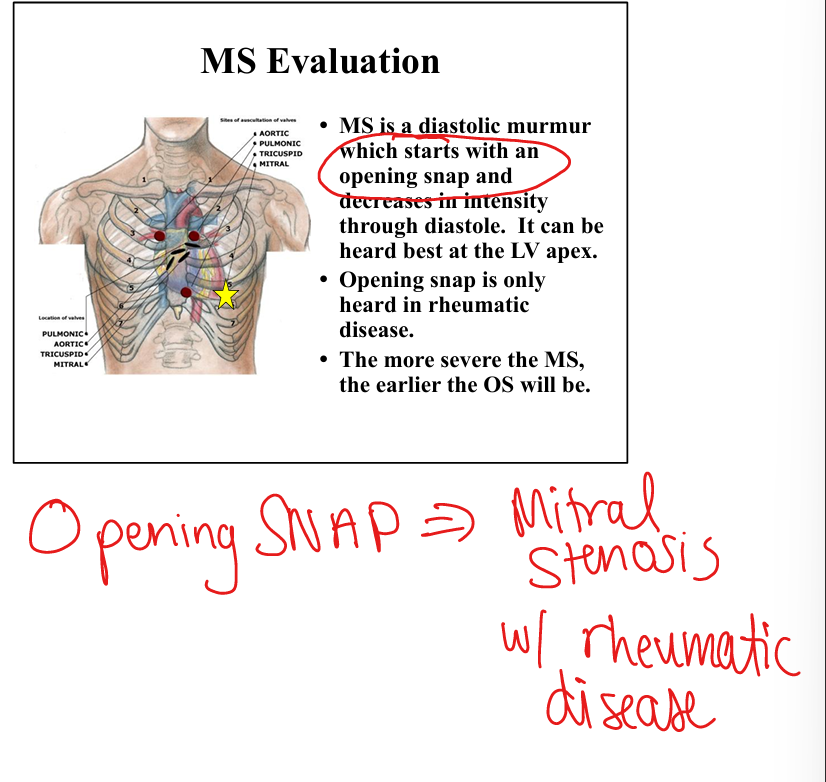
knowt flashcard image


<p>Mitral stenosis with rheumatic disease </p><img src="https://assets.knowt.com/user-attachments/dfd1e0dc-601d-4907-9069-a69316c63f2d.png" data-width="50%" data-align="center" alt="knowt flashcard image" style="display: block; width: 50%; margin-left: auto; margin-right: auto;"><p></p>
38
New cards

Ebstein’s Anomaly

Congenital defect in which septal and posterior leaflets of tricuspid valve are displaced towards the RV apex»enlarged right atrium (50% have Wolff-Parkinson-White)

knowt flashcard image


<p>Congenital defect in which septal and posterior leaflets of tricuspid valve are displaced towards the RV apex»enlarged right atrium (50% have Wolff-Parkinson-White)</p><img src="https://assets.knowt.com/user-attachments/a1dd1f5b-b2fc-4383-b522-7607f35b52e5.png" data-width="50%" data-align="center" alt="knowt flashcard image" style="display: block; width: 50%; margin-left: auto; margin-right: auto;"><p></p>
39
New cards

Noonnan Syndrome

RASopathy»overactivation within RAS/MAPK pathway,associated with pulmonary stenosis

knowt flashcard image


<p>RASopathy»overactivation within RAS/MAPK pathway,associated with pulmonary stenosis</p><img src="https://assets.knowt.com/user-attachments/742a742e-55d2-4384-9893-40b20338b890.png" data-width="50%" data-align="center" alt="knowt flashcard image" style="display: block; width: 50%; margin-left: auto; margin-right: auto;"><p></p>