ET III Ch.17 Carboxylic Acids and Esters
 Call Kai
 Learn
Learn Practice Test
 Spaced Repetition
 Match
Match Flashcards
 Knowt Play
1/28

There's no tags or description
Looks like no tags are added yet.
Name | Mastery | Learn | Test | Matching | Spaced | Call with Kai | Chat |
|---|
No analytics yet
Send a link to your students to track their progress
29 Terms
What are carboxylic acids (aka organic acids)?
Compounds containing one or more –COOH groups
What is the -COOH group in a organic acid called?
a carboxyl group
What is a carboxyl group?
a combination of a carbonyl =C=O and hydroxyl, -OH groups
What are organic acids derived from?
hydrocarbons in which a –CH3 group has been replaced by a –COOH group
What is the general formula for acids abbreviated as?
RCOOH
How are organic acids classified?
according to the number of carboxyl groups they contain
What are monocarboxylic acids?
Compound containing one –COOH group
What are monocarboxylic acids commonly known as?
as fatty acids
because they occur naturally in fats and oils
What is the first method for naming monocarboxylic acids?
Substituting the –e ending of a hydrocarbon with –oic
Methane – methanoic acid
What is the second method for naming monocarboxylic acids?
By their common name, or from the acids from which they are derived
Formic acid – from L. formica, or “ant”
What is methanoic acids common name?
Formic acid
Describe formic (methanoic) acid
Strongest of the monocarboxylic acids
Colorless liquid with a pungent odor
Has a blistering effect on the skin
Active irritant in the defensive secretions of ants, bees, and other insects
Excellent reducing agent and is used in the synthesis of many organic compounds
Match a photo of the structure of formic (methanoic) acid
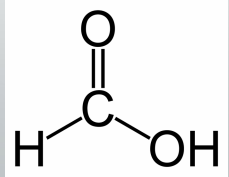
What is ethanoic acid commonly known as?
Acetic acid
Describe acetic (ethanoic) acid
Gives vinegar its characteristic sharp odor and taste
Vinegar is only 4-6% acetic acid
Pure acetic acid is called glacial acetic due to it sometimes being frozen at room temperature into a glass-like solid
What historically take the role of blood anticoagulating agents or water-softening agents in embalming fluids?
Dicarboxylic acids
What reacts with ionized calcium in the blood forming insoluble calcium oxalate?
Oxalates
How do precipitant anticoagulants work?
By removing calcium ions in the blood (via insoluble calcium oxalate), this prevents the initiation of the blood-clotting process
Why arent precipitant anticoagulants not used very often anymore?
Because of their toxic nature
What does calcium in the blood do when interacting with sodium citrate or potassium citrate?
It cross-links two molecules of sodium citrate to form a complex that prevents ionized calcium from initiating the coagulation process
What type of anticoagulants are sodium citrate and potassium citrate?
sequestrant anticoagulants
Are normal sequestrant anticoagulants popular?
No, they are non-toxic but falling out of favor (due to bacteria enzymes that can neutralize these and make the end product worse)
What are chelates?
Substance that binds metallic ions to inhibit coagulation
What is the most commonly used chelate?
ethylenediaminetetraacetic acid (EDTA)
Describe chelates
Anticoagulant
Excellent sequestrant with few limitations
What are esters?
Fragrant organic compounds formed by the reaction of an organic acid with an alcohol
What is the general formula for esters?
RCOOR’
Describe ethyl acetate
Ester
Commonly used in sealants for incisions
Fruity odor with low toxicity
Describe methyl salicylate
Ester
commonly known as oil of wintergreen
Used as a deodorant to mask the harsh smells of embalming fluids