Leaf
0.0(0)
Studied by 6 people Call Kai
 Learn
Learn Practice Test
 Spaced Repetition
 Match
Match Flashcards
 Knowt Play
Card Sorting
1/53

Earn XP
Description and Tags
Last updated 1:19 AM on 11/13/22
Name | Mastery | Learn | Test | Matching | Spaced | Call with Kai |
|---|
No analytics yet
Send a link to your students to track their progress
54 Terms
1
New cards
Blade
flattened laminar portion
2
New cards
petiole
stack which attaches the blade to the stem
3
New cards
sessile
If the blade is attached directly to the stem, the leaf is described as _________
4
New cards
bud scales
Leaves arise from an apical or lateral bud that is often protected by _____________
5
New cards
Stipules
small leaf-like structures that develop in pairs on each side of the leaf during the growing season
6
New cards
sheath
In monocots, the blades are usually narrow whose base is a ___________ that wholly or partly encloses the stem.
7
New cards
auricles and ligules
Between the blade and the sheath, some monocot plants have appendages such as ______________________.
8
New cards
persistent meristem
There is usually a ________________ at the base of the leaf that allows it to grow indefinitely.
9
New cards
linear
thin shape
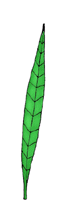
10
New cards
Lanceolate
spear-like shape
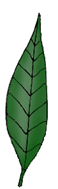
11
New cards
Ovate
oval shape
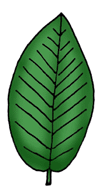
12
New cards
Cordate
shaped like a heart
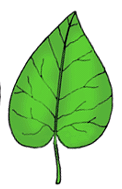
13
New cards
midrib
the middle portion of the blade usually has a prominent central vein or ___________ while smaller veins radiate from this.
14
New cards
netted
Dicots display __________ venation
15
New cards
parallel
Monocots usually have __________ venation.
16
New cards
Margin
edge of the blade
17
New cards
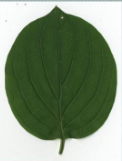
Entire
having a smooth edge; not broken up into teeth or lobes
18
New cards
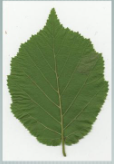
Toothed
having teeth especially of a certain number or type; often used in combination
19
New cards
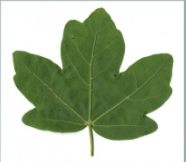
Lobed
propel in a high arc
20
New cards
Apex
leaf tip
21
New cards
Leaf base
part near the petiole
22
New cards
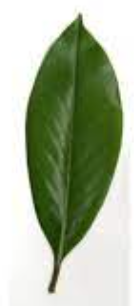
Simple leaf
has a single blade or lamina
23
New cards
Compound
composed of two or more separate leaflets.
24
New cards
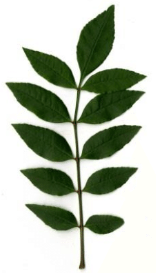
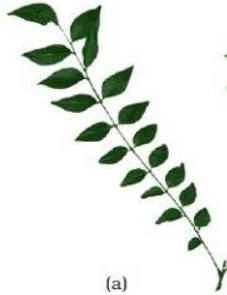
pinnately
the leaflets occur in a linear sequence lined up along both sides of a central axis, called the rachis
25
New cards
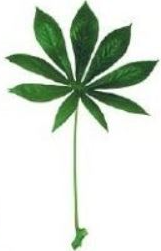
palmately
three, five, seven or more leaflets are all attached at one point near the tip of the petiole and they radiate out from this tip.
26
New cards
compound
If there is a bud in the angle formed by the petiole and stem, like an axillary bud, then the entire structure supported by the petiole is a ______________ leaf, regardless of the number of leaflets present.
27
New cards
Phyllotaxy
refers to leaf arrangement
28
New cards
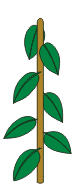
Alternate or spiral arrangement
one leaf occurs at each node.
29
New cards
alternate distichous
the leaves occur only on two rows.
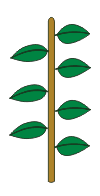
30
New cards
opposite
two leaves at a node facing each other.
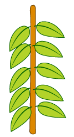
31
New cards
opposite decussate
two opposite leaves are perpendicular to the two opposite leaves below or above them.
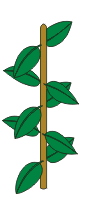
32
New cards
whorled arrangement
has three or more leaves at one node.
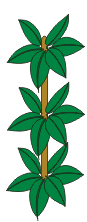
33
New cards
cuticle
These epidermal cells secrete a waxy substance which forms a covering over the outer dermal cells rendering these cells impermeable to water. The waxy covering is called
34
New cards
dorsiventral
There is an upper epidermis and a lower epidermis in a leaf with _________ orientation.
35
New cards
stomates
The openings in the epidermis are called
36
New cards
guard cells
The openings in the epidermis are called stomates which are formed between specialized epidermal cells called
37
New cards
trichomes
In many plants, ____________ (hairs) are found on the undersurface of the leaves and herbaceous stems. These help reduce evaporation of water from plants or protect young shoots from herbivores.
38
New cards
mesophyll
The ____________ tissue, with the exception of the vascular bundles, comprises all of the cells between the upper and lower epidermis and is usually divided into two parts.
39
New cards
palisade layer.
The cells toward the upper epidermis, which are elongated, make up the ________________
40
New cards
spongy layer
The zone below the palisade layer, composed of irregularly shaped cells is called the ______________.
41
New cards
isobilateral
In some monocots, there is no distinct palisade and spongy layers because the leaves are ________________
42
New cards
vascular bundles
function both as supporting and conducting tissue
43
New cards
Monocot
Monocot/Dicot: Leaves are typically longer and thinner
44
New cards
Dicot
Monocot/Dicot: Leaves are comparatively smaller and wider
45
New cards
Monocot
Monocot/Dicot: Attached directly to the stem (sessile)
46
New cards
Dicot
Monocot/Dicot: Connected through a petiole to the stem
47
New cards
Monocot
Monocot/Dicot: Isobilateral
48
New cards
Dicot
Monocot/Dicot: Dorsoventral
49
New cards
Monocot
Monocot/Dicot: Various sizes (small and large) and arranged complexly, has a vascular bundle that is covered by a sclerenchymatous bundle sheath.
50
New cards
Dicot
Monocot/Dicot: Large bundles and arranged in a ring, has a vascular bundle that is not wrapped in a bundle sheath
51
New cards
Monocot
Monocot/Dicot: Bulliform cells are present
52
New cards
Dicot
Monocot/Dicot: Bulliform cells are absent
53
New cards
Monocot
Monocot/Dicot: Stomates are amphistomatic
54
New cards
Dicot
Monocot/Dicot: Stomates are hypostomatic