UNIT 3/4 PSYCH EXAM (merged sets)
 Call Kai
 Learn
Learn Practice Test
 Spaced Repetition
 Match
Match Flashcards
 Knowt Play
1/561

There's no tags or description
Looks like no tags are added yet.
Name | Mastery | Learn | Test | Matching | Spaced | Call with Kai | Chat |
|---|
No analytics yet
Send a link to your students to track their progress
562 Terms
what’s the central nervous system
The CNS is a network of neurons throughout the brain & spinal cord.
The main role is to process information from the senses and to create efferent responses.
what does the CNS consist of & define (2)
THE BRAIN = is a network of neurons that processes information.
SPINAL CORD = is a long column of nerve tissue that runs from the bottom of the brain to the lower back, linking the brain to parts of the body.
what’s the peripheral nervous system and its sub categories
Includes all parts of the nervous system but the brain and spinal cord.
Further broken into 2more parts:
Stomatic nervous system (things you do voluntarily)
Autonomic nervous system (things you do involuntary)
what’s the stomatic nervous system (what category is it part of)
PART OF THE PERIPHERAL NERVOUS SYSTEM.
has voluntary control of senses and skeletal muscles, carrying afferent information from the 5 senses to the CNS.
what’s the autonomic nervous system (2 subcategories & what larger caterogy it’s part of)
PART OF THE PERIPHERAL NERVOUS SYSTEM.
Controls the body’s internal environment in an involuntary and self-regulated manner.
Directly connects to organs, glands and visceral muscles.
Broken up into sympathetic nervous system and parasympathetic nervous system.
what’s the sympathetic nervous system (what happens)
PART OF THE AUTONOMIC NERVOUS SYSTEM
prepares the body for action/threat by putting adrenaline into the bloodstream.
Pupils dilate = to let more light in allowing us to see threat better
Increased HR/BR = to allow more blood to the muscles.
Increase fats and sugars into bloodstream = to give more energy
what’s the parasympathetic nervous system (what happens)
PART OF THE AUTONOMIC SYSTEM
returns our responses to normal homeostasis after threat.
Pupils constrict = to return to normal
Reduced HR/BR = back to stable and normal levels
stomach and digestion begins to digest
fight, flight freeze and which system is dominate
the body’s natural reaction to threat or danger, which cause instant physiological changes.
When fighting or fighting the sympathetic nervous system is dominant.
When the body is freezing or ‘on-hold’ the parasympathetic nervous system is dominant.
define and example of fight
dealing with the stressor directly
example = picking up a vase and throwing it at a robber
define and example of flight
escaping the stressor
example = running away from robber in your house
define and example of freeze
immobilization of body to avoid detection
example = staying still to hide from robber
this stage only usually occurs for a short amount of time, then we fight or fly. This gives our body a chance to think about what to do next
3 types of neuron, acronym and what happens in a neuron
SENSORY NEURONS = afferent pathways (burning hand on toaster)
MOTOR NEURONS = efferent pathways (kicking a football/doing tasks)
INTERNEURONS = only found in brain and spinal cord send messages between other neurons
Use ‘SAME’ acronym Sensory/afferent & Motor/efferent.
A neuron fires an Action Potential down the Axon away from the Soma in the direction of the Axon Terminals.
what do dendrites do
receives data or signals from another neuron
what does an axon do
transmits electrical impulses or actions and connects neurons (nerve cells) to that they can communicate.
what does the myelin sheath do
allows electrical impulses to transmit quickly and efficiently along the nerve cells.
what does the axon terminal / end buttons do
allows the neuron to connect and send electrical impulses to another neuron
what does the synapse and neurotransmitter do
at synapse one neuron sends a message to another neuron (right)
carry chemical signals (“messages”) from one neuron (nerve cell) to the next target cell.
what type of messages do neurons send/ define pre & post synaptic neurons and neural synapse
electrochemical messages
wen the message is within the neuron it is electrical & when the message is external and being received from the neuron its chemical.
Pre-synaptic neuron sends the message
Post-synaptic neurons are receiving the message
Neural Synapse is the point where two neurons ‘meet’ and transfer a ‘message’.
7 stages of conscious processing
Stimuli is detected by sensory receptors
Information is then carried along afferent pathways via sensory neurons
This information is then passed on to interneurons within the spinal cord which carry it to the brain
The brain then processes this information and formulates an appropriate motor response
This motor response is then transmitted back to the interneurons within the spinal cord
Then passed to the motor neurons which travel along efferent pathways and to the skeletal muscles
Then action is done (specifically apply to question)
what are the two types of unconscious responses
Physiological response of the autonomic nervous system
The spinal reflex
what the physiological response of the autonomic nervous system
Autonomic NS controls unconscious physiological responses involving visceral (smooth) muscles, organs and glands.
Visceral muscle is found inside organs such as the heart (so it pumps blood).
what’s the spinal reflex
is an involuntary response to dangerous or harmful stimulus
stages of spinal reflex (5)
The harmful or dangerous stimuli is detected by sensory receptors
Sensory information travels along afferent pathways via sensory neurons
This then goes to the interneurons in the spinal cord which relay the information straight to a motor neuron
This motor neural signal then initiates an automatic and unconscious response as the information has not gone to the brain straight away
Finally, these motor signals are carried along efferent pathways to the skeletal muscles which then respond (either retracting the body part or moving it way from danger)
what happens after the spinal reflex
After the sensory information continues up to the brain via afferent pathways and then the brain independently registers the pain (this is only AFTER the response has happened)
6 steps of synapse / neurotransmission
When we have a thought, it’s called neurotransmission.
A neuron is activated and fires an action potential which travels down the axon, away from stoma towards the end terminals
Inside the terminal buttons are synaptic vesicles which are filled with neurotransmitters (pre-synaptic neuron)
When the action potential reaches the terminal buttons, it triggers the release of the neurotransmitters
The synaptic vesicles merge with the membrane at the end terminals and release neurotransmitters into the synaptic gap
Then the neurotransmitters travel across the synaptic gap towards the receptor sites on the dendrites Neurotransmitters then bind to the corresponding and specialized receptor sites on the post-synaptic neuron
what’s an exhibitory and an inhibitory neurotransmitter
There is increased likelihood that the post-synaptic neuron will fire an action potential / neural electrical impulse
There is a decreased likelihood that the post-synaptic neuron will fire an Action Potential.
what’s the main exhibitory neurotransmitter
glutamate
what does Glutamate do and an example
plays an important role in learning and memory in the brain by stimulating structural and functional changes to connections between neurons.
For example, as you read your notes and start to understand, Glutamate is being released in order for you to learn and creates a neural pathway in your brain to form a memory.
what’s the main inhibitory neurotransmitter
gamma-aminobutyric acid (GABA).
what does GABA do & an example when there is too little GABA.
decreases likelihood of post-synaptic neuron firing.
Having too much/not enough of one neurotransmitter can be harmful
For example, if there is too little GABA in the brain, the excitatory effects of Glutamate may cause too much stimulation of neurons which can lead to mental health disorders such as Anxiety
what are neuromodulators and neuromodulation
some neurotransmitters can influence or modulate the effects of neurotransmitters, these are called modulators and the process is called neuromodulation.
(they change the synaptic efficiency)
2 types of neuromodulation changes & an example
presynaptic via alteration in the number of neurotransmitters released
OR
Postsynaptic by altering receptor sensitivity
Example = it can change the reactivity of receptors to another type of neurotransmitter (e.g Glutamate) – making it either more excitatory than normal or more inhibitory than normal.
how impactful are neuromodulators & how fast/slow are they?
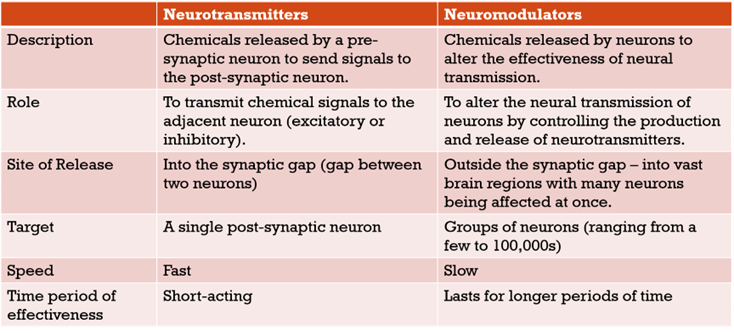
chemical messages are released into broader areas and can affect a large number of neurons at once.
Therefore, an entire neural tissue, brain area, pathway or multiple pathways may be influenced by exposure to a neuromodulator’s action.
Neuromodulators work more slowly than neurotransmitters, their effects take longer to become established a last longer
compare neurotransmitter & neuromodulators in terms of role, site of releasees, target, speed and effectiveness (time)
what is dopamine
is a neuromodulator and reinforces neural activity associated with pleasure, movement, attention, mood, cognition and motivation.
it can be both excitatory and inhibitory.
what is dopamine associated with and what happens
the reward pathway
when we do something pleasuring our body release dopamine creating feelings of pleasure and therefore the more dopamine the more likely we are to want to repeat the action
the reward pathway (what it is associated with, what it does, pathways)
associated with dopamine.
controls responses to natural rewards such as food, sex, and social interactions and important for motivation. The dopamine reward pathway has two overlapping pathways called
Mesolimbic
Mesocortical
what does the substantia nigra do, where is it, what occurs when damaged?
it’s located within the midbrain.
it produces dopamine which carries messages that allow smooth, coordinated function of muscles and movements.
when damaged = we get less dopamine which leads to irregular and fewer messages about motor activity causing muscle stiffness
dopamine and thirst
The gulping motion made by the throat and the liquid swallowed sends messages to the brain that water has been consumed, quieting neurons that generate the urge to drink.
This action allows reward signals to be carried by dopamine along the brains reward pathway.
dopamine and hunger
Hunger is a motivational sensation that led us to eating food.
The consumption of food release dopamine and gives us a feeling of pleasure. The dopamine reward pathway is prominent in controlling appetite and motivational drive for food.
steps of hunger and dopamine (5)
dopamine is decreased below baseline in the reward pathway
the sensation of hunger is felt
increased food seeking and eating behavior
dopamine levels increase above baseline in rewards pathway
pleasure experienced (reinforcing actions)
steps of dopamine and addiction (5)
Behavior occurs
Dopamine is released
Pleasure and excitement is felt
More dopamine is need to feel these same feelings
Behavior must increase to do this = addiction
how to naturally boost dopamine
Eating a healthy diet
Foods rich in L-tyrosine (dopamine protein)
Example = banana, almonds, beef, eggs, avocado
what is serotonin, where it is and what it does
is an inhibitory modulator
More than 90% of the body’s serotonin is found in the gastrointestinal track
It modulates behavioral processes such as mood, perception, anger, aggression, memory, sexuality and attention
where is serotonin produced and what high/low levels mean
It’s produced in the brain stem and then travels to the cerebrum & cerebral cortex, modulating activity in these areas.
High/ balanced serotonin = improves mood (allows for calmness, focus, happiness, attentiveness and stable moods.
Low serotonin = mood declines (associated with anxiety and depression)
potential causes of low mood
can be caused by faulty serotonin receptors and lack of tryptophan (amino acid which serotonin is made from) located in the gut.
serotonin and sleep
low levels have been shown to disrupt the rhythm of the sleep wake cycle & disrupt the release of melatonin (sleep hormone from the pineal gland)
serotonin and impulsivity (high and low levels)
It helps regulate brain activity associated with impulsive behavior.
Low serotonin in the grain leads people to be less likely to wait for a reward (increasing impulsive behavior)
High levels of serotonin lead people waiting longer for rewards (reducing impulsivity)
serotonin and aggression (low levels)
Serotonin helps regulate brain activity associated with aggressive behavior.
Low Serotonin affects communication between structures such as the amygdala and frontal lobe which is responsible for regulating emotions
Therefore, low levels can generate more emotional experiences and aggression, due to breakdown in structures and their communications.
boosting serotonin (food)
Tryptophan is a raw material for Serotonin (produced in the gut)
Therefore, Serotonin is lower when you haven’t eaten.
Foods like poultry (chicken soup) and chocolate can boost Serotonin – which is why they may be referred to as feel good foods
define synaptic plasticity and list the two versions
specific changes that occur within the synapses between neurons due to repeated stimulation or lack of repeated stimulation.
There are 2 important processes in synaptic plasticity
Long term potentiation (LTP)
Long term depression (LTD)
define long term potentiation (LTP), what happens & what it does
The relatively permanent strengthening of synaptic connections as a result of repeated activation of a neural pathway.
Happens when a natural pathway is activated during and Glutamate is released (excitatory)
Repeated stimulation and release of Glutamate allows for strong neural connections and memory will become stronger / more permanent.
define long term depression (LTD), what happens and why its helpful
is a relatively permanent weakening of synaptic connections as a result of repeatedly lower levels of activity in a neural pathway.
happens when a neural pathway is NOT activated any longer, strong connections become weaker over time.
it’s helpful because it allows the brain to reduce neural connections that are no longer useful
list the 3 modifications to the synapse
Sprouting
Rerouting
Pruning
define sprouting and when it occurs (LTP or LTD)
the growth of axon or dendrite fibers at the synapse
it occurs during LTP
define rerouting and when it occurs (LTP or LTD)
the formation of new networks between neurons to establish alternate neural paths
it occurs during LTP
define pruning and when it occurs (LTD or LTP)
the removal of extra neurons & synaptic networks to grow efficiency of transmission (fine tuning / enhancing efficiency of brain functioning)
it occurs during LTD
structural changes in LTP
increased number of receptor sites
bushier dendrites on the post-synaptic neuron due to sprouting
increased number of synaptic connections between neurons due to sprouting
structural changes in LTD
decreased number of receptor sites
decreased number of dendrites on the postsynaptic neuron due to pruning
decreased number of synaptic connections between neurons due to pruning
what happens during LTP (not structural)
Increased strength on neural connections
As a result, increased release of neurotransmitters (in particular glutamate)
what happens during LTD (not structural)
Involves decreased strength of synaptic connections
As a result, decreased release of neurotransmitters
define stress
a state of metal, physical and emotional tension
2 types of stress
eustress - good stress
distress - bad stress
stressor
stimulus that causes a stress response
2 types of stressors & examples
internal - exists within the person (illness, bad thoughts, low confidence, headache, injury / pain) they can be psychological or biological in nature
external - exists outside the person (tests, bullying, no money, war)
stress response (examples / sub-categories)
physiological - rashes, headaches, cold/flu, heart palpations, headaches, stomach ulcers
psychological
behavioral (eating & sleep change)
emotional (irritability, aggression)
cognitive (poor memory & concentration)
what occurs during acute stress / FFF
during acute stress (FFF) the body releases adrenaline from the adrenal gland, in order to give us energy to respond helping increase HR and BR
cortisol’s role when not dealing with stress
anti-inflammatory / helps with immune system **
regulate metabolism
gives us energy
what does cortisol do in times of chronic stress
when experiencing stress the body utilizes and creates more cortisol…
this helps give us energy,
use glucose more effectively = heightening awareness
repair issues in body caused by stress
divert energy from non-essential functions digestion, growth, reproduction
cortisol, stress & illness
how when utilize more cortisol during stress it suppresses our immune system which can make us more susceptible to illness
3 stages of GAS model / what it measures
measures the physiological effects of stress
alarm reaction - shock & countershock
resistance
exhaustion
what happens during phase 1 of alarm reaction
during shock the body’s resistance to deal with the stressor falls below normal.
we experience:
decrease muscle tone, glucose and body temp
responding as though injured (may faint)
This is only a quick reaction and doesn’t last long
what happens during phase 2 of alarm reaction
in countershock the body’s resistance to deal with the stressor raises gradually above normal level.
we experience:
a release of adrenaline and cortisol
activation of FFF
increasing HR,BR, pupils dilate, more glucose in blood
doesn’t last long - seconds to mins
what happens during resistance
if the stressor beings to persist over a longer period of time we must adapt to it, and resistance to deal with stressor increases above normal level.
We experience:
cortisol at it’s highest
interference with immune system causing flu/cold symptoms and headache
may lead to moodiness and irritability
what happens in exhaustion
the body has run out of ability to fit the prolonged stress and resistance to stressor falls below normal.
we experience:
inability to go about everyday life
causes server physical and psychological issues like heart conditions, depression, stomach ulcers, anxiety.
acronym for GAS model
S - shock (in alarm reaction
C - countershock (in alarm reaction)
A - alarm reaction
R - resistance
E - exhaustion
pros and cons of gas
pros:
highlights and focuses on physiological impacts of stress
shows that there is a connection between chronic stress and illness
cons:
not subject and assumes all people react biologically the same way to stress
only focuses on biological effects of stress and dient consider the psychological impacts too
what is the transactional model of stress and coping
is a model that represents the psychological impacts of stress and the understanding that people react to and classify stressors differently.
2 stages in the transactional model of stress and coping
primary appraisal
secondary appriasal
what is primary appraisal in the transactional model of stress and coping
when a person determines how significant a situation is to them
2 subcategories in primary appraisal
stressful
threat - anticipated that damage may happen in the future, “this might happen”
harm - damage has now occurred and the event has happened, “this has happened”
challenge - potential for growth, growth mindset, “how can i grow from this”
not stressful
benign/ positive - affects you in a good way
irrelevant - doesn’t affect you at all
what is secondary appraisal
this occurs if a stressor fits in the stressful category (of primary appraisal), because the person must now do something to manage the stress / situation
what happens in secondary appraisal
when a person is in this appraisal they use what is known as coping strategies that are available to them.
if a coping strategy is effective the stress is reduced
if a coping strategy is ineffective then the stress is increased
pros and cons of the transactional model of stress and coping
pros
it focuses on and highlights the psychological effects of stress
shows that individuals psychologically react and categorise stress differently
cons:
difficult to experiment and test due to subjective nature
only considers psychological effects of stress and doesn’t consider physiological
what is the gut brain axis / define
is the connection between the central nervous system and the enteric nervous system. (brain and gastrointestinal tract)
how many ways can the gut-brain axis communicate
is biodirectionnal which means that messages go both ways (from gut to brain and brain to gut)
what’s in our stomach/gut
we have a gut microbiome that consist of gut microbiota
what does the gut microbiota do / help / limit (8)
produce neurotransmitters (dopamine, GABA, 80% of serotonin
limiting immune system impairments
limiting digestive issues
helping body’s reaction to stress
mood
cognitive function
neurological disorders (autism / parkinson’s)
various mental disorders
what does change in gut microbiota do (early or throughout life)
can cause deficiency of certain microbiota / bacteria which reduces microbiome diversity, this is linked to issues. BUT treatment with healthy gut microbiota can reduce anxiety and stress (shown in humans and mice)
what does stress do to the microbiota (5)
can disturb the balance of the gut microbiota / microbiome diversity and impact
susceptibility to stress (likelihood of getting it)
physiological response to stress
psychological response to stress
resilience to stress
recovery from stress
microbiome / biota research (1)
infants who’s mothers were highly stressed during pregnancy and had high levels of cortisol in blood, tend to have abnormal composition of gut microbiota
infants born to these mothers have higher levels of harmful bacteria and lower levels do beneficial bacteria in their own gut
microbiome / biota research (2)
mice born and raised in sterile conditions / labs had very few microbiotas. Experimenters then transferred microbiotas associated with stress into them and found that their gut and body demonstrated worse stress responses compared to normal mice
higher HR, higher blood pressure
define coping
is all the things we do to mange and meet the demands of the stress from the stressor in an effective way
what’s a coping strategy
is a method used to mange or reduce stress produced by a stressor
what influences weather a coping strategy works
coping flexibility
context specific awareness
coping flexibility (what it impacts / define)
impacts if a coping strategy works.
it is how we can adapt modify or change a coping strategy to meet the demands of different stressors.
high & low coping flexibility
high = able to produce more adaptive coping strategies, resulting in decreased stress and responses
low = tend to rely on the same limited coping strategies to deal with stress (despite the situation) even if they are ineffective
what’s context specific awareness / what it impacts & example
impacts how we cope with stress
when we pick a coping strategy that is the most appropriate for the particular situation
(it matches the demands of the stressor and person)
Example = want to run a marathon, you get up and train
interlink with coping flexibility & context specific awareness
often if the coping strategy is not working we show “coping flexibility” and adapt our strategy to the stress to show “context specific awareness.”
approach strategy’s (define & examples)
confronting the stressor directly, to eliminate it.
examples =
seeking advice from a teacher
talking it out with somebody
looking at a problem from a positive side
developing plans to increase control