FL DMV Permit Test 2023
 Call Kai
 Learn
Learn Practice Test
 Spaced Repetition
 Match
Match Flashcards
 Knowt Play
1/83

Earn XP
Description and Tags
Florida Drivers License Class E/ Permit Practice test based on questions provided by the FLHSMV.
Name | Mastery | Learn | Test | Matching | Spaced | Call with Kai | Chat |
|---|
No analytics yet
Send a link to your students to track their progress
84 Terms
In your vehicle, what should you adjust before you start your engine?
◆ Be sure vehicle is in park or neutral. ◆ Adjust the seat so you can reach all controls. ◆ Adjust all rear-view mirrors so that you can use them without having to lean forward or backward. ◆ Move anything that blocks your view of mirrors or roadway. ◆ Lock all car doors. ◆ Fasten your safety belt and make sure all passengers do the same
What are the equipment requirements for windshields and side windows?
Side and Rear Windows: May not be composed of, covered by, or treated with any material which has a mirrored appearance or reflects more than 25% of the light (side windows) or more than 35% of the light (rear window). / Windshields: Must be safety glass and may not be covered or treated with any material that makes the windshield reflective or non-transparent. Must be free of any stickers not required by law.
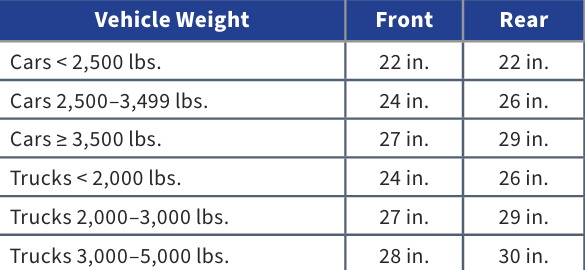
What are bumper height requirements? Are they the same for every vehicle?
Owners of automobiles and pickup trucks are required to have front and rear bumpers mounted within certain height levels. Height limitations are governed by the net shipping weight of the vehicle, not the modified or altered weight. The maximum allowable height between the pavement and bottom of the front and rear bumper are:
What must you do if hauling a load of material which could fall or blow onto the roadway?
SECURING THE LOAD You must not drive or move any loaded vehicle on the highway if the load is not secure. The load must not be able to drop, shift, leak, or otherwise escape. ◆ You must use a close-fitting cover when hauling loads which could fall or blow onto the roadway (e.g., dirt, sand, gravel). ◆ Every truck carrying logs or pulp- wood must use lock chains to securely fasten the load.
When a projected load extends more than 4 feet from the vehicle, what must you use to clearly mark it in the daytime? At night?
PROJECTING LOADS A load that extends beyond the sides of a vehicle and more than four feet or more beyond its rear must be clearly marked. During the day, red flags at least 18 inches square must mark the extremities of the load. Requirements from sunset to sunrise, and during any rain, smoke, or fog include: ◆ two red lamps on the back of the load that can be seen from at least 500 feet to the rear; ◆ two red reflectors on the rear that can be seen from 100 to 600 feet when directly in front of low beam headlights, and located to show the load’s full width; and/or ◆ one red lamp on each side of the load, visible from at least 500 feet to show maximum overhang of the load. If the trailer or motor vehicle is trans- porting logs, pulpwood, poles, or posts that extend more than four feet beyond the rear of the load, you must have one amber strobe-type lamp equipped so that the lamp is visible from the rear and both sides of the projecting load. The lamp must be operational and seen any time of day or night. Passenger vehicles must not be driven on any highway with a load extending beyond the fenders on the left side of the vehicle or extending more than 6 inches beyond the line of the fenders on the right side.
Why is drowsy driving dangerous?
Drowsy driving can be just as dangerous as drunk driving. Do not drive when you are tired. It is risky to drive drowsy because fatigue (being sleepy) can: ◆ slow your thought processes and reaction time; ◆ affect your judgment and vision; ◆ impair your senses and abilities; and/or ◆ cause micro-sleeping (“nodding off”) or falling completely asleep. The two main causes of drowsy driving are lack of quality/quantity of sleep and driving at times of the day when you would normally be sleeping. Avoid driving drowsy! ◆ Don’t drive at times when you would normally be asleep. ◆ Get a good night’s sleep before you travel. ◆ On long trips, take a break every 100 miles or 2 hours. ◆ If you feel sleepy find a safe place to stop and take a nap. ◆ Use the “buddy system” and switch drivers when needed.
What should you do if another driver is threatening you or intentionally driving dangerously around you?
Road Rage Road rage is violent or visibly angry behavior by a driver which can result in crashes or other incidents on roadways. If another driver is threatening you or intentionally driving dangerously around you, remain calm and try to put as much distance between you and them as possible. Slow down and let them pass. Do not make eye contact; do not make obscene gestures. If you need help, call FHP (347) or 911.
What are the three main categories of distracted driving?
1. Visual—taking your eyes off the road / 2. Manual—taking your hands off the steering wheel / 3. Cognitive—thinking about anything other than driving
Why is texting one of the most dangerous distracted driving behaviors?
Texting involves all three categories of distractions, making it one of the most dangerous of distracted driving behaviors.* However, this is not the only cause of distracted driving. Other common distractions include: ◆ talking on a cell phone; ◆ watching an object, person, or event outside of the vehicle; ◆ reaching for an object; ◆ interacting with passengers; ◆ eating or drinking; ◆ unsecured pets; ◆ grooming; ◆ adjusting radio or climate controls; ◆ lighting a cigarette; and/or ◆ daydreaming.
Can anyone drink and drive safely?
Even one drink of alcohol can affect your driving. Alcohol slows your reflexes and reaction time, reduces your ability to see clearly, and makes you less alert. You will have trouble judging distance, speed, and movement of other vehicles. You will also have trouble controlling your vehicle. If you drink alcohol—even just one drink—your chances of being in a crash are much greater than if you did not drink any alcohol. No one can drink alcohol and drive safely, even if you have been driving for many years. Because drinking alcohol and driving is so dangerous, the penalties are very tough. People who drive after drinking risk heavy fines, higher insurance rates, loss of driver license, and even jail sentences. A DUI (Driving Under the Influence) conviction must remain on your driving record for 75 years.
Both your judgment and vision are affected after drinking alcohol. Which is affected first?
A person’s judgment is the first thing affected after drinking an alcoholic beverage.
What can happen to you if you are in a crash and not wearing a seat belt?
Safety belts save lives, but only if worn correctly every time you are in a motor vehicle! You are far more likely to be killed in a crash if you are not wearing a safety belt. In a crash, your safety belt keeps you: ◆ from being ejected from the vehicle; ◆ from being thrown against other passengers, your steering wheel, or windshield; and ◆ behind the wheel, where you can control the vehicle.
What age are children required to be in a car seat? In a car seat or booster seat?
The best child seat is one that fits your child, fits your car, and that you can use correctly every time. Read the car seat’s instruction manual and the portion of your vehicle’s owner manual on car seat installation. Children under 13 should be secured in the rear seat because airbags can injure or kill young children in the front seat. Never place a rear-facing car seat in front of an airbag. It is the parent or guardian’s responsibility to supply a proper child restraint when transporting a child in a vehicle for hire (e.g., taxi, bus, limousine). FLORIDA LAW REQUIRES: ◆ All drivers, front seat passengers, and passengers under the age of 18 wear safety belts*. ◆ Children under age 4 must be in a safety seat and children ages 4 and 5 must be in either a safety seat or a booster seat.
If a law enforcement officer stops a vehicle and the front seat passenger under 18 years old is not wearing a safety belt, who will be charged with the seat belt violation?
Drivers will be charged with a safety belt/ child restraint violation if any passenger under 18 is not properly restrained.
What does a single broken white line on the highway mean?
Single broken white line. You may cross this line to change lanes when it is safe to do so.
What does a double solid yellow line in the center of the highway mean? A double solid white line?
Double solid yellow lines. Vehicles moving in either direction must not pass/ cross these lines. (May turn left or pass a bicyclist when it is safe to do so). / Double solid white lines. Crossing a double solid line/ changing lanes is not allowed.
What does a solid yellow line to the right of the center line of the highway mean?
Double yellow lines–broken on right (“your side” of line), solid on left. Passing is permitted in this lane when safe to do so.
What do the colors of traffic signs indicate (red, orange, yellow, etc.)?
Traffic Sign Colors / Red: Stop. Do not enter. Wrong way. Yield. / Orange: Construction and maintenance warning. / Yellow: General warning. Advisory of unexpected roadway conditions. / Flourescent Yellow Green: High emphasis warning of school, pedestrian and bicycling activity. / White/Black: Regulatory. Control traffic, set limits or give commands. / Green: Guide or directional information. / Blue: Driver guidance. Also used to identify parking spaces for disabled drivers. / Brown: Areas of public recreation, cultural and historical significance.
When more than one vehicle approaches a four-way stop sign, which one moves first?
All Way Stop. Traffic in all directions must stop. Vehicles proceed through the intersection in the order that they arrived; the first vehicle to reach the intersection should move forward first. If vehicles arrive at approximately the same time, each driver must yield to the driver on their right.
What does a red traffic light mean? What does a flashing red traffic light mean?
RED LIGHT / ◆ Come to a complete stop at the stop line. Remain stopped until the light turns green. / ◆ Don’t stop too far away from the stop line. Some signals change only when sensors detect vehicles at the stop line. /◆ After stopping, you may turn right if there is not a NO TURN ON RED sign and the way is clear. / ◆ You may turn left from a one-way street onto a one-way street that has traffic moving to the left. / ◆ Before turning, you must yield the right-of-way to pedestrians in the crosswalk and oncoming traffic. / ◆ Running (driving through) a red light is against the law and is extremely dangerous! FLASHING RED LIGHT / Used at dangerous intersections. Treat it like a stop sign; stop and proceed when safe.
After a full stop at a red traffic light when may a driver turn right?
What does a green arrow showing at the same time as a red traffic light mean you can do?
What does a flashing yellow light mean?
If you are approaching a railroad crossing that does not have gates or lights and you see a train coming, what should you do?
What happens to the force of impact when you double your speed? Triple your speed?
Unless otherwise posted, what is the speed limit for cars in a residential area?
What is the maximum speed limit on a limited access highway?
Can you be issued a citation for driving too slowly?
What are the steps for making a smooth stop?
What is the arm signal for a left turn? Right turn? Slow or stop?
How long (distance) should you signal before making a left or right turn?
When can you use a three-point turn? Where should you never make a three-point turn?
What is an open intersection? When must you yield right-of-way?
When may you drive in the left lane of a road with two lanes? With four lanes?
What does it mean if you see red reflectors on the lane lines facing you? What should you do?
What is the recommended safe following distance?
When should you increase your following distance?
What are blind spots?
How do you check your blind spots when you are preparing to change lanes or turn?
Where is it unlawful to overtake and pass?
Under what circumstances can you stop in the acceleration lane on an expressway?
What should you do if you drive past your exit on a limited access highway?
Where should you move your vehicle if you break down while driving on the highway?
What is the farthest away you can park from a curb?
If you have a manual transmission, what gear should you put the car in when parking downhill? Uphill? What if you have an automatic transmission?
Where is parking prohibited?
Which way should you turn your wheels when parking uphill along a curb? Which way should you turn them where there is not a curb? Which way should you turn them if parking downhill?
Are motorists required to stop or yield for pedestrians crossing the street?
What must you do when you see a pedestrian with a white cane in the street ahead of you?
What is the minimum distance a motorist must give when traveling next to a cyclist?
As a motorist, what should you do when preparing to turn right on a roadway with a bike lane?
When on the roadway, do motorcyclists and moped riders have the same rights and responsibilities as motor vehicle drivers?
If you are driving a motor vehicle, are you allowed to share a lane with a motorcyclist?
When a school bus is stopped to unload children on a highway divided with a raised barrier, are vehicles traveling in the opposite direction required to stop?
When a school bus stops to unload children, are vehicles traveling in the same direction required to stop?
What must you do when children or school crossing guards are present in a crosswalk?
What must you do if an emergency vehicle with activated lights and/or sirens is approaching you from behind?
What does the Move Over Law require you to do?
What is a “No Zone”?
At what times must you use your headlights?
At night, within how many feet of approaching a vehicle from the rear must you dim your high beam headlights?
Within how many feet of an oncoming vehicle should you dim your high beam headlights?
When driving in the rain, fog, or smoke in the daytime, what lights should you use?
What should you do when driving on wet roads in the rain? Why?
What should you do if your right wheels go off the pavement while driving?
What should you do if your tires begin to skid while driving?
When emergency braking, what is the difference between conventional brakes and anti-lock brakes (ABS)?
What should you do during a tire blow-out?
What must you do if you are involved in a minor accident and your vehicle is blocking the flow of traffic?
If you hit a parked car and are unable to find the owner, what should you do?
What are the penalties for leaving the scene of an accident involving injury or death?
◆ Death: 1st degree felony, minimum 4-year prison term. ◆ Serious bodily injury: 2nd degree felony. ◆ Injury: 3rd degree felony. All of the above include losing your driver license for 3 years minimum. Damage to a vehicle or other property which is driven or attended by any person is a 2nd degree misdemeanor.
What are the requirements of the No-Fault Law?
Before you register your car in Florida, you must show proof of Personal Injury Protection (PIP) and Property Damage Liability (PDL) coverage. PIP covers your injuries if you’re in a crash, no matter who caused it. PDL coverage pays for damage to other people’s property that you caused. Every owner or person in charge of operating a motor vehicle on Florida roadways must: ◆ provide proof of valid PIP and PDL insurance at the time of vehicle registration; ◆ have a minimum of $10,000 in PIP AND a minimum of $10,000 in PDL coverage; ◆ purchase the policy from an insurance agency licensed to do business in Florida; ◆ maintain the insurance continuously throughout the registration period; and ◆ always have proof of valid Florida insurance readily available when the vehicle is being driven on Florida roadways. You must comply if you own a motor vehicle that has been in the state for 90 days (consecutive or non-consecutive) during the last 365 days. You must maintain proper insurance or your driver license/license plate registration can be suspended.
If your license and registration are suspended for being in violation of the NoFault Law, what must you do to get them reinstated?
Always carry proof of insurance when you or someone else is driving your vehicle. Your insurance company will provide you with a Florida Insurance ID Card. You must have the card (or electronic proof on a smart phone) with you when you’re driving. You may receive a citation if you are stopped by a law enforcement officer and don’t have proof of insurance with you. You’ll have to go to court to prove that you had insurance coverage at the time you were stopped, or your driver license may be suspended. If you don’t have proof and the judge convicts you, your driver license and license plate will be suspended. In order to lift the suspension, you will have to get insurance and pay a reinstatement fee ($150 to $500). If your driver license and license plate have been under suspension for 30 days or more, a law enforcement officer can seize your license plate immediately. The officer may also take you to jail for driving with a suspended license, which is a first-degree misdemeanor punishable by up to a year in jail and a $1,000 fine. If your driver license or license plate is suspended for not having insurance, you won’t be able to get a temporary license for any reason, not even to go to work. If you show a law enforcement officer an insurance card when you know the insurance has been canceled—or if you falsify the card—you may be arrested and charged with a second-degree misdemeanor. FLHSMV will provide you with an opportunity to prove insurance coverage or have an administrative hearing. When you receive the notice of suspension of your license you may request a hearing; otherwise, one will not be scheduled for you.
What are the penalties if you are at fault in a crash and you are not insured in compliance with the Financial Responsibility Law?
If you leave the scene and it results in: ◆ Death: 1st degree felony, minimum 4-year prison term. ◆ Serious bodily injury: 2nd degree felony. ◆ Injury: 3rd degree felony. All of the above include losing your driver license for 3 years minimum. Damage to a vehicle or other property which is driven or attended by any person is a 2nd degree misdemeanor.
What are the time restrictions for a motorist with a learner’s license?
◆ ◆ Always drive accompanied by a licensed driver, age 21+, who rides in the closest seat to the right of the driver. ◆ Must only drive during daylight hours during the first three months. After three months, may drive until 10 pm.
What are the time restrictions for a licensed motorist under age 17? Under age 18?
◆ A 16-year-old licensed driver may not drive between 11 pm and 6 am unless driving to or from work or accompanied by a licensed driver age 21 or older. ◆ A 17-year-old licensed driver may not drive between 1 am and 5 am, unless driving to or from work or accompanied by a licensed driver age 21 or older.
When can you be charged with driving under the influence (DUI)?
You can be charged with Driving Under the Influence (DUI) if you are found to be driving or in physical control of a motor vehicle while under the influence of alcoholic beverages, controlled substances, prescriptions, or over-the- counter medications. At the time of arrest, your license will be administratively suspended if you have a breath or blood alcohol level (BAL) of .08 or above, or refuse to submit to a breath/ blood alcohol test.
What are the penalties for refusing to take a blood test, a urine test, or a breath test when suspected of driving under the influence?
If you refuse to take the tests when asked, your license will automatically be suspended for one year. By law, you have agreed by signing your driver license to take these tests if asked. A second refusal will result in an 18 month suspension and a first degree misdemeanor. (Implied Consent)
What can happen if you are found guilty of racing on the highway?
Speeding citations can result in fines and points on your driving record./ ◆ The fine for exceeding the speed limit by more than 50 MPH is $1,000 for the first offense and $2,500 for the second. ◆ Fines are doubled when speeding infractions occur within a school zone or construction zone, with possible civil penalties up to $1,000, and you can be required to complete a driving course
If you have a learner’s license, how many hours of driving experience are required to earn the Class E driver license?
Must have at least 50 hours of driving experience prior to getting driver license, and 10 hours should be at night.
What education course are you required to take if you are applying for a learner’s license (or have never held a driver license)?
Learner’s License 1. Be at least 15 years old. 2. Completion of Traffic Law and Substance Abuse Education Course (TLSAE)*. 3. Pass Vision and Class E Knowledge exams. Driver License 1. Be at least 16 years old. 2. Completion of TLSAE Course*. 3. Provide required identification. 4. Pass Vision, Class E Knowledge, and Driving Skill exams…. TLDR: TLSAE Drug and Alcohol Course.
Are you required to notify FLHSMV of any health problems that may affect your driving?
You must list any physical or mental issues that might affect your driving on your driver license application. If you have epilepsy, fainting spells, dizziness, blackouts, or any other medical condition that could impair your driving, you may be asked to have your doctor complete a medical report form. This form can be requested through your local driver license service center. The report must be completed by your doctor and submitted to FLHSMV before a driver license is issued.
Why would one opt to take a Basic Driver Improvement Course?
You must complete a basic driver improvement course (Traffic Collision Avoidance course) if you want to retain your driver license in the following circumstances: ◆ You were a driver in a crash and are found at fault and someone was transported to the hospital. ◆ You had two crashes in a two-year period, which resulted in property damage greater than $500. ◆ You were convicted of: ◆ running a red light. ◆ passing a school bus when it displayed a stopped signal. ◆ racing on the highway. ◆ reckless driving. If you receive a ticket for a non-criminal moving violation, the violation was not in a CMV and you do not hold a CDL, you may elect to attend a basic driver improvement course in lieu of points on your driving record. (You may not elect to attend if you were charged with exceeding the speed limit by more than 30 MPH.)
What maneuvers are required on a driving exam?
The Class E Knowledge Exam consists of 50 multiple-choice questions about: 1. Florida traffic laws, 2. Safe driving practices, and 3. Identifying traffic controls. / DRIVING SKILLS TEST You must provide a vehicle (with a valid license plate and insurance) for the driving skills test. Your vehicle will be inspected to determine that it is safe for a driving test. The driving skills test will not be given if the examiner finds: ◆ Horn, rear-view mirror, directional signals, steering wheel, brakes, tires, brake lights, or tail lights are defective or inoperable. ◆ No windshield wipers on the driver’s side. ◆ No operable headlights when visibility is reduced. ◆ Cracked or broken glass that hinders visibility. ◆ Expired tag. ◆ The vehicle doesn’t have doors. ◆ Front doors don’t open from the inside and outside. ◆ Vehicle doesn't have stationary seats. ◆ Vehicle does not permit the driver to give hand signals when required. ◆ Jeep-type vehicles without framed canvas or metal doors held by hinges and door latch. ◆ Doesn’t meet bumper height requirements. ◆ A low-speed vehicle. No other passengers are permitted during the exam (unless a language interpreter is necessary). You will perform the following maneuvers on the driving exam: ◆ Approach of Crossing. Get in the proper lane and look in each direction. ◆ Backing Up. Back up a distance of 50 feet at a slow speed while looking to the rear. Do not use the rear-view mirror or rear-view camera monitor. ◆ Follow at a Safe Distance. Do not follow too closely behind other cars. Keep a minimum following distance of three to four seconds. ◆ Obey Stop Signs. Approach in the proper lane, come to a complete stop before reaching the stop line or crosswalk, and remain stopped until you can move safely. ◆ Obey Traffic Signals. Get into the proper lane and approach the light at a speed that will allow you to stop if the light should change. When the light turns green, do not move forward until other traffic has cleared the intersection. ◆ Observe Right-of-Way. Allow pedestrians to cross, pull over and stop for emergency vehicles, and don’t enter an intersection where you will interfere with other traffic. ◆ Parking on a Grade. Correctly parking uphill and downhill, with and without a curb. ◆ Passing. Look ahead and behind to make sure you can pass safely. ◆ Signal and Turn. Get into the proper lane and signal your turn for the last 100 feet. Use hand signals or mechanical signals. ◆ Stay in Proper Lane. Drive in the right lane except on a one-way street. Do not change lanes until you may do so safely. ◆ Stop Quickly. Make a quick, safe stop when the examiner/agent instructs you. ◆ Straight-In Parking. The vehicle should be centered inside the space with no part of the vehicle extending out in the traffic lane. ◆ Three Point Turn. Turn car around in a 20–40 foot space. ◆ Use Proper Posture. Keep both hands on the steering wheel and do not rest your elbow in the window. The examiner will explain any mistakes you may have made after the test is completed. If you fail the driving skills test, you will be asked to study or practice before returning for retesting. If you pass the driving skills test, the examiner will collect the fee and issue your driver license.