microeconomics
 Call Kai
 Learn
Learn Practice Test
 Spaced Repetition
 Match
Match Flashcards
 Knowt Play
1/158

There's no tags or description
Looks like no tags are added yet.
Name | Mastery | Learn | Test | Matching | Spaced | Call with Kai |
|---|
No analytics yet
Send a link to your students to track their progress
159 Terms
What is the purpose of govt intervention
To prevent the abuse of monopoly power which would cause potential market failure and loss of consumer surplus
Types of price regulation
RPI - X (retail price inflation - expected efficiency improvements)
RPI - X + K (K represents investment)
Advantages of price regulation
encourages firms to be more efficient and cut costs
Encourages competition in markets
Disadvantages of price regulation
hard to determine value of X
can limit profit leading to limited investment
Risk of regulatory capture
Pros/cons of profit regulation
fix a max level of profit a firm can earn
- little incentive to cut costs and be efficient
- govt has asymmetrical information of the market
+ encourages investment
Quality standards
govt ensures minimum standards for quality a many firms only do so to maximise profits
- monopolies will resist (lobbying)
- policies require will and understanding to introduce
Performance targets
govt sets targets on a variety of outputs for a firm
- monopolists will attempt to find ways to meet targets without improving
- asymmetrical information
+ helps improve services and leads to gains for consumers
Ways to enhance competition through promotion of small businesses
UK (red tape challenge) - aims to simplify regulations
Small and medium sized Enterprises (SMEs) - stimulate innovation and investment
Competitive tendering for govt contacts
contacting out provisions so that private firms operate things such as roads or hospitals
Advantages of government intervention
govt are able to prevent monopolies changing excessive prices and aim to limit their profit
Aims to ensure consumers pay fair prices, receive good quality and have lots of choice
Can increase efficiency by increasing competition and contestability
Disadvantages of govt intervention
If regulation is too strong, costs and inefficiency may rise
The public sector is limited and may provide x-inefficiency
Large firms hold political power and are able to lobby
Regulatory capture
When a regulator becomes more empathetic, removing impartiality, weakening their ability to regulate
Asymmetric information
When regulatory bodies have to use information n provided to them by the industries when setting different targets
allocative efficiency
when resources are used to produce goods which consumers want and value most highly
P=MC
productive efficiency
when firms produce at the lowest point on the AC curve
MC=AC
Dynamic efficiency
when resources are allocated efficiently over time.
Related to the rate on innovation
concerned with investment
firms must have SNP
x-efficiency
when a firm is producing at any given output on the AC curve
characteristics of perfect competition
many buyers and sellers
sellers are price takers
no barriers to entry or exit
perfect knowledge
homogeneous goods
perfect competition
productive and allocative efficiency (MC=AC=MR=P)
cannot benefit from economies of scale
LR normal profit
characteristics of monopolistic competition
many small buyers and sellers sellers
low barriers to entry and exit perfect
imperfect information
heterogeneous goods
SOME price setting power
monopolistic competition
assumed to be SR profit maximisers
can only make normal profit in the long run
produce at AC=AR and MC=MR
characteristics of oligopoly
high concentration
interdependence
high barriers to entry and exit
non-price competition
differentiated goods
n-firm concentration
(total sales of N firms/total size of market) x 100
advantages of collusion
maximise industry profits
reduce uncertainty
disadvantages of collusion
illegal
fear of others firms breaking agreements
market share has to be divided
overt collusion
when there is a formal agreement on either price or market divide (cartel)
an agreement must be reached
potential competition must be restricted
ways of preventing cheating must be enforced
tacit collusion
no formal agreement
price leadership
barometric firm price leadership
unwritten rules
price competition
price wars: repeated undercutting of competitors prices
predatory pricing: when large firms set price bellow AC so smaller firms cannot make profit (illegal)
limit pricing: when firms set price bellow profit maximising point to discourage new firms from entering market but must be making normal profit
non price competition
advertising
loyalty cards
beading
quality
customer service
product development
game theory table
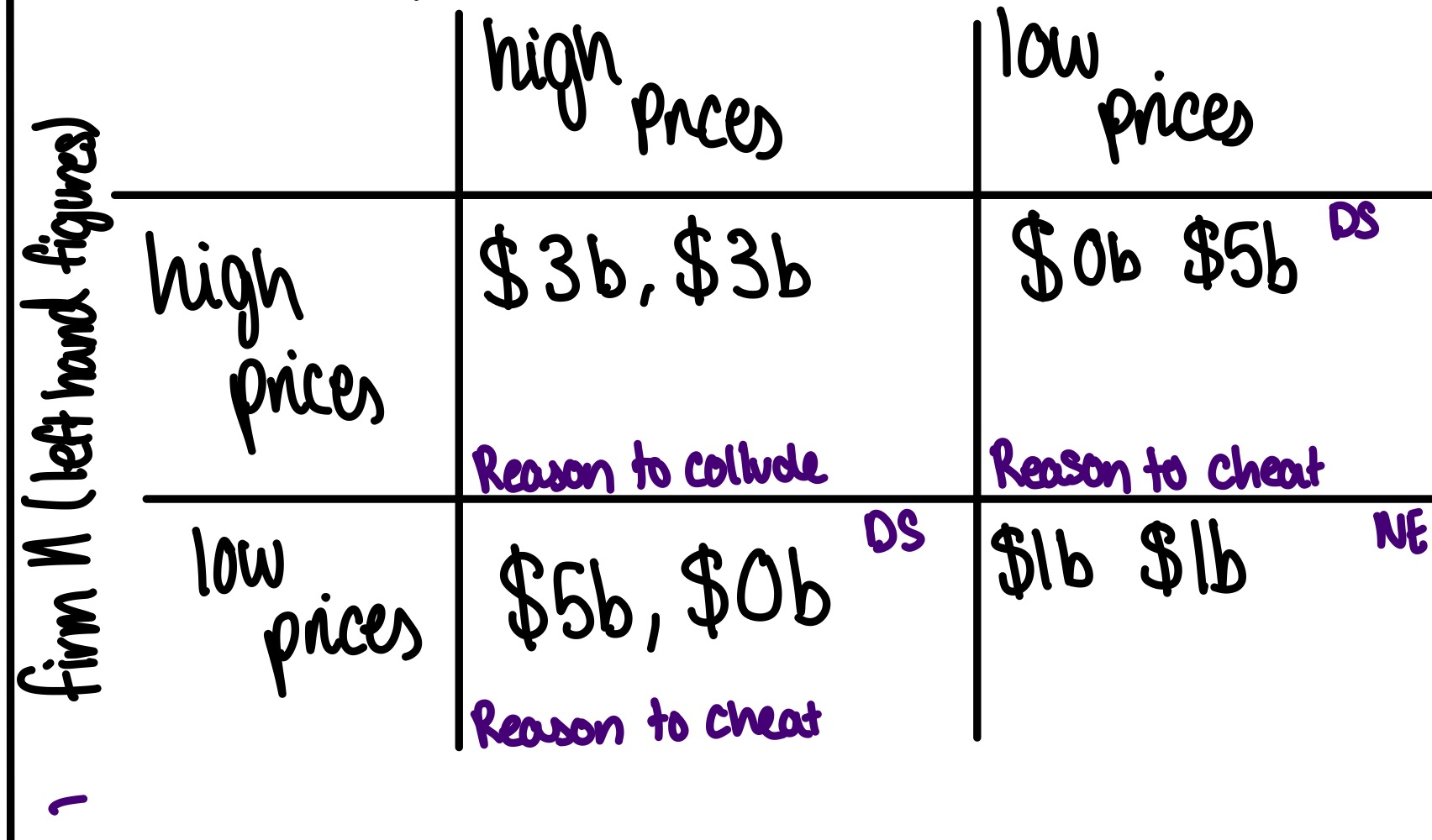
game theory
used to examine the best strategy a firm can adapt for each assumption about its rivals
nash equilibrium
where both firms use dominant strategy
dominant strategy
the best option regardless of what the other player chooses
characteristics of a monopoly
profit maximisation
one sole seller
high barriers to entry
price setters
price discrimination
third degree price discrimination
when the monopolist decides to charge different groups of consumers different prices for the same good or service
advantages of price discrimination
consumer:
may benefit from net welfare gain due to cross subsidisation
producers:
better use of spare capacity
higher SNP can stimulate investment
costs of price discrimination
consumers:
loss of consumer welfare
loss of allocative efficiency
higher prices
Producers:
firms may be regulated by competition and market authorities
firm may have to divide the market
may cause inefficiency as there is higher profit
lack of consumer choice
natural monopoly
when one firm naturally becomes the most efficient firms due to high fixed costs
characteristics of monopsony
single buyer in the market
assumed monopsonists are profit maximisers
price setters
costs of monopsony
firms providing loose profit
risk of labour exploitation
lower productivity if wages are too low
benefits of monopsony
NHS can negotiate lower prices for healthcare services
consumers may receive lower prices as cost of production is low
characteristics of contestable markets
actual and potential competition
entrants have free access to production techniques and technology
no barriers to entry or exit (no sunk cost)
low consumer loyalty
no of firms in market varies
implications of contestable market for the behaviour of firms
firms are more likely to be allocatively and productively efficient
threat of hit and run firms
firms can earn SNP in short run but only NP in long run
types of barriers to entry and exit
economies of scale
legal barriers
customer loyalty & branding
predatory pricing/limit pricing
anti-competitive practices
vertical integration
cost of making workers redundant
Marginal Revenue Product of Labour
the extra revenue generated by an individual worker
marginal output x price
difference in total revenue
derived demand
demand for labour is derived from the demand for the product the labour produces
factors influencing demand for labour
wage rate (movement along the curve)
demand for product/change in price of product wages in other countries
prices of other factors of production
technology
regulation
factors affecting PED of labour
PED for product
proportion of wages to the total cost of production
availability of substitutes
time
factors influencing supply of labour
wages
population & age distribution
education/training/qualifications
trade unions and barriers to entry
wages & conditions of other jobs
legislation
factors affecting the PES of Labour
level of qualifications and training
availability of suitable labour in other industries
time
reasons for market failure in the labour market
occupational immobility
~skills gap
~training gap
~experience gap
geographical immobility
~family ties
~cost of property
~migration controls
~language barriers
~cost of commuting
~access to good schools
discrimination
curved labour supply curve
work is an inferior good
the more wages rise, the more people are happy to work less hours and substitute work for leisure
Reasons for differing wages
age
Education
Training
Work experience
Skill/talent/ability
Sex and ethnic background (illegal)
Monopsony in the labour market
only one buyer of labour
LMC>LAC
Employ at MCL=MRPL
Monopoly in the labour market
existence of trade unions can operate as only supply of labour
Labour market issues
skills shortage
Young workers
Retirement
Wage inequality
Zero hour contracts
The ‘gig’ economy
Migration
How to tackle immobility of labour
Improve supple of houses
Improve transport links
National advertising
Increase vocational training
Encourage further studies
Improve education
Encourage spending on training
Apprenticeship schemes
Localised career advice and support
Types of government intervention
National minimum wage (1999)
Maximum wages
Public sector wage setting
Advantages of NMW
reduces poverty
Boosts consumer spending
Reduces reliance on benefits
More motivated workforce
Fair wage
Disadvantages of NMW
potential job loss
Raises AC for firms, may increase prices
Small businesses may struggle
Fall in investment
cost in the short run
at least one factor of production is fixed
cost in the long run
all factors of production are variable
diminishing marginal productivity
if a variable factor is increased when another factor is fixed, there will come a point where each extra unit of the variable factor will produce less output than the previous unit
economies of scale
when an increase in production causes a lower average cost leading to increase returns to scale
diseconomies of scale
when there is a potential decrease in efficiency and so an increase in output results in a rise in average cost, the firm experiences decreasing returns to scale
what is an internal economy of scale
an advantage that a firm is able to enjoy because of a growth within the firm
a movement along the LRAS
what are the types of internal economies of scale
technical EOS- a result of what happens to the production process
financial EOS- larger firsts can obtain finance easier as there is lower risk
managerial EOS- larger firsts firsts can appoint specialist managers in every field who are more efficient
marketing EOS
what is an external economies of scale
advantages which can arise from growth in the industry
a shift in LRAS
types of external economies of scale
labour- business established in an area with other successful firms from the same industry will find labour easier (silicone valley)
support services- business who provide goods for large firms will naturally more to the area those firms are based reducing transport costs
growth in technology in the market
what can cause diseconomies of scale
workers may lack incentive- low productivity
geography- large distances for transport may be hard to control
management- coordination and control, communication
what are constant returns to scale
where firms increase inputs and receive an increase in output by the same percentage
minimum efficient scale
he minimum level of output needed for a business to fully exploit economies of scale
normal profit
the return that is sufficient to keep the factors of production committed to business
AC=AR
supernormal profit
profit greater than normal profit
loss
when the firm fails to cover its costs
AR<AC
what are the different business objectives
profit maximisation
revenue maximisation
sales maximisation
satisficing
point of profit maximisation
MC=MR
point of revenue maximisation
MR=0
Sales maximisation point
AC=AR
satisficing point
where a firm makes enough profit to keep owners happy whilst following other objectives
reasons for firms to grow
to exploit economies of scale
to increase market shares
to reduce risk (have diverse options/economies of scope)
managers objectives
reasons to stay small
niche markets
avoid diseconomies of scale
lack of finance
regional monopoly
fear of divorce of ownership
what is the principle agent problem
where one group (the agent) makes decisions on behalf of the other group (the principal) and may maximise their own benefits rather than profit maximise
private vs public sectors
private- owned and run by individuals or groups of individuals
public- owned or controlled by local or central government
organic growth
where firms grow by increasing their output, for example increased investment
advantages of organic growth
integration is expensive, time consuming and high risk
firm is able to keep control of their business
disadvantages of organic growth
sometimes another firm has a market or an asset which the company would be unable to gain through organic growth
organic growth is slow
it will be difficult for firms to get new ideas
what are the three types of integration
vertical- integration of firms in the same industry but at different stages of production
horizontal- where firms in the same industry at the same stage of production merge
conglomerate- where firms in different industries integrate
constraints of business growth
size of market
access to finance
owner objectives
regulation
health and safety costs
what is a demerger
when a single business is broken down into two or more components
reasons for demerges
lack of synergies- different parts of firm have no real impact on each other and fail to make the other more efficient
value of the company/share price- value of the separate parts of the company is worth more than the company combined
focused companies- if management is focused of individual markets, they may become more efficient and successful
avoidance of competition authorities
impact of demerger on workers
job uncertainty
changes in compensation and benefits
opportunities for growth
impact of demerger on businesses
change in efficiency
loss/gain in economics of scale
change in stock prices
greater independence
impact of demerger on consumers
change in price/quality of goods
contractural changes
more choice/competition
what are the types of government intervention
indirect taxation
subsidies
maximum and minimum prices
traceable pollution permits
state provision of public goods
provision of information
regulation
advantages of indirect taxation
market produces at social equilibrium
raises government revenue
advantage of subsides
welfare is maximised
encourages production
advantages of price floor/ceiling
allow for some consideration of externalities
makes goods more affordable, reducing poverty
makes goods too expensive reducing consumption
advantages of trade pollution permits
pollution will fall
raise revenue by selling permits
encourages efficiency and more green production
advantages of state provision of public goods
corrects market failure
ensures everyone has access
the goods provide benefits to the economy

