PSY301 Lecture 2: Introduction to Qualitative Methods
 Call Kai
 Learn
Learn Practice Test
 Spaced Repetition
 Match
Match Flashcards
 Knowt Play
1/25

There's no tags or description
Looks like no tags are added yet.
Name | Mastery | Learn | Test | Matching | Spaced | Call with Kai | Chat |
|---|
No analytics yet
Send a link to your students to track their progress
26 Terms
What are Qualitative methods?
Data = words (and images)
Focus = Individuals/small populations
Goal = A rich/in depth understanding of human experience
Acknowledge of theoretical position: Realism & Positivism VS Critical realism & Contextualism VS Relativism & Constructionism
Types of Qualitative Methods
Interpretative Phenomenological Analysis (IPA)
Grounded Theory
Discourse Analysis
Thematic Analysis
Polytextual Thematic Analysis
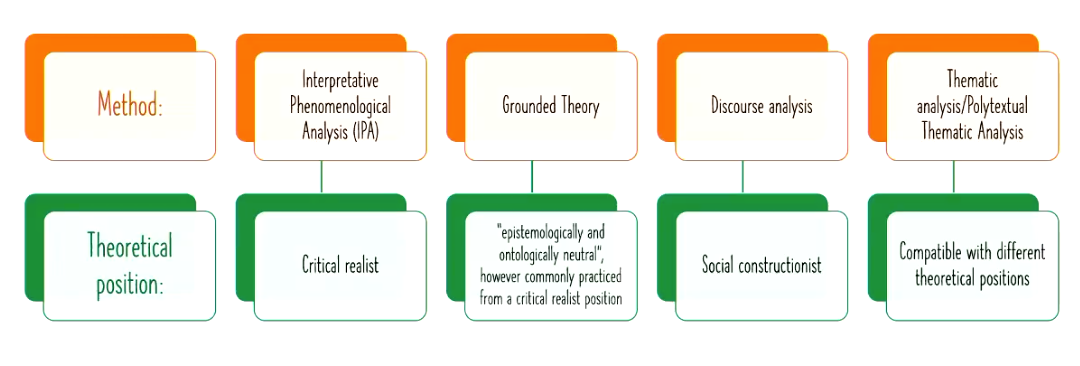
Which qualitative method?
The importance of the research question:
What do you want to know?
How are you going to find out?
What is your theoretical position?
Interpretative Phenomenological Analysis (IPA)
Interpretative: we interpret our own experiences and researchers interpret the experiences of research participants
Phenomenological: an emphasis on describing the ‘lived experience’ of a person from different perspectives
IPA: Data and sample size
Semi-structured, one-on-one interviews is the preferred method of data collection because it allows a focus on the individual’s experience
The sample size for IPA is preferably small to allow a focus on what an individual experiences, rather than attempting to generalise too quickly
IPA: Theoretical position
Critical realist: reality is objectively knowable and independent, but our access to it is never direct.
The double hermeneutic: The participant is interpreting their experience and then the researcher is interpreting the participant's interpretation
IPA: Steps of the analysis process
Case Study approach
Writing descriptive summaries
Initial Interpretations
Clustering Themes
Establishing Final Themes
Reflective Diary
IPA: Reflective diary
Writing notes about why you have chosen to describe data this way, why you have chosen to cluster these themes together and why you have chosen this final theme
Two important purposes;
Helps the analyst to explain the relationship between data, themes and final themes, which can aid in the writing up of the analysis
Allows the interpretative phenomenological analyst to recognise and, therefore, acknowledge their own assumptions about the data they have collected
Grounded theory
Goal: theoretical understanding of psycho–social phenomena that is grounded in the data collected from the lives and contexts of the participants
Inductive rather than deductive approach
Rejects the hypothetico-deductive model which begins with a theory and then develops a hypothesis to test the theory
Starts with data and uses inductive process to develop a theory that holds true for those cases
Grounded theory: Data and sample size
Data collection methods often include in-depth interviews or focus groups using open-ended questions. Questions can be adjusted as theory emerges.
Theoretical saturation determines sample size
Theoretical Saturation: analysis begins before all the data has been collected. Data collection stops when new data is not revealing any new codes
Grounded theory: Theoretical position
Classic Grounded Theory is “epistemologically and ontologically neutral”
“where grounded theory takes on the mantle for the moment of prepositivist, positivist, postpositivist, postmodernism, naturalism, realism etc, will be dependent on its application to the type of data in a specific research” (Glaser, 2005).
Most commonly practiced from a critical realist position
Grounded theory: Steps of the analysis process
Data Collection
Theoretical Sampling
Theoretical Saturation
Open Coding
Axial Coding
Theoretical or Selective Coding
Memo Writing
Proposing a Theory
Grounded theory: ‘The reflexive researcher’
Grounded theorists answer to their results being taken as simply ‘subjective’
Grounded theorists reflect upon how they affect the interpretation of the data, in order to minimise their impact on the interpretation
This is the crucial role of ‘memo writing’ and leaving an ‘audit trail’
Grounded theory: writing a theory
It is not enough to simply describe the data collected
Grounded theorists aim to propose a theory which explains the topic
Writing a theory means to explain the links between codes as well as how the codes help us to understand the topic
Discourse Analysis
Cluster of related methods that are used for studying language and its role in social life
Social constructionist position
There is no single version of reality that exists independently of us
Reality and knowledge are constructed through our social practices
It is an ongoing process
Types of Discourse analysis
Discursive psychology (DP)
Conversation analysis (CA)
Critical discourse analysis (CDA)
Multimodal Critical discourse analysis (MCDA)
Foucauldian discourse analysis (FDA)
Discourse analysis: Data and sample size
Data can be anything!
Questionnaires, diaries, interviews, focus groups
Online data: blogs, forums, discussion threads, social media
Media: newspapers, journals, television, radio, speeches, advertisements (text and/or images)
Sample size determined by research question and type of data
Discourse Analysis: method
To recognise the method in interaction: examine everyday methods of sense making
Ask yourself:
“What does this mean?”
“How does this make sense?
“What does it do in this context?”
How do we do Discourse Analysis?
Discursive devices:
Extreme case formulations: such as ‘the worst day of my life’ ... sometimes used to strengthen an account
Pronoun use and ‘footing shifts’: such as ‘I’, ‘we’ and ‘you’ ... often used to manage accountability
Three-part lists: such as ‘here, there and everywhere’ ... used frequently in political speeches as well as everyday situations to add credibility and authenticity to accounts
Interpretative repertoires:
Culturally agreed upon sets of connected ideas, descriptions and arguments, for example “Natural food is healthier”
Identify and describe what these devices DO
(Reflexive) Thematic Analysis
Flexible method - compatible with different theoretical positions and most types of data
Organises and describes data in terms of themes
Interprets how these themes address the research question
What is a theme?
Captures something important in relation to your research question
What ‘size’ does a theme need to be?
1. More instances (prevalence) doesn’t necessarily mean more crucial
2. Key is ‘significance’ or meaningfulness of the theme in relation to the research question
Thematic analysis (like all forms of qualitative analysis) is an active process:
Themes do not just ‘emerge’ from the data
Thematic Analysis: Steps of process
Familiarising yourself with the data
Generating initial codes
Searching for themes
Reviewing Themes
Defining and naming themes
Producing the report
Polytextual Thematic analysis
A method for analysis of visual data:
“It is polytextual in that it assumes that all texts (including visual texts) are predicated on one another, and each can only be read by reference to others. It is 'thematic' in that it attempts to identify the repetitive features or themes in the data that enable patterns to come into view.” (Gleeson, 2020)
Polytextual Thematic analysis: Process
1. Look at the images over and over again. Note any potential proto-themes (i.e., first attempts at themes, or primitive themes) that emerge, describing the features of the image that evoke that theme.
2. Make notes in a reflective log to capture reflections on experiences that connect with the image
3. Feel the effect that the images have on you and describe these as fully as you can in your notes.
4. Where a proto-theme appears to occur more than once, collate the material relevant to that theme. Does the proto-theme hold?
5. Write a brief description (or definition) of the proto-theme.
6. Go back over all of the other images to see if the proto-theme is recognisable anywhere else.
7. Again collate the material relevant to that proto-theme. Revise the description of the proto-theme if necessary. Bring together descriptions of elements from different images that best illustrate that theme. It is at this point that the proto-themes may be elevated to the status of theme.
8. Continue to work on identifying themes in the pictures until no further distinctive themes (that are relevant to the research question) emerge.
9. Compare descriptions of themes in relation to each other- consider the extent to which they are distinct. Write descriptions of themes that highlight the differences between themes.
10. Consider if any themes cluster together in a way that suggests a higher-order theme that connects them.
11. Define the higher-order themes and consider all themes in relation to it. As other higher-order themes emerge consider each in relation to all other themes that have emerged.
12. Decide which of the themes best address the research question so that a limited number may be selected for writing up. Incorporate any supporting materials that contextualise the images being analysed
Ethics in Qualitative data
Words as data:
people’s opinions,
beliefs,
values,
experiences
Important to consider issues of anonymity, reputation and respect.
Things to remember and traps to avoid in Qualitative research
Qualitative analysis takes time
Qualitative analysis needs evidence
Qualitative analysis is explanation, not description
Qualitative analysis is NOT psychoanalysis