5- Development & Periodic Trends
 Call Kai
 Learn
Learn Practice Test
 Spaced Repetition
 Match
Match Flashcards
 Knowt Play
1/31

Earn XP
Name | Mastery | Learn | Test | Matching | Spaced | Call with Kai | Chat |
|---|
No analytics yet
Send a link to your students to track their progress
32 Terms
Dobereiner
[DEVELOPMENT]
Classifying elements was initially done for only a selected few, just like when _____ grouped a few elements into three (aka triads) based on atomic mass.
de Chancoutois (telluric helix)
Newlands (law of octaves)
[DEVELOPMENT]
Initial attempts of the entire periodic table started with ____ [2]
Mendeleev and Meyer
[DEVELOPMENT]
_____ and _____ independently made their own versions of the periodic table using atomic mass, and atomic volume , respectively (they ended up being similar since the atom’s volume is derived from its mass anyway).
Moeseley
[DEVELOPMENT]
Several decades after, ______ used the surge in new knowledge about the atom to change the basis of the periodic table from atomic number.
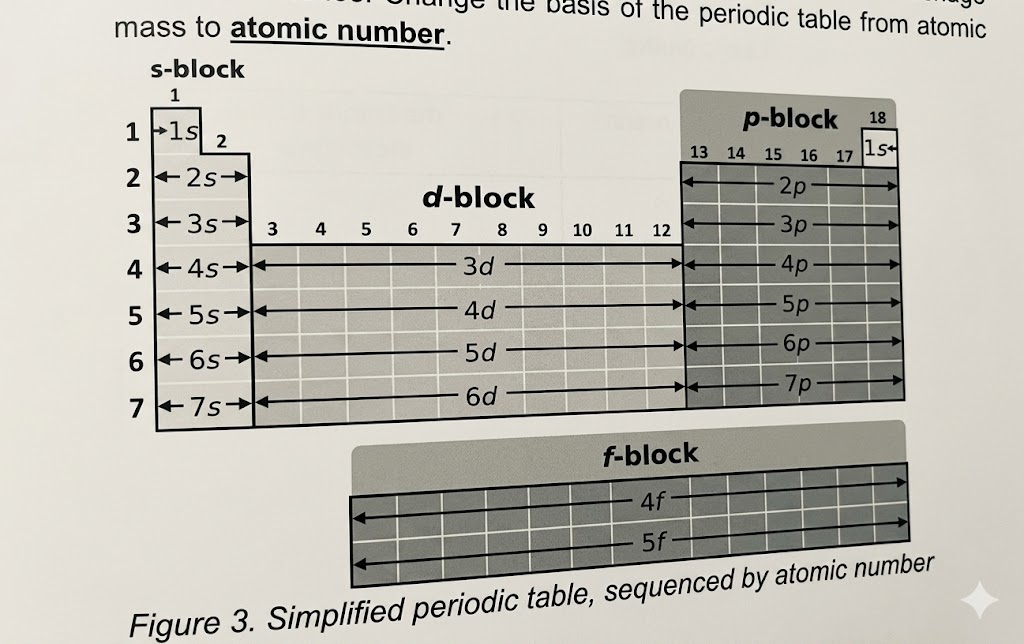
Rows are called periods
Columns are called groups
Four blocks exist based on the azimuthal number
Representative elements → s and p blocks [A]
Transition elements → d block [B]
Lanthanides and actinides → f block
Figure 3 . Simplified periodic table, sequenced by atomic number
Rows
Periods
a. Rows
b. Columns
Columns
Groups
a. Rows
b. Columns
Representative elements
s and p blocks
a. Representative elements
b. Transition elements
c. Lanthanides and actinides
Transition elements
d block
a. Representative elements
b. Transition elements
c. Lanthanides and actinides
f block
f block
a. Representative elements
b. Transition elements
c. Lanthanides and actinides
Scandium
eka-Boron
a. Scandium
b. Gallium
c. Germanium
c. Technetium
d. Francium
Gallium
eka -Aluminum
a. Scandium
b. Gallium
c. Germanium
c. Technetium
d. Francium
Germanium
eka-Silicon
a. Scandium
b. Gallium
c. Germanium
c. Technetium
d. Francium
Technetium
eka-Manganese
a. Scandium
b. Gallium
c. Germanium
c. Technetium
d. Francium
Francium
eka-Cesium
a. Scandium
b. Gallium
c. Germanium
c. Technetium
d. Francium
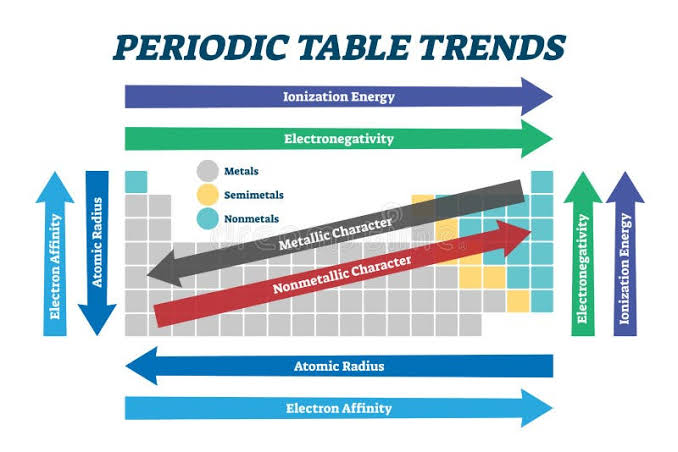
Atomic size
[PERIODIC TRENDS]
The size/radius of an atom
Ionization energy (IE)
[PERIODIC TRENDS]
The energy required to remove an electron from an atom
Electron affinity
[PERIODIC TRENDS]
The energy released when an electron is added to an atom
Electronegativity
[PERIODIC TRENDS]
The ability of an atom to attract an electron itself
Metallic and non-metallic strength
[PERIODIC TRENDS]
The observable properties that arise from their relative positions in the periodic table (see table 11)
Metals
[PERIODIC TRENDS]
Possess shiny luster
Non-metals
[PERIODIC TRENDS]
Do not have luster
Metals
[PERIODIC TRENDS]
Malleable
a. Metals
b. Non-metals
Non-metals
[PERIODIC TRENDS]
Brittle
a. Metals
b. Non-metals
Metals
[PERIODIC TRENDS]
Good conductors of heat and electricity
a. Metals
b. Non-metals
Non-metals
[PERIODIC TRENDS]
Poor conductors of heat and electricity
a. Metals
b. Non-metals
Metals
[PERIODIC TRENDS]
Reducing agent
a. Metals
b. Non-metals
Non-metals
[PERIODIC TRENDS]
Oxidizing agents
a. Metals
b. Non-metals
Metals
[PERIODIC TRENDS]
Form basic compounds
a. Metals
b. Non-metals
Non-metals
[PERIODIC TRENDS]
Form acidic compounds
a. Metals
b. Non-metals
Metals
[PERIODIC TRENDS]
Cations in aqueous solution
a. Metals
b. Non-metals
Non-metals
[PERIODIC TRENDS]
Anions in aqueous solution
a. Metals
b. Non-metals