Medchem material (2.2.7, 2.2.10, 2.2.12)
 Call Kai
 Learn
Learn Practice Test
 Spaced Repetition
 Match
Match Flashcards
 Knowt Play
1/48

There's no tags or description
Looks like no tags are added yet.
Name | Mastery | Learn | Test | Matching | Spaced | Call with Kai | Chat |
|---|
No analytics yet
Send a link to your students to track their progress
49 Terms
Penicillin G (fungal origin)
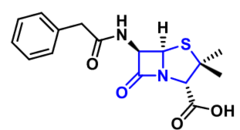
Cephalosporin C (fungal origin)

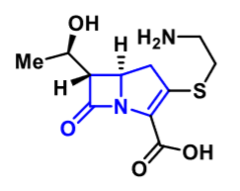
Thienamycin (bacteria origin (carbapenems))
Beta lactam antibiotics target ______, leading to inhibition of cell wall synthesis.
PBPs (transamidase)
Beta-lactam antibiotics are _________ agents
bactericidal (bacteria killing)
Beta lactam functional group characteristics
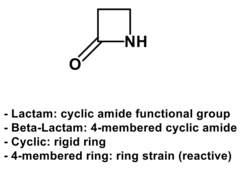
Electrophilic carbon

Beta-lactam antibiotics bind ____________ to the enzyme _______________, inhibiting bacterial wall synthesis
irreversible; transpeptidase
OH group from transpeptidase enzyme acts a ______________ oxygen and attacks the ________ carbon on the beta-lactam
nucleophilic; electrophilic
Bacterial resistance is due to __________, which inactivates the beta lactam
beta-lactamases (opens the ring)
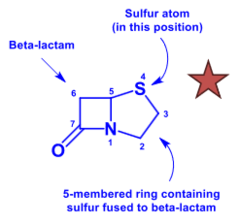
Penam ring
Removing the steric bulk from the amide, makes the antibiotic _____________
more sensitive to beta-lactamase
Examples of molecules sensitive to beta-lactamase (removal of bulk)

Cefem ring

Carbapenem pharmacophore (SAR)
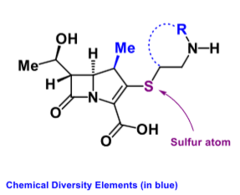
Carbapenem ring

Dimerization

On carbapenem antibiotics, for example thienamycin, ________________ is problematic for stability
free amine
Aminoglycosides inhibit protein synthesis by _______________, but there are likely several mechanisms of death ocuring.
binding to 30S ribosomal subunit
Streptomycin

Kanamycin
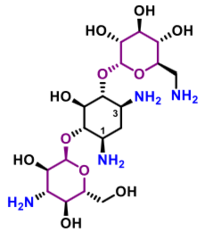
Blue: Amino
Purple: glycosides
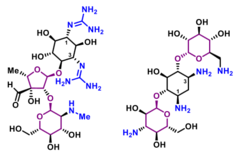
Glycosidic bonds

Hexanose sugar moiety

Carbocycle

Disaccharide (2 sugar moeities together)

Aminoglycosides bond via ___________ to target proteins
hydrogen bonding
How do bacteria inactivate aminoglycoside antibiotics?
Using aminoglycoside modifying enzymes (AME)
What are the 3 aminoglycoside modifying enzymes (AME)?
1. Aminoglycoside acetyltransferase (AACs)
2. Aminoglycoside Phosphotransferases (APHs)
3. Aminoglycoside Nucleotidyltransferases (ANTs)
Alcohols and amines have lone pairs of electrons and have ____________
nucleophilic character
Aminoglycosides attack (nucloephile) the AME, which will transfer a group and ___________, which leads to inactivation.
remove the possibility of hydrogen bonding to the protein
What happens if you mix a beta-lactam with an aminoglycoside?
they will react with each other, inactivating themselves
Nalidixic acid

Ciprofloxacin
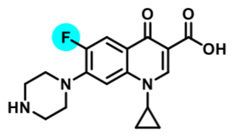
Fluoroquinolones (FQs) work by __________, inhibiting DNA replication
binding to DNA gyrase-DNA complex
FQs are _______agents
bactericidal
FQs are considered ____________ because of synthetic origin
antibacterial agents
Quinolone

Cell wall penetration (Potency)
A?
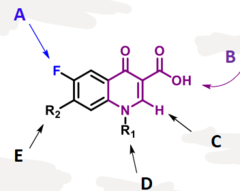
Pharmacophore
B?

Substitution interferes with binding
C?

potency
D?

Spectrum of activity
E?

Quinolone core is important for metal chelation, which helps bind DNA gyrase and topoisomerase IV
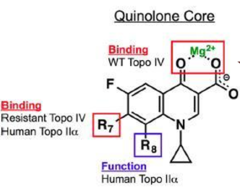
FQs kill bacterial cells by increasing the concentration of _________________
enzyme-DNA cleavage complexes
Quinolone-topoisomerase binding is facilitated through ____________
a water-metal ion bridge
Mechanisms of Fq resistance
1. Porin channels (in gram neg)
2. Plasmid-mediated resistance
3. Efflux pumps
4. Enzyme inactivation
5. Target modification
True or false: Aminoglycosidase acetyltransferase acylation can decrease the activity of Fluoroquinolones.
True
Mutations in gyrase and topo IV _______________
weaken quinoline-enzyme interactions