Anaerobic Respiration
 Studied by 2 people
 Call with Kai
 Learn
Learn Practice Test
 Spaced Repetition
 Match
Match Flashcards
 Knowt Play
1/18

There's no tags or description
Looks like no tags are added yet.
Name | Mastery | Learn | Test | Matching | Spaced | Call with Kai |
|---|
No study sessions yet.
19 Terms
Where in the cell does anaerobic respiration take place?
In the cytoplasm.
What is the net ATP yield of anaerobic respiration per glucose molecule?
2 ATP (produced solely during glycolysis).
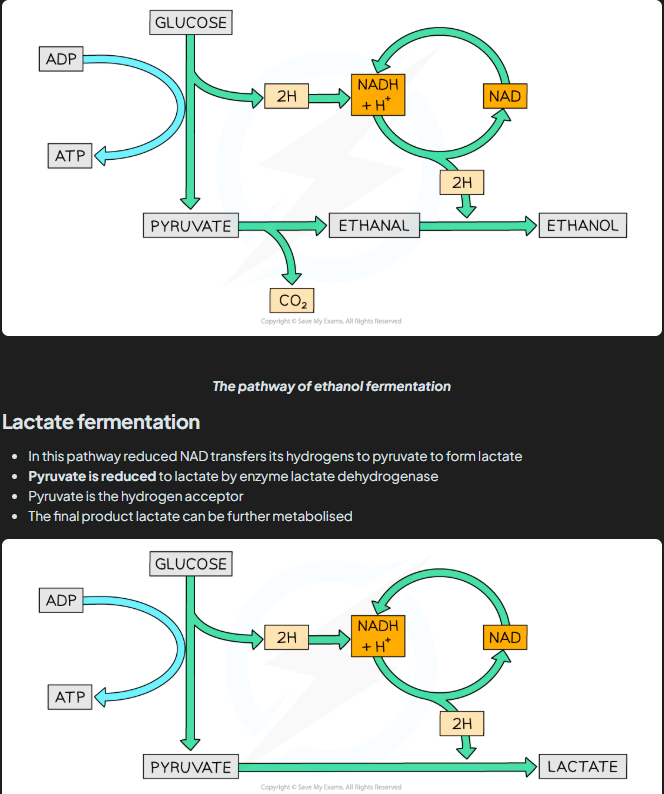
Why must pyruvate be converted into lactate or ethanol during anaerobic respiration?
To re-oxidise NAD (convert Reduced NAD back to NAD). This regenerates the NAD required for glycolysis to continue.
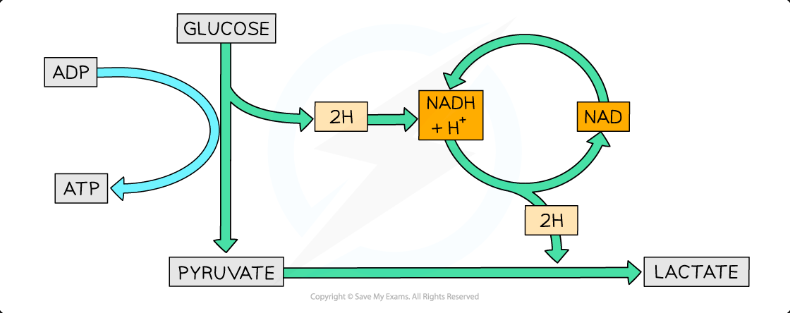
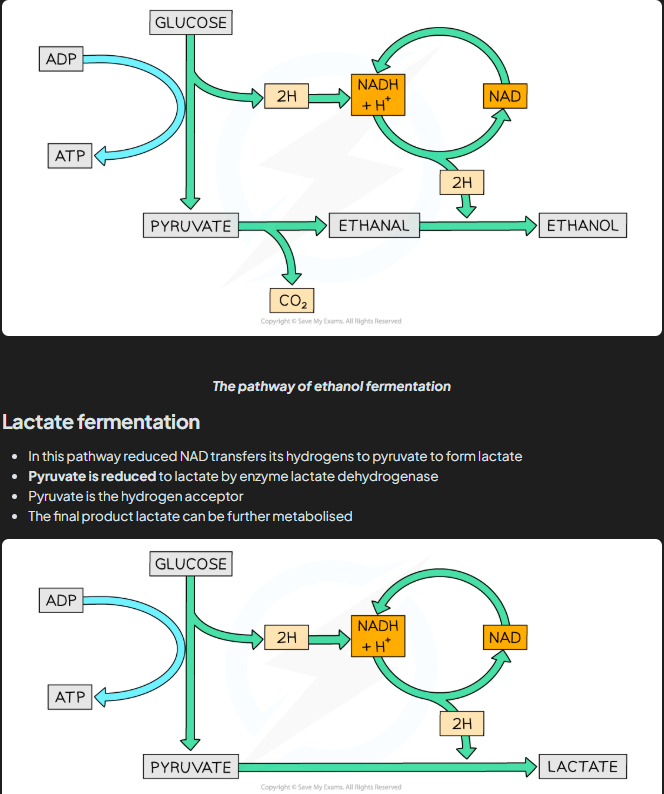
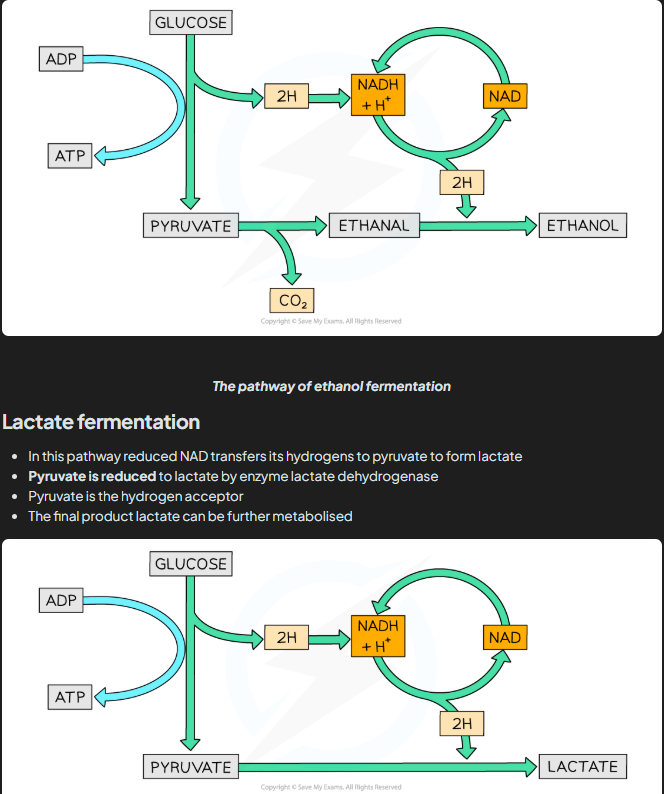
What is the end product of anaerobic respiration in mammals?
Lactate (Lactic acid).
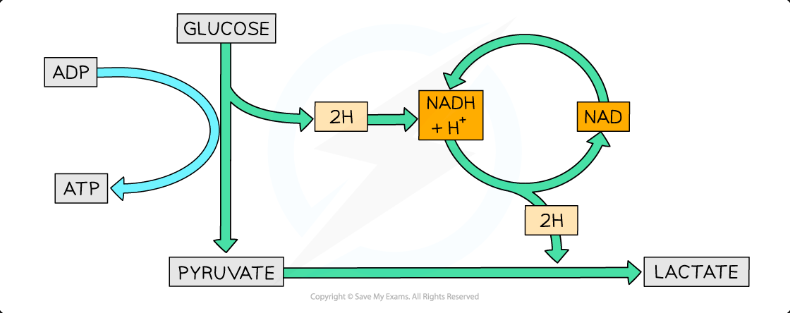
Which enzyme catalyses the conversion of pyruvate to lactate?
Lactate Dehydrogenase.
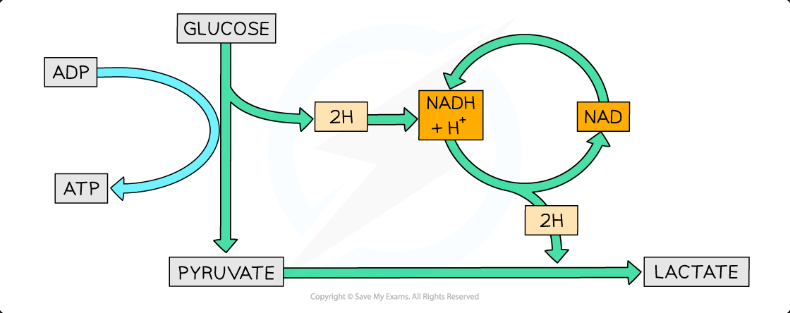
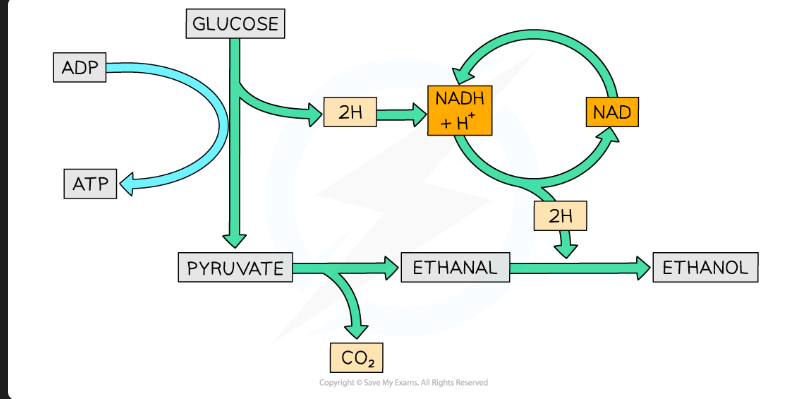
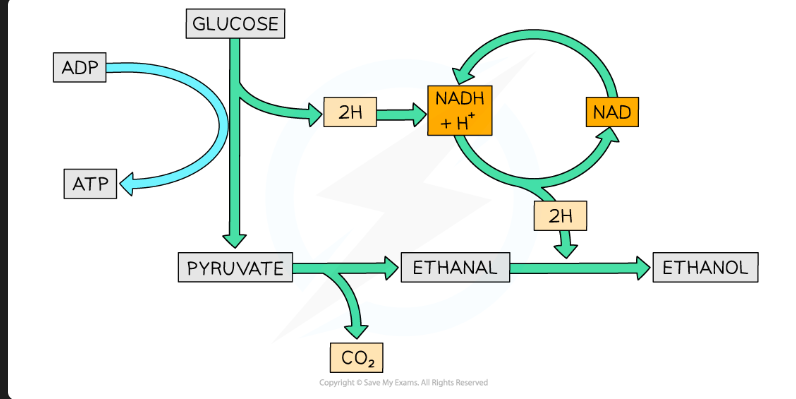
What are the end products of anaerobic respiration in yeast (alcoholic fermentation)?
Ethanol and Carbon Dioxide.
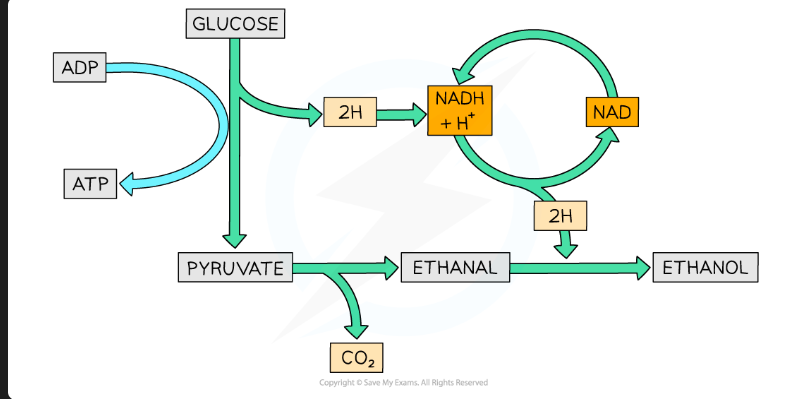
What is the intermediate compound in alcoholic fermentation?
Ethanal.
Which enzyme removes Carbon Dioxide from pyruvate in yeast?
Pyruvate Decarboxylase.
Is lactate fermentation reversible?
Yes. Lactate is carried to the liver and converted back to pyruvate (or glucose) when oxygen is available.
Is ethanol fermentation reversible?
Because a carbon atom is lost as CO2, the reaction cannot be reversed to reform pyruvate.
Why can't the Krebs cycle and Link reaction occur without oxygen?
Because they rely on NAD and FAD to accept hydrogens. If oxygen isn't there to accept electrons at the end of the chain, NAD/FAD remain "reduced" and cannot be recycled.
Can mammals survive on anaerobic respiration indefinitely?
No. The ATP yield is too low, and lactate is toxic (lowers pH, affecting enzyme activity).
Compare anaerobic respiration in mammals and yeast. (4 marks)
Product: Mammals produce lactate (1); Yeast produce ethanol and CO2 (1).
Number of Steps: Mammals is a single step reaction (1); Yeast is a two-step reaction involving ethanal (1).
Reversibility: Mammals is reversible (1); Yeast is irreversible (1).
(Any 4 points)
What are obligate aerobes?
Can only synthesise ATP in the presence of oxygen.
What are obligate anaerobes?
Organisms that can’t survive in the presence of Oxygen, and have to rely entirely on anaerobic respiration.
Explain the importance of regenerating NAD during anaerobic respiration. (3 marks)
Glycolysis requires NAD to accept hydrogen (dehydrogenation of triose phosphate) (1).
If NAD is not regenerated, the supply of oxidised NAD will run out (1).
Glycolysis would stop, meaning no ATP would be produced and the cell would die (1).
Suggest why anaerobic respiration produces much less ATP than aerobic respiration.(2 marks)
In anaerobic respiration, only glycolysis occurs (net 2 ATP) (1).
The Krebs cycle and Electron Transport Chain (oxidative phosphorylation), which produce the vast majority of ATP (approx 28-32), cannot take place (1).
Describe the fate of lactate produced in muscle cells. (2 marks)
It is transported by the blood to the liver (1).
It is converted back into pyruvate (for aerobic respiration) or glucose (gluconeogenesis) when oxygen becomes available (1).
Yeast is a facultative anaerobe. Explain what this means and how it benefits the yeast. (3 marks)
Facultative anaerobe: An organism that can respire aerobically when oxygen is present and anaerobically when it is absent (1).
Benefit: This allows it to survive in low-oxygen environments (1) while maximizing ATP production (growth) when oxygen is plentiful (1).