lecture 21 - DNA/RNA structure cont.
 Call Kai
 Learn
Learn Practice Test
 Spaced Repetition
 Match
Match Flashcards
 Knowt Play
1/18

There's no tags or description
Looks like no tags are added yet.
Name | Mastery | Learn | Test | Matching | Spaced | Call with Kai | Chat |
|---|
No analytics yet
Send a link to your students to track their progress
19 Terms
how is DNA compacted
supercoiling
relaxed DNA vs supercoiled DNA
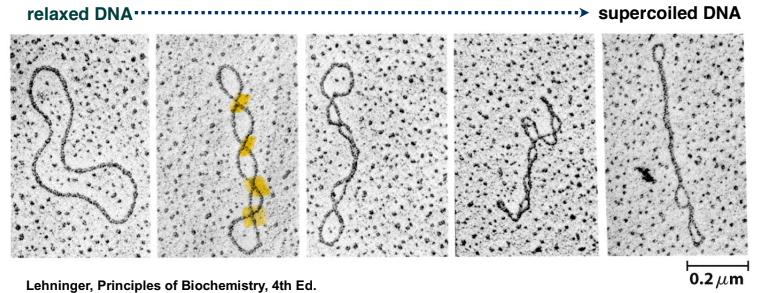
what kind of DNA can be supercoiled
supercoiling can only exist in a DNA molecule where both strands of DNA are closed circles or fixed at one end.
supercoiling: what happens if one strand breaks
if one strand breaks, the DNA rapidly loses its supercoiling (relaxes)
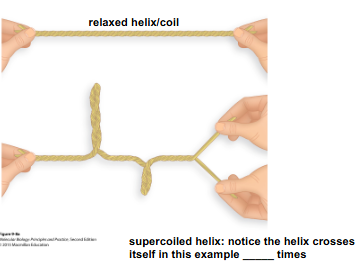
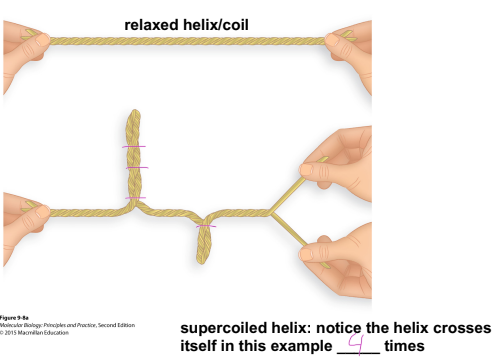
how is the topology(shape) of dsDNA defined?
by linking number
what is linking number
number of times one strand would have to be passed through the other strand in order for the strands to be separated from each other
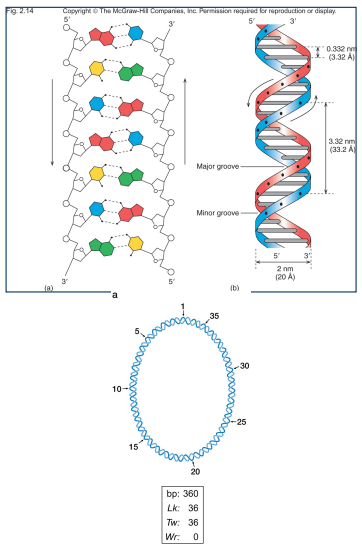
two components: Lk = Tw(twist) + Wr(writhe)
ALWAYS AN INTEGER
CANNOT BE CHANGED unless one or both strands of the duplex is broken
Tw, twist
for dsDNA, twist is number of full turns of the helix, for B form helix, bp = 10.5, ex. for a segment 105 bp long twist = 105/10.5 = 10
Wr, writhe
degree of supercoiling
number of times double helix crosses itself
left handed ds helix:
wr is positive
overwinding (+) makes it harder to separate strands of ds
BRLO (b form, left handed, overwinding)
right handed ds helix:
wr is negative
underwinding (-) makeas it easier to separate strands of ds
BRRU (b form, right handed, underwinding)
wr for relaxed dsDNA is 0
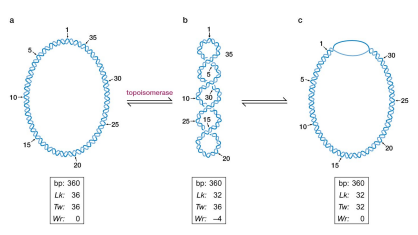
example of relationship between Lk = Tw + Wr
strain of local disruption of base pairing in double helix (c ) may be taken up by supercoiling in (b) to restore Tw to 36.
Linking number DOES NOT CHANGE
what level of structure is supercoiling
tertiary
supercoiling & gel electrophoresis
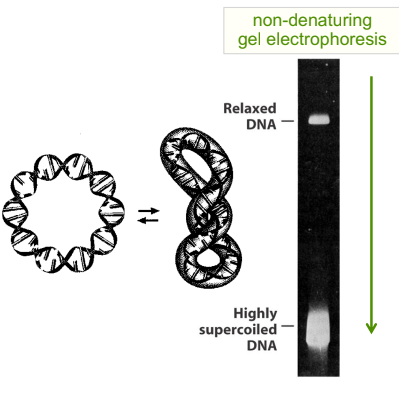
a supercoiled DNA molecule is more compact than a relaxed DNA molecule of the same length, it moves faster than relaxed DNA in gel electrophoresis
use ethidium bromide (EthBr)
DNA gel electrophoresis separates DNA fragments based on their size and shapes
in general, smaller & more compact DNA fragments move quicker
what are topoisomers
DNA molecules in different coiled forms that have the same nucleotide sequence
change superhelicity
what are topoisomerases
enzymes that catalyze topoisomers (change superhelicity)
what do topoisomeraes do and how(general process)?
topoisomeraes change linking number of DNA by catalyzing a three step process:
cleave one or both strands of dsDNA
the passage of a segment of DNA through the break
resealing of the DNA breaks
topoisomeraes have a key tyrosine residue in their active site that covalently attaches to a phosphate in the sugar-phosphate backbone that is transiently broken
other roles of topoisomerase
they help relieve torsional stress in replication, transcription, and recombination for both prokaryotes & eukaryotes, by unwinding the DNA during these events
types of topoisomerases & what they do
The degree of supercoiling of DNA is maintained by regulation of the net activity of topoisomerase types I and II.
type I | type II |
|
|
topoisomers & agarose gel
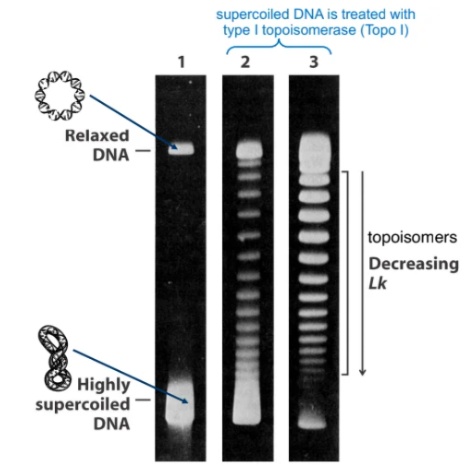
A population of mostly supercoiled circular DNA molecules shown in Lane 1 has been treated with Topo I in Lanes 2 and 3 (for a longer period of timein Lane 3).
The products of Topo I treatment migrate to different points in the gel depending on their linking number, Lk; each band differs by a single Lk (i.e., these DNA molecules are topoisomers).
With long enough Topo I treatment, all of the supercoiled DNA will be completely relaxed.
why are topoisomerases the target of antibacterial and anti-cancer drugs
without topoisomerases, cells cannot replicate or package their DNA, so they die
quinolones(bad) inhibit a type II topoisomerase by blocking the last step of the topoisomerase rxn, resealing of the DNA strand breaks. this inhibits the unwinding of DNA, preventing cell division