Lecture 2: Equine Lameness Examination
 Call Kai
 Learn
Learn Practice Test
 Spaced Repetition
 Match
Match Flashcards
 Knowt Play
1/25

There's no tags or description
Looks like no tags are added yet.
Name | Mastery | Learn | Test | Matching | Spaced | Call with Kai | Chat |
|---|
No analytics yet
Send a link to your students to track their progress
26 Terms
What needs to be asked during the history section of an equine lameness exam?
signalment, use of horse
duration of lameness, worse or improved w/ time or circumstance, which leg
gradual vs acute onset, hx of trauma, management changes
medications
past lameness hx
when last trimmed or shod by farrier
What is usually performed during a PE for a lameness exam?
quick TPR
observe: conformation, swellings, how horse is standing, hoof care, muscle symmetry
limb palpation: joints for effusion and ROM, tendons/ligaments, digital pulses
What are you palpating for on a limb during a lameness exam?
effusion
edema
bony proliferation

What two joints are being indicated here?
arrow: femoropatellar
circle: medial femorotibial joint
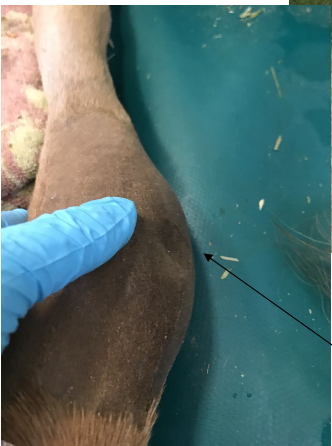
What is the arrow showing?
pitting
What are you palpating for on tendons and ligaments?
enlargement
thickening
pain
True or false: every horse should have digital pulses.
true: every horse should have a faint digital pulse → increase in ability to palpate are significant
What is the most appropriate conclusion to make from palpating increased digital pulses?
the horse has inflammation in the foot
Back pain can be a primary source of pain, but is often secondary to what other injury?
hock pain / hind limb lameness
What diagnostic test must be done BEFORE blocking the horse during a lameness exam?
hoof testing
What are the movements for a horse during a basic lameness exam?
walking in a straight line
trotting in a straight line
trotting in a circle (both directions) - hard and soft surface
What are the movements for a horse during a advanced lameness exam?
canter
under saddle
Describe the gait evaluation during a walk.
4 beat gait - each foot hits the ground separately
evaluate stride length
tracking up? (hind foot lands in same spot front foot left)
Describe the gait evaluation during a trot.
2 beat gait
limbs move in diagonal pairs
BEST gait for seeing lameness
What are the levels of the AAEP lameness grading scale?
0: Lameness not perceptible under any circumstances.
1: Lameness is difficult to observe and is not consistently apparent, regardless of circumstances
2: Lameness is difficult to observe at a walk or when trotting in a straight line but consistently apparent under certain circumstances
3: Lameness is consistently observable at a trot under all circumstances.
4: Lameness is obvious at a walk.
5: Lameness produces minimal weight bearing in motion and/or at rest or a complete inability to move.
How can you determine a sound limb from a lame limb?
sound limb
drops fetlock
head nod - head moves DOWN when horse bears more weight
lame limb
head bob - head moves UP when lame leg hits ground
hip hike - hind limb lameness, increased pelvic movement
asymmetrical movement - shorter stride
Why are flexion tests done during a lameness exam?
to put stress on a joint to see if it changes the horse’s lameness
How can lameness be localized?
nerve blocks: local anesthetic injected SQ over nerves
What are the basic blocking principles?
nerve blocks: start distal and work proximal
local anesthetic migrates so wait 5 min, use the least volume possible, and make sure your location is accurate to get accurate results
What are the three commonly used local anesthetics for blocks during a lameness exam?
mepivicaine (less tissue irritation)
lidocaine (stings)
bupivicaine
Where is a palmar digital nerve block given?
insert needle over neurovascular bundle proximal to the collateral cartilages
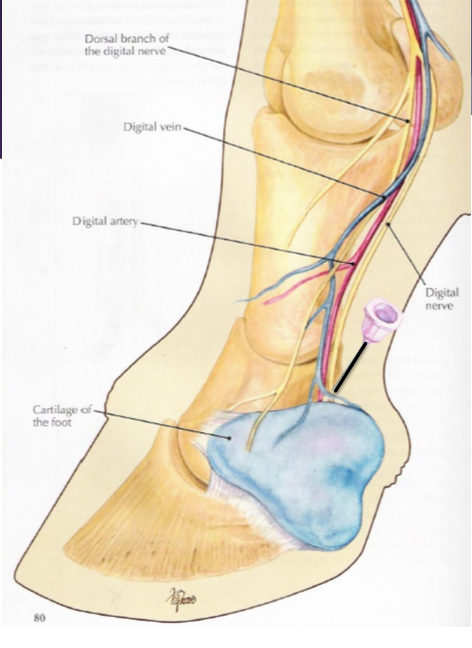
What structures are blocked by the palmar digital nerve block?
caudal 1/3 of the foot
sole
navicular apparatus
What is blocked by the abaxial sesamoid block?
all strucutes below fetlock, ± the fetlock itself
Where is the abaxial sesamoid block given?
insert needle SQ over the neurovascular bundle at the abaxial surface of the sesamoid bones
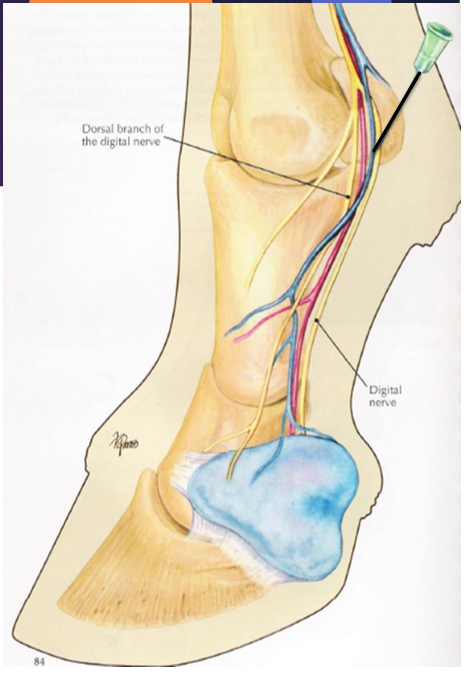
What structures are blocked by the low 4 point block?
fetlock joint and distal
inconsistent loss of skin sensation dorsally on hind limb
Where is the block given for a low 4 point block?
inject under the button of the splint bone (medial and lateral)
inject over the neurovascular bundle between the DDF and the suspensory ligament
