The Chemistry of Life: Chemical Elements
 Call Kai
 Learn
Learn Practice Test
 Spaced Repetition
 Match
Match Flashcards
 Knowt Play
1/36

There's no tags or description
Looks like no tags are added yet.
Name | Mastery | Learn | Test | Matching | Spaced | Call with Kai | Chat |
|---|
No analytics yet
Send a link to your students to track their progress
37 Terms
Matter
anything that has mass and takes up space (solid, liquid, gas, plasma)
Matter is composed of basic substances called...
elements
Element
composed of one atom, a subtance that cant be broken down into substances with different properties,

The 6 elements that make up 95% of the body weight of organisms
(acronym CHNOPS) Carbon, Hydrogen, Nitrogen, Oxygen, Phosphorus, Sulfur
The 3 elements all macromolecules have
Carbon, Hydrogen, and Oxygen
Phosphorus is found where?
DNA, RNA, Nucleic Acids
Sulfur is found where?
Occasionally proteins
Atom
smallest part of an element

proton
positive charge, in central nucleus

Neutrons
no charge, in central nucleus

Electrons
Negative charge, very low mass, in electron shells

electron shells
orbiting clouds around nucleus

Atomic number
equal to the number of protons in each atom of an element
mass number/atomic mass
the sum (+) of the number of protons and neutrons in the nucleus of an atom
Periods (periodic table)
Horizontal rows, elements in the same row have the same number of shells

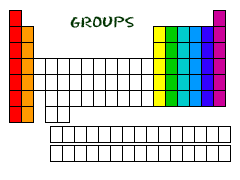
Groups
Vertical columns on the periodic table, elements in the same group have the same valence and similar chemical properties
Atoms in the periodic table being electrically neutral means..
the atomic number tells you the number of electrons and protons
Isotopes
atoms that are the same (same element) but have different atomic masses

Radioactive Isotopes
give off energy in the form of rays and subatomic particles, ex Carbon 14 (used to examine photosynthesis reactions)
Four elements that make up 96% of living matter
carbon, hydrogen, oxygen, nitrogen
Four elements that make up remaining 4% of living matter
phosphorus, calcium, sulfur, potassium
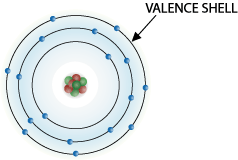
Valence shell
outermost energy shell of an atom, determines many of an atoms chemical properties
octet rule
states that the outermost shell is most stable when it has 8 electrons
excpetion to the octet rule
if an atom only has one shell, the outermost valence shell us complete when it had two electrons, (Hydrogen, only has 1 shell)
atoms that have their valence shells filled with electrons tend to be...
chemically stable
atoms that do not have their valence shells filled with electrons tend to be...
chemically reactive
Effect of electrons on atom
they determine its chemical behaviors using the number of electrons in the atoms outermost shell (valence shell), like if it will share electrons with another atom
What tendency drives chemical reactions and creates bonds?
Atoms tendency to either complete a partially filled valence shell or empty a partially filled valence shell
Hydrogen bond
weak, attraction between + and -

Hydrophobic bonds
weak, no charge (non polar), repels/doesnt mix with water
Hydrophilic bonds
weak, polar (- or + charge), reacts/mixes with water
Covalent bonds
Strong, very stavke bonds formed by sharing electron pairs so there are 8 between them, forms molecules. ex. hydrogen gas

The more electrons shared in a covalent bond...
the stronger it gets
Nonpolar covalent bond
pair of electrons shared equally by 2 atoms (ex methane)

Polar covalent bond
electrons are shared unequally, ex water

electronegativity
the ability of an atom ot attract electrons towards itself in a chemical bond

Why are the bonds in water polar?
because the oxygen atom is more electronegative than the hydrogen atoms