Types of Systems
 Call Kai
 Learn
Learn Practice Test
 Spaced Repetition
 Match
Match Flashcards
 Knowt Play
1/8

There's no tags or description
Looks like no tags are added yet.
Name | Mastery | Learn | Test | Matching | Spaced | Call with Kai | Chat |
|---|
No analytics yet
Send a link to your students to track their progress
9 Terms
- The computerized information systems that were developed to process large amounts of data for routine business transactions such as payroll and inventory
- eliminates the tedium of necessary operational transactions and reduces the time once required to perform them manually, although people must still input data to computerized systems.
- boundary-spanning systems that permit the organization to interact with external environments. Because managers look to the data generated by the systems or up-to-the-minute information about what is happening in their companies, it is essential to the
day-to-day operations of business that these systems function smoothly and without interruption.
Transaction processing systems (TPS)
- support data workers, who do not usually create new knowledge but rather analyze information to transform data or manipulate it in some way before sharing it with, or formally disseminating it throughout, the organization and, sometimes, beyond.
-Familiar aspects of this systems word processing, spreadsheets, desktop publishing, electronic scheduling, and communication
through voice mail, email (electronic mail), and teleconferencing.
Office automation systems (OAS)
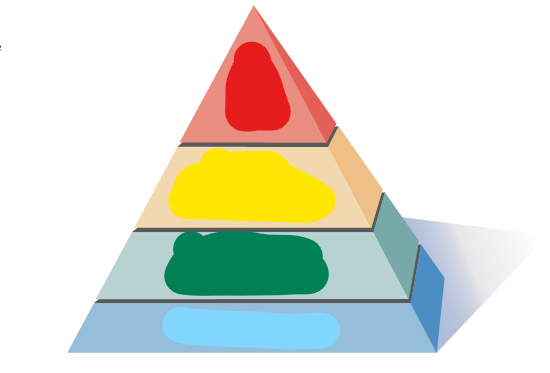
Enumerate the types of Information Systems by their 4 layers (from bottom to top).
- do not replace transaction processing systems; rather, this systems include transaction processing.
- computerized information systems that work be cause of the purposeful interaction between people and computers.
- By requiring people, software, and hardware to function in concert, management information systems support users in accomplishing a broader spectrum of organizational tasks than transaction processing systems, including decision analysis and decision making.
- To access information, users of this systems share a common database. The database stores both data and models that help the user interact with, interpret, and apply that data.
- output information that is used in decision
making
- help integrate some of the computerized in
formation functions of a business
Management Information Systems
- higher-level class of computerized information systems
- departs from the traditional management information system because it emphasizes the support of decision making in all its phases, although the actual decision is still the exclusive province of the decision maker.
- more closely tailored to the person or group using them than is a traditional management information system. Sometimes they are discussed as systems that focus on business intelligence.
- depend on a database as a source of data.
Decision Support Systems
- Artificial intelligence (AI) can be considered the overarching field for _________
- use the approaches of AI reasoning to solve the problems put to them by business (and other) users.
- a very special class of information system that has been made practicable for use by business as a result of widespread availability of hardware and software such as personal computers (PCs) and expert system shells.
- (also called a knowledge
based system) effectively captures and uses the knowledge of a human expert or experts for solving a particular problem experienced in an organization.
- selects the best solution to a problem
or a specific class of problems.
Expert Systems
- help executives organize their interactions with the external environment by providing graphics and communications technologies in accessible places such as boardrooms or personal corporate offices.
- rely on the information generated by TPS and MIS, this systems help their users address un structured decision problems, which are not application specific, by creating an environment that helps them think about strategic problems in an informed way.
- extend and support the capabilities of executives, permitting them to make sense of their environments.
Executive Support Systems (ESS)
- used in special rooms equipped in a number of different configurations, permit group members to interact with electronic support—often in the form of specialized software—and a special group facilitator.
- intended to bring a group together to solve a problem with the help of various supports such as polling, questionnaires, brainstorming, and scenario creation.
- software can be designed to minimize typical negative group behaviors such as lack of participation due to fear of reprisal for expressing an unpopular or contested viewpoint, domination by vocal group members, and “group think” decision making
Group decision support systems (GDSS)
include software support called groupware for team collaboration via networked computers.
Computer-Supported Collaborative Work Systems (CSCWS)