Bio Content Block 1
 Call Kai
 Learn
Learn Practice Test
 Spaced Repetition
 Match
Match Flashcards
 Knowt Play
1/66

There's no tags or description
Looks like no tags are added yet.
Name | Mastery | Learn | Test | Matching | Spaced | Call with Kai | Chat |
|---|
No analytics yet
Send a link to your students to track their progress
67 Terms
Null Hypothesis
A hypothesis of “no difference.” No relationship between observations
Alternative Hypothesis
States that there is a relationship between observations
Taxonomic Levels of Organization
Domain, Kingdom, Phylum, Class, Order, Family, Genus, Species
3 Domains
Archaea, Bacteria, Eukarya
Atom
Smallest unit
Charges of protons, neutrons, and electrons
Protons +
Neutrons
Electrons -
Isotopes
Differ in the # of neutrons, many elements exist in nature as a mix of different isotopes
Ions
The result of certain chemical reactions causing atoms to gain or lose electrons
Cation
An atom that has lost an electron and is positively charged
Anion
An atom that has gained an electron and is negatively charged
Atomic Mass
Protons + Neutrons
How many electrons can each shell hold?
1st shell- 2 electrons
2nd shell- 8 electrons
3rd shell- 8 electrons
energy levels increase in each subsequent shell
Rules for filling the electron shells
First 2 electrons go in the first shell
Next 4 electrons go in the 2nd shell, unpaired
Next 4 pair up with the first 4 in the second shell
Valence Electrons
Electrons in the outermost shell (can be paired or unpaired)
Valence Shell
The outermost shell
What are chemically inert elements?
Elements with a full valence shell
Valence Number
The number of unpaired electrons in the valence shell
Valence number determines the number and type of bond an atom can form
What creates bonds?
Atoms taking, giving up, or sharing electrons (the atoms want to fill their valence shell)
Types of chemical bonds
ionic bonds
covalent bonds
hydrogen bonds
What happens to an atom after an electron transfer?
Both atoms become ions
Ionic Bonds
Atoms give up/receive electrons to/from their bonding partners
Covalent Bonds
The sharing of 2 valence electrons by 2 atoms - very strong and stable
Single bond and double bond
Single bond - sharing 1 pair of electrons
Double bond - sharing 2 pairs of electrons
Electronegativity - what does it depend on
The ability of an atom to attract electrons - depends on number of protons in each atom and the molecular structure
The ____ electronegative an atom is, the ______ it pulls covalently shared electrons towards itself
More
Stronger
In general, an atom with ____ protons is ____ electronegative than an atom with ____ protons
More
More
Fewer
Nonpolar covalent bond
both atoms in the bond have equal or almost equal electronegativity
atom share electrons equally
Polar covalent bond
one atom is more electronegative than the other
atoms do not share electrons equally
Hydrogen Bonds
Not really a true bond, bonds of molecular force
no sharing/stealing electrons
the attractive force b/w 2 polar molecules
Hydrogen bonds contribute to the unique properties of water:
cohesion
adhesion
surface tension
high specific heat
evaporative cooling
expansion when frozen
Cohesion
water molecules share hydrogen bonds with other water molecules
Surface tension
allows water to be stretched
Adhesion
water molecules share hydrogen bonds with other polar covalent molecules
Heat and temperature
Heat is the total amount of energy due to molecular motion
Temperature is a measurement of the heat
What kind of molecule is water
Polar covalent
Specific Heat
The amount of energy it takes to change the temp of a substance by 1ºC
As temperature decreases, density ___
increases
Why does ice float?
Hydrogen bonds
What is max water density at?
4ºC
What happens to water density below 4ºC?
Hydrogen molecules expand and push water molecules farther apart, then freeze in place
Why is water a great solvent?
Due to its polarity
Hydrophilic
loves water
ex: sugar, salts
Hydrophobic
fears water
ex: oils, fats, waxes
pH less than 7
acidic
pH greater than 7
basic
pH 7
neutral
What is the pH of H+= 1×10^-4
pH=4
What is the pH of OH-= 1×10^-11
pH = 11
What are the different types of hydrocarbons?
Length, double bond, ring structure, branching

What type of hydrocarbon bond is this?
Length

What type of hydrocarbon bond is this?
branching
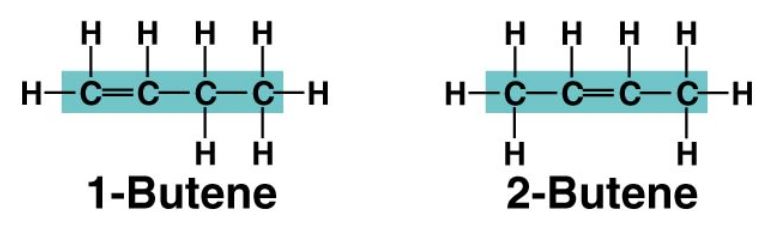
What type of hydrocarbon bond is this?
double bond position
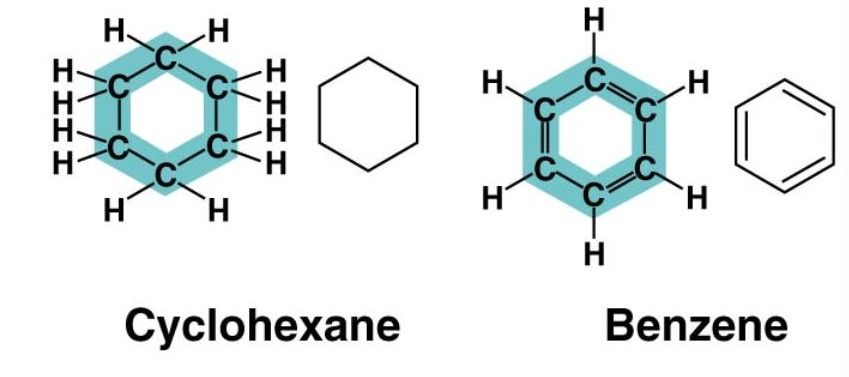
What type of hydrocarbon bond is this?
Ring structure
Isomers
Compounds with the same molecular formula but different structural arrangements
What are the 3 types of isomers?
structural
cis-trans
enantiomers
Structural isomers
Molecules have the same molecular formula but have different covalent bond arrangements - results in different structures (structure determines function)
Cis-trans isomers
Molecules have the same molecular formula but differ in spatial arrangement around a double bond - results in different structures (structure determines function)
Enantiomers - and qualities
Molecules are mirror images of each other
non-super imposable
very biologically important
most biologically active enantiomers are L isomers
What are all of the functional groups?
Hydroxyl (-OH)
Carbonyl ( >C=O)
Carboxyl (-COOH)
Amino (-NH2, NH3)
Sulfhydryl (-SH)
Phosphate (OPO3)
Methyl (-CH3)
Hydroxyl
Oxygen and hydrogen bonded to a carbon
creates polar compound due to electronegativity of oxygen
makes molecules hydrophilic
forms hydrogen bonds with water
make a compound an alcohol
Carbonyl
Oxygen double bonded to carbon
creates a polar molecule, hydrophilic
2 types of Carbonyl:
Ketone- if oxygen is in the middle of hydrocarbon
Aldehyde- if oxygen is at the end of hydrocarbon
Carboxyl
Carbon has double bond to oxygen and single bond to OH
makes molecules polar and hydrophilic
acts as an acid
Amino
Nitrogen bonded to 2 hydrogens and a carbon
acts as a base
still polar and hydrophilic
very important in proteins
Sulfhydryl
Sulfur bonded to hydrogen and carbon
slight polarity and hydrophilic
2-SH groups interact to stabilize protein structure
Phosphate
Phosphate bonded to 4 oxygens, one bond is a double bond
one of the oxygens is bonded to carbon
energy currency of cells - ATP
Methyl
Carbon bonded to 3 hydrogens
bond occurs in ring structures and in macromolecules such as DNA
affects gene expression
affects shape and function of male and female sex hormones