MGMT 105 Exam 1 Ch Summaries
 Call Kai
 Learn
Learn Practice Test
 Spaced Repetition
 Match
Match Flashcards
 Knowt Play
1/40

There's no tags or description
Looks like no tags are added yet.
Name | Mastery | Learn | Test | Matching | Spaced | Call with Kai | Chat |
|---|
No analytics yet
Send a link to your students to track their progress
41 Terms
What is marketing?
activity, set of institutions, and processes for creating, communicating, delivering, and exchanging offerings that have value for consumers and society
about delivering value to stakeholders
firms seek long-term profitability by identifying and satisfying consumers’ needs and wants
What is the marketing mix?
product, price, place, promotion
product = what satisfies customer needs
price = assigned value
place = gets the product to customer
promotion = efforts to convince customer to buy product
What can be marketed?
good, service, idea
goods = tangible products
service = intangible products
What’s the value of marketing?
form, place, time, and possession utility
form = transforming raw materials into finished products
place = making products available where and when wanted
time = storing products until needed
possession = allowing customers to own, use, and enjoy product
satisfying needs of stakeholders and society
Evolution of marketing
production era: most efficient ways of production and distribution, late 19th century
sales era: aggressively sell products, post WWII
relationship era: customer satisfaction, 1980s
triple bottom line era: financial, social, and environmental bottom line
future focus on:
AI
machine learning
branded content
corporate social responsibility
user generate content
value from customer perspective
value proposition = all benefits product promises to deliver
value from seller perspective
are transactions profitable?
are they providing value to stakeholders by creating competitive advantage?
are they providing value through value chain?
value from societal perspective
producers stress ethics and social responsibility
Basics of market planning
assess factors within organizations and external environment (SWOT analysis)
set objectives and develop strategies
target marketing strategy = divide overall market into segment then target most attractive one
Use marketing process to create personal brand
develop personal brand to meet needs
make personal value proposition to deliver value
exchange relationships
Decision to go global comes when
domestic growth opportunities peak or decline
success in foreign markets is possible due to competitive advantage
4 steps to deciding to go global
1. Whether to go global
2. Which market(s) to enter
3. Level of commitment
4. How to adapt marketing mix strategies: localize vs standardize
How do international organization like WTO, World Bank, IMF, economic communities, and country regulations facilitate and limit firm’s opportunities for globalization?
UN General Agreement on Tariffs and Trade (GATT): reduces import tax levels and trade restrictions
WTO: sets trade rules for its member nations and mediates disputes between nations
World Bank: lending institutions that wants to reduce poverty, improve economies, promote sustainable development
IMF: seeks to ensure stability of the international monetary exchange by controlling fluctuations in exchange rates
economic communities: groups of countries that band together to promote trade amount themselves and make it easier for member nations to compete elsewhere
Economic environment
economic health of a country (GDP, per capita GDP + economic infrastructure)
level of economic development (least developed, developing, developed)
stage in business cycle
External environment
economic: health, development, business cycle
competitive: microenvironment (brand, product, discretionary income competition) + macroenvironment (monopoly, oligopoly, monopolistic competition, perfect competition)
technological
political and legal: laws, regulations, political constraints (nationalization, expropriation)
sociocultural: demographics, values, social norms/customs, language, ethnocentricity
Foreign market entry strategies (least to most commitment, least to most risk)
exporting
contractual agreements (licensing, franchising)
strategic alliance (joint venture)
direct investment
localization/standarization strategies
straight extension (standardization): keep exactly the same
product adaptation (modified localization): slight changes
product invention (localization): new for each country
global pricing strategies
Ethnocentric = price of product stays the same everywhere
Polycentric = global subsidiaries or distributors set their own prices based on their understanding of their market environment
Geocentric = establishes global price floor/minimum for a product while recognizing that unique local market conditions should be considered when setting price
ethical philosophies
utilitarian: decision that provides the most good/least harm
rights: decisions that does the best job of protecting the moral rights of all affected (right to decide what kind of life to lead, to be told the truth, not to be injured, to privacy)
fairness/justice: decision that treats all humans equally or fairly based on some standard
common good: decision that contributes to the good of all in a community
virtue: decision that’s in agreement with certain ideal virtues (honesty, courage, compassion, generosity, tolerance, love, etc)
Sustainability strategies (4Ps)
Product strategies: use environmentally friendly and recyclable materials to make products and package them, fair trade suppliers
Price strategies: aim to price green products close to others
Promotion strategies: reuse old commercials
Place strategies: sustainable distribution, locavorism
fair trade suppliers
Things to observe to decide which industry and work environment is right for you
clue to culture and work environment: location, personality of key players, management philosophy and style, level of risk taking behavior, company ethics, social responsibility
What is business planning?
ongoing process of making decisions that guides the firm both in the short and long term
Identifies and builds on firm’s strengths, helps managers at all levels make informed decisions
3 levels of business planning
strategic planning: match firm’s resources with capabilities for long-term growth
functional planning: functional areas’ plans for short term, supporting strategic plan
operational planning: detailed, day to day plans
Business objectives should be….
specific, measurable, attainable, sustainable over time
Steps in strategic planning
Define the mission, vision, values
Evaluate the internal and external environment
Set organizational or SBU objectives: specific, measurable, attainable, sustainable over time
Establish business portfolio (groups of products/brands owned by organization)
Develop growth strategies
Steps in functional/market planning
1. Perform situational analysis
Analyze economic, technological, political and legal, and sociocultural environments
2. Set marketing objectives
Determine what the marketing function must accomplish if the firm wants to achieve overall business objectives
3. Develop marketing strategies
Decide which markets to target + develop marketing strategies (4Ps) to support positioning of the product in the market
4. Implement and control marketing plan
Manage various elements involved in implementing the marketing + monitor progress
Steps in operational planning
Develop actions plans to implement the marketing plan, use marketing metrics to monitor how the plan is working
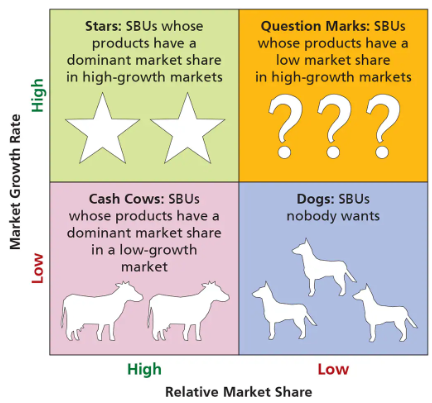
BCG growth market share matrix
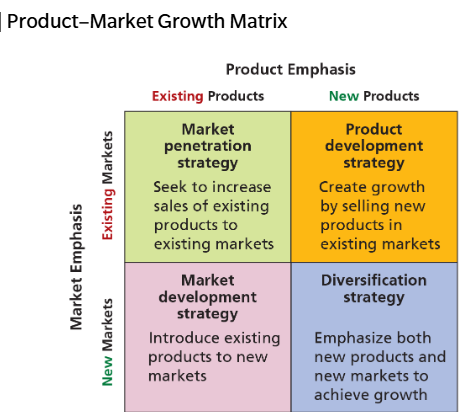
Product market growth matrix
Return on marketing investment (ROMI)
ROMI = Revenue (or profit margin) / Cost of Program (marketing expenditure)
Year 1 Sales = First 6 months Sales + (First 6 months sales + (projected sales growth * first 6 months))
Year 1 Marketing Expenditure = first 6 months + next 6 months
Year 1 ROMI = Year 1 Sales / Year 1 Expenditure
Developing strategic plan for your career
5 yr plan, review it every year and update it
mission statement defines overall purpose + what you hope to achieve in future
memorable, focuses on single theme, clear and concise, rallies you to action, serves as a guide for career decisions
Do external analysis, personal SWOT analysis, career objectives (SMART goals)
What’s a marketing information system (MIS)?
process that determines what information marketing managers need, then gathers/sorts/analyzes/stores/distributes relevant and timely marketing information to users
MIS system components:
Four types of data: internal company data, marketing intelligence, market research, and acquired databases
Computer hardware and software to analyze data and create reports
Output for marketing decision makers
What is the marketing decision support system (MDSS)?
includes analysis and interactive software that allows marketing managers to access MIS data and conduct their own analyses, often within the company intranet
Sophisticated statistical and modeling software tools
Can ask “what if” questions
What’s evidence based decision making?
marketer’s capability to utilize all of the relevant information available (evidence) to make the best possible marketing decisions
3 main tasks
Gather evidence
Interpret the evidence (turn data into information to get customer insights)
Apply what you’ve learned (apply customer insights)
Steps in the Market Research Process
1. Gather evidence
Define the research problem: objectives, population of interest, environmental context
Determine the research strategy: secondary data, primary data (exploratory, descriptive, causal)
Select the research design: survey, observational, online
Collect the data: probability sample, non probability sample
2. Interpret evidence
Analyze and interpret the data
Prepare the research report
3. Apply what you've learned
Implement data driven strategies
3 factors that influence quality of research results
1. Validity: extent to which the research actually measures what it intended to measure
Internal validity: extent that the research design was set up in a manner so that what was intended to be measured was accurately measured and not obscured
External validity: extent that research results are practically applicable to the relevant target market (do research results hold up in the real world?)
2. Reliability: extent to which research measurement techniques are free of errors
3. Representativeness: extent to which consumers in a study are similar to a larger group in which the organization has an interest
Exploratory research
generate insights for future, more rigorous studies, qualtitative research
indepth review = unstructured personal interview to understand motivations/beliefs/attitudes on something
focus group = product oriented discussion with small group to enhance/change/create product
market research online community = privately made group to understand customer sentiment
case study = examination of firm for indepth understanding in real life context
ethnography = observe people in own communities
Descriptive research
systematic look into marketing problems, large sample, quantiative
cross sectional = collect responses to questionairre
longitudinal = tracks respondents over time
Casual research
attempts to identify cause and effect relationships between two or more things
Sampling
process of selecting respondents for a study
probability sample = each member of the population has some known chance of being included, ensures sample represents population (simple random)
non probability sample = use of personal judgement to select respondents (convenience sample)
Using research to find a job/internship
look at big picture: industry, not job
Investigate your assumptions
Ask the right questions: type of people who succeed in that field, typical projects people in that job do, work environment, changes due to tech, advancement
Start by searching industries then companies then jobs