GEN 4600 L2 RNA Transcription Learning Objectives
 Call Kai
 Learn
Learn Practice Test
 Spaced Repetition
 Match
Match Flashcards
 Knowt Play
1/10

There's no tags or description
Looks like no tags are added yet.
Name | Mastery | Learn | Test | Matching | Spaced | Call with Kai | Chat |
|---|
No analytics yet
Send a link to your students to track their progress
11 Terms
Central Dogma
The information stored in DNA is used to make a functional protein or RNA molecule
Transcription is the copying of one strand of DNA (the template strand) into an RNA molecule (a transcript)
The RNA sequence matches the coding strand except U replaces T
DNA is transcribed into RNA by an RNA polymerase. It copies the coding strand of DNA by using the complementary strand (the template or non-coding strand) as a template
RNA polymerase separates the DNA strands, and allows ribonucleoside triphosphates to base-pair with the template strand
To produce a protein from an RNA molecule, the RNA sequence is read by the ribosome - this is translation. The RNA in this process is messenger RNA (mRNA)
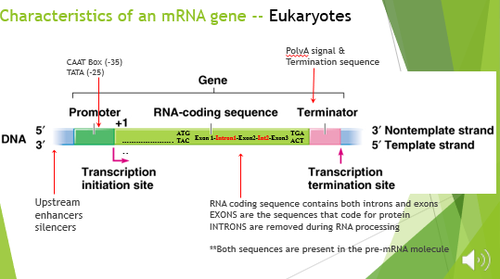
List the core DNA features of a typical eukaryotic gene and sketch how they are arranged
Promoter: Begins the process of Transcription (Initiation) with the binding of RNA Polymerase to the region located in the 5’ end of the gene
Transcription Start Site (TSS): The first base to be transcribed denoted with +1
Exons: Coding regions of the gene that remains in the mature RNA after splicing
Introns: Noncoding regions of the gene that’s spliced outUntranslated Region (UTRs): Region of the mRNA that’s transcribed from DNA but doesn’t code for amino acids in a protein
Enhancers: Short region of DNA that binds to activator proteins to increase the transcription and expression of a specific gene
Terminator: Region of the DNA that signals RNA to cease elongation
Name the four stages at which eukaryotic gene expression is regulated
Transcription
Post-Transcription
Translation
Post-Translation
Identify a genotype-by-environment (GxE) interaction and distinguish it from an effect that appears regardless
of environment
The Hy5 protein in seedlings control the length of the stem of the plant, but is degraded if low sunlight is available to allow for growth to reach the light better. If the environment had no effect then there would be no difference in the plant length regardless of sunlight amount
Name the protein that recognizes the core promoter and its DNA-binding domain, identify the core
promoter elements and explain why promoter prediction from sequence alone is unreliable
The TATA Binding Protein (TBP) is the protein that recognizes the core promoter and its DNA-binding domain. It is apart of the TFIID (Transcription Factor II D) complex
The core promoter elements are the TATA box, TFIIB Recognition Element (BRE), Initiator Element (INR), and Downstream Promoter Element (DPE found downstream of the transcription start)
Promoter prediction from the sequence alone is unreliable because the promoter motifs are often short and redundant, and many promoters lack these elements all together
Explain how enhancers and locus control regions act over long distances, using β-globin as the worked
example
Enhancers bind to proteins that help boost gene activity and Locus Control Regions (LCRs) is a combination of enhancers and insulator elements. They work over long distances by creating a loop in the DNA that physically brings a gene promoter to them which helps the LCR build the RNA Polymerase machinery for transcription
In the case of β-globin the LCR loops to the embryonic gene promoter and activates it during the embryo stage, then releases it and loops with the fetal globin gene during the fetus stage and releases it again and loops with the adult globin gene during the adult stage
Trace a transcript from template strand to mature RNA, correctly identifying the template strand, the coding
strand, and the +1 start site.

Name the three eukaryotic RNA polymerases (and the two extra plant polymerases) and state what each
transcribes
RNA Polymerase I: Transcribes Ribosomal RNA (rRNA)
RNA Polymerase II: Transcribes mRNA and small regulatory RNAs
RNA Polymerase III: Transcribes tRNA, 5S RNA, and sn RNA
RNA Polymerases I,V (plants only): Transcribes si RNA
Put the RNA Pol II pre-initiation complex in assembly order and give the job of each general transcription factor
1. TFIID binds to the TATA box via the TBP and causes local DNA unwinding
2. Some other components of TFIID, called TBP- associated factors (TAFs), mediate recognition of other promoter elements like INR and DPE
TFIIB is recruited. This recognizes the BRE promoter element and binds asymmetrically, helping to determine the transcription direction
TFIIA binds, and stabilizes the TBP-DNA interactions
TFIIF and RNA Pol II are recruitedTFIIE and TFIIH bind (TFIIH catalyzes ATP-powered unwinding of DNA)
Distinguish the allosteric and torpedo models of termination, and say what evidence would separate them
Allosteric model: RNA polymerase II conformation changes when it reaches and transcribes poly(A) tail or the 3’ end, leading to dissociation from DNA
Torpedo model: Excess RNA is degraded by ribonuclease which then torpedoes RNA polymerase enzyme, causing dissociation from DNA
Classify a regulatory protein by its DNA-binding motif: helix-turn-helix, zinc finger, bZIP, or bHLH
Helix-Turn-Helix: Two alpha helices connected by a short turning sequence. The second helix acts as the recognition helix that fits into the major groove of DNA
Zinc Finger Domain: A small structural domain stabilized by one or more zinc ions (Zn^2+) coordinated by regularly spaced cysteine and histidine residues. An alpha helix inserts into the major groove
Basic Region-Leucine Zipper (bZIP): Features a continuous alpha helix containing a basic DNA-binding region adjacent to a dimerization zone with regularly spaced leucine residues. The leucines interlock like a zipper to form coiled-coil dimers
Basic Region-Helix-Loop-Helix (bHLH): Contains two alpha helices connected by a flexible loop that allows protein dimerization, paired with a basic region that grips the major groove of DNA