Equations/Constants to know
 Call Kai
 Learn
Learn Practice Test
 Spaced Repetition
 Match
Match Flashcards
 Knowt Play
1/24

There's no tags or description
Looks like no tags are added yet.
Name | Mastery | Learn | Test | Matching | Spaced | Call with Kai | Chat |
|---|
No analytics yet
Send a link to your students to track their progress
25 Terms
Number density equation
N = (rho * N_A) / M or N = (m N_A) / (V * M)
rest mass equation
E_0 = m_0 * c^2
conversion from amu to MeV
1 amu = 931.5 MeV
rest mass energy of an electron
0.511 MeV (511 keV)
Relativistic mass correction factor
gamma = 1 / sqrt(1 - v^2/c^2)
Wavelength of particles equation
lambda = h / p (de Broglie wavelength)
Momentum of nonzero rest mass particle equation
p = gamma*m_0 *v
Derive momentum in terms of kinetic energy for a
particle
Relativistic: p = sqrt(KE^2 + 2*KE*m_0*c^2) / c | Non-relativistic: p = sqrt(2*m * KE)
Planck’s constant in 𝑒𝑉 ∗ 𝑠
h = 4.1357 x 10^-15 eVs
Speed of light
c = 3.00 x 10^8 m/s
Relativistic momentum and wavelength
p = (h / lambda) = gamma*m_0 *v => lambda = h / (gamma *m_0 * v)
Zero rest-mass particle energy and momentum
E = p * c (or p = E / c)
Boltzmann's constant in 𝑒𝑉/k
k_B = 8.617 x 10^-5 eV/K
Convert half-life to decay constant and vice versa
lambda = ln(2) / t_(1/2) or t_(1/2) = ln(2) / lambda
Decay constant to mean-life
tau = 1 / lambda
Convert between Ci and Bq
1 Ci = 3.7 x 10^10 Bq (1 Bq = 1 decay/sec)
Q-value equation
Q = (m_reactants - m_products) c^2 or Q = (M_initial - M_final) 931.5 MeV
Mass defect equation
Delta m = [Z m_p + (A - Z) m_n] - m_nucleus

Number of Neutrons*Mass of a neutron (1.008665)

Number of Protons*Mass of a proton (1.007825)

This is the Volume term. This term represents the attractive forces initially exhibited by the nucleons, and has A in the answer because the numbers of bonds between each nucleon are fixed and proportional to the mass number (A).

This is the Surface Term. This term corrects for the volume term, because the outer (surface) nucleons have less bonds than the inner ones. Because we are accounting for the outer nucleons, it is proportional to A^⅔ which is the surface area.
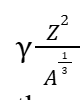
This is the Coulomb term. This term corrects for the repulsion forces between protons in the nucleus. It accounts for the number of proton pairs as well as the radius of the atom

This is the Asymmetry term. This term corrects for the imbalance between the number of protons and neutrons (hence “asymmetry”)

This is the Pairing term. This term reflects how nucleons tend to form spin-zero pairs.