Competitive Effectiveness - Exam 1 - Marketing Terms
 Call Kai
 Learn
Learn Practice Test
 Spaced Repetition
 Match
Match Flashcards
 Knowt Play
1/88

Earn XP
Description and Tags
Marketing
Name | Mastery | Learn | Test | Matching | Spaced | Call with Kai | Chat |
|---|
No analytics yet
Send a link to your students to track their progress
89 Terms
What marketing is about
Identifying and anticipating customer needs
satisfying customer needs profitably
revenue generation
Marketing
an organizational function and a set of processes for creating, communicating, and delivering value to customers and for managing customer relationships on ways that benefit the organization and its stakeholders
4 P’s of Marketing
Product
Price
Place
Promotion
Product
Procedures to ensure the products are ready for selling
Price
Set it at a level comparable to competitors
Place
How and where products are distributed to sell
Promotion
Brochures, ads, and information to generate interest
Effective Marketing
Customer Value
Relationships
Satisfaction
Customer Value
Deliver products and services that perform
Successful products and services deliver value and satisfaction to customers
We make buying decisions based on which product is perceived to offer the most value
Tangible/Intangible benefits vs. cost
Relationship Marketing
Keep customers coming back again and again
Acquiring customers is 5-25x more expensive than keeping current customers
About 70% of growing businesses rate customers success as “very important”
Over 80% of companies believe retention is cheaper than acquisition

Customer Satisfaction
The feeling that a product has met or exceeded the customer’s expectations
Good value
Provided reasonable solutions to customers’ expectations
Do what you say you are going to do
Customer Perceived Value
________ = Expected Benefits - Expected Costs
Perceived Benefits
Functional benefits
Psychological benefits
emotional benefits
self-expression benefits
social benefits
Perceived Costs
Purchase price
Additional costs
cost of using
Cost of maintaining
Cost of disposing
4 Factors that Contribute to Value
Exchanging
Communicating
Delivering
Creating
Evolution of Marketing
Production Era
Sales Era
Marketing Era
Relationship Era
Microenvironment
Outside but “close”
Suppliers, competitors, customers, stakeholders, general public, etc.
Macroenvironment
Outside and largely uncontrollable
but you need to understand it
How to understand how inflation will shape consumer behavior in the Americas
Mintel Recommends:
learn from the past
Prepare for uncertainty
Recognize that circumstances vary hugely
Trend
structurally important; a fundamental change; changes what people do
Fad
changes what people talk about; something that just gets media attention
Market Research
The process of planning, collecting, analyzing, and using information for marketing decision-making.
Assess market potential/select target market
Explore what product/service offerings customers want
Develop new products
Develop effective promotional strategies
Determine price points
Evaluate where consumers shop for/purchase products in category
Understand personal/external factors that influence consumer decision making
Measure existing customer satisfaction
Monitor the external environment
Sole purpose for conducting marketing research
To inform decisions and reduce uncertainty
Increase value to consumers
Increase value to shareholders
Research Objectives
Gather data = gather and present information relevant to the problem
Explain the data = Explain what the data means
Insights and predictions = Articulate what the data predicts, and how it relates to the marketing problem
Primary data
Data you collect yourself
Secondary data
Data that has been collected previously
internal info./databases
gov. agency info.
Trade/industry sources
market research firms
commercial publications
news media
Internet search engines/directories
Industry databases (e.g., Mintel, Lexis Nexis)
Secondary Data Pros
saves time and money
aids in determining direction for primary data collection
pinpoints people to approach
serves as a basis of comparison for other data
Secondary Data Cons
may not be exactly what researcher is looking for
quality/accuracy issues
Who gathered the data?
What method was used?
When was data gathered?
How were classifications developed?
Demographic Environment (Demography)
the study of human populations in terms of size, density, location, age, gender, race, occupation, other statistics
Important demographic trends
age structure due to falling birthrates and longer life expectancies
changing family structure
geographic shifts due to increased mobility and movement to “micropolitan” areas
increased education
increased diversity
Economic Environment
Factors that influence consumers purchase ability and buying behavior
Recession
Inflation
Unemployment
Income
Results of Economic Downturn
Sales increases
outdoor furniture, grills, etc. - “staycations”
private label brands
discount retailers
staple products
Higher ROI on marketing spending
while competitors are cutting back
less clutter
more supply of ad space
Repositioning opportunities
Natural Environment
accounts for the physical environment and natural resources needed as inputs by marketers or those that are affected by marketing activities
Weather
Pollution
Climate change
Pandemic
Technological Environment
the application of knowledge in science, inventions, and innovations to marketing
Device mesh and connectivity b/n sensors, cars, phones, computers, etc.
Autonomous agents and things (robots and driverless cars)
Artificial intelligence and machine learning
More devices yielding more and more info.
Ways to use AI in marketing
ad optimization
content inspiration
scaled A/B testing
sentiment analysis
campaign translation
intelligent chatbots
Political Environment
includes factors that provide rules and penalties for violates
protections for consumers and for business
includes factors that select leadership, create laws and regulations
laws protect businesses
laws protect consumers
Laws Protecting Consumers
Food and Drug Act (1906)
Public Health cigarette Smoking Act (1971)
Children’s Online Privacy Act (2000)
Financial Reform Law (2010)
Laws Protecting Business
Sherman Antitrust Act (1890)
Federal Trade commission Act 91914)
Wheeler Lea Act (1938)
Digital Millennium Copyright Act (1998)
Cultural Environment
the needs and wants of society and culture
Demographics
Psychographics (e.g., lifestyle, beliefs, values)
Culture (e.g., norms, values, rituals, language)
Attitudes (e.g., towards others, organizations, nature, etc.)
requires monitoring shifts in consumer trends and meaning
Strengths
things your company does well
qualities that separate you from your competitors
internal resources such as skilled, knowledgeable staff
tangible assets such as intellectual property, capital, proprietary technologies, etc.
Weaknesses
things your company lacks
things your competitors do better than you
resource limitations
unclear unique selling proposition
Opportunities
underserved markets for specific products
few competitors in your area
emerging need for your products or services
press/media coverage of your company
Threats
emerging competitors
changing regulatory environment
negative press/media coverage
changing customer attitudes toward your company
Market Segmentation
Who is out there?
Identify bases for segmenting the market
Develop segment profiles
Divide the market into distinct and meaningful groups (i.e., segments)
Market Targeting
Who should we pursue?
Develop measure of segment attractiveness
Select target segments
Market Positioning
Why should they choose us?
Develop positioning for target segments
Develop a marketing mix for each segment
Connecting Segmentation to Targeting and Positioning
Identify groups of similar customers and potential customers (segmentation)
Understand consumer behavior w/in segments (segmentation + targeting)
Prioritize the groups (targeting)
Respond with appropriate marketing strategies that satisfy the different preferences of each chosen segment (positioning)
Market Segment
a group of customers who share a similar set of needs and wants, and/or responses to marketing mix elements
Bases for Segmenting
Geographic
Demographic
Psychographic
Behavioral
Geographic
target customers based on a predefined geographic boundary
differences in interests, values, and preferences vary dramatically throughout cities, states, regions, and countries
Demographic
the process of dividing a market through variables such as age, gender, education level, family size, occupation, income, and more
this is one of the most wildly used strategies amongst marketers
Psychographic
focus on the intrinsic traits the target customer has
values, personalities, interests, attitudes, conscious and subconscious motivators, lifestyles, and opinions
Behavioral
break down the way customers go through their decision making and buying processes
attitudes towards the brand, the way they use it, and their knowledge base are all behavioral examples
Business-to-Business (B2B) Segmentation
same process, different bases for segmentation
demographics — business size, industry, etc.
geography — region, nation, international locations
benefits sought — service support, financial terms, etc.
loyalty
usage rates
customer operating characteristics — capabilities and tech. requirements, etc.
purchasing approaches/policies
situational factors — order size, urgency, etc.
personal characteristics — loyalty, risk aversion, etc.
Market Targeting
once a firm has identified market segments, it must decide which segment(s) to target
Characteristics of good segments for targeting
measurable
substantial
accessible
differentiable
actionable
Approaches to market targeting
undifferentiated marketing (mass marketing)
concentrated marketing
differentiated marketing
Undifferentiated Marketing (Mass Marketing)
one marketing mix for one big market
doesn’t recognize differences b/n groups
Concentrated Marketing
one marketing mix for one segment
Differentiated Marketing
multiple marketing mixes for multiple segments
at the extreme is one-to-one or micro marketing
Pros and Cons of Undifferentiated marketing (mass marketing)
Pro = savings on production/marketing costs
Con = more susceptible to competition (due to lack of product options
Pros and Cons of Concentrated Marketing
Pro = concentrated resources (i.e., production, marketing) and strong position among competition
Con = must know your customer — segments can change and without diversification → this is a big risk
Pros and Cons of Differentiated Marketing
Pro = generally higher profits, market share
Con = higher production/marketing costs
product design, production, promotion, inventory, research, management
Risk of cannibalization from other products
Positioning
deals with serving a specific target market by achieving a certain “position” in the consumers’ minds relative to the competition and based on important attributes
You design strategy to position, but ultimately positioning is in the mind of the consumer
The goal is to get the target market to recognize a company’s distinctive offerings
Aspiration
The company’s desired brand positioning
Co-Creation
What the consumer does
a collaborative business strategy where a company invites customers, employees, or partners to actively participate in designing, developing, or improving products, services, and brand campaigns
Reaction
The company’s adjusted brand positioning
Value Proposition
“Internal” statement to guide strategy
What is the specific value a product can provide (relative to the competition)
Reason why the target market should buy a product
Personality of the brand
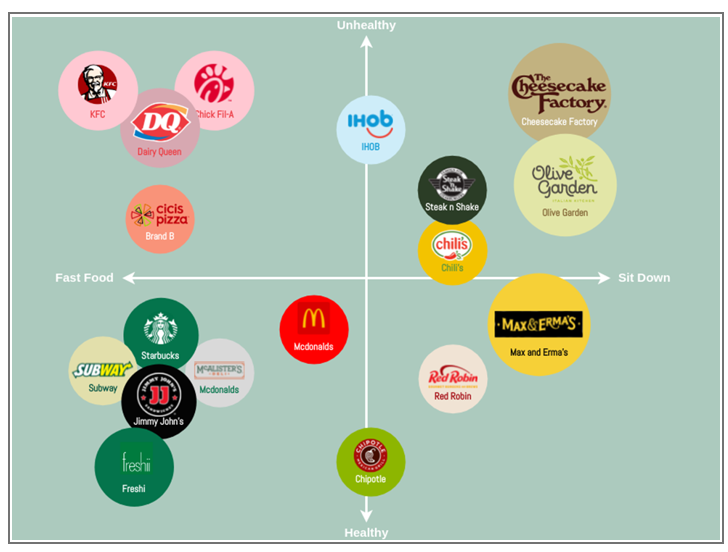
Perceptual Map
Picture showing how brands stack up on key attributes vs. their competitors
Consumers are asked to compare brands across a number of different attributes
Answers are used to determine most important attributes, and how close or far brands are to one another on those attributes
Create a two (or multi-) dimensional representation of what this looks like
Value Positioning Examples
L’Oreal cosmetics = Because you’re worth it
Michelin tires = Because so much is riding on your tires
Benefit Positioning Examples
Pampers Diapers = Our softest diaper ever wraps your baby in comfort and protection
Oral-B toothbrushes = Bends and adjusts with the contours of your teeth to remove more plaque
Feature Positioning Examples
Dove soap = Contains ¼ moisturizing cream
Organic Valley milk = Produced by family farmers without antibiotics, synthetic hormones or pesticides
Consumer Behavior
The process individuals or groups go through to select purchase, use, and dispose of goods, services, ideas, or experience to satisfy wants and needs.
Decision Making Process
Problem or need recognition
Information Search
Evaluation of alternatives
Make purchase
Post purchase behavior
Problem Recognition
Occurs when consumer sees a difference b/n actual state and ideal state
We buy products to solve perceived problems
Out of stock
Dissatisfaction
Life events
Related product needs
Market/marketer induced
Motivation triggered by internal state or external cue
Information Search
The act of identifying and evaluating options that might solve problem
Where to search?
Memory/personal experience
Personal sources like friends, coworkers
Market sources like websites, ads, retailers, salespeople
Public sources like Consumer Reports, Kelly Blue Book
Outcomes of Information Search
Choice alternatives are options, which are evaluated in terms of evaluative criteria
Evaluative criteria are the dimensions consumers use to compare competing product alternatives
e.g., feature, style, image, price, warranty
Evaluation of Alternatives
sometimes we know exactly what we want
Many times we consider different options in the marketplace
we use evaluative criteria to choose from the options in our consideration set
Integration Processes
Attitude formation
2 types of integration procedures
Formal integration strategies (e.g., multiattribute model)
Simpler procedures: heuristics
Attitude Formation
involves determining your overall evaluation of something
evaluate choice alternatives in terms of choice criteria
comprised of thinking, feeling, and behavioral components
Search heuristics
store selection
sources of information
source credibility
Evaluation heuristics
Key criteria
Negative criteria
Significant differences
Choice heuristics
For familiar, frequently purchased products:
works best
affect referral
Purchase Decision
the outcome of the process of evaluating alternatives
can result in purchase — or not
Outcomes:
Product choice
Brand choice
Dealer choice
Purchase amount
Purchase timing
Payment method
Postpurchase Behavior
the buying process doesn’t end w/ the purchase
Involves learning:
we evaluate out decision and integrate the personal experience into future decisions
what you learn impacts future decisions
satisfaction/dissatisfaction
attitude
cognitive dissonance
Routine Purchase Decisions
Low involvement
Short amount of time
Low costs
Internal information search only
One alternative
Limited Purchase Decisions
low to moderate involvement
short to moderate amount of time
low to moderate costs
mostly internal information search
few alternatives
Extensive Purchase Decisions
high involvement
Long amount of time
high costs
internal and external information search
many alternatives
Involvement
the amount of time and effort a buyer invests in the search, evaluation, and decision processes of consumer behavior
level of involvement determined by:
previous experience
interest
situation
risk of negative consequences
social visibility