Unit 3: Cell Biology
 Call Kai
 Learn
Learn Practice Test
 Spaced Repetition
 Match
Match Flashcards
1/42

There's no tags or description
Looks like no tags are added yet.
Name | Mastery | Learn | Test | Matching | Spaced | Call with Kai | Chat |
|---|
No analytics yet
Send a link to your students to track their progress
43 Terms
Cell Membrane
A thin semi-permeable “skin” that surrounds a cell.
Hydrophilic
Attracted to water; specifically the polar head of a phospholipid.
Hydrophobic
Repels water; specifically the nonpolar tail of a phospholipid.
Passive Transport
Does not require energy (ATP) to move molecules; includes Diffusion, Facilitated Diffusion, and Osmosis.
Active Transport
Requires energy (ATP) to move molecules; pumps molecules from low to high concentration using protein channels.
Solvent
The dissolving medium (usually water).
Solute
A substance being dissolved.
Diffusion
Movement of molecules from high concentration to low concentration.
Osmosis
Diffusion of water across a selectively permeable membrane toward the area with more solute (lower water concentration).
Isotonic Solution
An equal concentration of particles inside and out where the net movement of water is zero and the cell stays the same size.
Hypertonic Solution
More particles in the solution than in the cell causing water to move out to try to dilute the surroundings and the cell to shrivel.
Hypotonic Solution
Fewer particles in the solution than in the cell causing water to move in to try to dilute the internal environment and the cell to expand.
Endocytosis
Bringing molecules into the cell by forming vesicles.
Exocytosis
Secreting molecules out of the cell by releasing a vesicle.
Cell Membrane Components
Includes a phospholipid bilayer (hydrophilic heads on the surface and hydrophobic tails in the middle), cholesterol, receptor proteins, pore proteins, and channel proteins.
Cholesterol
Helps maintain membrane flexibility and stability.
Veins
Blood vessels that bring blood back to the heart.
Capillaries
Small blood vessels on the alveoli.
Hemoglobin
Protein in red blood cells that carries oxygen.
Reactant
What goes into a chemical reaction.
Product
What comes out of a chemical reaction.
Photosynthesis Formula
Carbon Dioxide+Water+Light→Sugar+Oxygen
Cellular Respiration Formula
Glucose+Oxygen→Water+Carbon Dioxide+ATP (Energy)
Cellular Respiration Steps
Glycolysis, 2. Krebs Cycle, 3. Electron Transport Chain.
Homeostasis
The maintenance of relatively stable internal conditions despite external conditions.
Vena Cava
Where blood enters the heart.
Pulmonary Artery
Where blood is carried to the lungs.
Aorta
Where blood is carried to the body.
Lactic Acid Fermentation
A type of anaerobic respiration occurring in animals and bacteria.
Alcoholic Fermentation
A type of anaerobic respiration occurring in fungi and bacteria.
Aerobic Respiration
Requires oxygen, happens in the mitochondria, and is common in eukaryotic cells.
Anaerobic Respiration
Happens when there is no oxygen and/or in cells without mitochondria; also known as Fermentation.
Alveoli
Where gas exchange happens in the lungs.
Arteries
Blood vessels that take blood away from the heart.
Concentration Gradient
A difference in the concentration of molecules between two areas. Molecules naturally move from high concentration to low concentration.
Facilitated Diffuc
Passive transport that uses a protein channel to move molecules from high concentration to low concentration.
Glycolysis
The first step of cellular respiration. Occurs in the cytoplasm and breaks down glucose.
Electron Transport Chain (ETC)
The final stage of cellular respiration. Produces the most ATP and requires oxygen as the final electron acceptor.
NADH & FADH₂
Electron carriers that transport high-energy electrons to the electron transport chain.
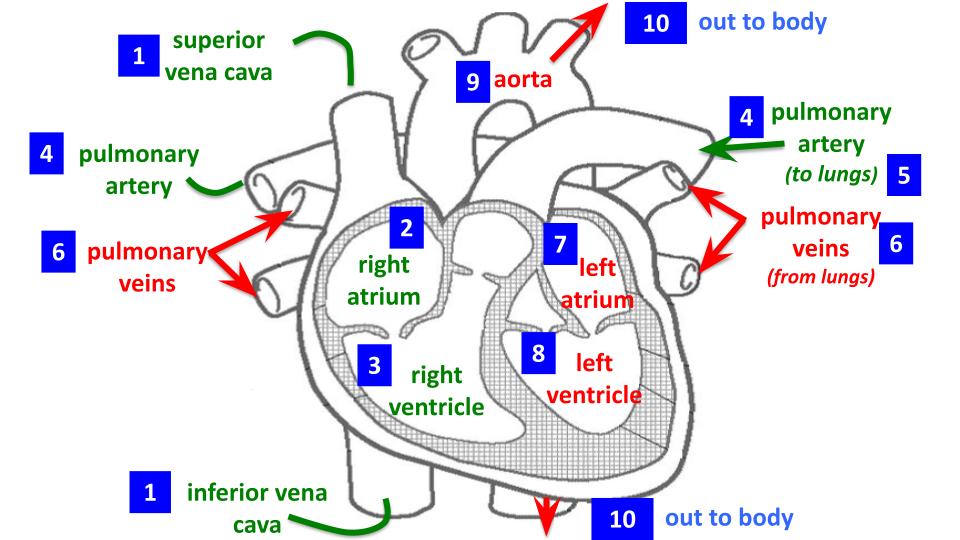
Blood Flow Through the Heart
1: Vena cava (Superior & Inferior)
2: Right atrium
3: Right ventricle
4: Pulmonary artery
5: Lungs (labeled as "to lungs")
6: Pulmonary veins (labeled as "from lungs")
7: Left atrium
8: Left ventricle
9: Aorta
10: Out to body
Capillaries
Small blood vessels on the alveoli.
Bone Marrow produces…
Produces red blood cells that carry oxygen.
Sternum
Breastbone that protects the heart.