Haematogenous and Non-Haematogenous Pigments
 Call Kai
 Learn
Learn Practice Test
 Spaced Repetition
 Match
Match Flashcards
 Knowt Play
1/26

Earn XP
Description and Tags
Haematogenous and Non-Haematogenous Pigments
Name | Mastery | Learn | Test | Matching | Spaced | Call with Kai | Chat |
|---|
No analytics yet
Send a link to your students to track their progress
27 Terms
What are haematogenous pigments derived from?
From haemoglobin within erythrocytes (RBCs).
What pigment colour is haemoglobin
light pink/red
What is the main site of old/damaged RBC removal?
The spleen
Splenic macrophages phagocytose RBCs
When haemoglobin is broken down, what component of it gets recycled into amino acids?
Globin
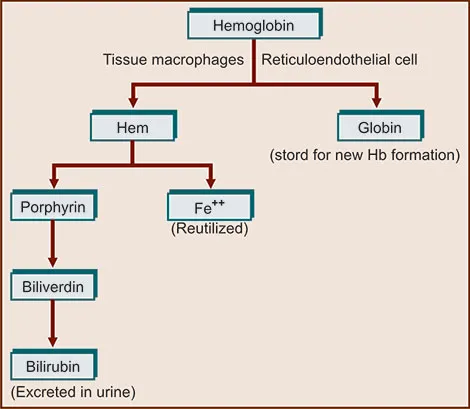
What are the products of haemoglobin breakdown? What happens to them?
Globin (protein component)
Broken into amino acids
Recycled to make new proteins
Haeme (pigment + iron component)
Separated into:
Iron (Fe)
Stored as haemosiderin or transported back to bone marrow.
Used to make new haemoglobin
Porphyrin ring
Converted into unconjugated bilirubin
Transported to liver
Conjugated and excreted in bile
What is the name of the process in which haemoglobin is prematurely broken down due to disease?
Haemolysis
What is haemolysis?
Haemolysis = premature destruction of RBCs (due to disease)
Normally RBCs are removed when old, but in haemolytic diseases they are destroyed too early/prematurely.
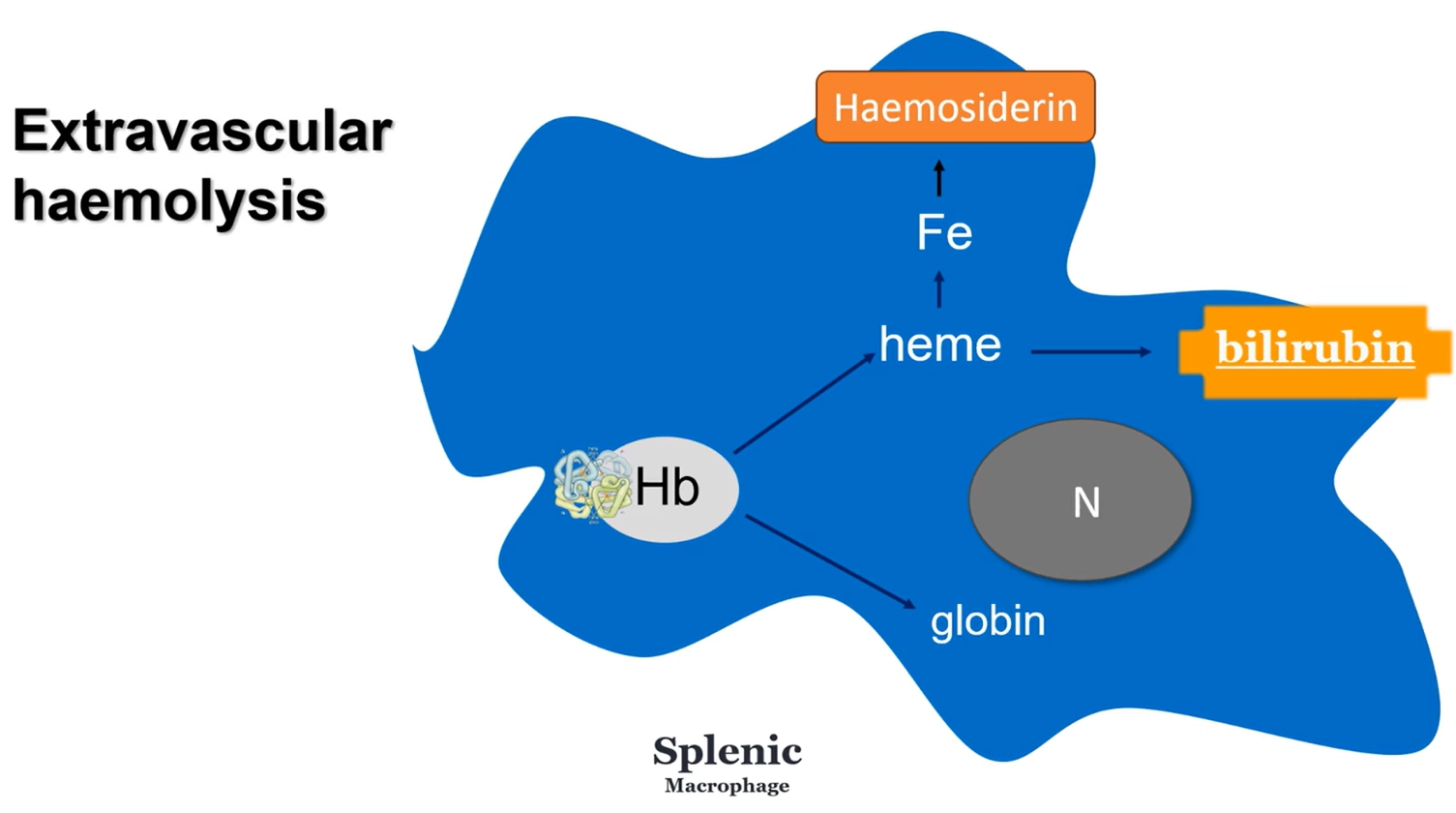
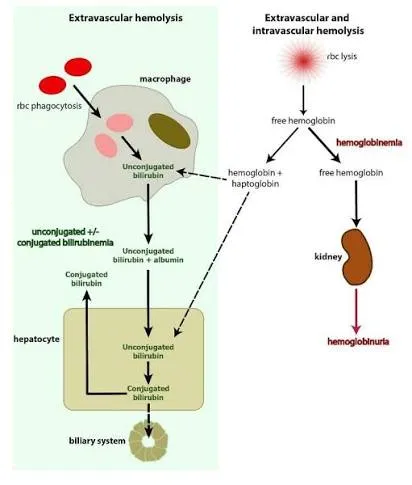
Where does extravascular haemolysis occur?
The RBC is removed by macrophages (e.g. in the spleen)
The steps are very similar to normal red blood cell breakdown.
The main difference is their is an excessive number of red blood cells being broken down.
Where does intravascular haemolysis occur?
Directly in the bloodstream
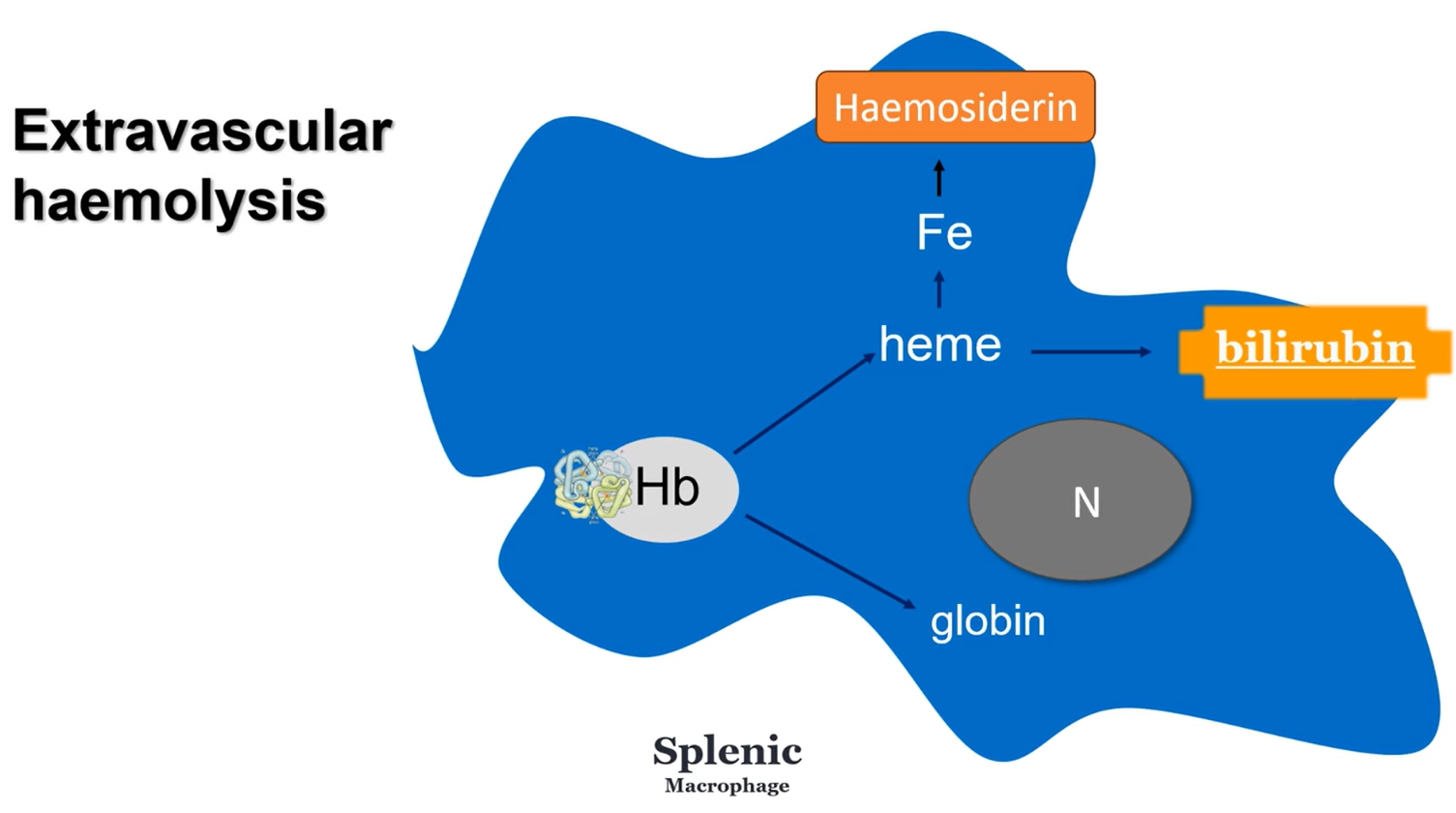
What pigments does extravascular haemolysis result in?
Forms Bilirubin and Haemosiderin
Bilirubin is a yellow/orange pigment
Waste product that needs to be processed and then excreted (used in bile and byproducts excreted in urine and stool)
Haemosiderin is a yellow/brown pigment.
Iron is stored Inside macrophages as haemosiderin.
What is bilirubin? What colour is it?
Bilirubin is a yellow/orange pigment formed by haeme breakdown.
Waste product that needs to be processed and then excreted (used in bile and byproducts excreted in urine and stool)
What is haemosiderin? What colour is it?
Haemosiderin is a yellow/brown pigment.
Iron from haeme breakdown is stored Inside macrophages as haemosiderin.
Iron is stored as ferritin first
The released iron binds to apoferritin forming ferritin
Iron + apoferritin = ferritin.
If too much iron accumulates than ferritin can store:
Ferritin molecules clump together.
And are converted into haemosiderin.
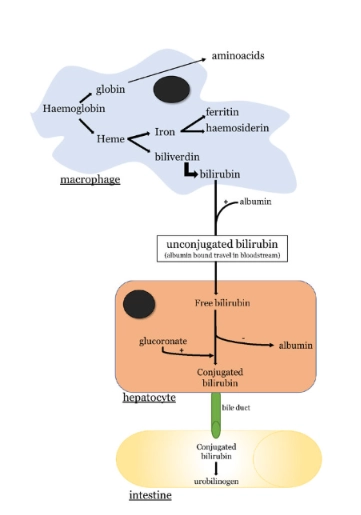
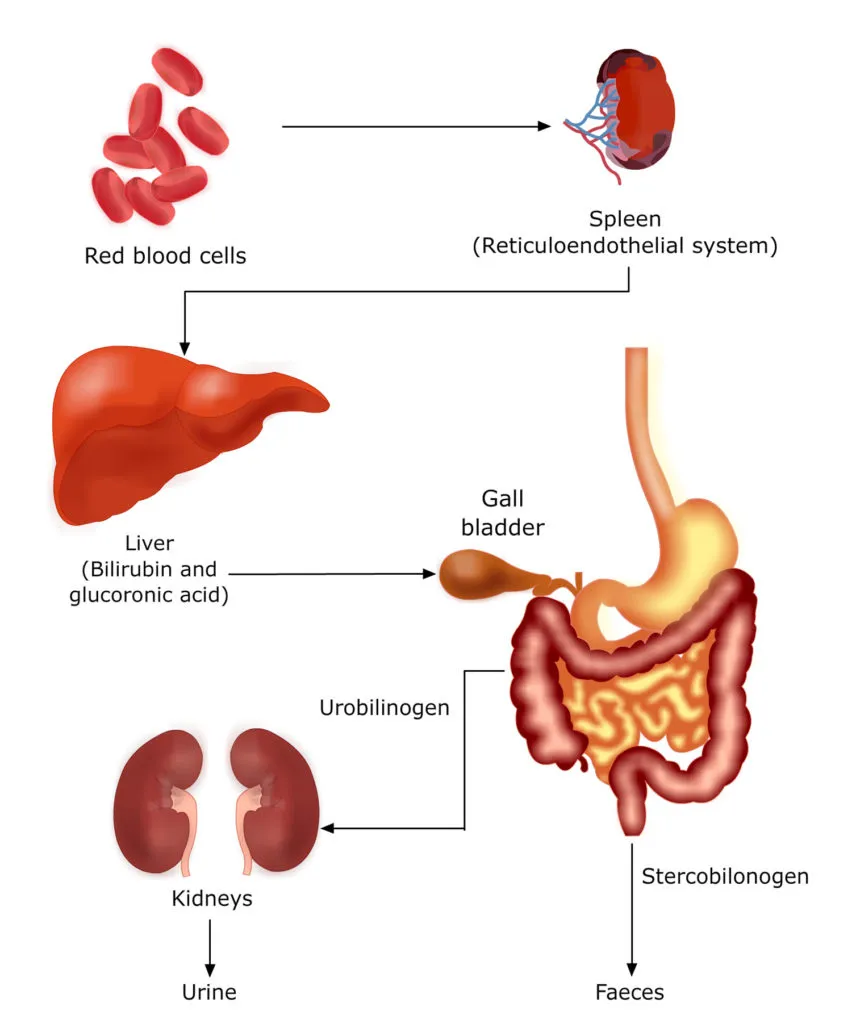
Describe the pathway of bilirubin from the blood, to the liver, and how it is excreted in the urine/faeces.
In the blood bilirubin loosely attaches to albumin.
Here it is called free or unconjugated bilirubin.
At this stage it can not be removed by the kidneys as is not very water soluble while it’s attached to albumin
To become more water soluble it travels to the liver, where hepatocytes take it up, detach it from albumin.
It is then attached (conjugated) to glucuronic acid.
This makes the bilirubin more water-soluble.
It is now called conjugated bilirubin
The conjugated bilirubin is then excreted in the bile.
It passes through the bile duct, and enters the small intestine.
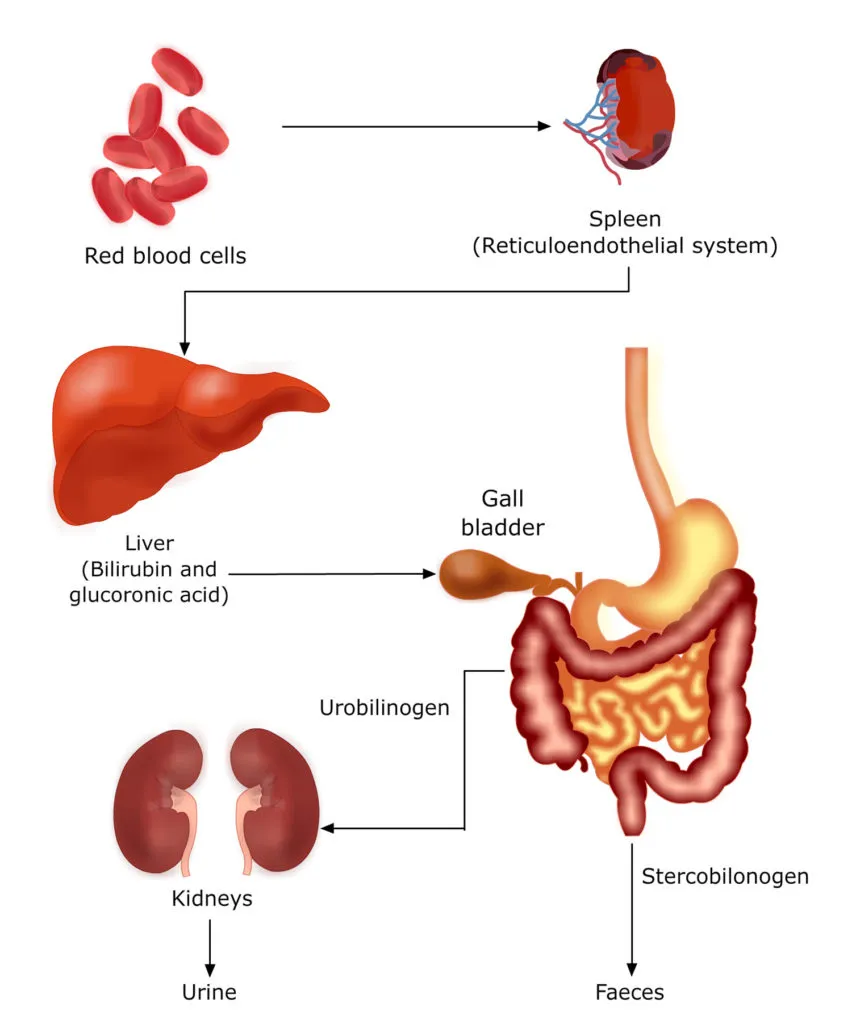
In the intestine, it is converted by bacteria into a group of colourless compounds called urobilinogens.
Some of these are reabsorbed into the blood and then excreted in the urine, where they are oxidised to give urine its yellow-brown colour.
Others pass through the intestine to be excreted in the faeces.
In the faeces urobilinogens are converted to stercobilin, which gives faeces their brown colour.
What protein does bilirubin attach to in the blood?
Albumin
What does bilirubin become attached/conjugated to in the liver, becoming conjugated bilirubin?
glucuronic acid (an amino acid)
Conjugated bilirubin is excreted in bile into the small intestine.
In the intestine, it is converted by bacteria into a group of colourless compounds called what?
Some of these compounds are reabsorbed into the blood and then excreted in the urine, where they are oxidised to give urine its yellow-brown colour.
urobilinogen.
In the faeces urobilinogens are converted into what?, giving faeces their brown colour.
Stercobilin
What does abnormally high concentration of bilirubin in the blood and tissues result in?
Jaundice/Icterus
The yellow discolouration of body tissue
What is Jaundice/Icterus? And what causes it?
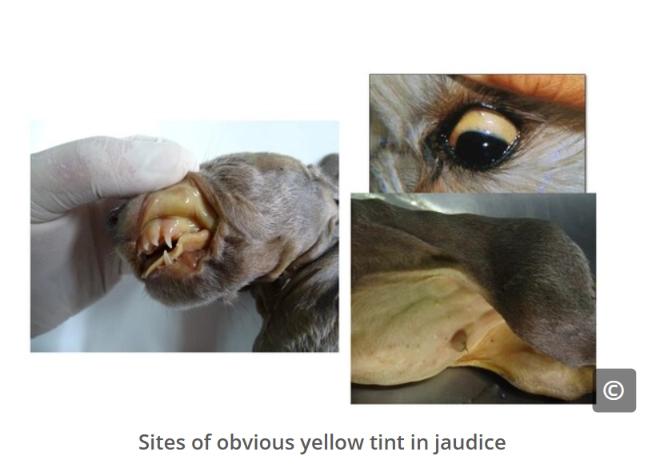
Jaundice (also known as icterus) is the yellow discolouration of body tissues by an abnormally high concentration of bilirubin in the blood and tissues.
Both intravascular or extravascular haemolysis can result in jaundice
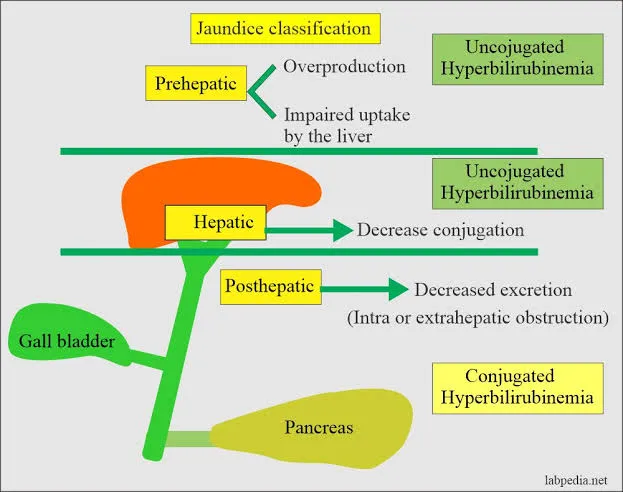
What are the three main mechanisms that can cause jaundice?
Pre Hepatic Jaudice: Haemolysis
Excessive breakdown of red blood cells (haemolysis) produces more bilirubin than the liver can process.
Hepatic Jaundice: Liver Damage
Disease or damage of hepatocytes reduces the liver's ability to take up, conjugate, or secrete bilirubin into bile.
Resulting in a build-up of unconjugated bilirubin.
Post-hepatic Jaundice: Billary System Obstruction
Cause by reduced bile flow/obstruction of bile excretion
Conjugated bilirubin is unable excreted via the bile duct
As a result it is released directly into the bloodstream
If pale faeces are seen this indicates the patient has what type of jaundice?
Post-hepatic Jaundice
Cause by reduced bile flow/obstruction of bile excretion
Conjugated bilirubin is unable excreted via the bile duct
As a result it is released directly into the bloodstream
If there is complete obstruction of the bile duct, urobilinogens are unable to reach the intestinal tract, resulting in pale faeces.
In practice, pale faeces are very uncommon, since only a tiny amount of pigment is required to impart a brown colour to faeces.
Post-hepatic Jaundice occurs due to blockage of the bile duct system.
This obstruction (cholestasis), can be classified as:
Extra-hepatic: when the obstruction is in the bile ducts that drain from the liver.
E.g. gallstones
Intra-hepatic: occurs when there is obstruction of the tiny bile canaliculi that travel between hepatocytes.
Is usually due to hepatocellular swelling (i.e., it is secondary to hepatic jaundice).
What cause Pre Hepatic Jaundice?
Excessive breakdown of red blood cells (haemolysis) produces more bilirubin than the liver can process.
What cause Hepatic Jaundice?
Disease or damage of hepatocytes reducing the liver's ability to take up, conjugate, or secrete bilirubin into bile.
Resulting in a build-up of unconjugated bilirubin.
What is post-hepatic jaundice?
Cause by reduced bile flow/an obstruction of bile excretion
Conjugated bilirubin is unable excreted via the bile duct
As a result it is released directly into the bloodstream