Phys Dx: Dental exam (copy)
 Call Kai
 Learn
Learn Practice Test
 Spaced Repetition
 Match
Match Flashcards
 Knowt Play
1/54

There's no tags or description
Looks like no tags are added yet.
Name | Mastery | Learn | Test | Matching | Spaced | Call with Kai | Chat |
|---|
No analytics yet
Send a link to your students to track their progress
55 Terms
Directional terms in the mouth:
Toward the front/rostral
Mesial
Directional terms in the mouth:
Away from the front
Distal
Directional terms in the mouth:
Toward the cheek
Buccal
Directional terms in the mouth:
Toward midline: Mandible
Lingual
Directional terms in the mouth:
Toward midline: Maxilla
Palatal
Directional terms in the mouth:
Between teeth
Interdental
Directional terms in the mouth:
Natural gap between teeth to allow normal occlusion
Diastema
Which teeth have these functions: nip, cut, groom, strip
Incisors
Which teeth have these functions: tear, rip, grab food/prey
Canines
Which teeth have these functions: Shear, crush, grind
Premolars
Which teeth have these functions: Crush, grind
Molars
In naming/identifying teeth, use these parameters:
-Side (L/R)
-______ (maxillary or mandibular)
-Position (first, second, third, fourth)
-Tooth (incisor, canine, premolar, molar)
Arcade
What does the first number in the modified triaden numbering system (MTNS) represent?
Quadrant
In the modified triaden numbering system (MTNS), you start in the __________, and end in the _____________
Upper right, lower right
________ teeth are always "-04"
Canine
________ teeth are always "-09"
First molars
_________ teeth: Large upper 4th premolar (PM) and 1st lower molar (M1) teeth of dogs and cats - adapted for shearing flesh. Very large, divergent roots- commonly fractured!
Carnassial
Approximate age of a puppy's deciduous incisors eruption
4-6 weeks
Approximate age of a puppy's deciduous canines eruption
3-5 weeks
Approximate age of a puppy's deciduous premolars eruption
5-6 weeks
Approximate age of a kitten's deciduous incisors eruption
3-4 weeks
Approximate age of a kitten's deciduous canines eruption
3-4 weeks
Approximate age of a kitten's deciduous premolars eruption
5-6 weeks
Deciduous tooth eruption is normally complete by _______ of age
8 weeks
Approximate age of a dog's permanent incisors eruption
12-16 weeks
Approximate age of a dog's permanent canines eruption
16-24 weeks
Approximate age of a dog's permanent premolars eruption
16-24 weeks
Approximate age of a dog's permanent molars eruption
20-28 weeks
Approximate age of a cat's permanent incisors eruption
11-16 weeks
Approximate age of a cat's permanent canines eruption
12-20 weeks
Approximate age of a cat's permanent premolars eruption
16-20 weeks
Approximate age of a cat's permanent molars eruption
20-24 weeks
Permanent tooth eruption is normally complete by __________ of age
7 months
Adult canine dental formula?
3/3, 1/1, 4/4, 2/3
How many rooted teeth do adult dogs have?
6
T/F: The rooted teeth in the adult dog are only present in the mandible
False (maxilla)
All other adult teeth (dog and cat) have _____ roots
two
Adult feline dental formula?
3/3, 1/1, 3/2, 1/1
How many teeth in the adult cat?
30
How many teeth in the adult dog?
42
How many adult cat teeth have three roots?
2
in your oral exam, what joint are you examining?
Temporomandibular
On examing your patient's face, assess the facial bones (including zygomatic arch and orbit) and the ________
mandible
On examing your's patient's face, look for: ________, muscle _______, palpate for pain, swelling, or bulging of the eyes
Symmetry, wasting
Examining the _________:
-Know basic locations
-Observe and palpate for swelling in submandibular or sublingual areas
-Ducts empy via salivary papilla in buccal and sublingual mucosa
Salivary glands
Most common cranial lymphocenters:
-____________ lymphocentrum
-Retropharyngeal node
-Parotid node
-Less common: facial/buccal node
Mandibular
Dental ____________:
-Mandibular incisors just lingual to maxillary incisors - scissor bite
-Mandibular canine centered between maxillary 3rd incisor and canine
-Interdigitation of premolars - "pinking shear"
-Mandibular carnassial tooth (M1) lingual to maxillary carnassial tooth (P4)
Occlusion
A class 3 malocclusion (mandibular arch rostral to normal position) considered "normal" for ____________ breeds
brachycephalic
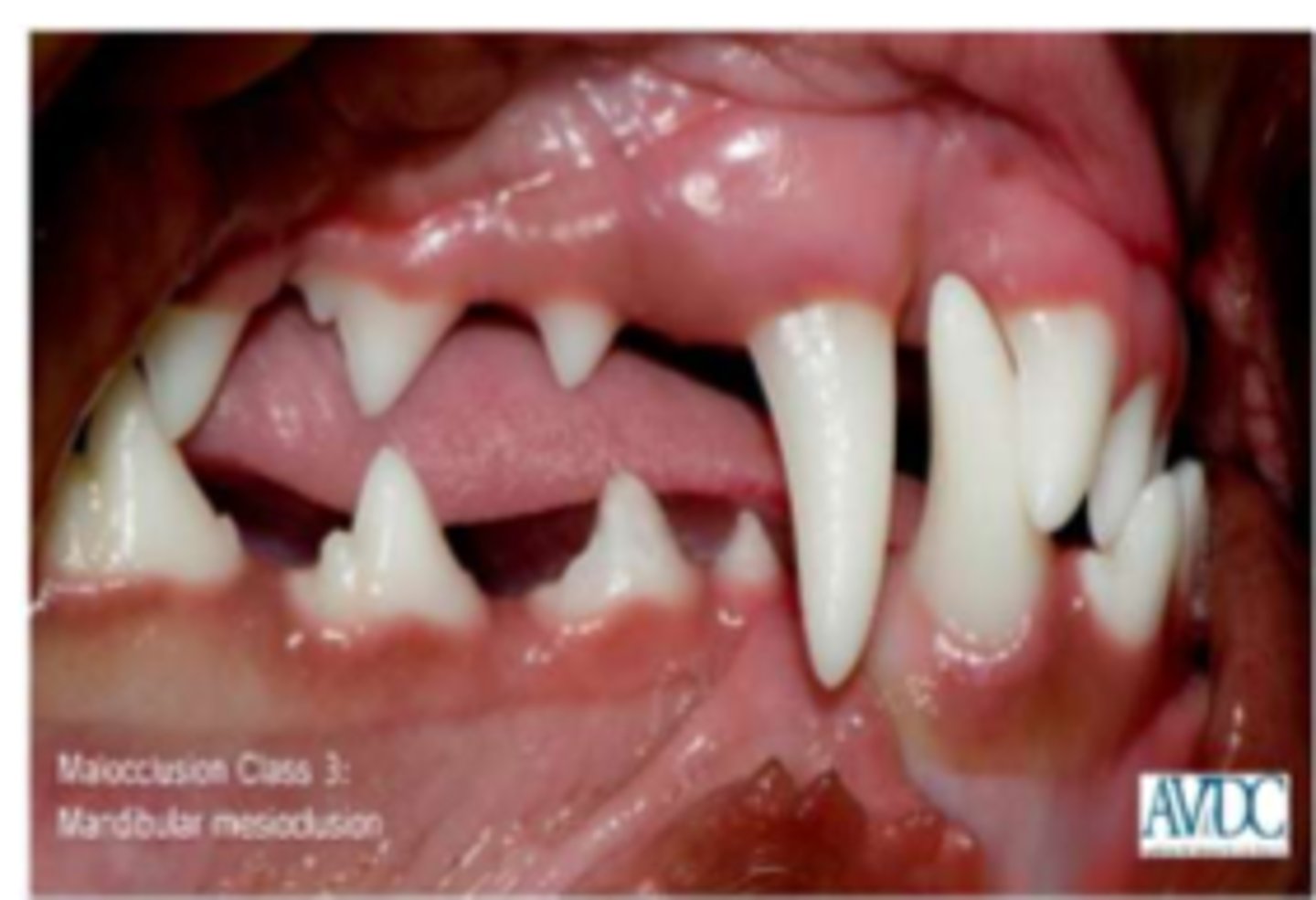
When should you ideally do your first dental exam on a dog?
first puppy exam
Treatment should be considered on all teeth negatively affectiong oral _______ or ______
comfort or function
What is the hardest structure in the body?
Enamel
-Covers and protects the crown
-Once damaged, cannot self repair
-Exposure to medications, viruses, or trauma while developing can cause long lasting disease
Enamel
Normal gingiva: thin, knife-life edge with no ___________ or ______________
redness, swelling
Any redness or swelling of the gingiva
Gingivitis
During your oral exam, aside from teeth, also make sure to assess the tongue and _________ area as well as the _________
sublingual, palate