AH Chemistry - Inorganic Chemistry - (c) - Transition Metals
 Call Kai
 Learn
Learn Practice Test
 Spaced Repetition
 Match
Match Flashcards
 Knowt Play
1/76

There's no tags or description
Looks like no tags are added yet.
Name | Mastery | Learn | Test | Matching | Spaced | Call with Kai |
|---|
No analytics yet
Send a link to your students to track their progress
77 Terms
What are d-block transition metals?
D-block transition metals are metals with an incomplete d subshell in at least one of their ions.
What does the filling of d-orbitals follow, and what are the exceptions to this and why?
The filling of the d-orbitals follows the aufbau principle, with the exception of chromium and copper atoms. These exceptions are due to a special stability associated with the d-subshell being half filled or completely filled.
What happens when atoms from the first row of transition elements form ions?
When atoms from the first row of transition elements form ions, it is the 4s electrons which are lost, rather than the 3d electrons.
When is an element said to be in a particular oxidation state?
An element is said to be in a particular oxidation state when it has a specific oxidation number.
What is the oxidation number of an uncombined element?
The oxidation number of an uncombined element is zero. For example, metallic magnesium or Cl2.
How can the oxidation number be determined for a molecule or neutral ion?
The oxidation number can be determined for a molecule or neutral ion by following the rule that the sum of all the oxidation numbers of all the atoms in a molecule or neutral ion must add up to zero.
How can the oxidation number be determined for a polyatomic ion?
The oxidation number can be determined for a polyatomic ion by following the rule that the sum of the oxidation numbers of all the atoms in a polyatomic ion must be equal to the charge on the ion.
How can the oxidation number be determined for ions containing single atoms?
The oxidation number can be determined for an ion containing single atoms by following the rule that ions containing single atoms have an oxidation number that is the same as the charge of the ion. For example, the oxidation number of Cl- is -1 .
In most of its compounds, what does oxygen have an oxidation number of?
In most of its compounds, oxygen has an oxidation number of -2.
In most of its compounds, what does hydrogen have an oxidation number of?
In most of its compounds, hydrogen has an oxidation number of +1.
In all of its compounds, what does fluorine have an oxidation number of?
In all of its compounds, fluorine always has an oxidation number of -1.
What can a transition metal have in its compounds, and what can these exhibit?
A transition metal can have different oxidation states in its compounds. These variable oxidation states exhibit differing stability.
What might compounds of the same transition metal in different oxidation states have?
Compounds of the same transition metal but in different oxidation states may have different colours.
What can oxidation be defined as?
Oxidation can be defined as an increase in oxidation number.
What can reduction be defined as?
Reduction can be defined as a decrease in oxidation number.
What can changes in oxidation number of transition metal ions be used to determine?
Changes in oxidation number of transition metal ions can be used to determine whether oxidation or reduction has occured.
What are compounds containing metals in high oxidation states often?
Compounds containing metals in high oxidation states are often oxidising agents.
What are compounds containing metals in low oxidation states often?
Compounds with metals in low oxidation states are often reducing agents.
What may ligands be?
Ligands may be negative ions or molecules with non-bonding pairs of electrons which they donate to the central metal atom or ion forming dative covalent bonds.
What is a ligand classified as if it donates one electron pair to the central metal atom or ion?
A ligand is classified as monodentate if it donates one electron pair to the central metal atom or ion.
What is a ligand classified as if it donates two electron pairs to the central metal atom or ion?
A ligand is classified as bidentate if it donates two electron pairs to the central metal atom or ion.
What is a ligand classified as if it donates three electron pairs to the central metal atom or ion?
A ligand is classified as tridentate if it donates three electron pairs to the central metal atom or ion.
What is a ligand classified as if it donates four electron pairs to the central metal atom or ion?
A ligand is classified as tetradentate if it donates four electron pairs to the central metal atom or ion.
What is a ligand classified as if it donates five electron pairs to the central metal atom or ion?
A ligand is classified as pentadentate if it donates five electron pairs to the central metal atom or ion.
What is a ligand classified as if it donates six electron pairs to the central metal atom or ion?
A ligand is classified as hexadentate if it donates six electron pairs to the central metal atom or ion.
What is the total number of bonds from the ligands to the central transition metal atom or ion known as?
The total number of bonds from the ligands to the central transition metal atom or ion is known as the co-ordination number.
How do you write the formula of a ligand?
To write the formula of a ligand, the metal symbol is written first, then the ligands are arranged alphabetically. Where possible, the coordinating atom should be placed nearer the central atom to provide more information about the structure of the complex. For example, it would be better to write [Fe(Cl)2(OH2)4]+ than [Fe(Cl)2(H2O)4]+
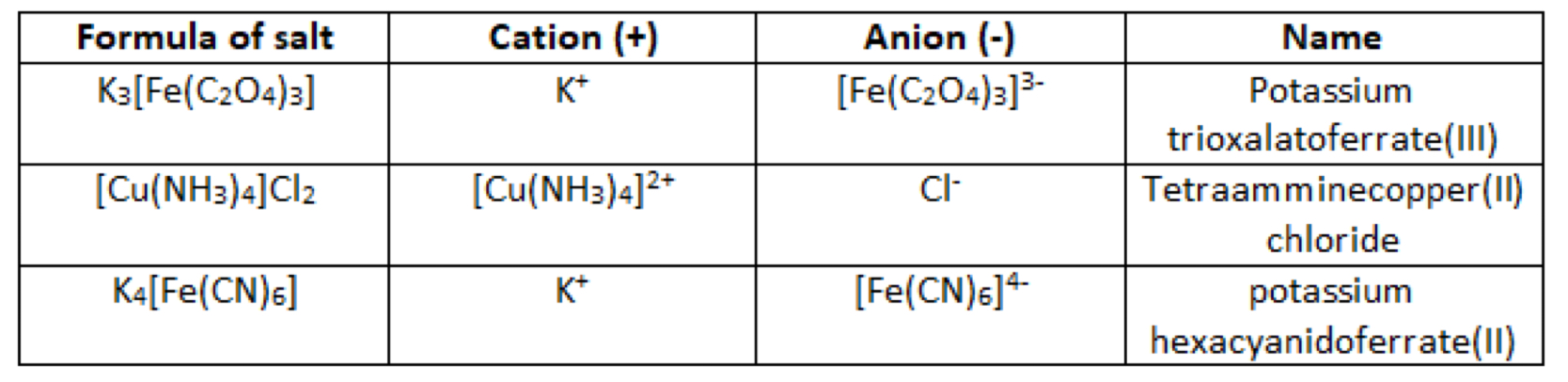
How do you name a complex ion or molecule containing ligands?
To name a complex ion or molecule containing ligands, you name the ligands first, in alphabetical order, followed by the name of the metal and it’s oxidation state represented by roman numerals.
What are the six prefixes for denoting the number of a particular ligand in a substance?
The prefixes for denoting the number of a particular ligand in a substance are:
Nothing for one
Di for two
Tri for three
Tetra for four
Penta for five
Hexa for six
If the ligand is a negative ion by which the name ends in ide, what does the final “e” change to?
If the ligand is a negative ion by which the name ends in -ide, the final “e” changes to “o”. For example, chloride would become chlorido.
If the ligand is a negative ion by which the name ends -ite, what does the final “e” change to?
If the ligand is a negative ion by which the name ends -ite, the final “e” changes to “o”. For example, nitrite would become nitrito.
What is the charge of the water ligand (OH2)?
The charge of the water ligand (OH2) is neutral.
What is the ligand name of the ligand (OH2)?
The ligand name of the ligand (OH2) is aqua.
What is the charge of the ammonia ligand (NH3)?
The charge of the ammonia ligand (NH3) is neutral.
What is the ligand name of the ammonia ligand (NH3)?
The ligand name of the ammonia ligand is ammine.
What is the charge of the carbon monoxide ligand (CO)?
The charge of the carbon monoxide ligand (CO) is neutral.
What is the ligand name of the carbon monoxide ligand (CO)?
The ligand name of the ammonia ligand is carbonyl.
What is the charge of the cyanide ion ligand (CN-)?
The charge of the cyanide ion ligand (CN-) is negative.
What is the ligand name of the cyanide ion ligand (CN-)?
The ligand name of the cyanide ion ligand (CN-) is cyanido.
What is the charge of the chloride ion ligand (Cl-)?
The charge of the chloride ion ligand (Cl-) is negative.
What is the ligand name of the fluoride ion ligand (F-)?
The ligand name of the fluoride ion ligand (F-) is fluorido.
What is the charge of the fluoride ion ligand (F-)?
The charge of the fluoride ion ligand (F-) is negative.
What is the ligand name of the bromide ion ligand (Br-)?
The ligand name of the bromide ion ligand (Br-) is bromido.
What is the charge of the bromide ion ligand (Br-)?
The charge of the bromide ion ligand (Br-) is negative.
What is the ligand name of the iodide ion ligand (I-)?
The ligand name of the iodide ion ligand (I-) is iodido.
What is the charge of the iodide ion ligand (I-)?
The charge of the iodide ion ligand (I-) is negative.
What is the ligand name of the nitrite ion ligand (NO2-)?
The ligand name of the nitrite ion ligand (NO2-) is nitrito.
What is the charge of the nitrite ion ligand (NO2-)?
The charge of the nitrite ion ligand (NO2-) is negative.
What is the ligand name of the hydroxide ion ligand (OH-)?
The ligand name of the hydroxide ion ligand (OH-) is hydroxido.
What is the charge of the hydroxide ion ligand (OH-)?
The charge of the hydroxide ion ligand (OH-) is negative.
What is the ligand name of the oxide ion ligand (O2-)?
The ligand name of the oxide ion ligand (O2-) is oxido.
What is the charge of the oxide ion ligand (O2-)?
The charge of the oxide ion ligand (O2-) is negative.
What is the ligand name of the hydride ion ligand (H-)?
The ligand name of the hydride ion ligand (H-) is hydrido.
What is the charge of the hydride ion ligand (H-)?
The charge of the hydride ion ligand (H-) is negative.
What is the ligand name of the oxalate ion ligand (C2O42-)?
The ligand name of the oxalate ion ligand (C2O42-) is oxalato.
What is the charge of the oxalate ion ligand (C2O42-)?
The charge of the oxalate ion ligand (C2O42-) is negative.
What is the ligand name of the EDTA ion ligand (EDTA4-)?
The ligand name of the EDTA ion ligand (EDTA4-) is Edta.
What is the charge of the EDTA ion ligand (EDTA4-)?
The charge of the EDTA ion ligand (EDTA4-) is negative.
What is the ligand name of the ethylenediamine ligand (NH2CH2CH2NH2)?
The ligand name of the ethylenediamine ligand (NH2CH2CH2NH2) is ethylenediamine.
What is the charge of the ethylenediamine ligand (NH2CH2CH2NH2)?
The charge of the ethylenediamine ligand (NH2CH2CH2NH2) is neutral.
How does the name of the metal change if the complex ion is a negative ion?
If the complex ion is a negative ion, the suffix -ate is added to the name of the metal. For example, cobalt would become cobaltate.
In a complex ion that is a negative ion, what would irons name be?
In a complex ion that is a negative ion, irons name would be ferrate.
In a complex ion that is a negative ion, what would coppers name be?
In a complex ion that is a negative ion, coppers name would be cuprate.
If a complex is a salt, how is the name of the substance affected?
If the complex is a salt the name of the positive ion precedes the negative ion.
In a complex of a transition metal, what are the d orbitals no longer?
In the complex of a transition metal, the d orbitals are no longer degenerate.
What does the splitting of d orbitals to higher and lower energies occur?
The splitting of d orbitals to higher and lower energies occurs when the electrons present in approaching ligands cause the electrons in the orbitals lying along the axes to be repelled.
What are ligands that cause a large difference in energy between subsets of d orbitals?
Ligands that cause a large difference in energy between subsets of d orbitals are strong field ligands.
What are ligands that cause a small difference in energy between subsets of d orbitals?
Ligands that cause a small difference in energy between subsets of d orbitals are weak field ligands.
What is the spectrochemical series?
The spectrochemical series is an order of ligands ability to split d orbitals.
What can the colours of many transition metal complexes be explained in terms of?
The colours of many transition metal complexes can be explained in terms of d-d transitions. Light is absorbed when electrons in a lower energy d orbital are promoted to a d orbital of higher energy. If light of one colour is absorbed, then the complementary colour will be observed. (Split this flashcard?)
When do electrons transition to higher energy levels?
Electrons transition to higher energy levels when energy corresponding to the ultraviolet or visible regions of the electromagnetic spectrum is absorbed.
What do ultra-violet and visible absorption spectroscopy involve?
Ultra-violet and visible absorption spectroscopy involve transitions between electron energy levels in atoms and molecules where the energy difference corresponds to the ultra-violet and visible regions of the electromagnetic spectrum.
What can transition metals and their compounds act as?
Transition metals and their compounds can act as catalysts.
What are heterogeneous catalysts?
Heterogeneous catalysts are catalysts that are in a different state to the reactants.
How can heterogeneous catalysts be explained?
Heterogeneous catalysts can be explained in terms of the formation of activated complexes and the adsorption of reactive molecules onto active sites. The presence of unpaired d electrons or unfilled orbitals is thought to allow activated complexes to form. This can provide reaction pathways with lower activation energies compared to the uncatalysed reaction
What are homogeneous catalysts?
Homogeneous catalysts are catalysts in the same state as the reactants.
How can homogeneous catalysts be explained?
Homogeneous catalysts can be explained in terms of changing oxidation states with the formation of intermediate complexes.