biotech - DNA fingerprinting
 Call Kai
 Learn
Learn Practice Test
 Spaced Repetition
 Match
Match Flashcards
 Knowt Play
1/15

There's no tags or description
Looks like no tags are added yet.
Name | Mastery | Learn | Test | Matching | Spaced | Call with Kai | Chat |
|---|
No analytics yet
Send a link to your students to track their progress
16 Terms
DNA Fingerprinting
Developed by Alec Jeffreys in 1984
identifies an individual based on the patterns formed from the variations in the genetic code
Also known as DNA profiling, genetic fingerprinting, DNA typing
Human Genome
20,000-30,000 genes
most of the DNA does NOT code for a protein or RNA (is not a gene)
non codng dna splits into
introns
Regulatory sequences
Highly Repetitive DNA
- tandemly repetitive dna
- telomere
- interspaced repetitive dna
Tandemly Repetitive DNA
Also called VNTRs (Variable Number Tandem Repeats)
Short DNA sequences repeated in a row
Types vary by repeat length
STRs = short repeats (often 4 bases)
Example: GGAA repeated (4 bp)
Characteristics of VNTRs
Polymorphic = many forms
Variation comes from the number of repeat units
The same DNA sequence (often an STR) is repeated
The repeat sequence can be repeated many different number of times in the population
Allelic Variation Compared
In a population, a polymorphic loci has many choices (alleles)
In an individual, there are only a maximum of two alleles
DNA Fingerprinting Method: STR Analysis
PCR
STR (fragment of interest) is at a specific locus on the chromosome
Primers locate and define this fragment
PCR amplifies (makes many copies of) the fragment
Gel Electrophoresis
Separates PCR products by size
Allows visualization of the DNA fragments
Allelic Variation in an Individual
Each person will have 2 copies but the copies can be different lengths (heterozygous) or the same length (homozygous)
A and C homozygous
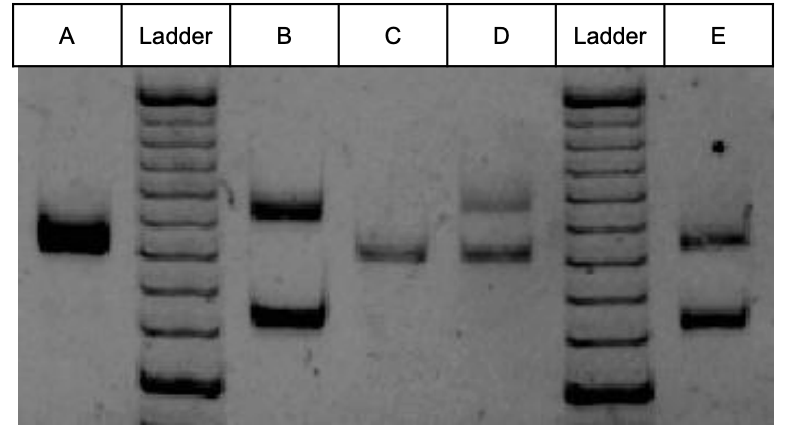
Allelic Variation
Only a limited number of alleles exist, but each can be shared by many people (5–20%)
👉 Implication:
A single allele is not unique to one person
You need to look at multiple loci to reliably distinguish individuals
Loci
STR analysis is powerful because it examines multiple loci (specific locations on a chromosome/DNA) at once
In North America: 13 loci + AMEL (sex marker) used for crime investigations
Fewer loci are used in paternity testin
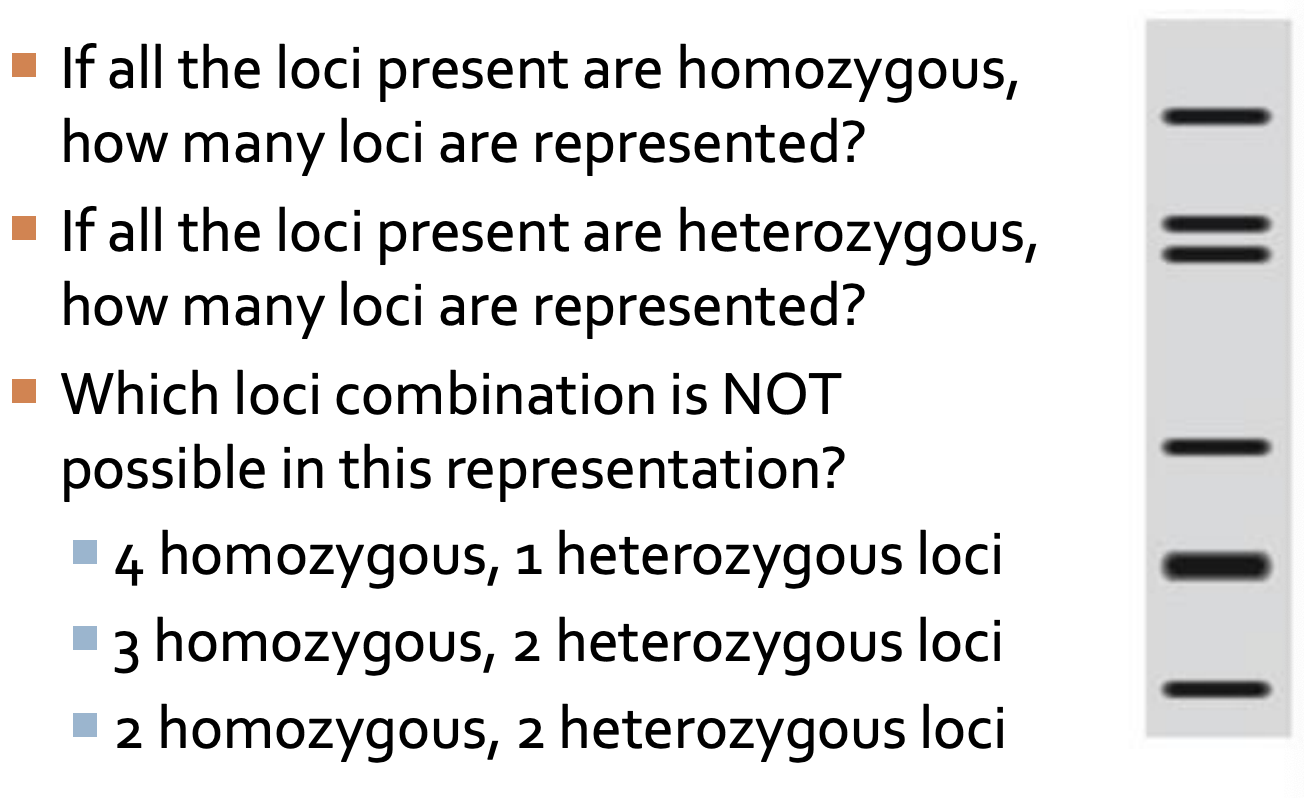
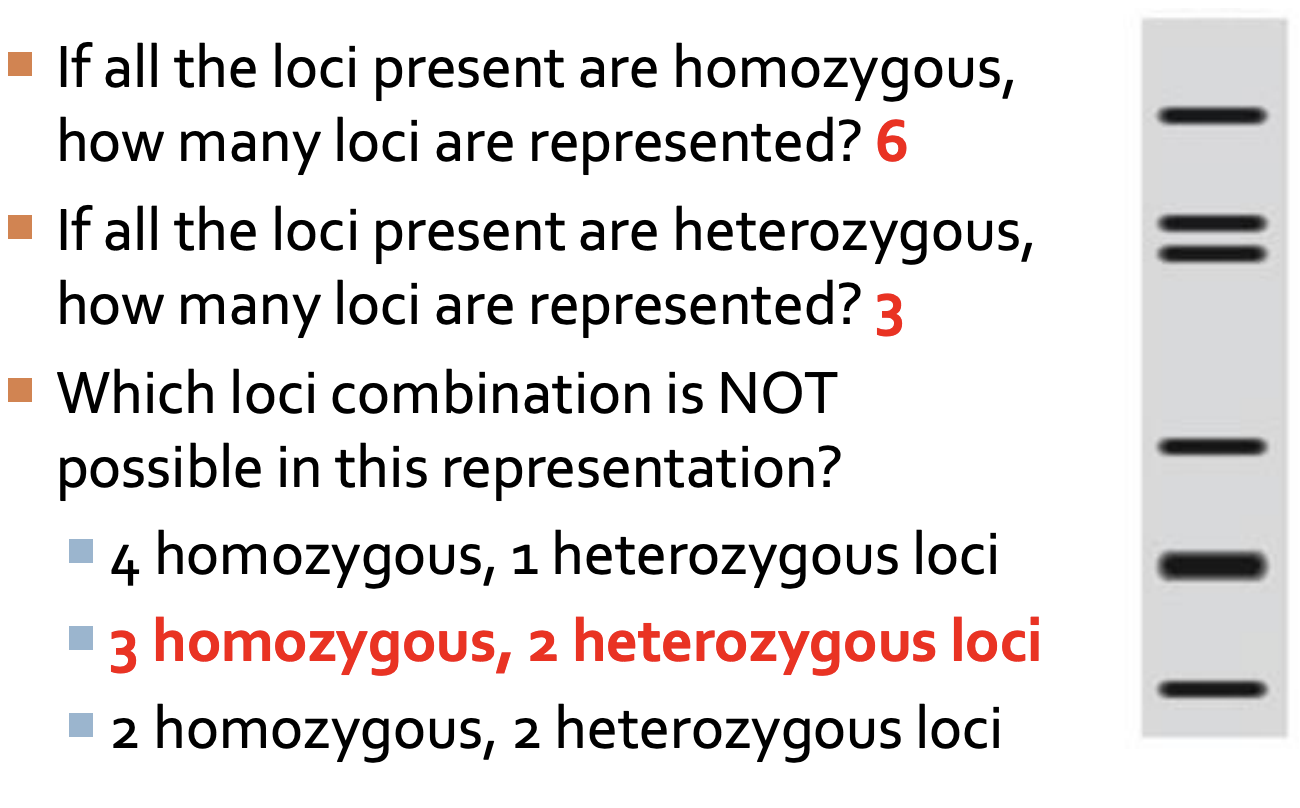
Loci answer
Homozygous locus (location on dna) → 1 band (dna fragment)
Heterozygous locus → 2 bands
4 homozygous + 1 heterozygous
= 4(1) + 1(2) = 6 bands ✅ possible3 homozygous + 2 heterozygous
= 3(1) + 2(2) = 7 bands ❌ not possible2 homozygous + 2 heterozygous
= 2(1) + 2(2) = 6 bands ✅ possible
Why use noncoding regions?
Coding regions are too similar between individuals and even species
DNA Fingerprinting Application
Paternity testing: identifying the father
Criminal cases: eliminating suspects
Identifying a corpse
Immigration disputes
Food testing (i.e. Champagne, horse meat)
Paternity
Used to identify a child’s parents
A child inherits one sent of chromosomes from both parents
Each band in the child must match a band from either the mother or father
paternity inclusion vs exclusion
Paternity inclusion: the man could be the father (his DNA matches the child’s at tested loci)
Paternity exclusion: the man cannot be the father (DNA does not match)
Why inclusion ≠ proof:
Many people can share the same alleles
A match at tested loci is not unique to one person
Only shows he can’t be ruled out, not that he is definitely the father
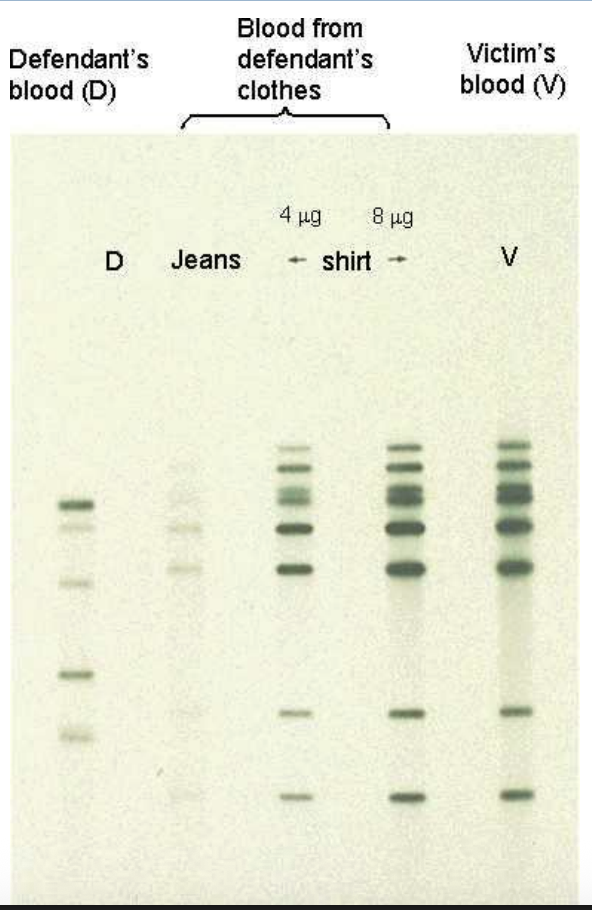
criminal case
If the blood from the defendant’s clothes: had one less band, could the victim’s blood still be considered present? had one more band, could the victim’s blood still be considered present?
If one band was missing, is victim still present?
👉 YES (usually)
DNA evidence isn’t always perfect
Bands can be missing due to:
degradation
experimental errorIf there’s one extra band, is victim still present?
👉 YES
Extra band could mean:
contamination
mixture of more than one person