Zoo Evolution & Taxonomy
 Call Kai
 Learn
Learn Practice Test
 Spaced Repetition
 Match
Match Flashcards
 Knowt Play
1/46

There's no tags or description
Looks like no tags are added yet.
Name | Mastery | Learn | Test | Matching | Spaced | Call with Kai | Chat |
|---|
No analytics yet
Send a link to your students to track their progress
47 Terms
Jean-Baptiste de Lamarck
developed an early theory of evolution based on:
1) Use & disuse: parts of the body that are used extensively become larger & stronger, while those that are not used deteriorate
2) Inheritance of acquired characteristics: characteristics acquired during an organism’s lifetime could be passed on to the next generation
*Lamarck’s explanatory mechanism was flawed*
Charles Darwin
developed natural selection as his mechanism for evolution:
-natural selection explains how adaptations arise
1) Genetic variation
2) Overproduction
3) Competition
4) Selection favors a trait
5) Evolution occurs as the unequal reproductive success of individuals leading to adaptations to their environment
6)Artificial selection
Genetic variation
Individuals in a population vary in their traits, many of which are heritable.
Overproduction
A population can produce far more offspring than can survive.
Competition
With more individuals than the environment can support, competition for resources is inevitable
Selection favors a trait
Individuals with inherited traits that are better suited to the local environment are more likely to survive and reproduce than individuals less well-suited.
Artificial selection
process by which species are modified by humans
*Individuals do NOT evolve; Populations evolve*
Example: Selective breeding for milk or meat production; development of dog breeds
Adaptations
characteristics that enhance organism’s ability to survive and reproduce in specific environments
Rapid speciation
new species filling new niches, because they inherited successful adaptations
Speciation
If an environment changes, or if individuals move to a new environment, natural selection may result in adaptation to these new conditions, sometimes giving rise to new species in the process.
*individuals from the new population are unable to mate successfully with individuals from the parent populations*
Homology
characteristics in related species can have an underlying similarity even though they have very different functions
Homologous structures
are anatomically similar structures with similar development.
Embryonic homologies
comparison of early stages of animal development reveals many anatomical homologies in embryos that are not visible in adult organisms.
Vestigial organs
-structures of marginal, if any, importance to the organism.
-remnants of structures that served important functions in the organism’s ancestor.
Molecular homologies
shared characteristics on the molecular level
(DNA, proteins, amino acid sequences)
Homeotic genes
master regulatory genes that determine the location and organization of body parts.
Convergent evolution
taken place when two organisms developed similarities as they adapted to similar environmental challenges – not because they evolved from a common ancestor.
explains why distantly related species can resemble one another
Analogous structures
similar functions with different internal structures & development
Example: bird wing/insect wing/bat wing
Biogeography
The geographic distribution of species
1) Species in a discrete geographic area tend to be more closely related to each other than to species in distant geographic areas.
2)Continental drift and the break-up of Pangaea can explain the similarity of species on continents that are distant today.
3)Endemic species are found at that certain geographic location and nowhere else.
The biological species concept
defines a species as: a group of individuals who have the potential to interbreed in nature and produce viable, fertile offspring.
Prezygotic & postzygotic
two types of barriers that prevent members of different species from producing offspring that can also successfully reproduce.
Prezygotic barriers
prevent mating or hinder fertilization if mating has occurred, include the following:
-Habitat (geographic) isolation
-Behavior isolation
-Temporal isolation (reproductive isolation)
-Mechanical isolation
-Gametic isolation
Postzygotic barriers
prevent a hybrid zygote from developing into a fertile adult:
-Reduced hybrid viability (frail offspring)
-Reduced hybrid fertility (infertile offspring)
Sexual Reproduction
-Advantage: genetic variation
-Disadvantage: energy requirement
Asexual Reproduction
-Advantage: numerous offspring, relatively quick, little energy required to find a mate
-Disadvantage: little genetic variation
allopatric speciation
a population forms a new species because it is geographically isolated from the parent population. When the population is geographically isolated gene flow is interrupted, resulting in reproductive isolation.
-geological events or processes that can fragment a population, resulting in geographical isolation of new populations
-Small, newly isolated populations undergo allopatric speciation more frequently because they are more likely to have their gene pools significantly altered.
Sympatric speciation
small part of a population forms a new species without being geographically separated from the parent population.
-population switching to a new habitat
-switching to a different resource such as food
-an accident during cell division, resulting in extra sets of chromosomes (polyploidy)
Adaptive radiations
periods of evolutionary change in which: groups of organisms form many new species whose adaptations allow them to fill open ecological niches.
Gradualism
proposes that species descended from a common ancestor and gradually diverge more and more in morphology as they acquire unique adaptations
Punctuated equilibrium
term used to describe periods of apparent stasis punctuated by sudden change observed in the fossil record
Carolus Linnaeus
-Grouped similar species into increasingly general categories based on a set of characteristics used to assess similarities and differences
-Developed taxonomy
-Developed binomial nomenclature
Taxonomy
branch of biology dedicated to the naming & classifying of all forms of life
-Hierarchical categories: Kingdom, Phylum, Class, Order, Family, Genus, Species (King-Phillip-Cried-Out-For-Goodness-Sake)
binomial nomenclature
two-part Latin naming system that includes the organism’s genus and species
Genus species
Example: leopard Panthera pardus
Dichotomous Key
*dichotomy means “two opposite parts or categories”*
-chooses between a series of two opposite statements that best describes the organism, until the user reaches the organism’s name
-should NOT use vague descriptions
- should only identify one characteristic
Phylogenetic Trees (dendograms)
-display the passage of time on the vertical axis and the degree of evolutionary divergence on the horizontal axis.
-shows the relationship between organisms based on their characteristics, genetic background, & evolutionary relationships.
-Estimating degree of evolutionary connection
1) Base of phylogenetic tree represents the ancestral species with primitive character(s)
2) Branches farther from the base of the tree, represent progressively more recent evolutionary lines & degree of relationship between species is based on the percentage of shared derived characters
3) Groups are organized based on the sequence in which unique derive characters appear in members of the related group -- Taxa on the same phylogenetic branch are closely related
Cladogram
shows relationship of shared anatomical features-shows the relationship of the closely related organisms
-made by compiling data on homologous characteristics shared by species
-can NOT show evolutionary links but they depict patterns of shared characteristics
Asymmetrical
no symmetry
Radial symmetry
parts in a circular arrangement around an axis

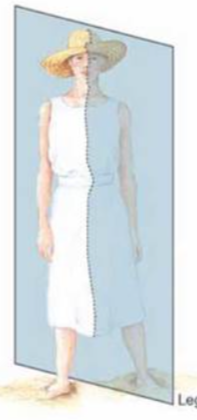
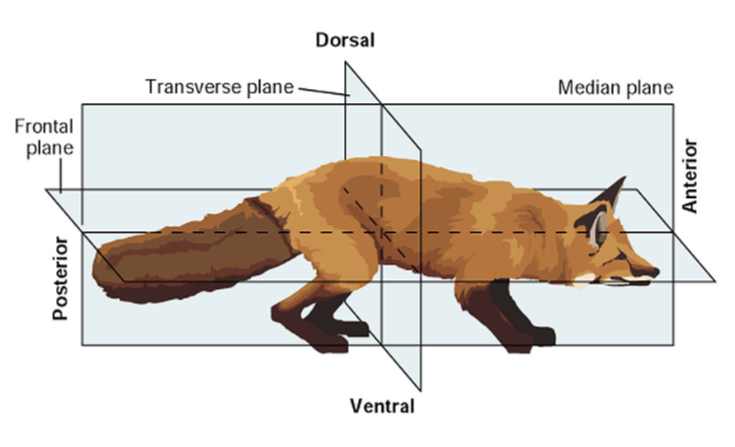
Bilateral symmetry
two similar halves on one central axis (animal tends to exhibit cephalization)
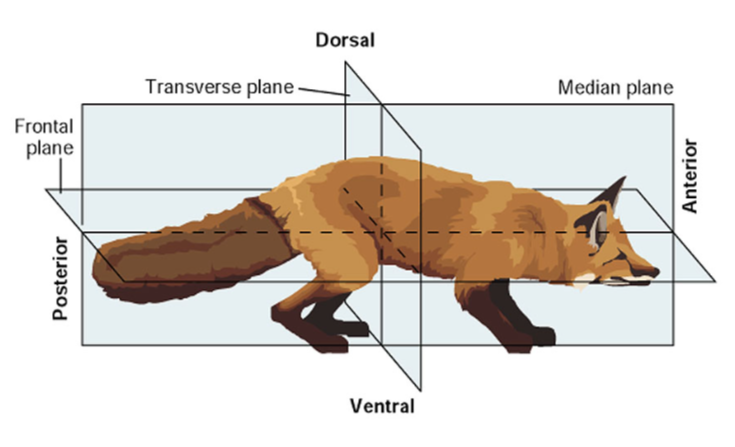
-Dorsal (back)
-Ventral (abdomen)
-Anterior (toward front/head area)
-Posterior (toward tail end)
Dorsal
back
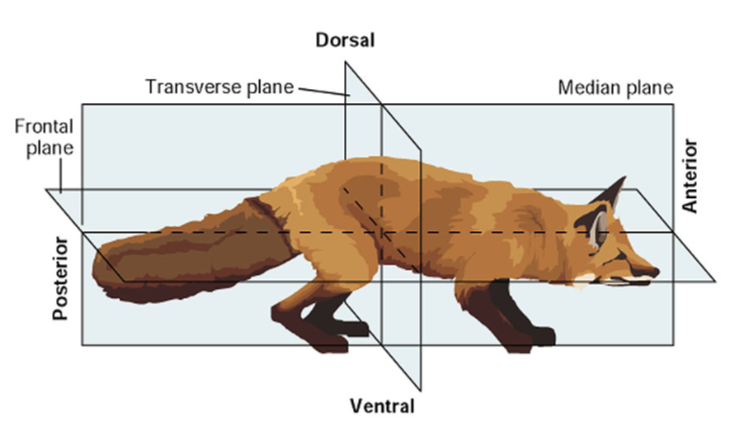
Ventral
abdomen
Anterior
toward front/head area
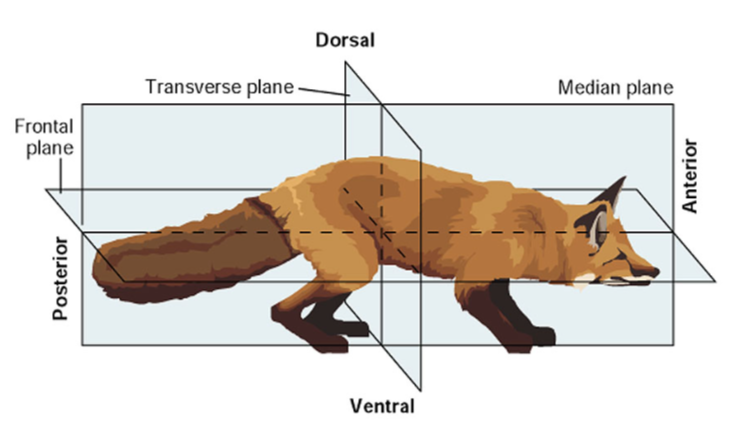
Posterior
toward tail end
Types of Body Cavities
-Acoelomate
-Pseudocoelom
-Coelom
Acoelomate
-no body cavity
-interior of animal is solid except for digestive tract/cavity
Pseudocoelom
-body cavity is NOT completely lined with mesoderm
-mesoderm does NOT surround the exterior of the endodermic gut
Coelom
-cavity completely lined with mesoderm
-surrounds and supports the endodermic gut