LEC 1 SP 131 INTRODUCTION
0.0(0)
Studied by 3 people Call Kai
 Learn
Learn Practice Test
 Spaced Repetition
 Match
Match Flashcards
 Knowt Play
Card Sorting
1/137

Earn XP
Description and Tags
Last updated 7:34 PM on 2/29/24
Name | Mastery | Learn | Test | Matching | Spaced | Call with Kai | Chat |
|---|
No analytics yet
Send a link to your students to track their progress
138 Terms
1
New cards
ANATOMY
Study of the structure of an organism
2
New cards
“Anatomia” or “Anatome”
dissection or cutting of parts of an organism
3
New cards
Applied or clinical anatomy
* Application of anatomical study for the diagnosis and treatment of disease
* Relevant to surgical procedures and things involving a typical human body
* Relevant to surgical procedures and things involving a typical human body
4
New cards
Descriptive or Systematic Anatomy
* Description of individual part of the body without reference to disease or any other condition
* Views the body as composite of systems that function together
* Views the body as composite of systems that function together
5
New cards
Gross
* Body as visible without microscopy
6
New cards
Microscopic
* Body by means of microscopy
7
New cards
Surface
* Body and its surface markings related to underlying structures
8
New cards
Developmental
* Anatomy with reference to growth
* Ex: from conception to adulthood
* Ex: from conception to adulthood
9
New cards
Pathological
* Body with respect to pathological entity
10
New cards
Comparative
* Homologous (similar position, structure, value, or purpose) structures of different animals
11
New cards
PHYSIOLOGY
Study of the function of the living organism and its parts, as well as the chemical processes involved
12
New cards
Physis
nature origin
13
New cards
Logus
study
14
New cards
SPEECH PATHOLOGY
* Study of the nature of diseases and of the structural and functional changes that are imposed upon the living organism as a result
* Understand the typical structure and function of the human body to understand and provide appropriate treatment to those individuals with altered anatomy and physiology
* Understand the typical structure and function of the human body to understand and provide appropriate treatment to those individuals with altered anatomy and physiology
15
New cards
Cranial cavity
* brain and other structures
16
New cards
Vertebral cavity
spinal cord and vertebral canal
17
New cards
Thoracic cavity
lungs and related structures
18
New cards
Pericardial cavity
heart
19
New cards
Abdominal cavity
digestive organs
20
New cards
ANATOMICAL POSITION
International standard position in which structures of the human body are described:
* Body standing upright and facing the observer
* Eyes looking forward
* Arms resting at the side
* Palms and toes facing forward
* Body standing upright and facing the observer
* Eyes looking forward
* Arms resting at the side
* Palms and toes facing forward
21
New cards
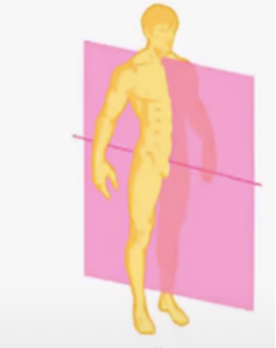
**Sagittal plane**
* Generally left and right
22
New cards
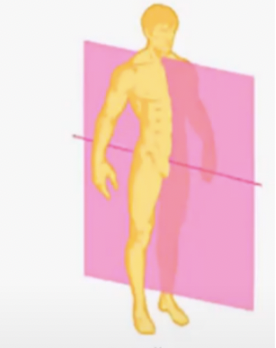
**Midsagittal plane**
* Exactly at the middle
* Equally divides left and right
* Equally divides left and right
23
New cards
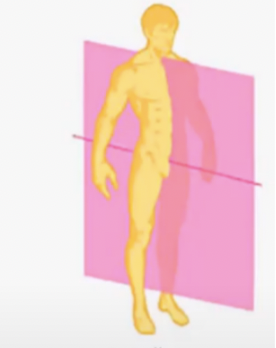
**Parasagittal plane**
* Anywhere else that divides left and right
* Not equal
* Not equal
24
New cards
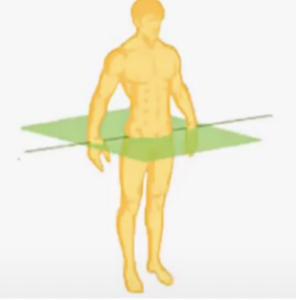
**Transverse, Horizontal, Axial**
Upper (superior) and lower (inferior)
25
New cards
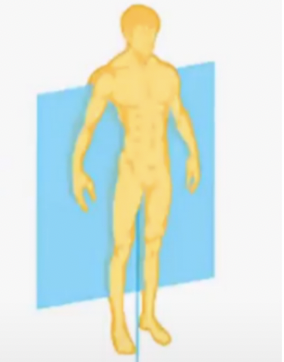
**Frontal, Coronal**
* Front (anterior) and back (posterior)
26
New cards
**Anterior**
**posterior**
27
New cards
**Ventral**
**dorsal**
28
New cards
Ventral and anterior
v and a are synonymous
29
New cards
Posterior and dorsal
p and d are synonymous (interchangeable)
30
New cards
**Rostral and Cranial**
**caudal**
31
New cards
In animals with linear nervous system
rostral is synonymous to anterior; caudal
32
New cards
True
our CNS is not linear
33
New cards
**Midbrain diencephalic junction**
At this point - 90 degrees nervous system
34
New cards
**Medial**
**lateral**
35
New cards
**Central**
**peripheral**
36
New cards
medial , central
starts at center
37
New cards
Lateral, peripheral
away from the center
38
New cards
**Extrinsic**
* **intrinsic**
39
New cards
**External**
**internal**
40
New cards
Extrinsic
* refers to structures that originate outside the body
41
New cards
Intrinsic
* situated within the body
42
New cards
**Proximal**
* **closer to reference point**
43
New cards
**Distal**
* **farther from reference point**
44
New cards
**Deep**
closer to the interior part of the body
45
New cards
**Intermediate**
* **in between**
46
New cards
**Superficial**
situated towards the external part of the body
47
New cards
**Superior**
farther from the ground
48
New cards
**Inferior**
* **lower, closer to the ground**
49
New cards
Unilateral
one side
50
New cards
Bilateral
two side
51
New cards
Ipsilateral
* same sides
52
New cards
Contralateral
different sides
53
New cards
**Cells**
Smallest unit of life
54
New cards
**Tissues**
Cells that work together to perform a specific function
55
New cards
**Organs**
Tissues that form a particular & identifiable structure of the body
56
New cards
**Organ systems**
Organs that work together
57
New cards
**organism**
All organ systems that work together
58
New cards
**Epithelial**
* Simple, compound, basement
* Superficial layer, constitute the skin in other areas
* absence of intercellular materials that allow them to create a tightly packed sheet
* role is to provide a barrier to some materials
* Superficial layer, constitute the skin in other areas
* absence of intercellular materials that allow them to create a tightly packed sheet
* role is to provide a barrier to some materials
59
New cards
**Muscle**
* 3 kinds: Striated, smooth, cardiac
60
New cards
**Nervous**
* consists of Neurons, glial cells
* highly specialized communicative tissues
* function is to transmit information from one neuron to another, from neurons to muscles, & from sensory receptors to other neural structures
* highly specialized communicative tissues
* function is to transmit information from one neuron to another, from neurons to muscles, & from sensory receptors to other neural structures
61
New cards
**Connective**
* Most complex
* Areolar, adipose, white fibrous, yellow elastic, lymphoid, blood, cartilage, bone
* Specialize for the purpose of support and protection
* Composed of intracellular material (the matrix)
* Areolar, adipose, white fibrous, yellow elastic, lymphoid, blood, cartilage, bone
* Specialize for the purpose of support and protection
* Composed of intracellular material (the matrix)
62
New cards
**Tissue Aggregates**
* when basic basic body tissues are used to form larger structures,
* for instance, tissue aggregates with functionality, all the tissues in an organ serve generally the same purpose
* for instance, tissue aggregates with functionality, all the tissues in an organ serve generally the same purpose
63
New cards
**Bone**
* Hardest connective tissue
* Provide support and protection
* Usually replaced with cartilage where elasticity is essential
* Help provide rigid skeletal support and protection for internal organs
* Provide support and protection
* Usually replaced with cartilage where elasticity is essential
* Help provide rigid skeletal support and protection for internal organs
64
New cards
**Joints**
* Union of bones with other bones, or cartilage with other cartilage
65
New cards
**Fascia**
* Sheetlike- membrane that surrounds organs
* Can be dense or flimsy, thin or thick
* Can be dense or flimsy, thin or thick
66
New cards
**Ligament (visceral & skeletal)**
* Visceral ligaments binds organs together or hold structures in place
* Skeletal ligaments bind bone to bone
* Skeletal ligaments bind bone to bone
67
New cards
**Tendon**
* Means of attaching muscle to bone or cartilage
* Tendons are arranged longitudinally
* have a greater tensile strength but have reduced compressive strength
* Tendons are arranged longitudinally
* have a greater tensile strength but have reduced compressive strength
68
New cards
Fibrous (synarthrodial)
* **Immobile/ fixed**
69
New cards
cranium
* Sutures in the skull\* (not just one big bone, there are part that make up our skull
70
New cards
gomphosis
* articulation is joint by this
* teeth to mandible
* teeth to mandible
71
New cards
syndesmosis
* specific types of different joints in the body - tibia fibula
72
New cards
Cartilaginous (amphiarthrodial)
* **Limited mobility/ have allowance for movement**
* Synchondroses and symphyses (ex. Bones in the ribcage that need to expand)
* Cartilage that ossifies through aging
* Synchondroses and symphyses (ex. Bones in the ribcage that need to expand)
* Cartilage that ossifies through aging
73
New cards
Synovial (diarthrodial)
* **High mobility**
* Due to the presence of Synovial fluid found within joint
* Due to the presence of Synovial fluid found within joint
74
New cards
**Pivot**
* rotation only, central bony pivot surrounded by a bony-ligamentous ring
* e.g., between C1 and C2 (vertebral column)
* e.g., between C1 and C2 (vertebral column)
75
New cards
**Hinge**
* movement in one place, usually flexion and extension
* e.g., joints of elbow, ankle, knee
* e.g., joints of elbow, ankle, knee
76
New cards
**Saddle**
* opposing articular surfaces (concave-convex shape) which makes it saddle-like appearance
* e.g., carpometacarpal joints
* e.g., carpometacarpal joints
77
New cards
**Ball & socket**
* ball-shaped surface fits into cup-like depression. Free movement along numerous axes
* e.g., hip, shoulder joints
* e.g., hip, shoulder joints
78
New cards
**Condyloid**
* convex surface articulates with concave elliptical cavity, also known as ellipsoid joints
* e.g., wrist joints
* e.g., wrist joints
79
New cards
**Plane**
* relatively flat articular surfaces, bones glide over on another
* e.g., subtalar joints
* e.g., subtalar joints
80
New cards
**Muscle Tissue**
* Specialized contractile tissue, fibers capable of being stimulated to contract
* Responsible for most body movement
* Can be classified as striated, smooth, or cardiac
* Responsible for most body movement
* Can be classified as striated, smooth, or cardiac
81
New cards
600
____ muscles in our body
82
New cards
**Striated or skeletal**
* Striped appearance
* Moves skeletal structures
* Voluntary movements
* Moves skeletal structures
* Voluntary movements
83
New cards
**Smooth**
* Sheet-like, spindle-shaped cells
* Digestive tract, blood vessels
* Involuntary movements
* Digestive tract, blood vessels
* Involuntary movements
84
New cards
**Cardiac**
* Net-like fashion heart
* Involuntary movements
* Involuntary movements
85
New cards
Muscle body
epimysium
86
New cards
Muscle fascicle
* bundles grouped by the perimysium
87
New cards
Muscle fiber
individually wrapped by endomysium
88
New cards
Myofibril
* cellular organelles
89
New cards
Sarcolemma
* cell membrane
90
New cards
Sarcoplasm
* similar to cytoplasm
91
New cards
Sarcoplasmic reticulum
* source of calcium
92
New cards
Sarcomere
smallest functional unit
93
New cards
Myofilament
* actin & myosin
94
New cards
Size
*Vastus (huge), maximus (large), longus (long), minimus (small), brevis (short)*
95
New cards
**Shape**
*Deltoid (triangle), rhomboid (rhombus), latissimus (wide), teres (round), trapezius (trapezoid)*
96
New cards
**Direction**
*Rectus (straight), transverse (across), oblique (diagonal), orbicularis (circular)*
97
New cards
**Location**
*Pectoralis (chest), gluteus (butt/rump), brachii (arm), supra-/infra- (above,below), lateralis (lateral)*
98
New cards
**Attachments**
*Sternocleidomastoid (involve sternum, clavicle, and mastoid), brachioradialis (origin of brachium, insertion to radius)*
99
New cards
**Number of origins**
*Biceps (2), triceps (3)*
100
New cards
**actions**
*Abductor, adductor, flexor, extensor, levator*