12. Individual Education Programs and 504 Plans - Vision of Children Summer 2026
 Call Kai
 Learn
Learn Practice Test
 Spaced Repetition
 Match
Match Flashcards
 Knowt Play
1/42

There's no tags or description
Looks like no tags are added yet.
Name | Mastery | Learn | Test | Matching | Spaced | Call with Kai | Chat |
|---|
No analytics yet
Send a link to your students to track their progress
43 Terms
True or False:
Public schools are obligated to provide help to children who learn differently than other children
true
States are obligated to identify children with _____ under The Individuals with Disabilities Education Act
disabilities
Under The Individuals with Disabilities Education Act, evaluations of a child must assess what?
all areas related to the suspected disability
Under The Individuals with Disabilities Education Act, who determines if the child has a disability?
a group of qualified professionals and the child's parents
If the child is determined to be a "child with a disability" as defined by the IDEA, the child will be eligible for what?
special education and related services
If the child is determined to be a "child with a disability" as defined by the IDEA, what must happen?
an IEP team must meet to write an IEP within 30 days
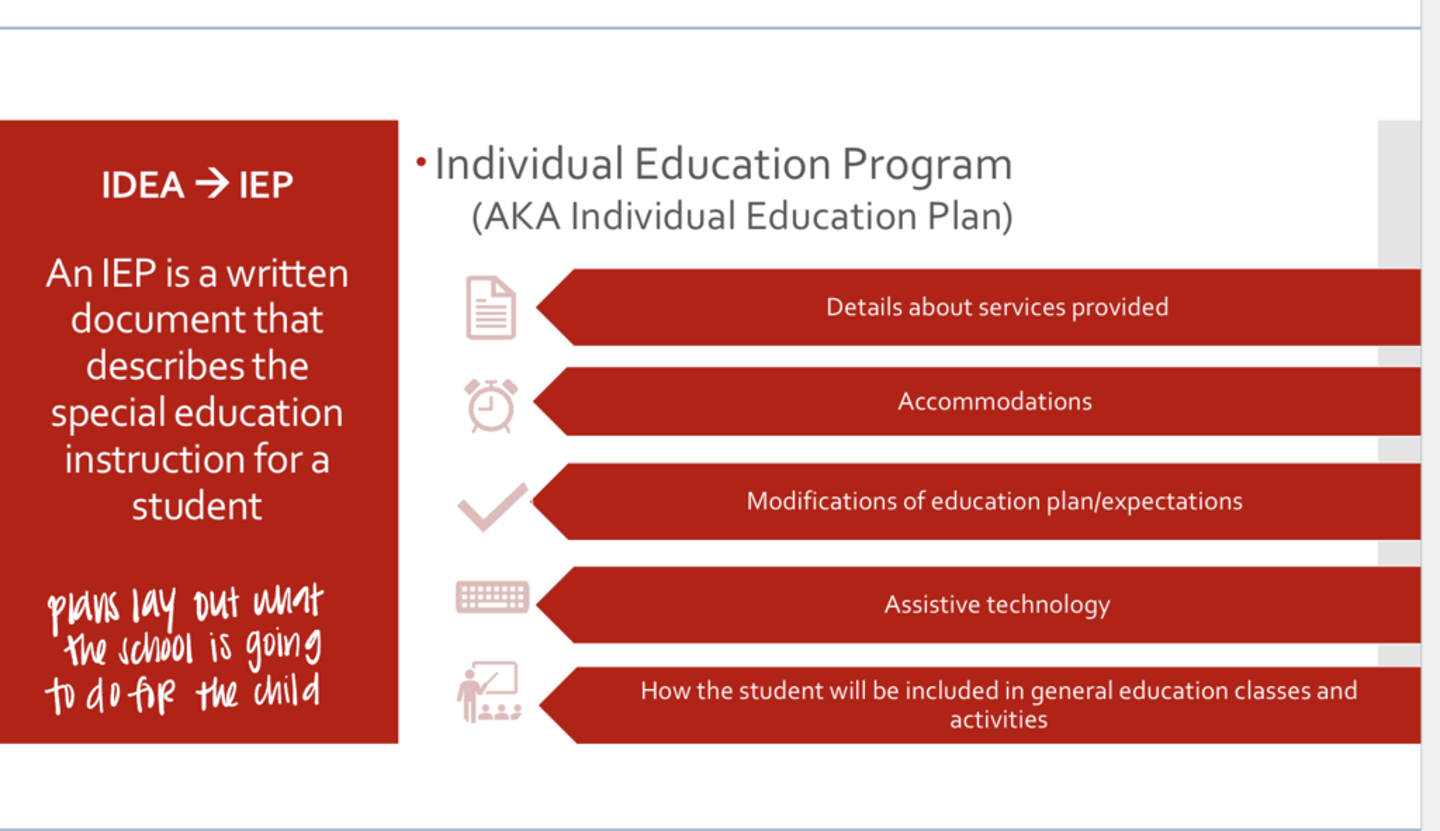
What is an IEP?
a written document that describes the special education instruction for a student
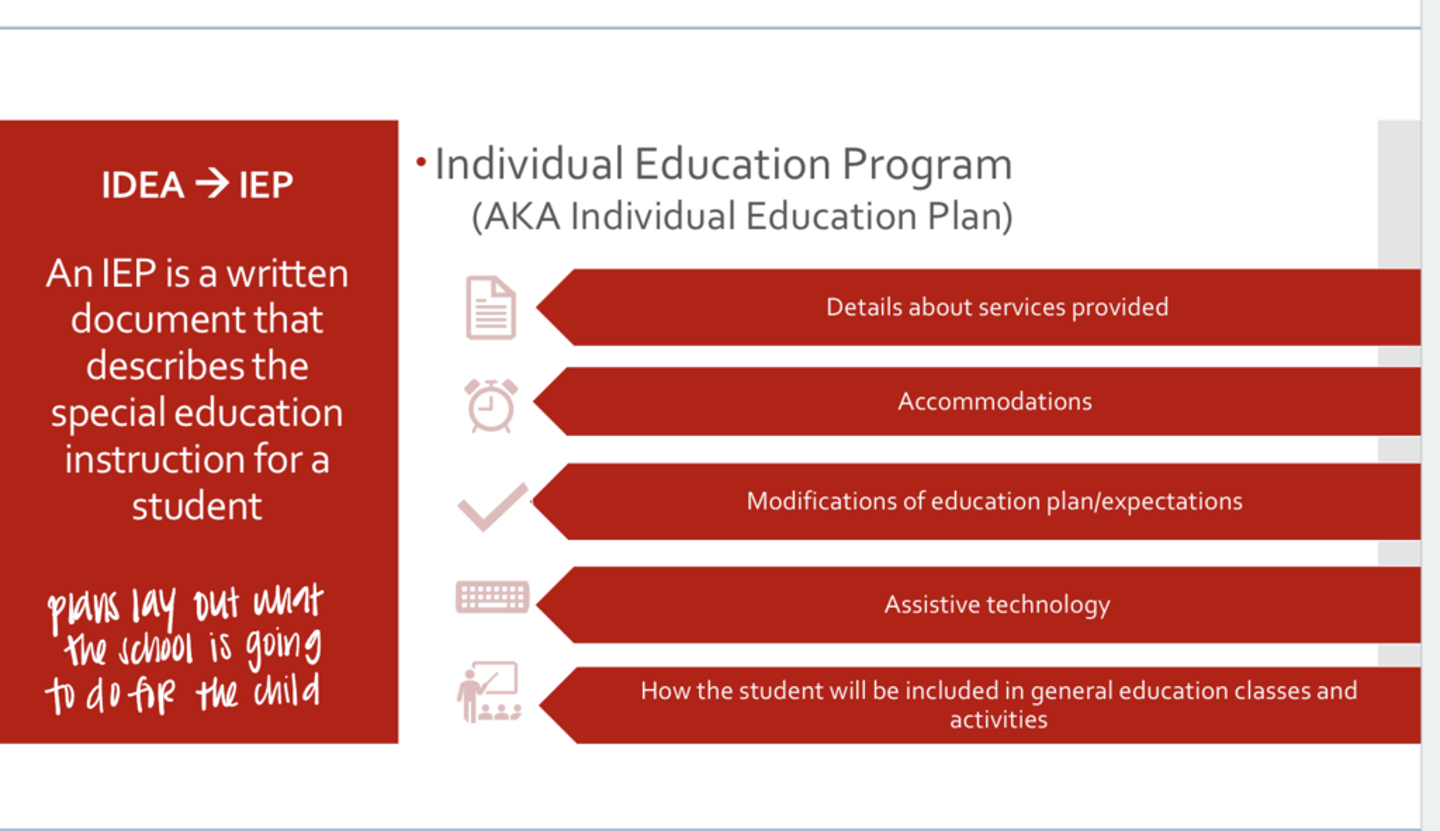
What does an IEP contain?
-details about services provided to the child
-accommodations
-modifications of education plan/expectations
-assistive technology
-how the student will be included in general education classes and activities
A student must meet 1+ out of 13 disability categories listed in the IDEA in order to qualify for an IEP. What are these 13 disability categories?
-specific learning disability
-speech or language impairment
-other health impairment (ADHD)
-autism
-intellectual disability
-emotional disturbance
-developmental delay
-multiple disabilities
-hearing impairment
-orthopedic impairment
-visual impairment
-traumatic brain injury
-deaf-blindness
What does an IEP include?
-present level of performance
-a plan for frequency of assessments to track progress
-annual measurable goals
-re-evaluation at least once every 3 years to determine if an IEP is still needed
IEPs need to be re-evaluated every _____ years to determine if an IEP is still needed
at least every 3 years
An IEP is created after a ______ consents
parent
Who is an IEP created by?
-team of people
-student's parents/caregiver
-at least one general education teacher
-at least one special education teacher
-a school psychologist or other specialist who can interpret the eval results
-a district representative who has the authority to approve school resources for the student
An ______ is required to be completed by public schools for an IEP
evaluation
Private evaluations are paid for by who?
Parents
If a parent decided to get a private eval on their own, they could go to who?
-educational psychologist
-neuropsychologist
-clinical psychologist
What is the role of an educational/school psychologist?
assess a child's educational abilities and recommend actions to facilitate student learning and overall school function
Where do educational/school psychologist work?
-school systems
-community-based agencies
-private practice
What can educational/school psychologists specialize in?
school related problems like learning disabilities, reading, and ADHD
Are educational/school psychologist well-trained in medical-based disabilities and disorders?
Maybe not
Medical professionals often refer to ___________ when all medical (and visual) problems have been ruled out
educational psychologists
What type of tests do educational/school psychologist administer?
norm-based psychological tests and criterion-referenced educational (achievement) tests
What is the role of a neuropsychologist?
clinical psychologist, typically with additional training in neurological development, who examine cognition (ability to think, remember, and learn), behavior, and emotions in relation to brain function (esp in the relation to the effects of brain damage and organic brain disease)
What do neuropsychologist use knowledge of brain development, brain organization, and effects of varoius forms of brain injury to guide?
assessments and interpretation
What are the typical elements of an IEP evaluation?
-psychological evaluation
-interviews of parents, teachers, people who may work with the child
-physical exam
-academic testing
-behavioral assessment
-speech assessments
-language assessments
-fine motor
-gross motor
-vision
What was the USA's first civil rights law for people with disabilities?
Section 504 of the Rehabilitation Act of 1973
What did the Section 504 of the Rehabilitation Act of 1973 propose?
-A school must provide reasonable accommodations to people with disabilities that give equal access to learning and school activities
-Schools do not need to change the programs -- but need to make them accessible
Public schools provide a ______ if a disability gets in the way of a student's ability to learn the curriculum
written 504 plan
To have a 504 plan, a student must have what?
a disability that impacts one or more major life activities needed for learning (reading or paying attention)
Which have more requirements?
IEPs or 504 plan
IEPs
Can a child qualify for a 504 plan but NOT a IEP?
Yes
Who does a 504 plan include
a plan created by a team that MAY include the student's parent/caregiver, general and special educations teachers, and/or school principle
A 504 plan is generally reviewed ______ with a re-eval every 3 years or when needed
every year (annually)
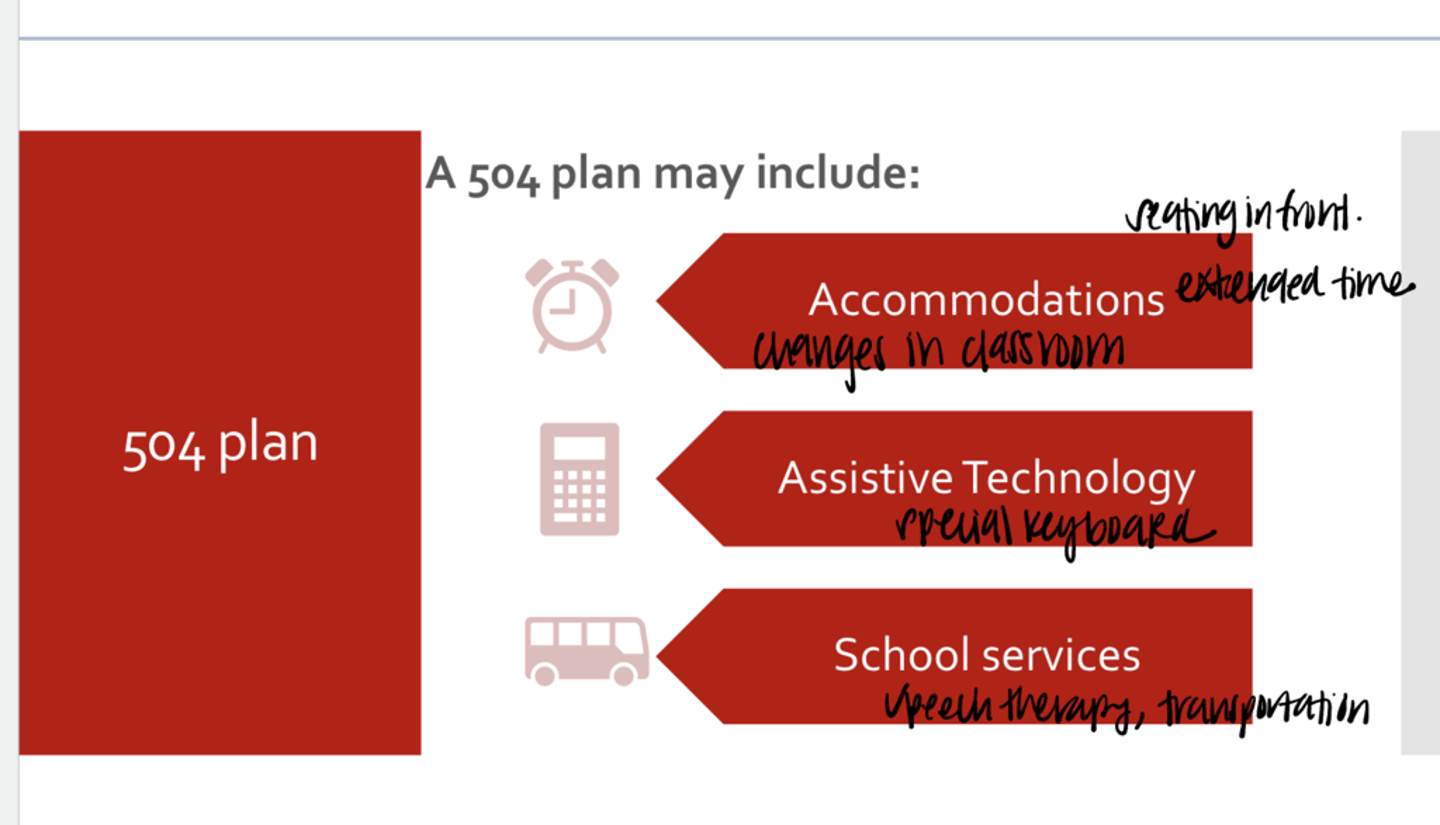
What can a 504 plan include?
-accommodations
-assistive technology
-school services
Possible accommodations a child can need (not limited to only these)
-extended time on tests or assignments
-peer assistance with note taking
-extra set of textbooks for home use
-computer aided instruction
-large print
-low vision device
-preferential seating
-audio books
-braille
What is the definition of visual impairment?
(includes blindness). Impairment of vision that, even with correction, adversely affects a child's educational performance
What does the term visual impairment include?
partial sight and blindness
What does the term visual impairment NOT include?
-disorder in one or more parts of the basic psychological processes
-perceptual disabilities
-brain injury
-minimal brain dysfunction
-dyslexia
-developmental aphasia
True or False:
States can vary in how they decide to further implement an IEP
true
In Ohio, House Bill 95 was passed in 2003, and required what?
required an eye exam to be completed within 90 days of the initiation of an IEP
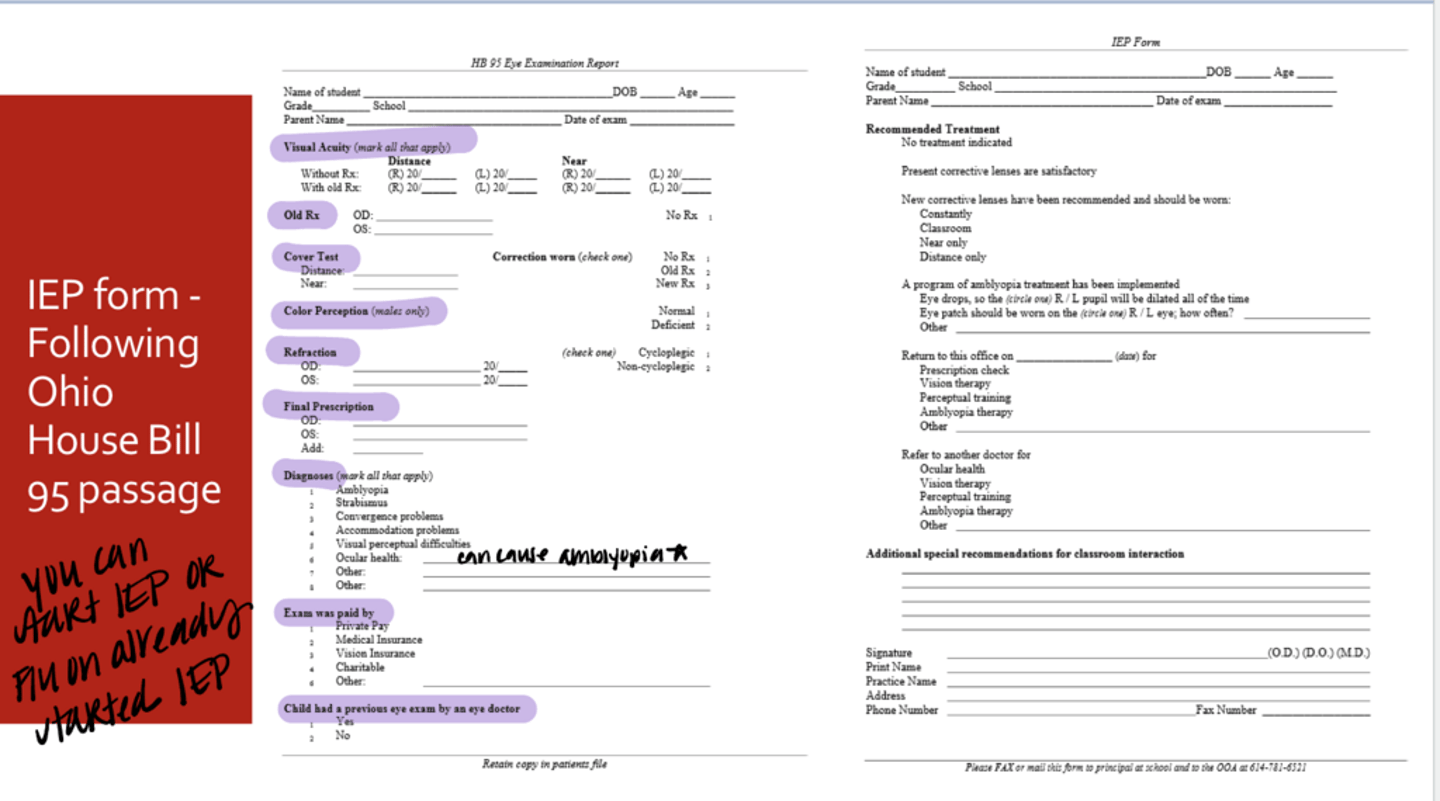
IEP Form Following Ohio House Bill 95 Passage (Pic)
IEP Form Following Ohio House Bill 95 Passage (Pic)
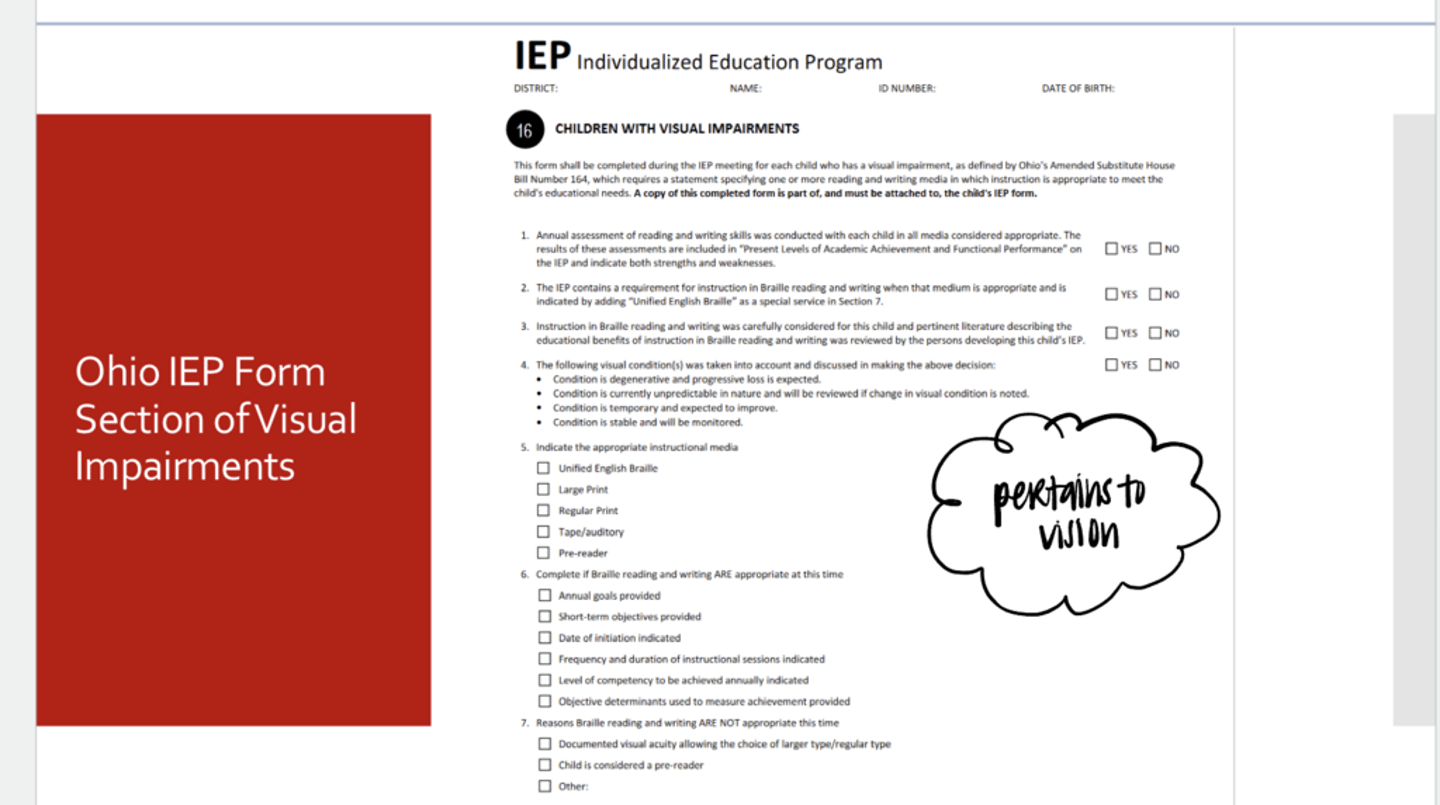
Ohio IEP Form Section of Visual Impairments (Pic)
Ohio IEP Form Section of Visual Impairments (Pic)
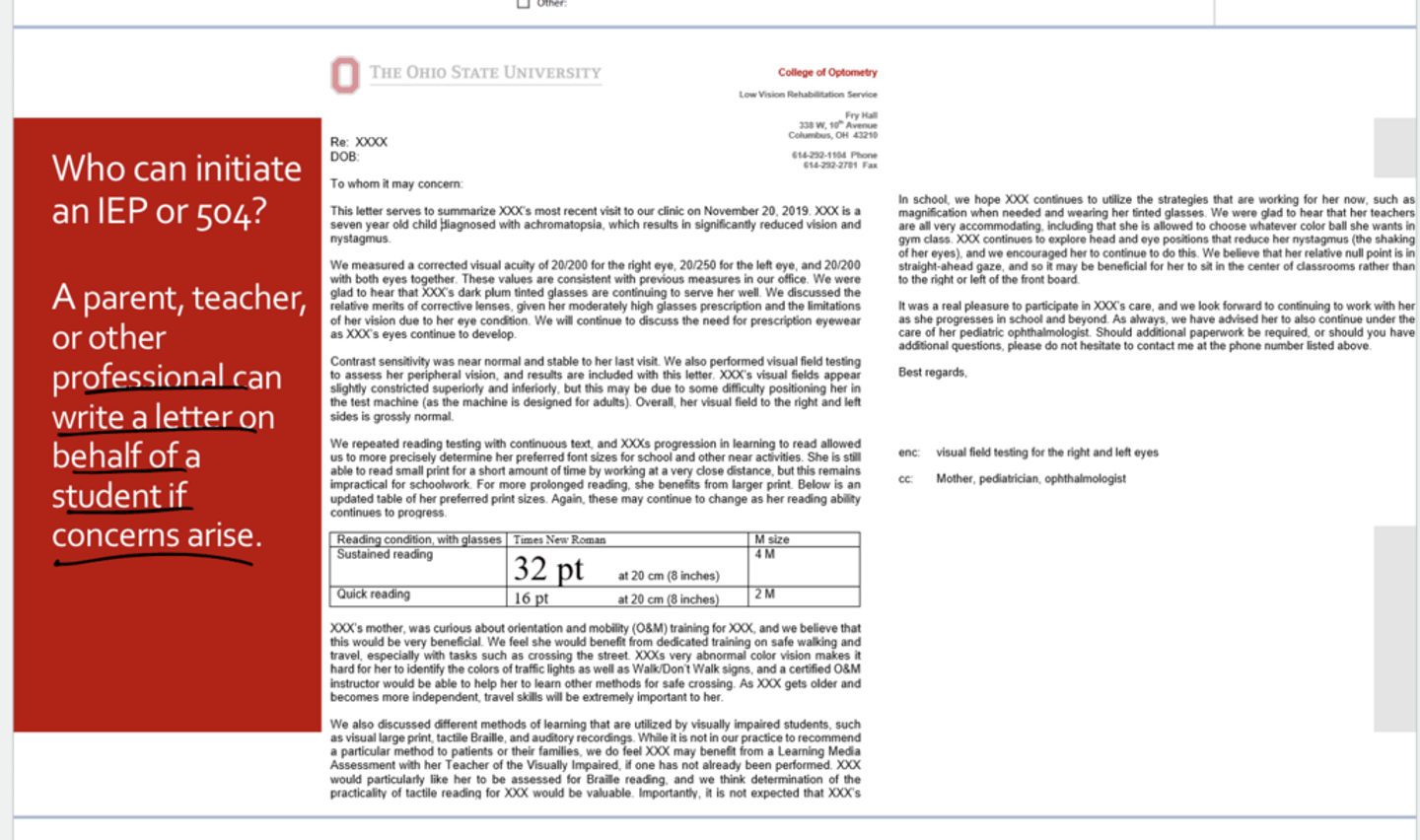
Who can initiate an IEP or 504 plan?
A parent, teacher, or other professional can write a letter on behald of a student if concerns arise