week 4- Interviewing suspects and witnesses
 Call Kai
 Learn
Learn Practice Test
 Spaced Repetition
 Match
Match Flashcards
 Knowt Play
1/28

There's no tags or description
Looks like no tags are added yet.
Name | Mastery | Learn | Test | Matching | Spaced | Call with Kai | Chat |
|---|
No analytics yet
Send a link to your students to track their progress
29 Terms
Ploygraph
assumes lying is to do with..
some signs are…
limitation?
•Assumed that lying is accompanied by physiological activity within liar’s body
•Sweating of fingers (GSR), blood pressure, respiration
•Lack of standardisation
–Scoring is subjective
–Questions differ from test to test
Problems with polygraphs (3)
Potentially low rates of deception
Innocent people may still react strongly to questions about whether they committed a crime
Countermeasures may be used by suspect
→Reduced detection of lies by 50% (Honts et a., 1994)
ways people can over come these bodily signs in an interview (physical and mental)

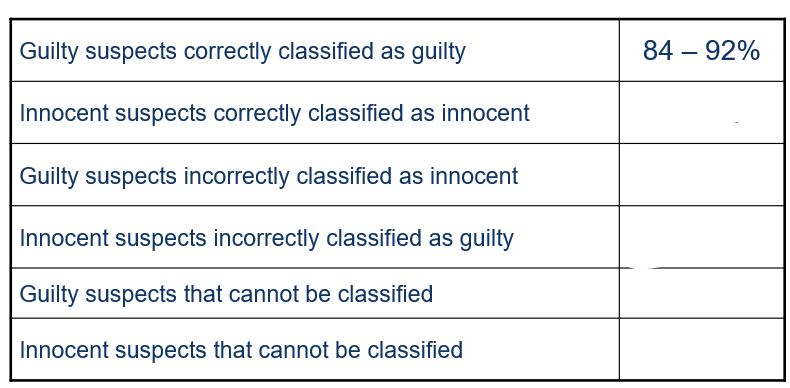
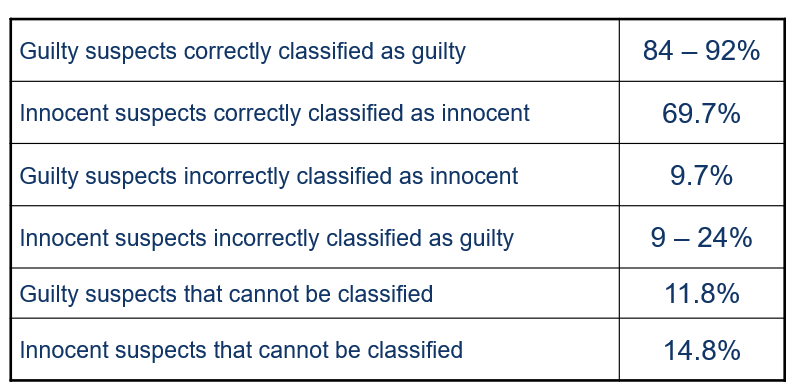
Polygraph accuracy (across 63 studies) (%)
Difficult to test the accuracy of the polygraph
Laboratory studies (experimental) don’t involve the same severity (high stakes) of consequences
In field studies, we never know for certain who is lying
Micro expressions
how quick are they?
training tool? small or large increase in accuracy after 1 hr training?
•40 milliseconds
•Across cultures
•METT: Micro Expression Training Tool:
–Trained to identify micro expressions, feedback, photos of faces with emotions,
–large increases in accuracy with one hour training
•Training, practice and feedback in detecting NV indicators improve skill
Interviewing Witnesses:
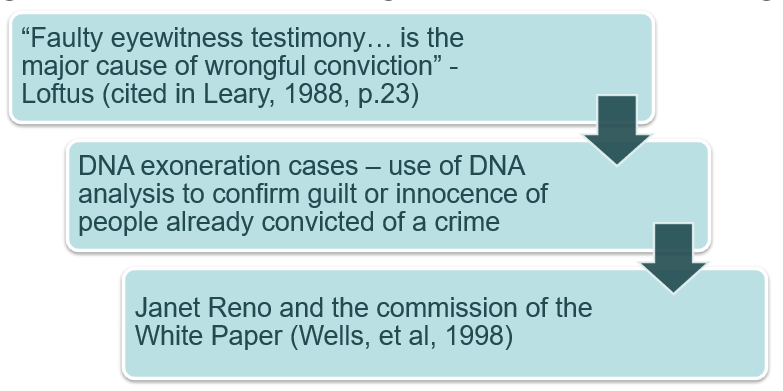
Eyewitness testimony
appox how many people per yr charged soley on eyewitness evidence?
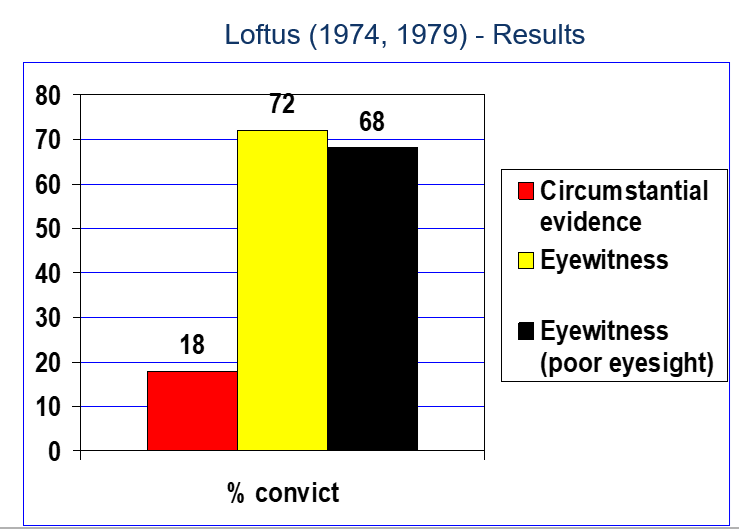
Loftus, how much % resulted in conviction?
77,000
•Loftus – UK cases where only evidence was eyewitness testimony – 74% resulted in conviction
Loftus, more detail
•Small grocery store robbed, owner murdered, police caught a suspect
•Group 1: Circumstantial evidence
•Group 2: Circumstantial evidence + eyewitness testimony
•Group 3: Same as group 2, but eyewitness shown to have poor uncorrected eyesight
dutch media and plane crash *
•Crash of plane into apartment building
•Dutch media showed aftermath of crash
•66% of participants reported having seen coverage of actual crash
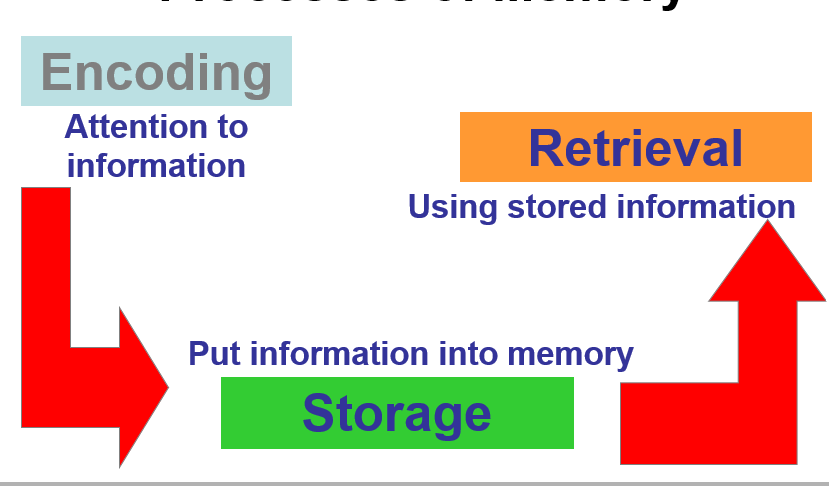
Processes of Memory
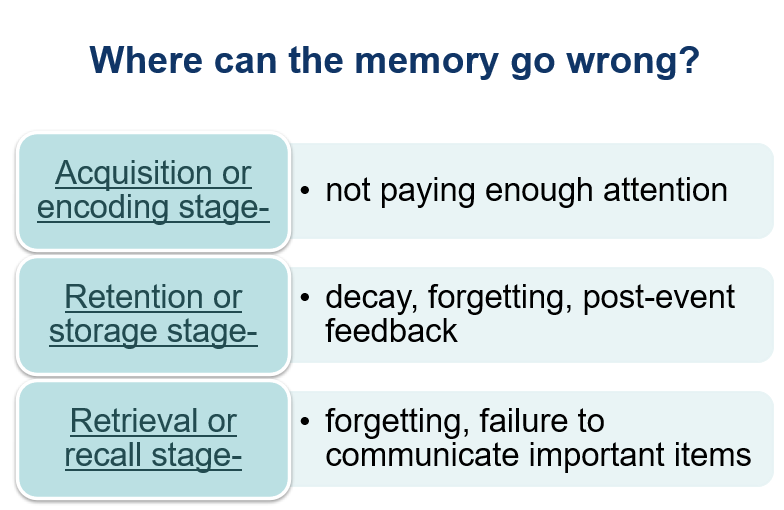
Where can the memory go wrong? (3)
Eyewitness accuracy *
How can psychology contribute to the legal system in this area? (3)
•Assess the validity of an individual eyewitness
–Munsterberg (1908)
•Prevent errors in the first place (Wells, 1998, White Paper)
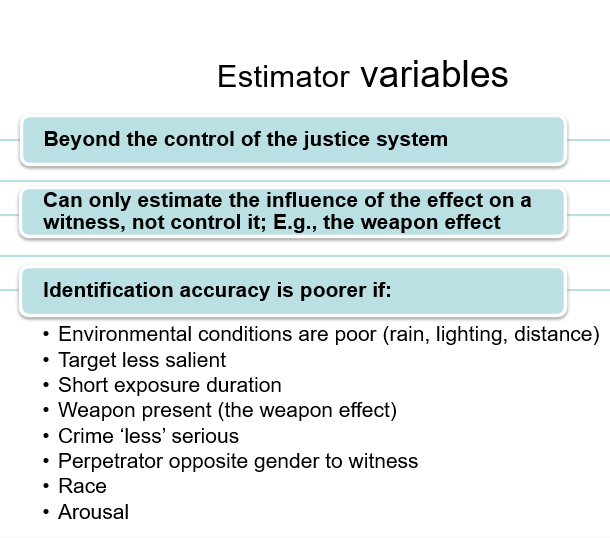
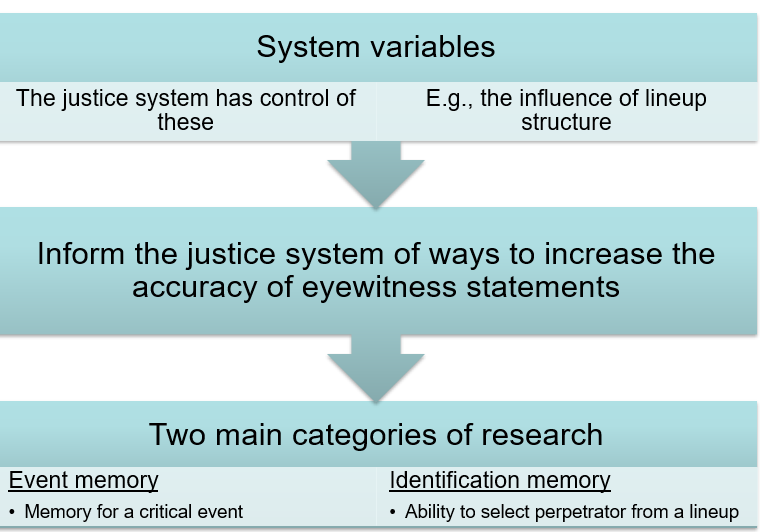
•Two types of variables that influence eyewitness errors
•Estimator variables
•System variables
Estimator variables
system variables
Event Memory- how can it be altered?
•Misleading questions: The Misinformation Effect
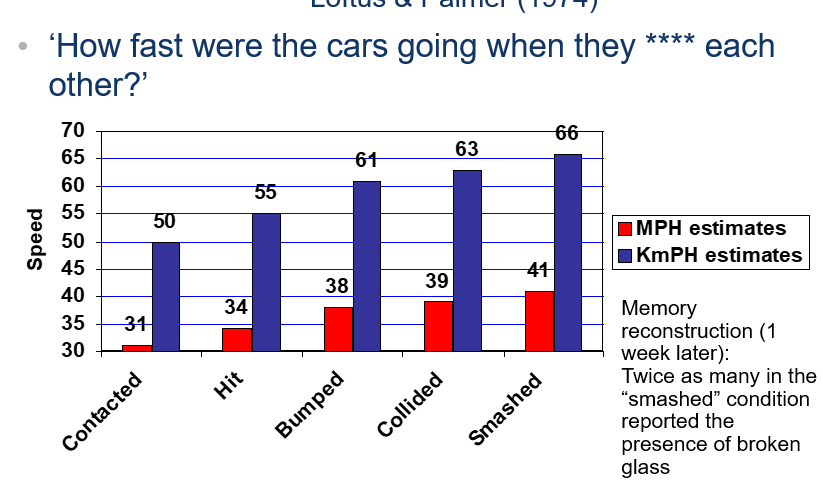
Loftus & Palmer (1974)
–Memory is malleable and shaped by events that occur after a person witnesses an event
–Schemas can be triggered by questioning which influences the way in which information is recalled or reconstructed
does the speed increase with more intense words used for a car accident?
a note on memory reconstruction?
yes
Memory reconstruction (1 week later):
Twice as many in the “smashed” condition reported the presence of broken glass
Training in interviewing witnesses ( 2 stats)
•98% of US officers not trained in witness interviewing (Sanders)
•In UK, out of 16 forces, 6 had no training and 10 had one day training. (George)
•Even when trained, the officers don’t tend to use the recall strategies
•Officers receive little or no training conducting interviews with cooperative witnesses
Errors made in police interviews that led to development of Cognitive Interview (3 errors)
–Asking too many closed-ended questions and too few open-ended questions
–Frequently interrupting eyewitnesses in the middle of narrative responses
–Asking questions in a predetermined and inflexible order
The Cognitive Interview
improves what elements of interview?
how much % improvement
•Attempts to enhance recall by improving elements of the interview:
–The social dynamics and communication
–The eyewitness’s memory and other cognitive processes
•Between 35% and 55% improvement in amount of information recalled vs police interview with no increase in incorrect information
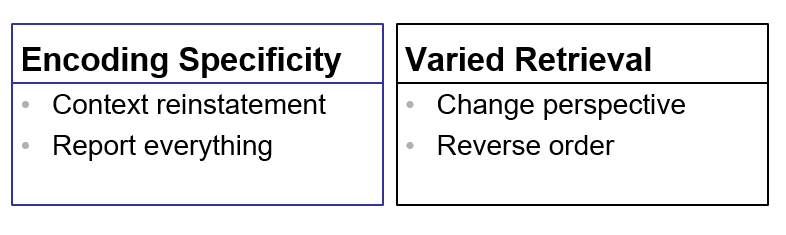
The Cognitive Interview: Encoding specificity
•“The likelihood of retrieving a given memory will be enhanced where the characteristics and features of the retrieval cue overlap with those of the encoded input trace” (Boon and Noon, 1994)
•Scuba divers
•Exam taking
The Cognitive Interview:Varied retrieval
•Varied retrieval (Tulving, 1974)
•There are multiple pathways to a memory and what is not readily available with one pathway may be available with another.
•Use a different cue
CI Theories and Mnemonics
Cognitive Interview methods (4)
•Context Reinstatement
–What were the physical/personal contexts at time of crime?
•Report Everything
–Include (perceived to be) irrelevant detail
•Change Perspective
–Place yourself in shoes of someone else at the scene…..
•Reverse Order
–Recall from a variety of chronological orders
Identification Memory
how many people per day become defendants bc of these?
stats on written policy?
•Lineups/photospreads
–In the USA about 200 people per day become defendants as a result of these
–
•Of 619 US law enforcement agencies:
– 64% have no written policy for construction and administration of photo line ups
–84% have no written policy for construction and administration of live line ups
Fillers / foils / distractors
typically how many?
7
–Fillers should fit the verbal description of the perpetrator (or resemble the suspect in significant features if description is inadequate)
–Do not want to make them too similar or too different
Instructions prior to viewing
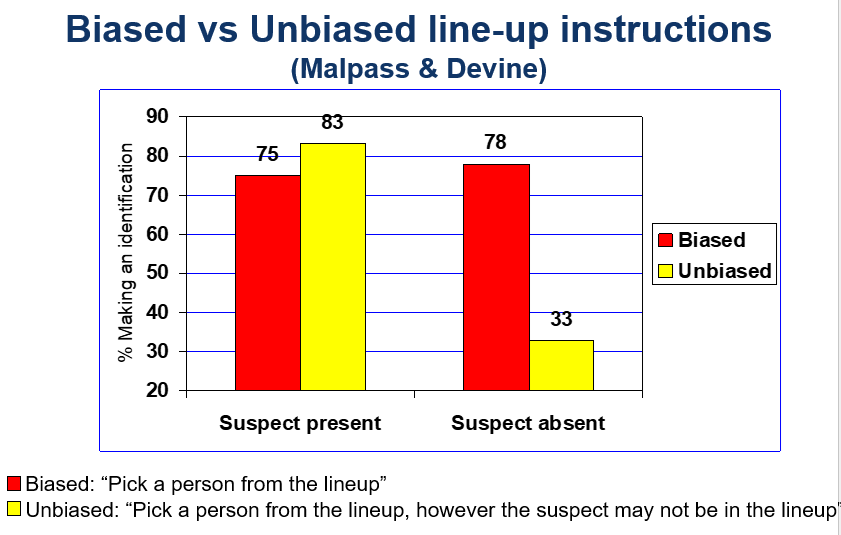
•Eyewitnesses need to be told that the perpetrator may or may not be in the lineup (Malpass & Devine, 1981)
•Eyewitnesses might believe that the person who most closely resembles the perpetrator is the perpetrator
–Surely the police would only go to the trouble of holding a lineup if they had apprehended the perpetrator?
Sequential versus simultaneous line-ups
•Standard practice is simultaneous
•
–Fillers and suspect presented at the same time
–Eyewitness tend to compare each person to determine which most closely resembles the perpetrator, a relative judgement (Wells, 1984; 2013)
–Unbiased instructions eliminate to some degree tendency to pick the person who ‘most closely resembles’ the perpetrator.
•Sequential process
–Eyewitness is presented with one person at a time
–Must decide for each if they are the perpetrator prior to being allowed to view the next person – an absolute criteria
–Results in an improvement in perpetrator absent lineups
•Mistaken identification:
–43% with simultaneous presentation (all at once)
–17% with sequential presentation (one at a time)
Confidence and accuracy
correlation between confidence and accuracy is strong/poor and what no.
•People assume that a confident witness is an accurate witness (Wells, Lindsay, & Ferguson)
•The judicial system supports that an eyewitness’ certainty is an indication of their accuracy
•
•Leippe
–Accuracy is a function of memory variables
–Confidence is a function of social variables
–
•Mistaken eyewitnesses who are told that another agrees with their identification becomes more confident (Luus & Wells, 1994)
•Generally the correlation between confidence and accuracy is poor .29
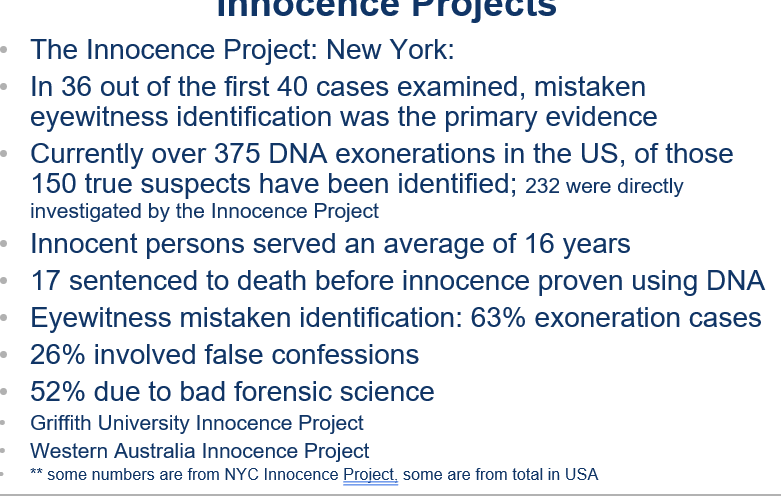
Innocence Projects*