Comprehensive Organic and Biological Chemistry Chapter 1: Matter, Measurement, and Properties
 Call Kai
 Learn
Learn Practice Test
 Spaced Repetition
 Match
Match Flashcards
 Knowt Play
1/121

There's no tags or description
Looks like no tags are added yet.
Name | Mastery | Learn | Test | Matching | Spaced | Call with Kai | Chat |
|---|
No analytics yet
Send a link to your students to track their progress
122 Terms
What is matter?
Anything that takes up space and has weight.
What are the two types of matter?
Pure substances and mixtures.

How are pure substances classified?
As elements or compounds.
What is a pure substance?
Matter made up of only one type of substance, represented by one chemical formula or symbol.
What is an element?
The simplest type of matter made up of only one type of atom.
Give examples of elements.
Calcium, Hydrogen, Carbon.
What is an atom?
The smallest unit of matter that retains its unique characteristics.
What is a compound?
A pure substance made of two or more elements chemically joined together.
Provide examples of compounds.
Pure water, Rust, Ibuprofen.
What is a mixture?
A combination of two or more substances that can be separated into its components.
What is a homogeneous mixture?
A mixture with a uniform composition throughout, such as air or laundry detergent.
What is a heterogeneous mixture?
A mixture with a non-uniform composition, such as a chocolate chip cookie.
What does the periodic table represent?
A listing of all the elements on Earth.
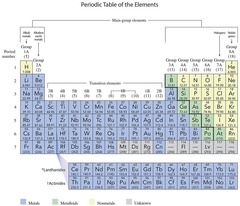
What does each block in the periodic table represent?
A different element, with a chemical symbol and numbers indicating its properties.
What is a group in the periodic table?
A vertical column of elements with similar chemical behaviors.
What is a period in the periodic table?
A horizontal row of elements, numbered from 1 to 7.
What separates metals from nonmetals in the periodic table?
A staircase-shaped line starting at boron.
What are macronutrients?
Elements needed in quantities greater than 100 milligrams per day, such as sodium and calcium.

What are micronutrients?
Elements needed in quantities less than 100 milligrams per day, such as iron and zinc.
What is a chemical formula?
A representation that shows which elements and how many atoms of each are present in a compound.
What is a physical change?
A change in the state of matter where the identity remains the same.

What is a chemical change?
A change that results in a change in the chemical identity of a substance.
What does a chemical equation show?
What happens to the substances involved in a chemical reaction.

What is the law of conservation of mass?
Matter cannot be created or destroyed; it only changes form.
What is a coefficient in a chemical equation?
A number added in front of a chemical formula to balance the equation.
What is the difference between reactants and products in a chemical reaction?
Reactants are the starting substances, while products are the substances formed.
What does (s), (l), (g), and (aq) indicate in a chemical equation?
They indicate the physical state: solid, liquid, gas, or aqueous (dissolved in water).
What is an example of a compound's chemical formula?
Water (H2O) is composed of two hydrogen atoms and one oxygen atom.
What is the first step in balancing a chemical equation?
Examine the original equation to see if it is balanced.
How should you balance a chemical equation?
Balance the equation one element at a time by adding coefficients, starting with elements that appear only once on each side.
What should you check after balancing a chemical equation?
Check to see if the equation is balanced and that the coefficients represent the smallest possible set of numbers.
What is the balanced form of the reaction CH4 + O2?
CH4 + 2 O2 → CO2 + 2 H2O.
How many carbon atoms are on the left side of the equation CH4 + O2?
1 carbon atom.
How many hydrogen atoms are on the left side of the equation CH4 + O2?
4 hydrogen atoms.
How many oxygen atoms are on the left side of the equation CH4 + O2?
2 oxygen atoms.
What is the standard unit for mass in the SI system?
Kilogram (kg).
What is the standard unit for volume in the SI system?
Liter (L).
What is the standard unit for length in the SI system?
Meter (m).
What does the prefix 'kilo-' mean in the metric system?
It means × 1000 (1x10^3).
What does the prefix 'mega-' mean in the metric system?
It means × 1,000,000 (1x10^6).
What does the prefix 'giga-' mean in the metric system?
It means × 1,000,000,000 (1x10^9).
What does the prefix 'milli-' mean in the metric system?
It means × 0.001 (1x10^-3).
What does the prefix 'centi-' mean in the metric system?
It means × 0.01 (1x10^-2).
What is dimensional analysis?
It is the process of converting units to an equivalent unit using conversion factors.
How do you convert 10,000 centigrams to grams?
Use the relationship: 1 cg = 1 x 10^-2 g, resulting in 10,000 cg = 100 g.
How do you convert 5 milligrams to grams?
Use the relationship: 1 mg = 1 x 10^-3 g, resulting in 5 mg = 0.005 g.
How many microliters are in 0.0040 liters?
There are 4,000 microliters in 0.0040 liters.
How do you convert 5 mL to dL?
Use the relationships of mL to L and L to dL to find the conversion.
What is the equivalency statement for gigameters to meters?
1 Gm = 1 x 10^9 m.
What is the equivalency statement for milliliters to liters?
1 mL = 1 x 10^-3 L.
What should you do if you get stuck while balancing an equation?
Erase what you have and start again, trying a different element first.
What is the relationship between milliliters (mL) and deciliters (dL)?
1 dL = 1 x 10^-1 L; therefore, 5 mL = 0.05 dL.
What is the significance of significant figures in measurements?
Significant figures indicate the precision of a measurement, including all known digits plus one estimated digit.
How do zeros affect the significance of a number?
Zeros can be significant or not, depending on their position in the number.
What is the rule for significant figures when adding or subtracting?
The answer should match the least number of decimal places in the measured numbers.
What is the rule for significant figures when multiplying or dividing?
The answer should match the least number of significant digits in the measured numbers.
How do you round a number if the leftmost digit to be dropped is 4 or less?
Simply remove it and the remaining digits.
How do you round a number if the leftmost digit to be dropped is 5 or greater?
Increase the last retained digit by 1 and remove all other digits.
What is scientific notation?
A way to express numbers as a product of a coefficient (between 1 and 10) and a power of ten.
What does a positive exponent in scientific notation indicate?
The actual number is greater than 1.
What does a negative exponent in scientific notation indicate?
The number is between 0 and 1.
How can you convert a fraction to a percent?
Divide the numerator by the denominator, multiply by 100, and add a percent sign.
How can you convert a decimal to a percent?
Multiply the decimal by 100 and add a percent sign.
What is mass in terms of chemistry?
Mass is a measure of the amount of material in an object, commonly measured in grams (g).
What determines the weight of an object?
The pull of gravity on the object, which can change depending on location.
What is the general form for scientific notation?
C × 10^n, where C is the coefficient and n is the exponent.
What is an exact number in terms of significant figures?
Numbers used in defined conversion factors and counted items have an infinite number of significant figures.
How many significant figures are in the number 0.0055?
2 significant figures.
How many significant figures are in the number 5300?
2 significant figures.
How many significant figures are in the number 1.030?
4 significant figures.
What is the significance of the number of significant figures in calculations?
The answer can be no more certain than the least certain number in the calculation.
What happens when you round a large number with no decimal point?
Substitute zeros for numbers that are not significant.
What is the significance of the number 0.0030 in terms of significant figures?
It has 2 significant figures.
What is the result of 75 - 21.3 rounded to the correct number of significant figures?
54.
What is the result of 0.005 + 1.23 rounded to the correct number of significant figures?
1.24.
What is the result of 8.24 x 3.0 rounded to the correct number of significant figures?
25.
What is the result of 12.4 / 0.06 rounded to the correct number of significant figures?
200.
How does the mass and weight of an object relate when weighed in the same location?
They have the same measured value.
What is volume?
A three-dimensional measure of the space occupied by matter.
What is the typical unit for measuring volume in a lab?
Milliliters (mL).

How is volume often measured in a clinical setting?
With calibrated syringes.
What is the relationship between milliliters and cubic centimeters?
One milliliter equals one cubic centimeter.
What is density?
A comparison of a substance's mass to its volume, calculated as d = m/V.
What is the density of water?
1.00 gram/milliliter.
How can density be used as a conversion factor?
Density values can determine either the mass or the volume of a substance.
What is specific gravity?
The ratio of the density of a sample to the density of water.
Why is specific gravity unitless?
Because it is a ratio of two densities that have the same unit.
What instrument is used to measure specific gravity?
A refractometer.
What is the SI unit for temperature?
Kelvin.
What temperature scale is commonly used in the United States?
Fahrenheit.
How do Celsius and Kelvin scales relate?
They are offset by 273 degrees.
What is the relationship between Celsius and Fahrenheit?
One degree Celsius is equal to 1.8 degrees Fahrenheit, with an offset of 32 degrees.
What are the three most common states of matter?
Solid, liquid, and gas.

How are particles arranged in a solid?
In an orderly arrangement, tightly packed together, and moving only slightly.
What is the characteristic of a liquid's volume?
A liquid has a definite volume but takes the shape of its container.
How do gas particles behave?
They have no orderly arrangement, are far apart, move at high speeds, and expand to fill their container.
What is the shape and volume of a gas?
A gas has no definite shape or volume.
What are the three states of matter?
Solid, Liquid, Gas
How does the shape of a solid differ from that of a liquid?
A solid has a definite shape, while a liquid adopts the shape of its container.
What is the volume characteristic of gases?
Gases fill the volume of their container.