Chem 101 Midterm 1
 Call Kai
 Learn
Learn Practice Test
 Spaced Repetition
 Match
Match Flashcards
 Knowt Play
1/111

There's no tags or description
Looks like no tags are added yet.
Name | Mastery | Learn | Test | Matching | Spaced | Call with Kai | Chat |
|---|
No analytics yet
Send a link to your students to track their progress
112 Terms
Intensive Property
A property that doesn’t change with the amount of the substance present (ex. density)
Extensive Property
A property that changes with the amount of substance present (ex. mass, volume).
Chemical property
A property having to do with a chemical change, if it says “reacts,” it’s probably a chemical property (ex. flammability, acidity)
Physical property
A property that can be observed or measured without changing the substance's chemical identity (ex. color, melting point).
Elements vs Compounds
Elements are pure substances that cannot be broken down into simpler substances, while compounds are substances formed when two or more elements chemically bond together.
Atoms vs Molecules
Atoms are the smallest unit of an element, while molecules are two or more atoms bonded together, representing the smallest unit of a compound.
Diatomic elements
Elements that are found as two of the same element bonded together (Ex. H2, N2, O2, etc). Neumonic: Have No Fear Of Ice CoLd Beer. Hydrogen, Nitrogen, Fluorine, Oxygen, Iodine, Chlorine, Bromine.
Physical Change
A type of change that alters the form or appearance of a substance but does not change its chemical composition. (Ex. Evaporation, melting, freezing)
Chemical Change
A process that involves the transformation of one or more substances into different substances, resulting in a change in chemical properties (Ex. combustion, rusting, digestion)
Energy
The capacity to do work
Kinetic Energy
The energy of motion
Potential Energy
Energy by virtue of position or composition
Law of Conservation of Energy
Energy cannot be created or destroyed, but it can be converted from one form to another. (physical and chemical changes have changes in energy)
Potential Energy as a Measure of Stability
Oppositely-charged particles attract, PE is negative
More Stable
Like-charged particles repel, PE is positive
Less Stable
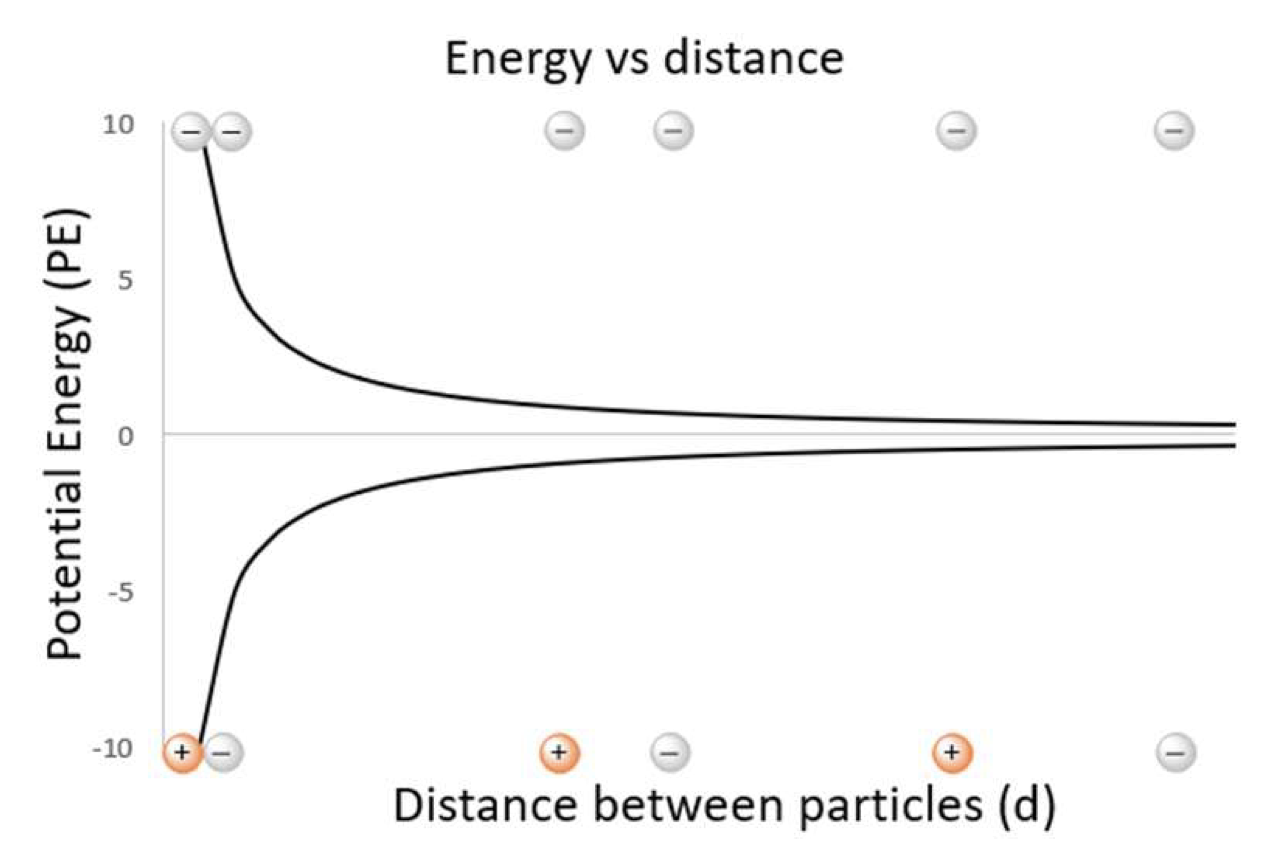
Which is more favorable, negative PE or 0 PE
Negative
Sublimation
Going from solid to gas, sublime → lifts you up (Ex. water vapor coming off ice)
Deposition
Going from gas to solid (In back of freezer)
Energy Absorption
From lower energy to higher energy (Ex. Solid → Liquid, Liquid → Gas)
Energy Release
From higher energy to lower energy (Ex. Gas → Liquid, Liquid → Solid)
Does physical or chemical changes require more energy?
Chemical changes
Dimensional Analysis
How we analyze units
cm compared to mL
1cm³ = 1mL = 1cm x 1cm x 1cm
Relative mass of an electron (e^-)
~0 amu or 0.0005 amu
Relative mass of a proton (p^+)
~1 amu or 1.007 amu
Relative mass of a neutron (n^0)
~1 amu or 1.009 amu
Thompson’s Plum Pudding Model (blueberry muffin)
Idea that an atom was a positive sphere of matter (muffin) with negative electrons (blueberries) embedded in it
Rutherford’s Experiment
He shone a beam of alpha particles on a thin sheet of gold foil, a.k.a. what should’ve been the blueberry muffin. They saw that most of the particles went through, but some veered off and bounced back in different directions at large angles, showing that there is a nucleus. This disproved Thomson’s model
Nucleus
Region of concentrated mass and positive charge
If you increase thickness of gold in Rutherford’s experiment what will happen?
More alpha particles would be scattered at large angles, more nuclei more likely the particles are to hit the nuclei
What size would the atom be if the nucleus was the size of a blueberry
The size of Kenan Stadium
What is most of the mass of an atom?
Protons and Neutrons
Most of atoms are _____
Empty Space
Atoms are defined by the number of _____
Protons
Most of the volume in an atom is accounted for by _______
The electron cloud
Group 1 in the periodic table
Alkali Metals
Group 2 in the periodic table
Alkaline earth metals
Group 16 in the periodic table
Chalcogens
Group 17 in the periodic table
Halogens
Group 18 in the periodic table
Noble gases
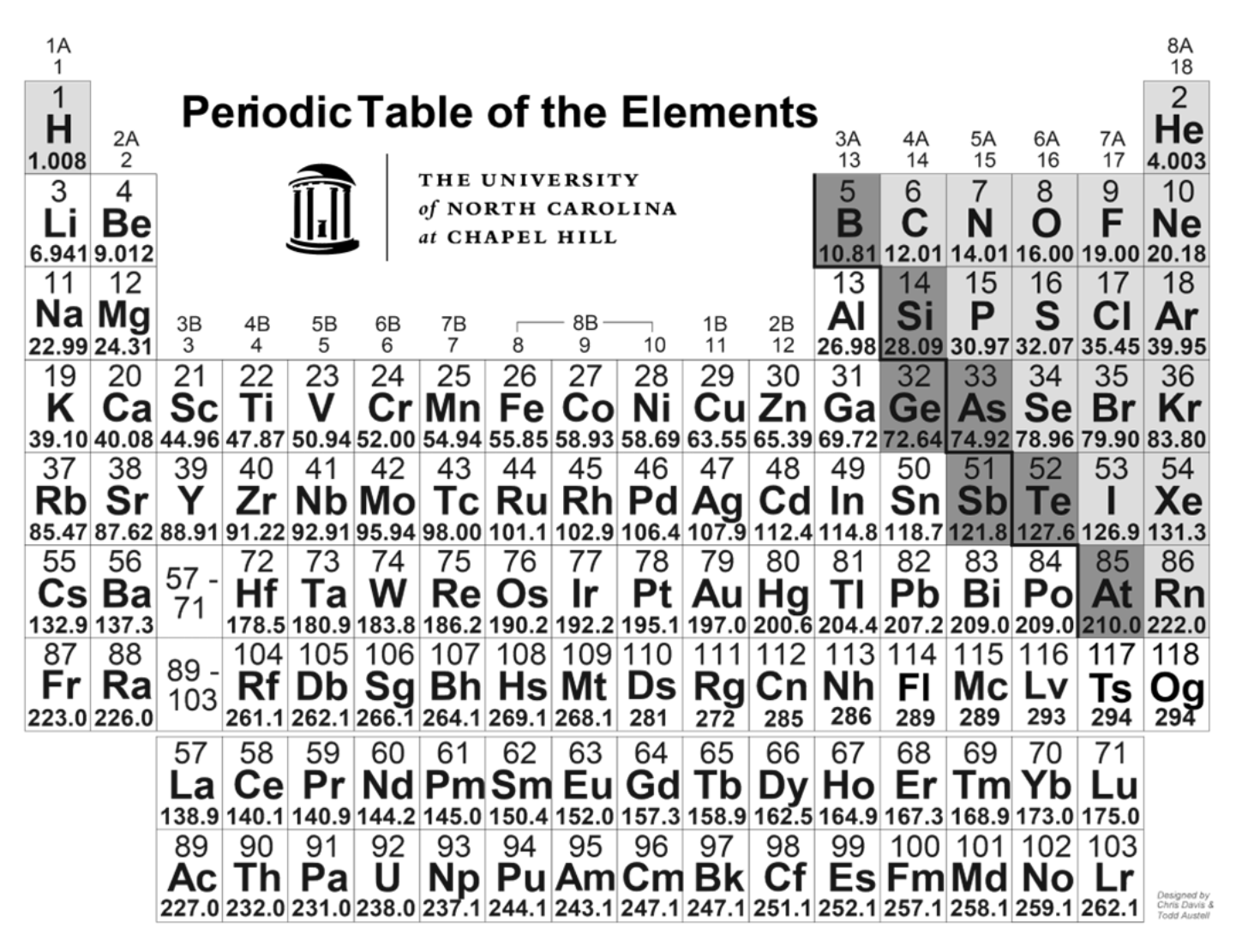
Metals
White section
Shiny, solid, conductor
Malleable and ductile
Solid at room temp (except mercury)

Nonmetals
Light gray section
Solids (brittle), liquids, and gases
Nonconductors

Metalloids
Dark gray section
Shiny (like metals) but brittle (like nonmetals)
Semiconductors
Relationship between density, mass, and volume

Units to measure speed
length/time: u (speed/velocity) = m/s
Units to measure volume
length³: V = m³
Units to measure density
mass/volume: D = kg/m³
Units to measure energy
Joule: J = kg x m² / s²
Units to measure power
Watt: W = Joule/s
Relationship between Celsius and Kelvin
Celsius is shifted 273 to become Kelvin (K=C+273). Melting point of ice is 0C and 273K
Temperature
A measure of the average kinetic energy of the particles in a sample
What are celsius and kelvin based off of
Celsius is based on the properties of water, Kelvin is based on the properties of gas
Accuracy
Proximity of a measurement to the true value (bullseye)
Precision
Proximity of several measurements to each other (shooting darts at the same place every time)
Measurement
The comparison between a known and unknown value
Uncertainty
The smallest measurable difference between measured properties. More decimal places means less uncertainty and more precision. Determines the limits of precision of a measurement

Significant figures
The measured digits in a number
How many significant figures
0s after a number with no decimal point don’t count (12000 has only 2 sig figs)
A decimal point means all 0s after it are significant (1.2000 and 12000. have 5 sig figs)
0s on the left of a number are not significant (0.0012 has 2 sig figs)
Exact numbers have infinite precision (2 iclickers)
Sig figs from conversion factors within one system are not counted (1 m = 100 cm, 1ft = 12in)
Conversion factors between systems need to follow rules (2.2 lb = 1.0 kg)
Exception: 1in = 2.54 cm exactly
Sig figs for multiplication and division
Same as number with fewest sig figs
Sig figs for addition and subtraction
Same as number with fewest decimal places
Why is a mole so large?
So we can interact with the amount of the substance bc atoms are so small
Molar Mass
The mass (in grams) of one mole of a substance, same as atomic mass (u/atom)
One mole of an element has a mass of:
That element’s atomic mass
Relationship between wavelength and energy and frequency
Shorter wavelength is more energy less frequency
Frequency ν (measured in Hz)
How often the wave (λ (measured in meters)) happens
Speed of light (c)
c=λν or ν=c/λ
Energy of a photon
E=hc/λ or λ=hc/E
How do photons interact with atoms?
1 photon hits 1 atom to eject 1 electron
Does the difference between Bohr model steps change?
The energy difference between two steps is always a set difference. Energy levels are described by quantum numbers (n = 1, 2, 3, etc)
Electron moves to higher energy level
When photon is absorbed
Electron moves to a lower energy level
When photon is emitted, more energy between levels means photon emitted is higher energy
Wavelength of an electron (de Broglie wavelength)
λ = h/mu
In what way do electrons behave like waves?
They experience interference in a double slit experiment
Constructive interference
When two waves in phase (building something together, in line with each other) add to give a wave with twice the amplitude
Destructive interference
When two waves out of phase with each other add to cancel each other out
Standing waves
Waves constructively interfering with itself. They need to be integers because non-integer wavelengths don’t match up when wrapped around themselves.

Wave-particle Duality
Since electromagnetic radiation (EMR) can have particle behavior (photons), particles can have wave behavior
How does wave-particle duality have do do with electrons
Electrons (and any object with mass) are moving in a wave-like pattern
Hertz (Hz)
# of cycles per second (1s^-1)

Why is it hard to observe wavelength of large objects
Their wavelength is very small compared to their size
Implications of de Broglie wavelength
Large object = large mass and speed = smaller wavelength
Smaller wavelength (relative to object) = no observed wave-like movement
Larger wavelength (relative to object) = object moves as wave
Uncertainty Principle
We cannot simultaneously define the position and momentum of a quantum mechanical particle. With electrons we define energy (proportional to momentum) exactly but accept limitation that we do not know exact position
(Δx)(Δmu) ≥ h/4π → Uncertainty of position and Uncertainty of momentum
If you measure one precisely, the uncertainty of the other increases
Schrodingers Equation
Shows a 3D wave function Ψ (how we define orbitals) that shows where the electron with that set of quantum numbers is most likely found. Most will be in the middle though some on the sides like spraying ink onto a paper. Solving the wave equation gives a set of wave functions or orbitals
Orbitals
Describes the volume around the nucleus where the electron is most likely to be found, described as quantum numbers (n, l, m sub l)
Quantum number “n”
The principal quantum number describes the energy level (shell) on which the orbital resides. The values are integers greater than or equal to 1. As the energy level increases, so does the number of nodes; orbital size increases, and it is easier to remove an electron (a greater distance from the nucleus makes the connection weaker)
The # of nodes
n - 1
Radial Probability
The likelihood of finding an electron at some distance from the nucleus. At zero, the radius is zero, so the radial probability function (Ψ²r²) goes to zero. Even as n increases there is still a probability that there are electrons close to nucleus, even though small probability
Why isn’t the nucleus a node?
To be a node the phase must switch
Quantum number “l”
Defines the shape of the orbital
Values between 0 to n-1
Value of l and corresponding designation:
0,s
1,p
2,d
3,f
4,g
Quantum number “m sub l”
Describes the 3D orientation of the orbital (along which axis)
Values between -l and +l (Ex. l=2 msubl=-2,-1,0,1,2)
An orbital is a 3d representation of a ______
Wave
S Orbital
l = 0
msubl has 1 value: 0
Looks like a sphere
No nodes

p orbitals
Value of l=1
msubl has 3 values: -1,0,1
Dumbell shape (2 lobes) with a node between

d orbitals
Value of l=2
msubl has 5 values
(4/5 orbital shapes) 4 lobes, one orbital looks like dumbell with donut on it
4 lobes with 2 nodes

f orbitals
6 lobes
3 nodes
msubl has 7 values

Orbitals vs electrons
n,l,msubl describe orbitals, all those plus msubs describe electrons. There can be 2 electrons in 1 orbital but without describing the spin of the electron, all that is described is the orbital
Spin Quantum Number “msubs”
2 values (+1/2 or -1/2)
Spin up vs spin down
Degenerate orbitals
for one-electron atoms or ions, orbitals with the same n value have the same energy

Non-Degenerate Orbitals
As the number of electrons increases so does the number of interactions between them
In many-electron atoms, orbitals with the same n-value are not degenerate
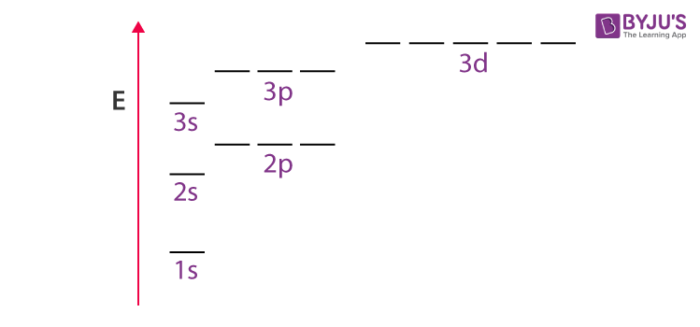
Subshells and the periodic table
*note that helium (at top right of p block) is in the s block technically*

Aufbau Principle
Fill lower energy orbitals first, in ground state