Pathophysiology Test 1 Study Materials - Key Terms and Definitions
 Call Kai
 Learn
Learn Practice Test
 Spaced Repetition
 Match
Match Flashcards
 Knowt Play
1/109

There's no tags or description
Looks like no tags are added yet.
Name | Mastery | Learn | Test | Matching | Spaced | Call with Kai | Chat |
|---|
No analytics yet
Send a link to your students to track their progress
110 Terms
What is the therapeutic index and what does a low/high TI mean?
- ratio of toxic dose to therapeutic dose
- a low TI means that the drug will likely be prescription and a high TI means it will likely be OTC
What is the drug elimination rate determined by?
clearance rate and half life
What is drug half life?
Time it takes for 1/2 the amount of an administered drug to be metabolized and eliminated
What is drug clearance rate?
determined through blood flow to the intended area and the fraction of drug removed from the plasma as it passes through the organ
Describe drug metabolism?
AKA biotransformation, process of chemically changing drug into inactive metabolites, done through oxidation, reduction, hydrolysis or conjugation of the original compound
Where does drug metabolism primarily occur?
Liver
Where do the metabolites go after metabolism?
drug metabolites are ionized into the body's fluid and made water soluble, for transport into the blood stream and excretion by the kidneys
What are the FDA approval processes, describe each step?
Pre clinical phase- initial laboratory test to determine a drugs effects and safety (done on animal subjects); last for 1-2 years
Phase I- determining effects, safe dosage and pharmacokinetics; done on a small population of healthy volunteers (100); lasts for less than a year
Phase II- Assess drug's effectiveness in treating a specific disorder or disease; done on a small population with target disorder (200-300); lasts for 2 years
Phase III- Assess safety and effectiveness in a larger patient population; done on a large population with target disorder (1000-3000); lasts for 3 years
Phase IV (Postmarketing surveillance)- Monitor any problems that occur after NDA approval; patient population; indefinitely
What has to happen before a drug can move into Phase I trials?
- An investigational new drug (IND) application is filed with the FDA
- FDA must review and give feedback to determine if drug is safe for human testing
What has to happen before a drug can move into Phase IV (postmarketing surveillance)?
New drug application (NDA) approval
About how long does it take for a drug to make it through all stages of the drug approval process?
5-9 years, on average 7 and a half years
What are the 3 ways the FDA can "fast track" a drug?
Fast track review- speeds up the process but still goes through the 4 phases
Priority review- ex) COVID-19
Accelerated review- sped up process for people with rare disorders (typically do not have a large enough patient population to get through the first 3 phases)
What are orphan drugs?
Drugs used to treat diseases that relatively affect very few people (
What is the difference between an exon and an intron?
exon- DNA and RNA nucleotide sequences that are bonded together to develop mRNA (transcription) remember "exon-expressed"
intron- nucleotide sequences that are removed by RNA splicing and are not expressed
What is a codon?
a sequence of three nucleotides that together form a unit of genetic code in a DNA or RNA molecule.
What is DNA and it's macrostructure?
deoxyribonucleic acid, "master blueprint," codes for proteins, needs to use RNA, needs to replicate; strands of DNA wrap around histones to form what is called a nucleosome, these are then tightly packed to form chromatin (this is done in preparation for cell division)
What are the 3 types of RNA covered in this course?
mRNA- messenger RNA: RNA polymerase transcribes the DNA, including all (introns and exons), which produces pre mRNA which is then processed into mature mRNA (what will code for proteins)
tRNA- transfer RNA: "anticodon" that transports individual amino acids to each corresponding "codon"
rRNA- ribosomal RNA: forms in the nucleus and binds to ribosomal proteins to form a pre-ribosome, exits the nucleus through nuclear pores and matures into ribosome
What is transcription?
DNA + RNA polymerase = mRNA, DNA is "transcribed" or copied by the RNA polymerase into mRNA
What is translation?
mRNA + tRNA = Amino Acid, the ribosome attaches to the mature mRNA and, with the help of many tRNAs (anticodon), begins to "translate" the mRNA into an amino acid chain (polypeptide)
Easy way to remember transcription and translation
think of an original book that was written in latin, you first need to copy the book (transcribe DNA to RNA), then you can translate the book into a different language ie. nucleotide sequence to amino acid
What organelle coordinates protein synthesis and what is it studded with?
Rough endoplasmic reticulum (ER); ribosomes
What does the smooth endoplasmic reticulum (ER) do?
- lipid synthesis
- steroid hormone production
- detox
What does the Golgi apparatus do?
(the sorting center) transport vesicles pinch off from the ER and fuse with the Golgi apparatus and are sent to:
1) organelles
2) cytosol
3) outside of the cell
What are the 8 cell types and what do they originate from?
1) muscle cells
2) fat cells
3) bone cells
4) blood cells
5) nervous cells
6) epithelial cells
7) immune cells
8) sex cells
-all originate from stem cells
Describe the 3 types of muscle cells
skeletal- striated, voluntary movement, sustains body function and posture
cardiac- tubular structures made from chains of myofibrils, involuntary
smooth- thick and thin filaments, non-striated, assists in organ function, involuntary
What are the two types of fat cells and what is their purpose?
white- secrete hormone like molecules
brown- contain more mitochondria, dissipate heat
serve as secondary storage for energy, heat insulation and protection of organs
What are the 4 types of bone cells and what do they do?
osteogenic cells- initial cell that develops into an osteoblast
osteoblasts- build bone
osteoclasts- break down bone
osteocytes- maintain bone
What are the 3 types of blood cells and what is their function?
erythrocytes- red blood cells; transport oxygen to tissue and waste back to the lungs
leukocytes- white blood cells; protect against infection
thrombocytes- platelets; help form clots and prevent bleeding
Describe the structures and function of a neuron
structures: soma, axon, dendrite, and axon terminal
function: sends and receives signals through neurotransmitters, glial cells act as support
What are the 3 types of epithelial tissue and what is their function?
squamous, cuboidal and columnar
- may be multiple layers
- protection, secretion, absorption, excretion, filtration, diffusion and sensory reception
- located on the outer lining of the body (skin), lining of respiratory tract, intestines, abdominal cavities, and glands.
Where are white blood cells created and what is their function?
bone marrow; fight infections, neutralize harmful substances and fight non-infectious diseases
What sex cells do males have, what do females have and what is the purpose?
males- spermatozoa (sperm)
females- ovum (egg)
they fuse to create a zygote, half of the genetic material from each sex cell, form through meiosis
What are the two types of cell permeability?
passive transport- no ATP required, moves with gradient, water, dissolved oxygen, simple alcohols
active transport- ATP is required, moves against gradient, can transport large molecules and charged molecules, require transport proteins
What happens in the G1 phase of interphase?
Cell growth
What happens to DNA in the S phase?
DNA is replicated
What happens in the G2 phase?
Growth and preparation for mitosis
What are the stages of mitosis (m phase)?
describe each stage
PMAT
Prophase: chromosomes condense into chromatin and nuclear envelope breaks down
Metaphase: DNA lines up on the "metaphase plate" (fancy for in the middle)
Anaphase: DNA is split and pulled to two sides of the cell
Telophase: cell begins to split apart, then cytokinesis
What are the two main causes of cell injury?
genetic and aquired
What is the cell's basic response to injury?

Describe the 8 steps of the inflammatory process
Immediate vasoconstriction
Vasodilation & Hyperemia
Hemostasis
Accumulation of leukocytes
Exudation of fluid
Deposition of fibrin
Angiogenesis
Fibroblastic organization and maturation
What are the cardinal signs of inflammation?
erythema- redness, caused by vasodilation and increased blood flow
edema- swelling, caused by fluid and cells leaking from local blood vessels into the extravascular spaces
heat- caused by vasodilation and increased blood flow
pain- caused by direct trauma, chemical mediation and pressure on the nerve caused by edema
Describe the 3 steps of hemostasis
Hemostasis is the stopping of blood through broken vessels by
1)Vascular spasms occur-(vasoconstriction)smooth muscle in wall of blood vessel constricts, slowing flow of blood (primary)
2)Platelet plug formation- platelet plug is formed through fibrinogen (primary)
3)Coagulation events occur- blood clot is created using fibrinogen, thrombin and fibrin (secondary)
What is margination?
neutrophils cling to the walls of capillaries in the injured area
What is diapedesis?
Neutrophils and Macrophages move through the capillary pores toward area of tissue damage by chemotaxis.
What is chemotaxis?
inflammatory chemicals attract neutrophils to the injury site, concentration gradient dependent
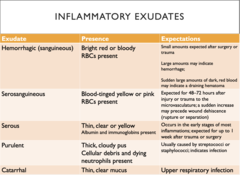
What is exudation?
Arterioles dilate, fluid and proteins leak into the injured area (leads to edema)
What are the 5 types of exudate? describe them
What are the 3 stages of tissue healing?
1) hemostasis and inflammation
2) proliferation and migration
3) remodeling and maturing
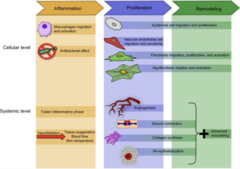
Describe Phase 1 of tissue healing
Hemostasis (begins immediately)
- Body attempts to stop bleeding leading to clot formation
- Platelets release chemicals (GFs) to summon inflammatory cells
Inflammation (seconds to minutes after injury)
- Brings fluid to injured area to dilute harmful substances and support infection fighting (neutrophils and macrophages)
- Degeneration results in the formation of a hematoma, necrosis of dead cells, and start of the inflammatory response
- happens within 24 hours
Describe Phase 2 of tissue healing
Proliferation and Migration
- Epidermal skin cells move down the sides of the wound to fill in the gap
- Fibroblasts move in from the dermis
- New blood vessels form to create granulation tissue that will eventually become scar tissue
- Happens within 48 hours
Describe Phase 3 of tissue healing
Maturation and Remodeling
- Scar tissue is reduced and remodeled
- Less red in color as concentration of blood vessels decreases
- Stronger, less dense tissue is left behind
What are the two types of immunity?
- Innate: has two parts, barrier defenses like skin and mucous membranes; innate immune response includes specialized cells like phagocytes, dendritic and NK cells, and is non specific
- adaptive: slower acting, more specific, uses WBC (leukocytes/lymphocytes) includes humoral and cell-mediated immunity
- Macrophages and dendritic cells act in both systems
What are antigens?
foreign substances in the body that do not have the characteristic cell surface markers of the individual, elicits immune response
epitopes: protrude from cell surface of an antigen, the more epitopes an antigen has the greater the immune response
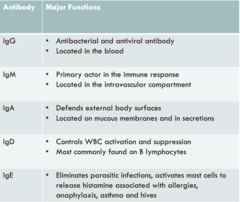
What are the 5 antibodies and what is their function?
Describe the function of lymphocytes
- present in the lymphatic system and blood
- B-cell develop in the bone marrow
- T-cells develop in the thymus
- once lymphocytes have matured they then go to secondary organs searching for antigens
Describe the function of the B lymphocytes
to make antibodies (immunoglobulin), b-cell receptor complex recognizes antigens, binds them, and sends signals to T-cells
Describe the function of the T lymphocytes
Help others do their job (CD4+) and kill invaders (CD8+)
- Helper T-cells (CD4+) help B-cells make antibodies, help macrophages eat bugs
- Cytotoxic T-cells (CD8+) kills virus infected cells and tumor cells
- Suppressor T-cells suppress helper and killer T cells
Describe the function of the helper T cells
Most numerous (T-4, CD4)
Help in immune function, major regulator of all immune functions
Secrete mediators:
- lymphokines
- Interleukins
- Interferon
- Colony stimulating factor
Destroyed by HIV
Describe the function of the killer t cells
CD8
Attach directly to antigens
Secrete hole forming enzymes =perforins
Can be reused over and over
Describe the function of the suppressor t cells
- Suppress helper and killer T cells
- Halt robust immune reactions that can damage tissue
- Wards off attacking own body = immune tolerance
Describe the function of the NK cells
- White blood cell that kills tumor cells or infected cells
- Located in blood & spleen
- Don't have antigen specific receptors, rather create pores in cells and also secrete inhibitory ligands and tumor necrosis factors
- Useful in killing tumors, pathogens &viruses
What are antigen presenting cells?
dendritic cells: located all over the body, brings antigens to B and T cells
macrophages: eat infection and bring antigens to T cells to create more macrophages
B cells: Present antigens to CD4+ T-cells, which tell plasma cells to make antibodies
What are effector cells?
Eliminate infection
- natural killer cells, plasma cells, CD4+ and CD8+, macrophages, other leukocytes
What is the difference between cell-mediated and humoral immunity?
humoral: B-cells (produce memory cells that can last up to a year) 5 types: IgG, IgM, IgA,IgD, and IgE
cell-mediated: T-cells (recognize hidden organisms, search them out and destroy them on a cell to cell basis)
What is the principle of auto-immune diseases?
the body fails to recognize it's own cells and begins to attack itself
What is Graves disease?
- Primarily seen in women over age 20 Autoimmune response to defective suppressor T lymphocytes which leads to the formation of thyroid-stimulating immunoglobulins.
- treatments: antithyroid medication, radioactive iodine (RAI), and surgery
Type II hypersensitivity disorder
What are the signs and symptoms of graves?
- Wide eyes, mild enlargement of the thyroid, nervousness, heat intolerance, weight loss despite increased appetite, sweating, diarrhea, tremor, palpitations
What is important to keep in mind with graves disease which could result in you having to call emergency services?
Thyroid storm (potentially fatal call 911)- severe tachycardia (HR >100 bpm at rest), high fever, delirium, dehydration, extreme irritability or agitation
What is systemic lupus erythematosus?
- Classic auto immune disease; results from immune mechanisms directed against self-antigens, body fails to distinguish self from non-self
- most common in women, 3x more likely in black women
- treatment is focused on controlling flare ups and damage from the disease
- Almost everyone with SLE has joint pain and swelling
- the joints of the fingers, hands, wrists, and knees are often affected
- characteristic "butterfly rash"
type III hypersensitivity disorder
What is rheumatoid arthritis?
- a chronic progressive disease causing inflammation in the joints and resulting in painful deformity and immobility, especially in the fingers, wrists, feet, and ankles.
what are some risk factors for RA?
nulliparous women (never given birth), age (30-40), women are at a 2x greater risk
Classic signs and symptoms of RA?
Bilateral in wrists, hands, and knees; swan neck, ulnar deviation of the fingers, boutonniere, nodules
What are the diagnostic criteria for RA?
Morning joint pain that never seems to completely go away (different from osteoarthritis), positive for rheumatoid factor (RF) in the blood and/or anti-citrullinated peptide/protein antibody (such as anti-cyclic citrullinated peptide [CCP])) testing, elevated levels of C-reactive protein (CRP) or the erythrocyte sedimentation rate (ESR)
Primary pharmacology used for RA
DMARDS: remicade & humira halt TNF alpha from destroying joints
NSAIDs: non steroidal anti inflammatories
Things to keep in mind for treating RA as a PT
Joint ankylosis (fusion)
Joint instability
Joint deformity
Tendon/ligament laxity
Altered biomechanics
What are erythrocytes and what is their function?
Red blood cells ~40% of blood volume
carry oxygen (via hemoglobin) from lungs to tissues and carry waste back to the lungs
During gestation they are made in the liver, lymph and spleen but are only made in the bone marrow after birth
What does a low RBC count indicate?
anemia, less oxygen being carried out through the body and reduced aerobic capacity which results in fatigue and weakness
What does a high RBC count indicate?
aka polycythemia, blood is too thick and can cause increase risk for stroke (CVA) and myocardial infarction (MI)
What is hypovolemia, what is it caused by and what are the signs and symptoms?
low blood volume (usually blood plasma)
caused by: bleeding, dehydration from vomiting, diarrhea, sweating, severe burns, diuretic medications
Signs and symptoms: Orthostatic hypotension, tachycardia, elevated body temp;
What is hypervolemia what is it caused by and what are the signs and symptoms?
fluid overload (excess blood plasma)
caused by: excess fluid intake IV or transfusion, sodium retention (heart failure or kidney disease)
signs and symptoms: swelling in the legs, ascites (fluid in the abdomen), fluid in the lungs
What are platelets and what is their function?
cell fragments that function to form clots and slow, stop or prevent bleeding, made in the bone marrow
What is a low platelet count called and was does it mean?
Thrombocytopenia; increased risk for bleeding and bruising
What is a high platelet count called and was does it mean?
Thrombocytosis; increased risk for thrombosis resulting in stroke (CVA) or myocardial infarction (MI)
What are white blood cells?
fight infection
formed in the bone marrow and lymph system and are transported to areas of inflammation/infection as needed
What is a low WBC count called and what does it mean?
leukopenia; increased risk for infection, usually cause by damage to the bone marrow (ex: radiation therapy)
What are the two types of high WBC count called and what do they mean?
leukocytosis; indicates infection or leukemia
leukemia; cancer of the blood cells, too many abnormal WBCs being produced overshadow the normal WBCs
What are the 5 types of white blood cells (leukocytes) and what is their function?
Monocytes: ingest dead/damaged cells (Macrophages)
Lymphocytes: 3 types (T, B, NKs)
Neutrophils: protect body against infection by ingesting bacteria and debris
Basophils: active in allergic response
Eosinophils: kill parasites, destroy cancer cells, active in allergic response
When do adverse reactions to blood transfusions typically occur?
within 15 minutes
How long after a blood transfusion SHOULD you engage in physical therapy with a patient?
60 minutes, but the guidelines say 30-60
What blood types can type A receive?
A and O
What blood types can type B receive?
B and O
What blood types can type AB receive?
A, B, AB and O
What blood types can type O receive?
O
What is sickle-cell?
abnormal hemoglobin characterized by the "sickle" shape
can cause blocks in the blood vessels causing stroke and MI
therapy includes blood transfusions and gene therapy
What are standard precautions?
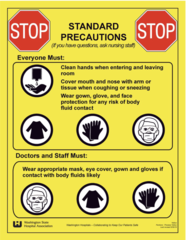
What are the 4 types of Standard + precautions?
Standard + contact
Standard + Droplet
Standard + Airborne
Standard + neutropenic
What are the standard + contact precautions?

What are the standard + droplet precautions?

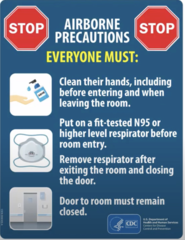
What are the standard + airborne precautions?
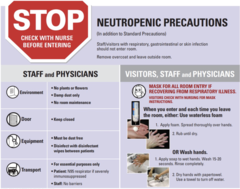
What are the standard + neutropenic precautions?
for patients with WBC < 1000/mm^3 OR Absolute Neutrophil Count (ANC)