Geography - people and the biosphere
 Call Kai
 Learn
Learn Practice Test
 Spaced Repetition
 Match
Match Flashcards
 Knowt Play
1/101

There's no tags or description
Looks like no tags are added yet.
Name | Mastery | Learn | Test | Matching | Spaced | Call with Kai | Chat |
|---|
No analytics yet
Send a link to your students to track their progress
102 Terms
Define abiotic
non living part of a biome, includes the atmosphere, water, rock, soil ph, etc
Define altitude
Height of the land
Define altitudinal zonation
The change in ecosystems at different altitudes, caused by alterations in temperature, precipitation, sunlight, and soil type
Define atmosphere
The layer of gases above the earth's surface
Define biomass
Renewable organic materials such as wood, agricultural crops or wastes, when used as a source of fuel or energy
Define biome
A large scale ecosystem e.g. tropical rainforest
Define biosphere
The living layer of earth between the lithosphere and atmosphere
Define biotic
Living part of the ecosystem made up of flora and fauna
Define boserupian
A view based on the published works of Ester Boserup, which argues that as population grows, innovative humans invent new ways of producing more food
Define carbon sequestration
Removing carbon dioxide from the atmosphere and locking it up in biotic material
Define carbon sink
Natural stores for carbon containing chemical like carbon dioxide or methane
Define climate
The average weather conditions over a 30 year period
Define club of Rome
The think tank that popularised the malthusian view in the 1970s
Define decay
Decomposition of organic materials by bacteria and fungi
Define decomposition
The process of decay or rotting
Define ecosystem
Localised biome made up of living things and their non living environment, for example, a pond
Define ecosystem services
A collective term for all the ways humans benefit from ecosystem
Define evaporation
The changing of liquid vapour into a gas
Define fallout
Dead plants and animals become litter on the soil surface
Define food web
A complex network of food chains that connect the movement of energy through plants and animals in biomes
Define goods
Physical materials such as timber from trees or fish caught in a lake
Define groundwater
Water that is stored in the ground (shock)
Define hydrological cycle
The movement of water between its different forms
Define indigenous peoples
The original people of a region. Some indigenous peoples still follow traditional lifestyles e.g. a tribal system, hunting for food
Define industrialisation
Where a mainly agricultural society changes and begins to depend on manufacturing industries instead
Define infiltration
The soaking of rainwater into the ground
Define interception
The capture of rainwater by leaves and branches
Define latitude
How far north or south a location on the earth's surface is from the equator, measured in degrees
Define leaching
Nutrients are washed out of the soil of water moves through
Define lithosphere
The uppermost layer of the earth that includes the crust and the very top of the mantle
Define litter
Decaying leaves and twigs
Define malthusian
A theory introduced in 1798 by Reverend Thomas Malthus, which argues human population will eventually grow so large that the planet will run out of resources
Define natural resources
Materials found in the environment that are used by human
Define nutrient cycle
Nutrients move between the biomass, litter, and soil as part of a continuous cycle that keeps both plants and soil healthy
Define nutrient transfer
The movement and exchange of nutrients between biomass, litter, and soil, which are called nutrient stores
Define permeable
Allows water to pass through
Define photosynthesis
The process of plants converting sunlight into energy
Define precipitation
Water vapour that is released from clouds and falls to the earth as rain, sleet, snow or hail
Define runoff
The movement of rainwater over ground
Define slash and burn
A type of farming where farmers clear small areas of forest by cutting and burning them. The ash adds nutrients to the soil allowing plants to grow
Define soil erosion
The removal of soil by wind and rain
Define treeline
The limit or altitude in a biome where trees will no longer grow
Define urbanisation
A rise in the percentage of people living in urban areas, compared to rural areas
Define weathering
The physical, chemical, or biological breakdown of solid rock by the action of weather (e.g. frost, rain) or plants
Name the biomes from top to bottom
Taiga, tundra, temperate forest, temperate grassland, desert, tropical grassland, tropical rainforest (check this)
Latitude of tundra
High latitudes in polar regions such as Alaska, Canada, Russia
Weather characteristics of tundra
Cold all year - highs of 10 in summer, and below - 30 in winter. Very low precipitation (less than 250mm), mostly snow Near continuous daylight in summer, little to no light in winter. Very impacted by the fact it is often at high latitudes
Soil, flora and fauna adaptations of tundra
Plants - mosses, grasses, low shrubs and hardly any trees, because cold climate and lack of light in winter makes it hard for plants to grow Animals - few species because of lack of vegetation and cold climates. There are some animals like arctic hares and foxes (short limbs, round bodies, white fur), and birds which migrate south for the winter Soil - thin, nutrient poor because sparse vegetation means less leaf litter, and the cold climate means it decomposes slowly. There is also a layer of permafrost on the ground below the soil surface, which can stop water draining away
Latitude of taiga
These forests are found between 50 and 60 north of the equator, such as scandinavia, russia, canada
Weather characteristics of taiga
Short summer, average 10 , lots of daylight, long winter - 20 average → cold temps Less than 500mm per year precipitation Caused because are sinks hear due to cold temps Precipitation is mostly snow.
Soil, flora, and fauna adaptations of taiga
Plants - coniferous trees, which are evergreen so they can grow whenever there is enough light, making the most of sparse light in winter. Trees have needle-like leaves, which have a thick waxy cuticle because the coating and the small surface means less heat is lost. Flexible branches so snow can slide off easily Animals: few species due to cold climate. Some include reindeer, bears, and foxes. They grow thick coats to keep warm. Bears hibernate over the winter months Soil - thin, nutrient poor and often acidic. Leaf litter decomposes slowly due to the cold climate. In some places, the ground is frozen all year round
Latitude of temperate forest
Mid latitudes 30 - 60 degrees. Europe and North America mostly.
Weather characteristics of temperate forest
4 seasons, summers average around 20 while winters average around 5. This is because of the tilt of the earth's axis High rainfall, around 1000mm per year. This is because it mostly consists of low pressure systems, where rising air cools and condenses to form clouds.
Short winter days and long summer days. Daylight varies throughout the year
Soil, flora and fauna adaptations of temperate forest
Plants - less than rainforest, but more than colder climates. Deciduous trees that lose their leaves in Winter. This helps as by dropping leaves in autumn, energy is saved so it can be used to insulate during the colder months of winter. Photosynthesis is slowed down due to less sunshine so it is important that plants conserve energy at this time of year. Lots of shrubs, undergrowth like ferns. Animals - have to adapt to changing seasons. Some hibernate like hedgehogs, others like birds migrate to escape the cold Soil - brown earth, fertile thick, nutrient rich. Nutrients come from falling autumn leaves that decompose quickly due to the moist, mild climate. Earthworms in the soil help to mix the nutrients and blend layers. The tree roots are deep and break up soil and rocks, giving the soil more nutrients
Latitude of temperate grassland
40 - 60, hungary, south africa, argentina
Weather characteristics of temperate grassland
Very variable, hot summers up to 40 and cold winters down to -40. Seasons are more extreme than coastal areas because the land heats up and cools down quickly , while the sea acts as a temperature moderator. Low rainfall - 250 -500 mm, mostly in late spring - early summer Sunlight varies throughout the year due to distance from the equator
Soil, flora and fauna adaptations of temperate grassland
Plants - mainly grass as they are adapted to thrive in the warm summers, and survive the cold winters by slowing down their growth. Few trees due to lack of rain and they struggle to survive the range of temp Animals - few animal species like bison and wild horses that are able to migrate. Some rodents like mole rats Soils -
Latitude of desert
Near the tropics. 15-35. E.g. sahara in northern Africa
Weather characteristics of desert
Hot days above 45 and sub 0 nights, this is due to the high pressure system. As the air sinks there are few clouds to act as a blanket the hot air escapes at night and it cold dramatically Very low rainfall. It may only rain once every few years. This is because the sinking air warms so can hold less moisture, so there is little condensation and cloud formation Lots of sunlight every day. More daylight during summer
Soil, flora and fauna adaptations of desert
Plants - sparse due to lack of rainfall. Cacti are adapted to expand and store water in their stems. They have long roots to find water deep underground Animals - few live in the desert due to tep and lack of plants. Some small mammals burrow underground for shade. Camels store fat in their humps which can be converted to energy when there is a scarcity of food. Animals like fennec foxes are often crepuscular and are awake at the most mild times of day Soils -
Latitude of tropical grassland
Found either side of the tropical rainforest. Found in central Africa, southern India, South America
Weather characteristics of tropical grassland
Distinct wet and dry seasons, because it is quite near the equator, temperatures are still high. Hot all year, just before the wet season, temps are highest - around 35 , after it they are lowest around 15 Lots of sunshine all year round 800 - 900 mm per year rain
Soil, flora and fauna adaptations of tropical grassland
Plants - mostly grass, scrub, dense bushes, small plants, few scattered trees like acacia, because the dry season hinders dense tree growth. Tall grasses, such as elephant grass grows rapidly in the moist summer but dies back in the dry winter Animals - wide open spaces and lots of grass to graze on leads to lots of herd herbivores like zebras and antelopes. This also leads to a high amount of predators such as lions and hyenas Soils - because the grass dies back in the dry season, it decomposes to form a thin nutrient- rich soil. The nutrients are washed out during the wet season
Latitude of tropical rainforest
Along the equator. E.g. Amazon in Brazil
Weather characteristics of tropical rainforest
Hot all year round, no definite seasons, generally 20-28. Hot all year because it is at the equator, so the sun is overhead all year. Light is heavily concentrated. Each day has roughly 12 hours. Heavy convectional rainfall (sun is directly overhead so hot air rises → cools → condenses), usually in the afternoon. 2000mm per year. This zone is known as Intertropical Convergence Zone
Soil, flora and fauna adaptations of tropical rainforest
Plants - dense forest with several layers of evergreen, hardwood trees and dense vegetation. Each layer provides a habitat for specific animals. Large buttress roots help trees stay stable and grow tall. Drip tips on leaves to shed water and avoid moulds Animals - rainforests contain half the world’s species (including jaguars, anacondas, sloths, butterflies, toucans) due to the different layers of rainforest. Soils - red due to the high iron and aluminium content. Thick layer of leaf litter decomposing on the surface. Rapid nutrient cycle
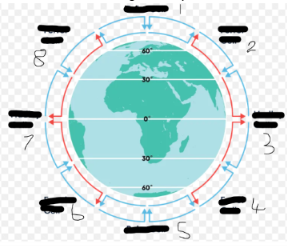
Fill in the blanks:
1, 5 → polar cells 2, 4, 6, 8 → ferrel cells 3, 7 → Hadley cells

What makes this diagram important?
It has a large impact on biomes as it determines where biomes are formed. For instance, in places where the air pushes down, there is little rainfall, which means less plants grow there, so less animals, so thin nutrient poor soils.
How does latitude affect temperature and daylight and why?
At higher latitudes the sunlight is less concentrated as it travels further and at an angle. This leads to lower temperatures and less daylight hours
How does pressure affect precipitation?
Low pressure means the air is moving upwards. As it does this, it cools and condenses, forming clouds that rain. However, in low pressure systems, the air is moving downwards so there is less precipitation
How does maritime influence and continentality impact temperature?
Near the sea, the climate is milder. This is because the sea takes a long time to warm up in summer, so it cools the air. It also takes a long time to cool down in winter, so it warms the air. Inland, the ground heats up and cools down quickly, leading to more extreme temperature differences
How does altitude influence biomes?
Temp decreases every 1 degree for 100 metres up The higher up you go, the less plants there are as they struggle to grow in the cold This leads to less animals as there are no plants for them to eat As there is so little organic matter to be decomposed (also any decomposes slowly due to cold), the soil is very thin and nutrient poor This makes it even harder for plants to grow
Explain how how easily the rocks are weathered impacts biomes
Rocks that are susceptible to weathering break down more easily into smaller particles. This means that it is easier for plants to grow here as these smaller particles absorb water more easily and allow roots to penetrate. More plants help to break down the soil further due to biological weathering. Over time, this increases biodiversity as more plants and animals are able to live here.
Explain how soil type influences biomes
More nutrient rich soils support different types of plants. The types of plants that can grow (and therefore the animals) depends on different factors of the soil such as pH, permeability, etc.
Explain how drainage impacts biomes
Poor drainage in soils like clay means the land will get waterlogged easily, possibly turning into marshland or a bog. This means that only aquatic animals and plants can live there. Slopes drain well as the water runs down so plants adapted to drier conditions will live there.
Explain carbon sequestration
Carbon is removed from the atmosphere through the process of photosynthesis. It is locked up in the plants that photosynthesis, then in the animals that eat them. When they die the carbon ends up in the soil
Why does carbon sequestration make biomes important?
They remove carbon from the atmosphere. This reduces the enhanced greenhouse effect, helping to prevent or limit the effects of global warming. This means that they help to regulate the composition of the atmosphere
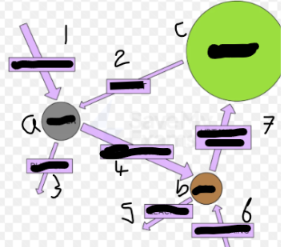
What is this model called and what does it do? (image)
This is the gersmehl model, which shows how nutrients transfer between stores in a biome

Explain this model by filling in the blanks
Precipitation (1) like rainfall adds nutrients to the litter (a), but excess water and runoff (3) can also remove nutrients. The litter decomposes (4), adding nutrients to the soil (b). Nutrients may be taken from the soil by leaching (5), where water moving through the soil washes nutrients away. It can also be added to the soil by the weathering of rocks (6). It is transferred to biomass (c), as plants take up the nutrients during growth (7). As these plants, and the animals that eat them, die, they add to the litter through fallout (2).
How do plants help to maintain a healthy and nutrient rich soil?
They hold the soil together with their roots which helps to prevent erosion by wind or rain. Vegetation intercepts rainfall which helps to prevent leaching.
How does the biosphere help farmers (hint: soil)
All land that is now used for agriculture was once a natural biome. The soil that farmers grow on, therefore, is formed by the biome. The biome determines its nutrient makeup.
How does deforestation affect the hydrological cycle
With no trees, there is no interception of rainwater, so it hits the ground directly. This means it does not infiltrate the soil (decreasing groundwater supplies, which are a source of water for many people) as deeply, and increases soil erosion (less nutrients in the soil → less fertile land → less crop growth if used for agriculture). As surface runoff increases, the water gets into the river channels much faster (increased risk of flooding). The river is made dirty by soil washed in, The soil dries out quickly so overall evaporation is reduced → so less cloud formation → less rainfall → drier climate
How do plants help regulate the hydrological cycle?
By the process of transpiration in which water is taken up in their roots and then is pulled upwards into the leaves, evaporates and leaves through the stomata. This means that they store water and release it slowly, reducing the risks of drought and flooding by ensuring a steady amount of rainfall.
How biotic and abiotic components interact: water
Rain falls to the ground and infiltrates into the soil. This allows plants to grow, which take up the water and release it again through transpiration. Animals are able to eat these plants
How biotic and abiotic components interact: energy
Plants get energy from sunlight through photosynthesis. Animals then eat these plants to gain energy. The energy moves up the food chain
How biotic and abiotic components interact: oxygen and carbon dioxide
Plants take in CO2 and release O2, while animals do the opposite, creating a balance.
How biotic and abiotic components interact: soil and nutrients
More nutrient rich soils mean more plants can grow as they take them up through roots. This means more animals can live here too. When these die, they decompose adding more nutrients to the soil
What are the 4 categories of services humans can receive from an ecosystem? Give examples of each.
Provisional services (goods) → food, fuelwood, timber for buildings Supporting services (keep the ecosystem healthy so it can provide other services) → nutrient cycling, photosynthesis and food webs, soil formation Regulating services (keep large regions, and even the whole planet healthy) → storing carbon, emitting oxygen, regulating water Cultural services (benefits people visiting or living in the ecosystem) → recreation and tourism, wellbeing, science and research
What is slash and burn farming? Is it sustainable?
Slash and burn farming is a method in which farmers cut down a small area of forest and burn it. The ash adds nutrients to the soil, allowing them to farm on it for 5-6 years, after which the soil becomes infertile. They then move on to a new area of land, and the forest will eventually grow back on the old land. It is a sustainable method as long as the area and the number of people who use it remains small.
Give examples of ways in which ecosystem services are destroyed by exploitation
Commercial farming, especially livestock Mining ores like copper or iron Timber for paper, furniture, or construction Construction of dams for HEP
What are the positives of commercial exploitation of ecosystems
Provides profits for TNCs, jobs for locals, and tax income for the government
What are the negatives of commercial exploitation of ecosystems
Ecosystem species are destroyed. The forest cannot grow back. Areas that were once forest can no longer store carbon, regulate the water cycle or be used for recreation.
How do indigenous peoples use the biosphere for food
Many get their food directly from plants and animals Foraging for food, hunting animals and catching fish Growing food by subsistence farming
How do indigenous peoples use the biosphere for medicine
Lots of plants have medicinal properties used to keep people healthy Plant species in tropical rainforests have been used to create over 7000 drugs
How do indigenous peoples use the biosphere for building material
Trees provide wood for construction Sap can be used as a glue or to make buildings waterproof Reed and straw can be used as rope
How do indigenous peoples use the biosphere for fuel
Rely on plants and animals for cooking and keeping warm Wood, moss, dried grass and dung are used as fuel Some use animal fat like blubber as insulation
How do humans exploit the biosphere for energy? Why? What effect is it having?
Demand for energy is increasing due to increasing population and use of electronic devices Large forests are cut down to clear land for biofuel plants, coal mines, or power stations Some areas of tropical rainforest have been flooded by hydroelectric dams Drilling for oil and gas in the tundra is damaging the biosphere because pipelines are melting the permafrost
How do humans exploit the biosphere for water? Why? What effect is it having?
People need water for drinking, washing, irrigating farmland Water resources like lakes, rivers, and aquifers, are being over exploited This severely damages the biosphere as plants and animals can no longer survive
How do humans exploit the biosphere for minerals? Why? What effect is it having?
Minerals like gold and iron are used in construction, electronic devices, and scientific instruments They are often extracted by mining Mining in tropical rainforests is responsible for lots of deforestation and toxic chemicals are washed into streams and rivers, killing wildlife Open pit mining removed large areas of the land’s surface