Viruses & Human Disease
 Call Kai
 Learn
Learn Practice Test
 Spaced Repetition
 Match
Match Flashcards
 Knowt Play
1/127

Earn XP
Description and Tags
Lecture 1,
Name | Mastery | Learn | Test | Matching | Spaced | Call with Kai | Chat |
|---|
No analytics yet
Send a link to your students to track their progress
128 Terms
Define: Viruses
Obligate intracellular parasite whose genomes replicate only in suitable host cells
What are the seven steps of virus replication?
Binding to cell receptor
Entry and uncoating
Early gene expression
Replication of viral genome
Late gene expression
Assembly of virions
Exit
Why do some viruses replicate in the cytoplasm vs the nucleus
DNA viruses typically replicate in the nucleus unless they make their DNA polymerase own.
RNA viruses typically replicate in the cytosol and encode for their own RNA polymerase.
What do viruses depend on the host cell for?
Ribosomes for protein synthesis, (some) DNA replication, and energy metabolism
Why do RNA viruses mutate more?
RNA viruses make more mistakes because they do not have a built-in mechanism for proofreading like DNA polymerase. Resulting in more mutation and the evolution of RNA viruses.
Define: Zoonosis
Transmission of viruses from animals to humans
How can a virus infect both humans and animals?
Virus undergoes genetic reassortment to cross the species barrier and infect both humans and animals. Can occur when two strains infect the same host cell.
Define: Bacteriophages
Viruses that infect bacteria.
What is the impact of having ancient viral sequences in the human genome?
This helped shaped mammalian evolution, it helps fuses cells of the placenta together, creating a barrier between the placenta and the womb..
Accounts for ~8% of our genome.
What is the approx. amount of bacteriophage particles in the worlds water? What is their role?
There is >1030 bacteriophage particles in the worlds water. They infect and kill microbes (bacteria) in the water to prevent them from overwhelming the ecosystem.
What are some examples of how viruses can be used as a tool of discovery?
Discovery of DNA as genetic material - bacteriophages
Reverse transcription - retroviruses
Oncogenes - retroviruses that cause cancer
Introns - adenovirus
mRNA Special Structures (5’ cap and 3’ poly-A tail) - pox virus
Transcription factor and enhancer motifs - SV40
Nuclear Localization of Protein - SV40
What are some early examples of viruses in history?
Polio documented in Ancient Egypt
Rabies documented in Ancient Mesopotamia
Small Pox documented ~3,000 years ago
Inoculation of Small Pox in India and China in the 11th century
Who and when was the first vaccine produced?
In 1796 Edward Jenner produced the first vaccine against smallpox. This was accomplished by infecting individuals with cowpox that gave individuals immunity against smallpox.
Define: cross protection
A phenomenon in which a pre-existing viral infection or vaccination prevents a secondary infection with the same or closely related virus
Who and how was the first attenuated viral vaccine produced?
Produced by Louis Pasteur in 1885. Pasteur passaged rabies virus in rabbit using spinal cord extracts. After serial passages, the preparations induced only mild disease (attenuated) yet produced effective immunity against rabies.
What is the Chamberland Filter? What did it prove?
.It is a porcelain water filter invented in 1884, with pores ~0.1 - 1 microns. This helped prove that there are filterable and non-filterable agents that both cause disease. It was known that there were filterable agents, such as fungi and bacteria, that cause disease. However, after filtering, there was still an agent that caused disease, something smaller, that we now know to be viruses.
What is the capsid?
Protein shell that surrounds/protects the viral genome during transmission from cell to cell
What is the viral envelope?
Host cell and virus derived lipid bilayer
What is the nucleocapsid?
Viral genome associated with its nucleocapsid/capsid protein. Term to describe the core structure found within an envelope
What is a virion?
A virus particle, an infectious structure.
What is the role of structural proteins?
They are present in mature virion, form protective shell, deliver genome into new host cells.
They should be easily disassembled during entry (metastable state- stable enough to survive outside the cell but unstable enough to uncoat in host)
Are virions symmetrical or asymmetrical?
Symmetrical
How many different proteins are needed to build capsids? Why is it so?
Only one viral protein can be used to construct an entire capsid. There are typically very few or even one viral protein due to genetic economy (want a simple/small genome) and efficient assembly.
Why are there non-covalent interactions between the viral protein subunits of the capsid?
So that the subunits can disassemble easily.
What are the three types of capsid symmetry?
Helical, icosahedral, complex
Define: Helical symmetry
Repeated protein subunits can interact along a common axis to form a helical/tubular structure. RNA is bound by capsid in a repeating fashion. Allows flexibility in nucleocapsid.
Define: Icosahedral symmetry
Closed, highly symmetrical structure composed of 20 triangular faces. Formation of a simple closed shell with 60 identical protein, simple icosahedral → T=1 : 60 capsid protein subunit. 60 x (T-value) = # of subunits.
Define: Complex capsid
Viruses with asymmetrical structures that do not fit simple helical or icosahedral symmetry. Ex: Adenovirus, Reovirus, Herpes, Retrovirus, Poxvirus.
When does genome packaging occur for icosahedral and helical capsids
For many icosahedral viruses, capsid self-assembly can occur prior to packaging of genome.
For helical capsids, packaging occurs more simultaneously with replication of the genome.
Define: Proteases`
Involved in virion maturation (processing of capsid proteins)
What are other components found in a virion?
Viral polymerase, integrase (if inserting into host genome), matrix proteins, proteases, matrix proteins, nucleases. Some viruses package host-derived molecules too (histones or tRNA)
What is the role of matrix proteins?
They connect the nucleocapsid to viral envelope
What is the typical viral genome size?
~1-2 kb but can be up to 300 kb
What to viruses encode in their genome?
Capsid proteins, polymerases, and immune evasion proteins.
What is the difference between positive and negative sense RNA?
Positive-sense RNA can act directly as messenger RNA (mRNA) to make proteins, while negative-sense RNA is complementary and must first be copied into a positive-sense strand before translation. If negative sense RNA the virus must bring RDRP to make mRNA.
What does the enzyme DDDP, “read” and “produce”?
Reads: DNA
Produces: DNA
What does the enzyme DDRP, “read” and “produce”?
Reads: DNA
Produces: RNA
What does the enzyme RDRP, “read” and “produce”?
Reads: RNA
Produces: RNA
What does the enzyme RT, “read” and “produce”?
Read: RNA
Produce: DNA
What must viruses with dsRNA bring with them?
They must bring RDRP to make mRNA since (+) RNA strand is trapped inside dsRNA and host ribosomes cannot access it.
What is ambisense RNA genome?
Genome that contains coding regions in both positive and negative-sense orientations.
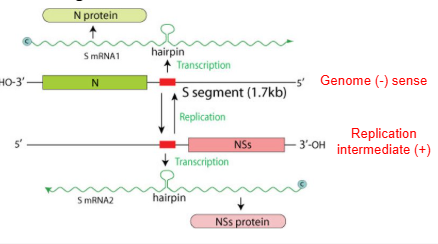
What is the Baltimore classification system?
Framework that groups viruses into seven distinct classes based on their type of genetic material and how they generate messenger RNA (mRNA).
What are the seven groups of the Baltimore system?
Class I (dsDNA): Double-stranded DNA viruses that use standard host transcription. Need DDRP.
Class II (ssDNA): Single-stranded DNA viruses that synthesize a double-stranded intermediate before making mRNA. Need DDDP.
Class III (dsRNA): Double-stranded RNA viruses that use their negative strand as a template to produce mRNA. Need RDRP.
Class IV ((+)ssRNA): Positive-sense single-stranded RNA viruses where the genome directly acts as mRNA. Need RDRP.
Class V ((-)ssRNA): Negative-sense single-stranded RNA viruses that must copy their genome into a positive-sense mRNA strand using viral enzymes. Need RDRP.
Class VI (ssRNA-RT): Single-stranded RNA viruses that use reverse transcriptase to convert their RNA genome into a DNA intermediate before integration. Need RT and DDRP.
Class VII (dsDNA-RT): Double-stranded DNA viruses that replicate through an RNA intermediate using reverse transcriptase. Need RT, DDDP, and DDRP.
What is the life cycle shared by all viruses?
Binding to cell receptor
Entry and uncoating
Early gene expression
Replication of viral genome
Late gene expression
Assembly of virions
Exit
What are the essential steps of viral entry?
Attachment
Receptor engagement
Entry
Uncoating
Genome Trafficking
What does influenza virus use as its receptor? How does this receptor change to infect different hosts?
Influenza uses sialic acid as its receptor.
Different linkages of sialic acid to galactose in avian (2’-3’ linkages) versus human influenza virus (2’-6’ linkages).
What are the two major entry pathways used by viruses?
Plasma membrane fusion/penetration
Endocytic entry
(AKA phagocytosis and endocytosis)
How to viruses mediate envelope membrane fusion?
Enveloped virus anchors to host membrane through a viral fusion protein inserting its fusion peptide into the host membrane, this is the pre-hairpin conformation, causing a trigger that releases the fusion binding unit. This insertion causes a conformational change, the prebundle conformation. This leads to Six-helix bundle formation (hemifusion). Trimer of hairpins, fusion pore forms. Viral fusion.
Describe how viruses hijack cellular vesicle fusion, SNARE?
Vesicles v-SNARE’s heterodimerizes with the cells t-SNARE’s to form a four-helix bundle, “zipping together”. This complex is called the SNARE Complex or “SNAREpin”. Causes a conformational change to form cis-SNARE complex, leading to vesicle fusion.
Why is it important that fusion proteins store energy in a metastable conformation?
The mechanical force generated by the protein dropping into its low-energy conformation is what physically drags the two membranes together, forcing them to undergo fusion.
Basic steps of SNARE fusion?
Fusion peptide/loop (PRIME site needs to be cleaved to form fusion loop) → membrane insertion → refolding (conformational change → membrane fusion/merging
pH Dependent vs pH Independent Viruses?
Viruses can fuse in a pH dependent or independent manner.
pH Independent → uncoating at the plasma membrane at neutral pH (~7.4)
ex: HIV
pH Dependent → virus uncoating in the endosomal compartment at low pH
ex: Influenza Virus
Is binding sufficient for activation of all viruses?
No!
One example is proteolytic cleavage, this can help “activate” the virus for fusion (ex: Ebola).
What are the two ways non-enveloped viruses enter the cell?
Pore Formation
Endosomal Membrane Disruption
Compare and contrast enveloped and non-enveloped viral entry?
Enveloped:
Membrane Fusion
Lipid envelope present
pH dependent or independent fusion
Driven by viral fusion proteins
Non-Enveloped:
Membrane Penetration
No lipid envelope
Capsid-mediated entry
Driven by viral capsid proteins
How do viral genome traffic to intended intracellular locations?
Cells utilize cytoskeleton (microtubule) networks to move organelle and vesicles
What are the strategies for the virus to enter the nucleus?
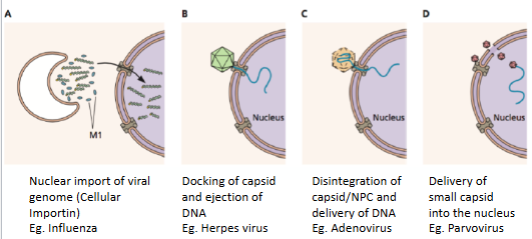
Define susceptible cell?
Expresses viral receptor.
Needed for Productive infection if cell also supports replication. If not, abortive infection occurs.
Define resistant cell?
Does not express viral receptor. If cell also supports replication this results in no infection.
Define permissive cell?
Supports viral replication.
Is needed along with receptor to have a productive infection. If not it results in no infection.
What are the routes of virus infection into hosts?
A. Respiratory
B. Mucosal surfaces
C. Gastrointestinal
D. Blood
E. Skin
F. Vector
G. Sexual
Localized Replication VS Dissemination VS Systemic Replication of Viruses?
Localized: Replication at site of entry.
Dissemination: Spread of virus to other organs.
Systemic: Replication if multiple organs are infected.
Define germ-line transmission?
Integration of viral genome intro host; passes via sperm/egg
Define vertical transmission?
Mother to offspring in utero, birth, or breastfeeding.
Define horizontal transmission?
Infectious virus passed from host to host.
Define emerging virus?
Causative agent of a new or previously unrecognized infection
Define endemic?
The presence of a disease at expected levels in the population—the baseline level of the disease
Define epidemic?
An unexpected surge in levels of a disease in a population of a specific geographical area—an outbreak
Define pandemic?
An epidemic that has expanded to multiple countries and continents, infecting a large group of people
What is spillover?

What are the methods for cultivation of viruses? Why?
Lab animals
Embryonated eggs
Cell culture
Because they need a host!!
Why can one embryonated egg support the growth of different viruses?
Different compartment → different cell types/receptors →
different susceptibility & permissiveness → different viral replication

Significance of the breakthrough made by Enders, Weller, and Robbins?
Propagation of cells in culture. Establish primary cultures of embryonic tissues and propagate poliovirus.
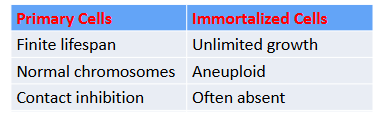
Primary VS Immortalized Cells
What are cytopathic effects (CPE)? What are some examples?
They are morphological changes observed in cells during infection.
Cell Death
Apoptosis or lysis
Cell Fusion
Syncytia formation (pH independent and envelope viruses)
Cell Dysfunction
Host-shut off
Dysregulation of cell cycle
Biological VS Physical Quantification
Biological Quantification:
Measures the number of infectious particles
Examples: plaque assays, endpoint dilution assays (TCID50)
Physical Quantification:
Measures the total number of viral physical particles
Examples: hemagglutination assays, electron microscopy, qPCR, ELISA
Steps of a plaque assay?
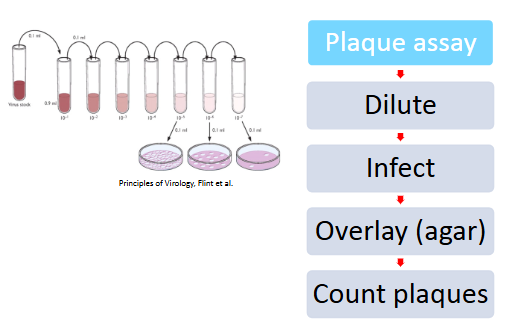
Steps of endpoint dilution assay?

PFU VS TCID50

Why is an endpoint dilution done versus a plaque assay?
Done if the virus does not form clear plaques!
Describe a hemagglutination assay?
Works on the principle that red blood cells have sialic acid on
their surface
Many viruses bind to sialic acid to cause ”agglutination” of RBC and form a lattice of cells rather than a dot
Can be used to measure relative amount of virus

How can you physically measure virus particles?
Hemagglutination
Electron microscopy
Viral enzymes
Serology
Nucleic acids
What is the particle-to-PFU ratio?
#of physical particles / # of infectious particles
Does not equal one b/c not all viruses are successful.
Draw the phases of the one-step and multi-step growth curve?

When do you use PCR?
Use for new infections, as the antibodies against viral infection have yet to be produced.
Goal and steps of PCR?

What is qPCR?
Relies on a fluorescent dye to detect the accumulation of amplified products with each cycle of amplification.
negative and postive controls are essential
reported as Ct (RFU/cycles)
lower Ct = more viral DNA/RNA

What is RT-PCR?
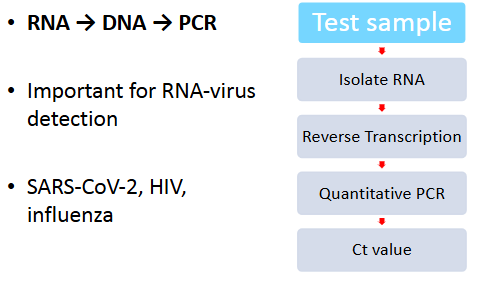
How can you detect the presence of reverse transcriptase activity?
Colorimetric or radioactive assays developed that can detect RT activity in lysed
virus (secreted) or cells with virus.
Measures accumulation of DNA product derived from RNA template.
Describe immunofluorescence assay?
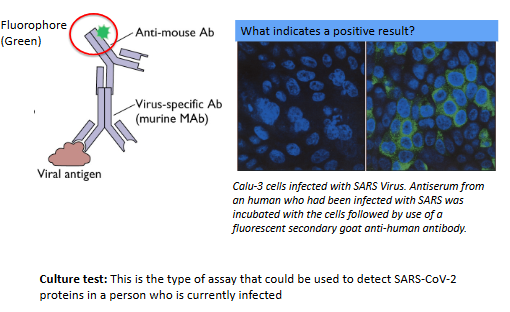
Can be direct or indirect. Uses fluorescently labeled antibodies to find and see specific proteins or antigens inside cells or tissues under a special microscope. Direct = antibody with fluorophore binds directly with viral antigen. Indirect = secondary antibody with fluorophore binds to another antibody that is bound to the viral antigen.
What is an ELISA-type assay?
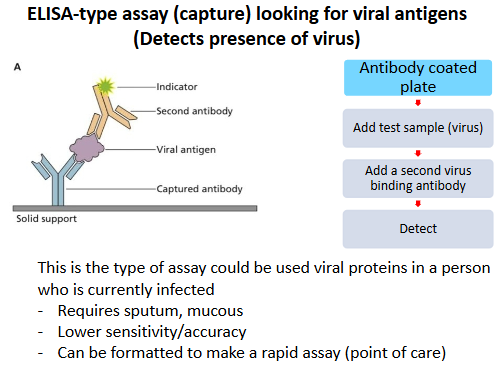
Looks for antibodies to a virus in serum, does not direct virus itself.
When to use PCR VS Antigen VS Antibody Diagnostics?
PCR = current infection
Antigen = rapid detection
Antibody = previous infection/immunity or vaccine respose
What is MOI
Average number of infectious units per cell. Needs to be >8 to infect all cells in a culture.
What happens in the first 24 hrs after viral infection?
1. Barriers
2. Intrinsic defenses
3. PAMP recognition
4. Interferon production
5. ISG induction
6. Antiviral mechanisms
7. Complement/NK cells
8. Transition to adaptive immunity
How does a host defend itself against a virus?
Barriers → physical and chemical barriers to viral infection
Intrinsic cellular defenses → apoptosis/self-destruction
APOBEC induces mutation in the HIV genome during Reverse Transcription
Describe the innate immune response?
Rapid
Cell autonomous - individual cell can defend against infection
Complement, NK cells, sentinel cells (dendritic cells,
macrophages)
Describe the adaptive immune response?
Specific and has memory
T cells and B cells
Efficient virus control and clearance of virus
Memory protection against subsequent infection
What is PAMP? What are viral PAMPS?
PAMPs = microbial molecular signature
(Pathogen-Associated Molecular Patterns) - Viral genome or replication intermediates (different DNA/RNA)
Viral PAMPs
Unusual RNA/DNA or wrong cellular compartment or viral protein structures
What are PRRs?
PRRs = host sensor that detects PAMPs as foreign
(Pattern Recognition Receptors) - Host encoded molecules that recognize
PAMPs and activate signaling cascade to initiate anti-microbial responses
Endosomes → TLRs (Toll-like receptors)
Cytoplasm → RNA sensors/DNA sensors (RIG-I like receptors)