Unit 9 - Sensation and Perception
 Call Kai
 Learn
Learn Practice Test
 Spaced Repetition
 Match
Match Flashcards
 Knowt Play
1/85

Earn XP
Description and Tags
It's the day before :D
Name | Mastery | Learn | Test | Matching | Spaced | Call with Kai | Chat |
|---|
No analytics yet
Send a link to your students to track their progress
86 Terms
sensation
detecting physical energy in environment
sound waves
light waves
molecules
perception
interpreting sensation.
providing:
definition
category
understanding
reception
the absorption of physical energy by the receptors. Receptors can either be specialized cells that change with physical energy or the dendrites of a sensory neuron itself.
transduction
transition of physical energy → electrochemical pattern in the neuron (action potential)
thresholds
how much stimulation s required before an action potential is generated in reference to sensation
how much stimulation is required before sensory receptors respond.
absolute threshold
minimum amount if stimulation required to detect a stimulus 50% of the time it is presented.
difference threshold
minimum amount of additional stimulation required to notice a difference (either increase or decrease) in a stimulus 50% of the time.
sensory adaption
change in sensitivity when a sensory system is either stimulated or not stimulates for a period of time. can happen at the receptor level or higher in sensory processing
stimulation long period → decrease sensitivity
stimulation short period → increase sensitivity
*weak to moderate stimuli
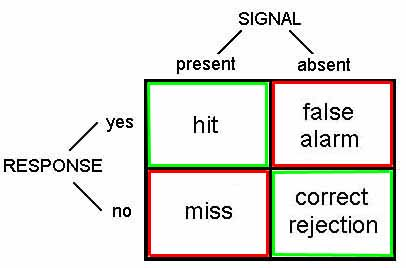
signal-detection theory
a line of research in probability which examines the rewards or results we can get from detecting a sound or signal.
the researcher presents a very faint signal, and asks the subject whether or not the signal was present.
2 possible variables of concern in signal-detection theory
is a signal present?
does the subject indicate the signal is present?
*4 possible outcomes
4 possible outcomes of signal-detection theory
*the cost of a “hit” or “miss'“ can determine whether or not the subject reports the presence of a signal.
visible light
the portion of the electromagnetic spectrum that is visible to the human eye (detected by human’s photoreceptors).
range: 400 - 750 nanometers (nm)
400 nm = violet/blue
500 nm = green
700 nm = red
riris
colored area which overlies the muscles surrounding the pupil; controls amount of light entering the eye
pupil
opening in the eye that light passes through
lens
focuses light waves on the back of the eye. The lens is a transparent structure that adjusts its shape (accommodation) to help focus light onto the retina, enabling clear vision at various distances.
near-sightedness: image is focuses in front of the fovea
far-sightedness: image is focused behind the fovea
retina
light-sensitive lining of the back of the eye; contains photoreceptors; part of the brain
fovea
area of central focus; many photoreceptors, few ganglion cells
photoreceptors
light-sensitive; contain chemical that reacts with light waves.
two types:
rods
cones
rods
120 million
outside fovea
highly sensitive to light
black/white/grey vision
fuzzy vision
cones
6 million
at fovea
lower sensitivity to light
color vision
acute vision
dark and light adaption
light environment → cones
dark environment→ rods
blind spot
are of eye where ganglion axons leave the eye; no photoreceptors; thus “blind” in that area.
we tend to “fill in” missing details to smooth out out vision.
trichromatic theory
(Young/Helmholtz)
three different types of cones, each sensitive to different wavelengths of light
short wavelength → violet/blue
medium wavelength → green
long wavelength → orange/red
opponent-process theory
(Hering)
we perceive color in paired opposites. bipolar cells have both excitatory and inhibitory synapses with the three types of cones; paired so that when one color is perceived, the other color is not.
paired:
red - green
blue - yellow
black - white
negative afterimage
fatiguing one or the other of the opponent-processing visual cells. if you stare at the color long enough, you will fatigue it and therefore when you look at a white surface (where all wavelengths can be seen) the opposing color is perceived.
JESUS!
color blindness
the lack of one or more type of cone; makes it impossible to distinguish between paired colors
red/green → common
blue/yellow → rare
audition (hearing)
humans can detect between 20 Hz and 20,000 Hz sound waves
outer ear
external ear flaps
auditory canal
tympanic membrane (eardrum)
middle ear
three smallest bones in the body
hammer
anvil
stirrup
inner ear
cochlea
oval window
basilar membrane
cochlea
snail-shaped, fluid-filled tube that contains the receptors and structures necessary for hearing
oval window
a thin membrane at the base of the cochlea; the stirrup strikes the oval window and causes it to vibrate
basilar membrane
membrane that “floats” in the middle of the cochlea; contains the hair cells.
hair cells
tiny receptors in the inner ear that change sound waves into electrical signals (action potentials) when they bend.
place theory
LOCATION
pitch is determined by where the vibration occurs of basilar membrane.
compares hearing pitch to strings on a piano
best describes how we hear high frequency sounds (high pitches)
basilar membrane is is narrow and stiff at the base and wide and floppy at the the terminal end
frequency (temporal) theory
RATE
basilar membrane vibrates at frequency of sound wave
fore example a 50 Hz sound would cause 50 action potentials
best for lower frequency sounds (up to 100 Hz)
2 major types of deafness
nerve deafness (sensorineural hearing loss)
conduction deafness
nerve deafness (sensorineural hearing loss)
damage to on or multiple:
hair cells
auditory nerve
temporal nerve
**if damage is in the hair cell, a cochlear can help
conduction deafness
mechanical failure
eardrum
middle ear
**in case of conduction deafness, hearing aids can help amplify sound waves
the chemical senses
smell
taste
sense of taste is also called
gestation
taste (gestation)
much of it involves the sense of smell
no smell → taste not right
papilla
structures on the tongue which contains taste receptors (taste buds)
number of taste receptors (buds) in humans
2,000 - 10,000
6 major tasted
sour - acids
salty - sodium
sweet - calories
bitter - poisonous
unami (savory) - proteins
“fatty”
sense of smell is also called
olfaction
olfactory (smell) cells
cells in nasal cavity that detect odor by responding to moleculres that carry smell information
humans have about
5 million cells
arranges on about 1,000 different receptor types
and can respond to about 10,000 smells
olfactory information is sent to
hypothalamus, other limbic system structures, and prefrontal lobe
this is why our sense of smell is so closely tied to memory and also why why the emotions evoked by smells can be “unconscious”
prefrontal lobe: lets us consciously use smell (expert wine testers, for example)
vomeronasal organ
an area in the nasal cavity that has receptors sensitive to pheromones
pheromones
chemicals released by an organism that acts on other organisms of that species to produce specific behavioral or physiological responses
reproduction
humans and pheromones
we secrete steroid molecules that resemble pheromones of other species in structure, and we have a vomeronasal organ, but we don’t know if we use it.
we can identify individuals by smell
women who live together often begin to onset menstrual cycles
women who sleep with the same male over time ovulate more regularly
touch is also called
somatosensory system
somatosensory system (touch)
the bodily senses; discriminate touches
doesn’t have receptor cells that pass information to the sensory neurons; rather, the dendrites of the neurons involved in the somatosensory system transduce physical energy to neuron energy themselves.
division of the somatosensory system
touch
itch/tickle
touch
flutter
vibration
temperate
cold
warm (NO HOT)
pain
proprioception (of body)
position
movement
the sensation of pain
located throughout the entire body (but not in the brain itself!)
has motivational properties - remove ourselves from or avoid painful situations
effects and is affected by psychological processes
3 areas of the brain that seem to be involves in human experience of pain
somatosensory cortex
limbic system & insular cortex (in frontal lobe)
prefrontal cortex
somatosensory context
involved in the location and descriptive qualities of pain
limbic system & insular cortex
(in frontal lobe): involved in the motivational aspects of pain
(AVOIDANCE of painful stimuli)
prefrontal cortex
involved in anticipating painful events and worry about pain
phantom limb pain
experiencing pain in a limb (arm, leg, finger, etc.) that is no longer part of the body; may be due to a reorganization of somatosensory areas responsible for the missing limb.
modulating pain
endorphins (internal morphine)
released by the periaqueductal grey in the midbrain which blocks pain information from reaching the cortex
kinesthetic sense
movement of body through space
proprioception
movement of joints & body position
vestibular sense (equilibrium)
monitors head movements; involved in experiencing dizziness
principles of perceptual goruping
stated by Gestalt physiologists, thought to be an innate predisposition of our nervous system to organize senosry input in particular ways.
figure/ground
principle proposed by Gestalt psychologists, figure/ground refers to our innate organization of objects (figures) against a background (ground).
We see them as two separate thing seeing the figure as the focal point and the ground as everything else that surrounds it.
proximity
elements that are close together → belong to same object
elements that are far apart → belong to different opbjects
similarity
elements that physically resemble each other → same object
disparate elements → belong to different objects
closure
we tend to fill in gaps in borders, because objects are perceived to be completely enclosed by borders
continuity
lines tend to be perceived co in smooth, continuous patterns, rather than oddly-shaped turns and angles
common movement (common fate)
features that move together are grouped together
depth perception
refers to seeing objects in 3D. this allows us to judge distance.
2 sets of views give us information about depth
binocular cues
monocular cues
binocular cues of depth
involving two eyes
retinal (binocular) disparity
each eye, because they are separate and angled slightly differently, recieve visual information at different locations.
greater angle difference → closer the object
smaller angle difference → further the object
eye convergence
reflects how much the eyes needs to come together (or converge) to focus on object.
greater convergence → closer object
eye convergence is not very useful unless object is fewer than a few feet away.
monocular cues of depth
only require one eye
these cues have been used for centuries in art to create sense of depth using only two dimensions
interposition (occlusion)
closer objects block the objects located behind them
linear perspective
parallel lines converge (come together) in the distance
texture gradient
closer objects have more texture; objects further away appear smoother
relative size
when viewing objects approximately the same size, the one creating the larger retinal image is closer
relative height
when viewing objects on a horizontal plane, objects that appear lower on the plane are closer, objects higher on the plane are further away
relative brightness (shadowing)
the use of shadowing can be cue to distance
relative clarity (aerial perspective)
objects in the distance appear “fuzzy” and bluer
motion parallax
head movement
objects closer tend to move “faster” than objects in the distance
constancies
objects retain their shape, size, color, and brightness, even if the actual image on the retina is distorted
illusion
the perceptual illusions play on depth cues and constancies
5 famous illusions:
ames room
muller-lyer illusion
poggendorf illusion
ponzo illusion
moon illusion