Lifespan Motor Control - Exam #1
 Call Kai
 Learn
Learn Practice Test
 Spaced Repetition
 Match
Match Flashcards
 Knowt Play
1/99

There's no tags or description
Looks like no tags are added yet.
Name | Mastery | Learn | Test | Matching | Spaced | Call with Kai | Chat |
|---|
No analytics yet
Send a link to your students to track their progress
100 Terms
Newborn
- Birth to 6 weeks
Infant
- 6 weeks to age at walking
Toddler
- Age at walking to 2 years
Preschooler
- Age 3 to age at start of school
Young Child
- Age at start of school to 7 years
Child
- 8-10 years
Preadolescent
- 11 years to onset of puberty
Adolescent
- Onset of puberty to 20 years
Young Adult
- Age 21 to 40 years
Middle-aged Adult
- Age 41 to 60 years
Young-old Adult
- Age 61 to 74 years
Old Adult
- Age 75 to 99 years
Centenarian
- Age 100 years or more
Age Category Breakdown

Motor Development
- The acquisition of motor skills following a neuromaturational sequence
- Takes times months/years, a baby doesn't walk to about a year
- Change in motor behavior experienced over the life span to meet the needs
- Development is affected by biological and environmental factors
- Maturation and learning are interdependent because learning does not occur unless the system is ready to learn
- Biological factors are not stable over time and are evidenced by differences in rate of growth, magnitude of growth, sensory processing, flexibility, strength, and speed of response. Maturation and learning depend on each other because learning does not occur unless the system is ready to learn. The rate of maturation is affected by the amount and type of learning experiences, and the type of learning experiences is affected by the sociocultural environment. Environmentally, the variables are infinite and include physical surroundings, family structure, access to motor learning experiences, and culture. Needs are related to survival, safety, motivation, psychological development, and sociocultural expectations. Together, all of these factors produce change or adaptation in the motor behaviors of the individual
- Developmental Sequence
One of the most important concepts about movement, and possibly the most universal concept, is that movement skill development is sequential. Movement development in the broadest sense is based on what came before. Each movement learned is used again in a slightly different way to achieve something else. Although the rate of development may vary normally from individual to individual and is referred to by the term individual differences, the sequence is the same for similar populations and cultures. In Western cultures, infants master sitting before creeping, standing, or walking. The typical sequence of motor skill acquisition will be presented

Motor Learning
- Focuses on the acquisition of skilled movements as a result of practice
• Process of acquiring the capability of producing skilled actions
• Direct result of practice
• Cannot be observed directly, can be inferred from changes in behavior
• Produces relative permanent change
-Set of processes associated with practice or experience leading to relative permanent change in the capability of skilled movement
- An area of study focusing on the acquisition of skilled movements as a result of practice
- As PTs, we will be taking our patients through this
- Happens over hours/days/weeks as you learn and practice a new skill
-Think driving a car, riding a bike, learning how to juggle

Motor Control
- The ability to regulate the mechanisms essential to movement
- Happens fast, Immediate, seconds
- CNS organization of muscles/joints
- Sensory information comes in, in all different forms, and then a motor output is created
- Perception of self, tasks, and environments
- Spans all ages and all practice settings!

Summary of the Fields of Motor Behavior

Movement
- Individual generates ______________ to meet the demands of a task being performed within a specific environment
- Organization of _____________ constrained by factors within the individual, task and environment.
- The intersection of these 3 result in the ____________
- Task, individual, environment
- The ____________ we observe in patients is shaped not just by factors within the individual, such as sensory, motor and cognitive impairments, but also by attributes of the task being performed and the environment in which the individual is moving

Factors within the individual that constrain movement
- Understanding the control of movement means understanding the motor output from the nervous system to the body's effector systems, or muscles
- The body many muscles and joints, all of which must be controlled during the execution of coordinated, functional movement
- There are also multiple ways a movement can be carried out (many solutions)
- This problem of choosing among equivalent solutions and then coordinating the many muscles and joints involved in a movement has been referred to as the "degrees of freedom problem"
- Studying a specific activity (sit to stand, baseball throw, etc) with the understanding that control processes related to this activity will provide insight into principles for how all of mvmt is controlled
Perception
- Integration of sensory impressions into psychologically meaningful information
- Includes peripheral sensory info and higher level processing that adds interpretation and meaning
- Important aspect of movement and how we interact with the environment
Movement and Cognition
- Attention, planning, problem solving, motivational, emotional aspects of motor control that underlie the establishment of intent or goals
- Since movement is not usually performed in the absence of intent, cognitive processes are essential to motor control.
- Motor control includes perception and action systems that are organized to achieve specific goals or intents.
- While each of these components of motor control— perception, action, and cognition—can be studied in isolation, we believe a true picture of the nature of motor control cannot be achieved without a synthesis of information from all three.
- The more relevant something is, the more likely the person is to find it important to them which creates better movement
Stability Tasks
- Sitting or standing are performed with a nonmoving base of support
- Lowest attentional demand - static postural control tasks
- Practiced prior to mobility tasks
Mobility Tasks
- Walking and running have a moving base of support
- Increase attentional demand
Manipulation Tasks
- Increases the demand for stability beyond that demanded for the same task without the manipulation component
- Tasks might be sequenced in accordance with the hierarchy of stability demands (e.g., standing, standing and lifting a light load, standing and lifting a heavy load)
- Or perhaps the load must be manipulated longer or with a less stable base of support (BOS)
Open Movement Tasks
- Such as playing soccer or tennis require performers to adapt their behavior within a constantly changing and often unpredictable environment
Closed Movement Tasks
- Relatively stereotyped, showing little or much less variation, and they are performed in relatively fixed or predictable environments
- The training for this is often performed prior to that for open movement tasks, which require adapting movements to ever changing environmental features
What are the 3 components related to movement?
- Individual, task, and environment
Task Constraints
- What does the task actually require
- Either Discrete or Continuous-an alternate way to organize movements

Discrete Movement Tasks
- Such as kicking a ball or moving from sitting to standing or lying down, have a recognizable beginning and end
- ex. I am sitting and I want to rise up to stand. We have a clear start and stop point.
Continuous Movement Tasks
- Such as walking or running - the end point of the task is not an inherent characteristic of the task but is decided arbitrarily by the performer
- When do I stop running?
Serial Movement Tasks
- Is a series of discrete movements that are linked together. Think of a dance routine, or a step by step activity
- By stringing together a group of discrete skills you create a new or more complex skill
- An example is a javelin throw. While simply throwing a javelin can be classified as a discreet skill, a javelin throw where the run up, release and follow though is performed in a sequence can be classified as this
Semipredictable Movement Tasks
- Between closed and open movement tasks
Regulatory Environment Features
- Specify aspects of the environment that shape the movement itself
- Task specific movements must conform to this in order to achieve the goal of the task
- Examples include: the size, shape, and weight of a cup to be picked up and the type of surface on which we walk, The grass or other uneven surfaces is very different than a smooth flat hospital hallway
- Understanding features within the environment that both regulate and affect the performance of movement tasks is essential to planning effective interventions!
- This is the skill in what we do as PT's!
Non-Regulatory Environment Features
- May affect performance, but movement does not have to conform to these features
- Examples include: background noise and the presence of distractions. Features of the environment can in some instances enable or support performance, or alternatively, they may disable or hinder performance. For example, walking in a well-lit environment is much easier than walking in low light conditions or in the dark because the ability to detect edges, sizes of small obstacles, and other surface properties is compromised when the light level is low
Dynamic Systems Theory
- Variability is not considered to be the result of error, but rather as a necessary condition of optimal function. - Optimal variability provides for flexible, adaptive strategies, allowing adjustment to environmental change, and as such is a central feature of normal movement
- A small amount of variability indicates a highly stable behavior. Highly stable behaviors are often viewed as an attractor state. Attractor states may be considered highly stable, preferred patterns of movement; many are used to accomplish common activities of daily life
- Takes into account not only the contributions of the nervous system to action, but also the contributions of the muscle and skeletal systems, as well as the forces of gravity and inertia, it predicts actual behavior much better than did previous theories
- This theory reminds us that the nervous system in isolation will not allow the prediction of movement.
- However, a limitation of some variations of this model can be the presumption that the nervous system has a less important role in determining behavior, giving mathematical formulas and principles of body mechanics a more dominant role in describing motor control. Understanding the application and relevance of this type of analysis to clinical practice can be very difficult
Variability
- Too little can lead to injury (as in repetitive-strain problems), while too much leads to impaired movement performance, such as occurs in persons with ataxia
Walking Pace
- Animals all habitually walk at a preferred pace that represents an attractor state for walking speed specific to the individual
- Walking at other speeds is possible, but barring outside influences, individuals tend to walk at a preferred pace, which is energetically most efficient
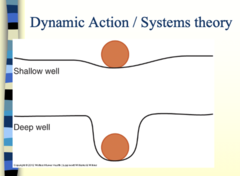
Attractor Well
- The degree to which the flexibility exists to change a preferred pattern of movement
- The deeper the well, the harder it is to change the preferred pattern, suggesting a stable movement pattern.
- A shallow well suggests an unstable pattern.
- May be viewed as riverbeds. When a riverbed is quite deep, the likelihood that the river will flow outside the established riverbed is slight. The river flows in the preferred direction established by the riverbed, which is a deep attractor well. Alternatively, if the riverbed is shallow, the river will be more likely to flow in areas not established by the riverbed. In this case, the shallow riverbed is a shallow _______________
- So too, movement patterns in patients could be characterized as stable or unstable based on the difficulty associated with changing them. It will be much easier to change an unstable movement pattern that has a shallow _______________ than to change a stable movement pattern that has a deep _________________
Movement patterns
- Stable movement patterns become more variable, or unstable, just prior to a transition to a new movement pattern.
- For example, if a person is asked to move their two index fingers of the right and left hand out of phase, (that is, one finger is flexing while the other is extending) while making the movements faster and faster, an abrupt phase transition occurs between the two fingers. The asymmetrical out-of-phase mode shifts suddenly to a symmetrical in phase mode (both fingers flexing) involving a shift to activation of muscle groups at the same time.
- Researchers have documented an increase in variability prior to the emergence of new, more stable patterns of behavior during the acquisition of new movement skills in both children and adults
- It may be possible for therapists to view variability in movement behavior as an antecedent to change in some patients.
- Described by unstable and stable movements and their ability to change
Motor Control Theories
- Abstract ideas about the control of movement
- Reflect differences in opinion about the relative importance of various neural components of movement
- Describe viewpoints regarding how movement is controlled
- A set of interconnected statements that describe unobservable structures or processes and relate them to each other and to observable events
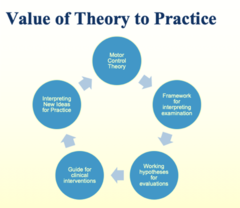
- Rehabilitation practices reflect the theories, or basic ideas; we have about the cause and nature of function and dysfunction
- Provide a clinician with:
◦A framework for interpreting behavior
◦A guide to clinical action
◦New ideas
◦Working hypotheses for examination and intervention
- Reflex theory
- Hierarchal theory
- Motor programming theory
- Systems theory
- Ecological theory
*each build off of each other
Sir Charles Sherrington
- His research formed the experimental foundation for a classic reflex theory of motor control
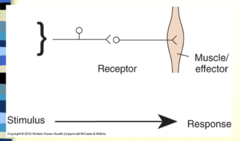
- For him, reflexes were the building blocks of complex behavior. He believed that complex behavior could be explained through the combined action of individual reflexes that were chained together
- His view of a reflexive basis for movement persisted unchallenged by many clinicians for 50 years, and it continues to influence thinking about motor control today

Reflex Theory
- Older theory that focuses on reflexes as the name sounds
- These reflexes are the building blocks of movement according to this theory.
- Reflex building blocks of complex behavior - reflexes chained together to form movement
- One of the biggest arguments of this theory is that movement does happen in the absence of sensory stimulation or in those who do not have full sensory input.
*Limitations: First, the reflex cannot be considered the basic unit of behavior if both spontaneous and voluntary movements are recognized as acceptable classes of behavior, because the reflex must be activated by an outside agent.
- Second, the the theory does not adequately explain and predict movement that occurs in the absence of a sensory stimulus. More recently, it has been shown that animals can move in a relatively coordinated fashion in the absence of sensory input.
- Third, the theory does not explain fast movements, that is, sequences of movements that occur too rapidly to allow for sensory feedback from the preceding movement to trigger the next.
- For example, an experienced and proficient typist moves from one key to the next so rapidly that there is no time for sensory information from one keystroke to activate the next.
- Movement CAN occur without sensory input
- Fourth, the concept that a chain of reflexes can create complex behaviors fails to explain the fact that a single stimulus can result in varying responses depending on context and descending commands.
- For example, there are times when we need to override reflexes to achieve a goal. Normally touching something hot results in the reflexive withdrawal of the hand. However, if our child is in a fire, we may override the reflexive withdrawal in order to pull the child from the fire. Finally, reflex chaining does not explain the ability to produce novel movements. Novel movements put together unique combinations of stimuli and responses according to rules previously learned. A violinist who has learned a piece on the violin and also knows the technique of playing the cello can play that piece on the cello without necessarily having practiced it on the cello. The violinist has learned the rules for playing the piece and has applied them to a novel situation.
*Clinical Implications: How might this theory of motor control be used to interpret a patient's behavior and serve as a guide for the therapist's actions? If chained or compounded reflexes are the basis for functional movement, clinical strategies designed to test reflexes should allow therapists to predict function. In addition, a patient's movement behaviors would be interpreted in terms of the presence or absence of controlling reflexes. Finally, retraining motor control for functional skills would focus on enhancing or reducing the effect of various reflexes during motor task
- Some of our functional movements dont go to our higher processing centers
*Have been useful in explaining certain stereotyped patterns of movement and the top down hierarchial is helpful as well, but it leaves much about movement unexplained
- Lack of reflexes can help us understand extent of damage
Hierarchical Theory
- Nervous system is organized as a hierarchy
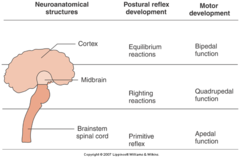
- Brain has higher, middle, and lower levels of control, equated with higher association areas, the motor cortex, and spinal levels of motor function
- Hierarchical control in general has been defined as organizational control that is top down. Each successively higher level exerts control over the level below it
- In a strict vertical hierarchy, lines of control do not cross and there is never bottom-up control
- Reflexes controlled by lower levels of the neural hierarchy are present only when cortical centers are damaged. These results were later interpreted to imply that reflexes are part of a hierarchy of motor control, in which higher centers normally inhibit these lower reflex centers (Magnus)
- In infants, normal motor development was attributed to increasing corticalization of the CNS, resulting in the emergence of higher levels of control over lower level reflexes. This has been referred to as a neuromaturational theory of development.
- This theory assumes that CNS maturation is the primary agent for change in development
*This theory minimizes the importance of other factors, such as musculoskeletal changes, during development
*CURRENTLY: no longer believe the strict organizational hierarchy
- Each level can act on another level
*Reflexes are not sole determinant in movement
*Limitations: bottom up control of movements DO occur in intact people
- the theory doesn't explain reflex dominated movements
*There is some hierarchy, but it is NOT always top down!

Current Concepts Related to Hierarchical Control
- Modern neuroscientists have confirmed the importance of elements of hierarchical organization in motor control. The concept of a strict hierarchy, in which higher centers are always in control, has been modified. Current concepts describing hierarchical control within the nervous system recognize the fact that each level of the nervous system can act on other levels (higher and lower), depending on the task. In addition, the role of reflexes in movement has been modified. Reflexes are not considered the sole determinant of motor control, but only as one of many processes important to the generation and control of movement.
*Limitations: One of the limitations of a reflex/hierarchical theory of motor control is that it cannot explain the dominance of reflex behavior in certain situations in normal adults. For example, stepping on a pin results in an immediate withdrawal of the leg. This is an example of a reflex within the lowest level of the hierarchy dominating motor function. It is an example of bottom-up control. Thus, one must be cautious about assumptions that all low-level behaviors are primitive, immature, and non-adaptive, while all higher level (cortical) behaviors are mature, adaptive, and appropriate
Clinical Implications of Reflex Organization
- Abnormalities of reflex organization have been used by many clinicians to explain disordered motor control in the patient with a neurologic disorder.
- CNS maturation is the primary agent for change in development. Motor Control emerges from reflexes that are organized in various levels
*What/where will you see this in the clinic? Brain injuries results in loss of higher control... Lower level reflexes becoming exaggerated and pathological.
- Brunnstrom and Bobath (1960's - 1970's)- NDT Neurodevelopmental Treatment - spurred as a result of this theory.
Motor Program Theory
- Variability is considered to be the consequence of errors in motor performance, with the assumption that as performance improves during skill acquisition, error—and consequently variability—decrease
- Action rather than reactions - movement can occur in the absence of sensory stimuli/input
- Can exist with either sensory or CNS stimulus
- Existence of central pattern generators (CPGs)
- Moved away from views of the CNS as a mostly reactive system and have begun to explore the physiology of actions rather than the physiology of reactions
- Variability is considered to be the consequence of errors in motor performance, with the assumption that as performance improves during skill acquisition, error—and consequently variability—decrease.
*An interesting way of viewing reflexes is to consider that one can remove the stimulus, or the afferent input, and still have a patterned motor response. If we remove the motor response from its stimulus, we are left with the concept of a central motor pattern.
This concept of a central motor pattern is much more flexible than the concept of a reflex because it can either be activated by sensory stimuli or by central processes
- This theory has considerable experimental support. Experiments that studied this theory in grasshopper or locust and showed that the timing of the animal's wing beat in flight depended on a rhythmic pattern generator. Even when the sensory input, while not essential in driving movement, has an important function in modulating action.
- These conclusions were further supported by work examining locomotion in cats - the results of these experiments showed that in the cat, spinal neural networks could produce a locomotor rhythm with neither sensory inputs nor descending patterns from the brain
- By changing the intensity of stimulation to the spinal cord, the animal could be made to walk, trot, or gallop. This then demonstrates that reflexes do not drive action, but that central pattern generators (spinally mediated motor programs) by themselves can generate such complex movements as the walk, trot, and gallop.
- Further experiments showed the important modulatory effects of incoming sensory inputs on the central pattern generator - these experiments led to the development of this theory. This term has been used in a number of ways by different researchers, so care should be taken in determining how the term is being used. The term motor program may be used to identify a central pattern generator (CPG), that is, a specific neural circuit like that for generating walking in the cat. In this case, the term represents neural connections that are stereotyped and hardwired.
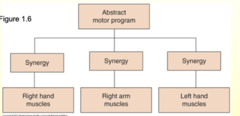
- It has been hypothesized that the rules for writing a given word are stored as an abstract motor program at higher levels within the CNS. As a result, neural commands from these higher centers used to write your name could be sent to various parts of the body. Yet, elements of the written signature remain constant regardless of the part of the body used to carry out the task
- Can have motor output without sensory input
*Limitations: does not take into account that the nervous system must deal with both musculoskeletal and environmental variables in achieving movement control. Our daily activities require constant adjustments and refinements - musculoskeletal and environmental variables need to be considered. Also, injury to the CNS results in complex adjustments in Motor control.
-does not take into account sensory input (which we know is definitely a big factor)
-a central motor program cannot be considered to be the sole determinant of action.
*Clinical Implications: has allowed clinicians to move beyond a reflex explanation for disordered motor control. "Motor Memory" Explanations for abnormal movement have been expanded to include problems resulting from abnormalities in central pattern generators or in higher level motor programs. In patients whose higher levels of motor programming are affected, motor program theory suggests the importance of helping patients relearn the correct rules for action. In addition, intervention should focus on retraining movements important to a functional task, not just on reeducating specific muscles in isolation.
Motor Program
- Term used to describe the higher level motor programs that represent actions in more abstract terms. - A significant amount of research in the field of psychology has supported the existence of hierarchically organized ______________ that store the rules for generating movements so that we can perform the tasks with a variety of effector systems
Systems Theory (used today)
- Bernstein was looking at the nervous system and body in a whole new way. Previously, neurophysiologists had focused primarily on neural control aspects of movement. Bernstein recognized that you cannot understand the neural control of movement without an understanding of the characteristics of the system you are moving and the external and internal forces acting on the body
- Body seen as a mechanical system - Bernstein noted that we have many degrees of freedom that need to be controlled. We have many joints, all of which flex or extend and many of which can be rotated as well. This complicates movement control. He said, "Coordination of movement is the process of mastering the redundant degrees of freedom of the moving organism" Body Mechanics (e.g. gravity, inertia)
- As a solution to the degrees of freedom problem, Bernstein hypothesized that hierarchical control exists to simplify the control of the body's multiple degrees of freedom. In this way, the higher levels of the nervous system activate lower levels. The lower levels activate synergies, or groups of muscles that are constrained to act together as a unit. Thus, for example, when the demands of a task increase, the control signal to the synergy increases, leading to parallel increases in the activation in all muscles in the synergy.
- Synergies are principles of abundance - organizes sharing of task among a set of elemental variables (such as muscles)
-ensures covariation among elemental variables with the purpose of stabilizing performance variables (such as center of mass in posture control or end point in a reaching task)
- Synergies show both stability against perturbations and flexibility to solve concurrent tasks
- In describing the characteristics of the system being moved, Bernstein looked at the whole body as a mechanical system, with mass, and subject to both external forces such as gravity and internal forces such as both inertial and movement-dependent forces. He thus showed that the same central command could result in quite different movements because of the interplay between external forces and variations in the initial conditions. - BACK to the example of standing on one leg"
- For the same reasons, different commands could result in the same movement. Bernstein also suggested that control of integrated movement was probably distributed throughout many interacting systems working cooperatively to achieve movement. This gave rise to the concept of a distributed model of motor control
- Smaller movements, if altered, affect the movement as a whole
*Evolved into dynamic systems theory using principles of self organization
-critical features are examined as nonlinear properties of the system where the output is not proportional to the input
-nonlinear behavior changes into a different behavior when one parameter reaches a clinical value
*Limitations: too mechanical, not enough emphasis on person's nervous system
*Clinical implications: body as a mechanical system, individual and interacting systems, movement is an emergent property - meaning it emerges from the interaction of multiple elements that self-organize based on certain dynamic properties of the elements themselves.
- This means that shifts or alterations in movement behavior can often be explained in terms of physical principles rather than necessarily in terms of neural structures.
*Evolved into the dynamic systems theory

How does Bernstein's approach to motor control differ from the other approaches?
- He asked questions about the organism in a continuously changing situation. He found answers about the nature and control of movement that were different from those of previous researchers because he asked different questions, such as:
• How does the body as a mechanical system influence the control process? and
•How do the initial conditions affect the properties of the movement?
Nonlinear Behavior
- A nonlinear system is one whose output is not proportional to its input
- ________________ is one that transforms into a new configuration when a single parameter of that behavior is gradually altered and reaches a critical value.
- For example, as an animal walks faster and faster, there is a point at which, suddenly, it shifts into a trot. As the animal continues to move faster, there is a second point at which it shifts into a gallop. What causes this change from one behavioral pattern (e.g., a walk) to a new behavioral pattern (e.g., a trot)?
Systems Theory: Control Parameter
- Variable that regulates change in the behavior of the entire system. In our example, the _______________ is velocity. When the animal's walking velocity, a control parameter, reaches a critical point there is a shift in the animal's behavior, from a walk to a trot.
- The dynamic action perspective has deemphasized the notion of commands from the central nervous system in controlling movement and has sought physical explanations that may contribute to movement characteristics as well
Variability in the control of movement
- Necessary condition of optimal function
- Flexible, adaptive strategies, adjustment to environment
- Small variability, resistant to change, attractor state or having deep well
- Larger variability, less resistant to change, shallower well
- If see increased variability, possible to see emergance of new stable behavior soon
Dynamic Action Theory
- Suggests that the new movement emerges because of a critical change in one of the systems, called a "control parameter."
What are the implications of systems theory for treating motor control disorders in patients?
- If as clinicians we understood more about the physical or dynamic properties of the human body, we could make use of these properties in helping patients to regain motor control. For example, velocity can be an important contributor to the dynamics of movement. Often, patients are asked to move slowly in an effort to move safely. This approach to retraining fails to take into account the interaction between speed and physical properties of the body, which produce momentum, and therefore can help a weak patient move with greater ease.
- Variability as a characteristic feature of normal movement has important clinical implications for therapists involved in retraining movement in patients with neural pathology. When variability is viewed as a consequence of error, therapists will use therapeutic strategies designed to reduce error, guiding patients toward an optimal and stable movement pattern. In contrast, when variability is viewed as a critical element of normal function, therapists will encourage patients to explore variable and flexible movement patterns that will lead to success in achieving performance goals
Ecological Theory
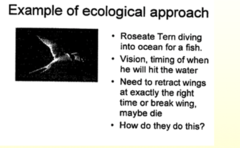
- How we detect information in our environment that is relevant to our actions and how we use this information to control our movements. The ability to use perceptions to guide action emerges early in life.
- Perception of environment can drive movement
- For example: by 15 weeks of age infants do not automatically reach for every object that passes by, but instead they are able to use perceptions related to velocity to determine in advance whether or not they can catch a ball
- This view was expanded by students of Gibson and became known as the ________________
- Motor control evolved so that animals could cope with the environment around them, moving in it effectively in order to find food, run away from predators, build shelter, and even play
- What was new about this approach? It was really the first time that researchers began focusing on how actions are geared to the environment.
- Actions require perceptual information that is specific to a desired goal-directed action performed within a specific environment. The organization of action is specific to the task and the environment in which the task is being performed. Whereas many previous researchers had seen the organism as a sensory/motor system, Gibson stressed that it was not sensation per se that was important to the animal, but perception. Specifically, what is needed is the perception of environmental factors important to the task. He stated that perception focuses on detecting information in the environment that will support the actions necessary to achieve the goal. From an ecological perspective, it is important to determine how an organism detects information in the environment that is relevant to action, what form this information takes, and how this information is used to modify and control movement
- This perspective has broadened our understanding of nervous system function from that of a sensory/motor system, reacting to environmental variables, to that of a perception/action system that actively explores the environment to satisfy its own goals
*Limitations: Although this has expanded our knowledge significantly with regard to the interaction of the organism and the environment, it has tended to give less emphasis to the organization and function of the nervous system that led to this interaction. Thus, the research emphasis has shifted from the nervous system to the organism/environment interface.
*Clinical Implications: A major contribution of this view is in describing the individual as an active explorer of the environment. The active exploration of the task and the environment in which the task is performed allows the individual to develop multiple ways to accomplish a task. Adapt-ability is important not only in the way we organize movements to accomplish a task, but also in the way we use perception. An important part of intervention is helping the patient explore the possibilities for achieving a functional task in multiple ways.
- The ability to develop multiple adaptive solutions to accomplishing a task requires that the patient explore a range of possible ways to accomplish a task and discover the best solution, given his or her set of limitations
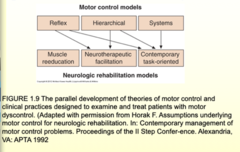
Parallel development of clinical practice and scientific theory
*Neurofaciliation: used reflexive and hierarchical theories based upon inhibitory and facillitory techniques
-modify CNS through retraining
*Underlying assumptions: control of movement top down, compensation do not develop, higher levels must regain control of lower levels for recovery to occur, function returns when abnormal movements are inhibited and normal movements are facilitated, repetition of movements will automatically become functional
*Clinical applications: sensory critical to everything, CNS can be modified, reflexes are central
- Reflex ---> dynamic systems
Vision Statement for the PT Profession
*Transforming society by optimizing movement to improve the human experience
*Today - we use a systems approach
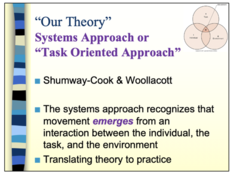
Task Oriented Approach
*Underlying assumptions:
- Movement occurs secondary to interaction among many different systems
- Movement organized around behavioral goals
- Movement constrained by the environment
- Sensation is essential to predictive and adaptive control - but it is not absolute
*Clinical applications:
- Work on function
- Active problem solving
- Adaptation is critical
How do our perceptions of ourselves, the tasks we perform, and the environment in which we are moving influence our movement behavior?
- Motivation
- Relevance
- Believing in your ability
Motor Control: Importance to PT
◦ Many of our patients have a motor control problem (primary/secondary)
◦ Utilize a combination of approaches/theories
◦ Limitations and implications for most theories
◦ Dynamic systems theory and Task oriented
◦ Assessment and treatment of movement disorders depend on a number of factors, including knowledge of the neural basis for normal movement control and pathophysiology of impaired movement
◦ Depending on what approach you use it will change your practice and outcomes
Nature of Movement
- Individual has to generate movement to meet the demands of a task being performed within a specific environment. The individual's capacity to meet interacting task and environmental demands determines that person's functional capability. Motor control research that focuses only on processes within the individual without taking into account the environment in which that individual moves or the task that he or she is performing will produce an incomplete picture.
- Organization of movement constrained by factors within the individual, task and environment
Systems Underlying Motor Control
- Recovery of function: following CNS damage requires that a patient develop movement patterns that meet the demands of functional tasks in the face of sensory/perceptual, motor, and cognitive impairments. Our intervention strategies should therefor help the patient (re)learn to perform functional tasks, taking into consideration underlying impairments, that are essential to maximizing the recovery of functional independence.
SO, we need to apply all this information to determine:
- What tasks should be taught, in what order, and at what time?
- An understanding of task attributes can provide a framework for structuring tasks. Tasks can be sequenced from least to most difficult based on their relationship to a shared attribute
- What is constraining the movement - a factor in the individual, environment, or task?

Taxonomy of tasks: Gentile
- This framework provides a structure for individual treatment sessions with a patient or to progress the level of difficulty of motor tasks throughout a treatment plan
- Start in upper left box
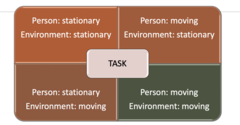
Task Constraints on Movement
◦ Tasks can impose constraints on movement
◦ Task attributes can provide a framework for organization
- Practice is important
- Attentional resources increase as stability demands increase. The lowest attentional demand are those with a nonmoving base of support (often called "static postural control tasks") such as sitting and standing; attentional demands increase in mobility tasks such as walking and obstacle clearance.
- The presence of a manipulation component has also been used to classify tasks
- The addition of a manipulation task increases the demand for stability beyond that demanded for the same task lacking the manipulation component. This means sequencing of tasks is important when working with our patients.
- Stability -> mobility -> manipulation
Individual Constraints to Movement
- Action: Motor output in a coordinated pattern to
control muscle and joints.
- Perception: Integrate sensory information and perceptual systems
- Cognition: Where is their attention? Problem solving?
What is their motivation & emotional state?
Environmental Constraints to Movement
*Regulatory:
Movements must conform- this can include size/shape of item to be picked up; type of surface we are walking on
*Non-regulatory:
May affect performance- distractions or background noise
• Regulatory features specify aspects of the
environment that shape the movement itself.
• Task-specific movements must conform
To regulatory features of the environment
inorder to achieve the goal of the task.
Summary of Movement Types

Week 1 Summary

Learning vs. Performance
- Learning: relatively permanent change
- Performance: temporary change in motor behavior seen during practice sessions
Motor Learning vs Recovery
- Motor Learning: the study of the acquisition or modification of movement in normal subjects.
- Recovery: reacquisition of movement skills lost through injury
Different forms of memory
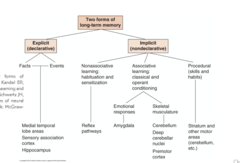
Implicit Learning
*Type of nonassociative learning:
-Given a sensation repeatedly
Implicit Learning: Habituation
-Decrease in responsiveness that occurs to repeated exposure of a non-painful stimulus
-Used to treat patients who experience dizziness
Implicit Learning: Sensitization
-Increase in responsiveness following threatened or noxious stimulus
-Can counteract habituation - teaching someone about falls
Implicit Learning: Associative Learning
- Learns to predict relationships
Implicit Learning: Classical Conditioning
- Learning to pair two stimuli together and respond accordingly

Implicit Learning: Operant Conditioning
- Trial and error learning; associate response with a consequence
Implicit Learning: Procedural Learning
- Learning tasks that can preformed automatically without thought
- Develops slowly needing much practice
Declarative Learning
- Type of explicit learning
-Knowledge that can be consciously recalled
- Requires constant repetition can change this into implicit learning
-Relies on sensory association cortices - practice helps
-Short term and long term memory
"nose over toes" when teaching sit to stands
-Involves four steps:
•Encoding
•Consolidation
•Storage
•Retrieval
Schmidt Schema Theory
- Open-loop control process- doesn't require sensory feedback, (comparing actual to intended)
- But HOW can motor programs be learned
-General rules for a specific class of mvmt
- After indiv makes a mvmt: 4 things available
1. Initial mvmt conditions
2. Parameters used in motor program
3. Outcome of mvmt= KR
4. Sensory consequences
- How movement can be carried out without feedback
- Outcomes:
-Variability of practice improve learning
-New movement can be done well if based on previous rule
- Limitations:
-How is a new movement performed when there are no schema?
Schema
- Abstract representation that is stored in our memory following movement - not specific but has generalized rules for movement
-Used to select particular response
*Recall _________:
-Uses certain parameters
-Relationship created between parameter size and outcome
-Rule is only aspect retained
-ex. each time person makes movement with a goal in mind they use particular movement parameter and receive input to its accuracy
-new data is then inputed into the system to refine the rule
-learning how someone is going to serve throughout tennis match
*Recognition __________:
-Evaluate the response
-Relationship between sensory and outcomes of similar previous movements to create representation of expected sensory consequence
- Past movement instead of ongoing movement
-Sensations are compared to ongoing movement
-ex. missed the ball last time, so this time im going to position myself better to get the next ball
- Update recognition and recall __________ once we've seen enough balls in order to be more successful
Ecological Theory (proposed by Newell)
- Perception and action
-Increases coordination between perception and action
-Dependent upon task and environment constraints
-Need to determine most important motor output and perceptual cues
-Critical to this is knowledge of performance and knowledge of results - know whats going on while you're doing the task and what happens after you complete the task
- Combo of systems and ecological motor control
- Theory of search strategy
- Perceptual info relates to understanding the goal of the task
-Demonstration is important
-Feedback = knowledge of performance
-Task-relevant mapping of perception
-ex. glass of water - how full it is, how slippery it is, the shape of it, all these perceptions of the glass leads to how you will pick it up
*Outcome:
-Exploration of perception and motor output to create best strategy
-Interaction between task, environment, and individual
*Limitation:
-Not really well studied yet
Gentile's Two Stage Model
- More popular and most studied
*1st stage explicit
-Develop understanding of task and environment
-Understanding of movement pattern needed
-Understanding of regulatory and non-regulatory features
*2nd stage fixation and diversification or implicit
-Refine movement
-Adapt movement to environmental context
-Movement consistent and efficient
*open skill - more movement patterns involved

Fitts and Posner 3 Stage Model
- Very popular - used widely
1. Cognitive Stage
2. Associative Stage
3. Autonomous Stage

Fitt's and Posner Cognitive Stage
- Beginner
*How do I produce this movement pattern?
*Performer's Behavior:
***Understanding the nature of the task, developing strategies that could be used to carry out the task, determine how task could be evaluated. PERSON experiments with a variety of strategies and then abandons those that don't work, keep the ones that do. Performance variable, improvements in performance large.
• Learning the fundamental movement patterns
• High cognitive activity (attention to movement and self-talk) can be tiring learning new skill
• Inconsistent performance
• Many gross errors
• Greatest performance improvements occur during this stage
*Therapist's role:
• Assisting the learner in understanding the movement pattern
• Teaching strategies are most effective during this stage (e.g., verbal instruction, demonstrations, modeling, etc.)
*In summary:
-Understanding the task
-Developing new strategies
-Determining how to evaluate outcomes
-Performance is variable
-Improvements in task are very notable
-Selection most effective strategy at the completion of stage
-What to do
Fitt's and Posner Associative Stage
- Intermediate
*I've got it! Now, how do I get to the next level?
*Performer's Behavior:
***Person has selected the best strategy and now begins to refine the skill. Less variability in performance. Improvement occurs more slowly. Last days to weeks depending on performer and the intensity of practice.
• More consistent performance
• Fewer errors
• Fewer attentional demands
• More gradual performance improvements
*Therapist's role:
• Practice design
• Facilitating error detection
-trying to figure out whats going wrong when they do something wrong
*In summary:
-Refinement of skill
-Less variability in performance
-Improvement of task is slow
-Cognitive aspects of skill is less important at this stage
-Development of optimal pattern at the end of this stage
-Spatial and temporal concepts are refined into coordinated pattern
-Proprioception more critical than visual guidance
-How to do
Fitt's and Posner Autonomous Stage
- Advanced
*I'm on top! How do I stay here?
*Performer's role:
***Doesn't require attention and in fact may interfere. Dual task at this stage = beneficial. Focusing on outside aspects of task (hitting target) vs inside (feel of the swing) beneficial.
• High level of skill proficiency
• Performance largely automatically
• Very few errors
• Very consistent
• Focus on strategies
*Practitioner's role:
• Practice design
• Refining the performance
• Motivating the performer to keep practicing
-progress isn't as fast in this stage
*In summary:
-Automaticity of skill
-Low attention needed
-How to succeed
-Divert attention to environment or doing another task
Systems Three Stage Model of Motor Learning (Bernstein's)
-Controlling degrees of freedom*
-1st stage: reduce the degrees of freedom; decreases the efficiency and flexibility- Novice
•Movement is not efficient/ flexible
-2nd stage: Advanced
- Allow more movements; synergies vs co-contraction; decreased efficiency and flexibility in response to changing task or environment demands
•Movement is more efficient, more joints move, more synergies of movements across joints
-3rd stage: Expert
- More efficient, using mechanical advantages and inertia. Person has learned to take advantage of the mechanics of the musculoskeletal system and the environment to optimize the efficiency of the mvmt.
•All degrees of freedom are used
•Less expenditure of force
*Clinical implications:
-Provides reason for co-activation that occurs (some of body shuts down so theres less to control - using less degrees of freedom)
-Can provide support to the idea to master skill with less degrees of freedom first
-Provide support for using external assistance/support that reduces degrees of freedom to ameliorate skill (such as braces)
-co-activation is a reasonable strategy to the inability to control degrees of freedom. Using development sequence for this reason rather than recapitulation (neuromaturational rationale). External support during early phases of learning a motor skill can be very helpful
*Limitations:
- less support for last stage of motor learning
Stages of Motor Learning

Practical applications of motor learning
- Practice Level *MOST IMPT is amount*
-FEEDBACK is necessary in order for learning to take place:
-Intrinsic
• Knowledge of performance (KP) - info we get through our sensory systems (vision - watching yourself do something)
-Extrinsic
• Knowledge of results (KR) - how things ended up (verbal or tactile cues)
-Delay
-Constant
-Fading
-Summary
Law of Practice
- More practice more learning
- A power function or log-linear function,
-T, to complete an action (where performance is measured in terms of time)
-a and b are constants,
- P is some measure of the amount of practice (e.g., number of trials).
- Practice increases and P becomes larger, the ratio a/P decreases, resulting in smaller time to complete the action, T;
- The larger the constant b, the more "rapid" are the decreases with practice
- Rate of improvement related to amount left to improve
- Description relationship between practice trials and performance does not always depict learning
- Motivation is a key factor
Practice
- Can include on-task situations, as well as conditions in which the learner does not physically interact with the task
- Motivation is a key factor

Motivation for Learning
- If views the task as meaningless learning may not occur
- Task needs to seem important* (asking your patient what THEY want - what their goals are)
- Goal setting
-Focus attention
-Help regulate effort
-Help maintain attention
-Provide a benchmark
Verbal information you give as a PT
*Instructional set
-Effects learning and performance
-Movement itself
-Idea of movement
-Prompts to how to recognize errors
*Focus of attention
-External focus facilitated both performance and learning
-Essential to movement
*Learning without awareness
-Learning can occur in the absence of explicit instructions (picking up on observations)
*Knowledge of mechanical principles
-Some learning can occur without this information
Perceptual learning
- Potential for learning with better performance - the better we are at perceiving what we have to do the better we perform it
- Better learning when instructed to attend to certain stimuli and respond to certain stimuli
- Better learning when instructed to most relevant information
Observational learning
- Demonstrate skill
- Timing
- Spatial relationships
- Model can be expert or a learner
- May learn more from a learner if:
-Model provides information about movement
-From augmented feedback to learner
-From next trial of seeing information utilized Intersperse with physical practice

Practice Conditions
-Massed (more practice than rest) vs distributed (more rest time than practice time):
Fatigue - sometimes not safe to just keep practicing
-Constant (practices one variation of a movement skill several times in a row) vs variable (practices several variations of a motor skill - increases ability to adapt):
-Random (random order of practicing skills - makes learning more effective in the long run) vs blocked (same task practiced over and over again - not a lot of experience with the task or low intellectual inability such as someone with down syndrome)
-order in which tasks are practiced
- Adults learn better from random practice*
-Whole vs part - break down task into steps if it can be divided into smaller tasks but important to go back to the whole
-Transfer
-Mental Practice
-Guidance vs Discovery

Whole vs. Part training
- Can practice part/ break the task down
- Practice separate components
- Then separate components need to be re-grouped into one whole task
Transfer of skills from one condition to another
- Depends on the similarity of two tasks
- Depends on the similarity of the environment
- Start in a well controlled environment and then gradually move to more realistic environment
- Resemble environment they have to perform the task in