3.2 Mini Video Lecture: The Transition to Early & High Classical Sculpture
 Call Kai
 Learn
Learn Practice Test
 Spaced Repetition
 Match
Match Flashcards
 Knowt Play
1/14

Earn XP
Description and Tags
More Than Just a Bunch of Guys Standing Around--the Continued Journey Toward Naturalism in Greek Sculpture
Name | Mastery | Learn | Test | Matching | Spaced | Call with Kai | Chat |
|---|
No analytics yet
Send a link to your students to track their progress
15 Terms
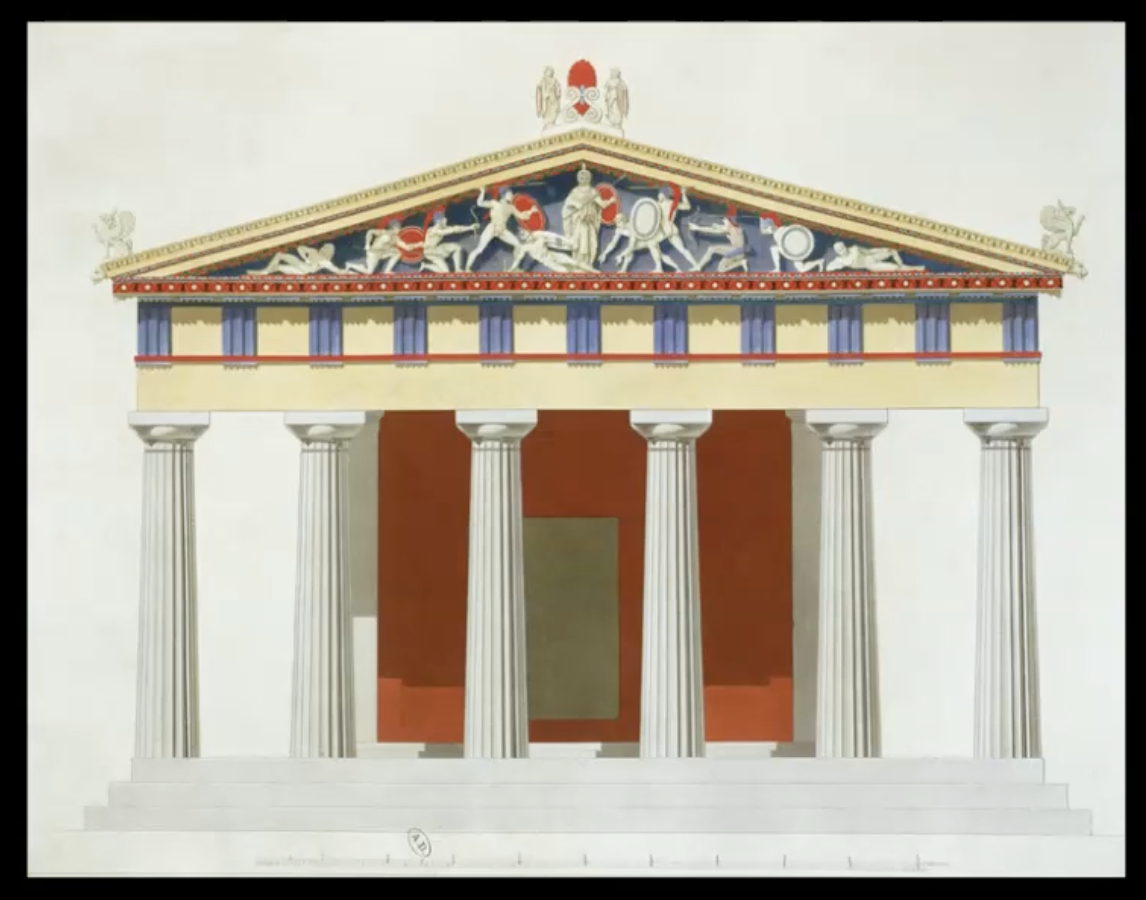
restored view of the temple of aphaia, aegina, greece, ca 490 BCE
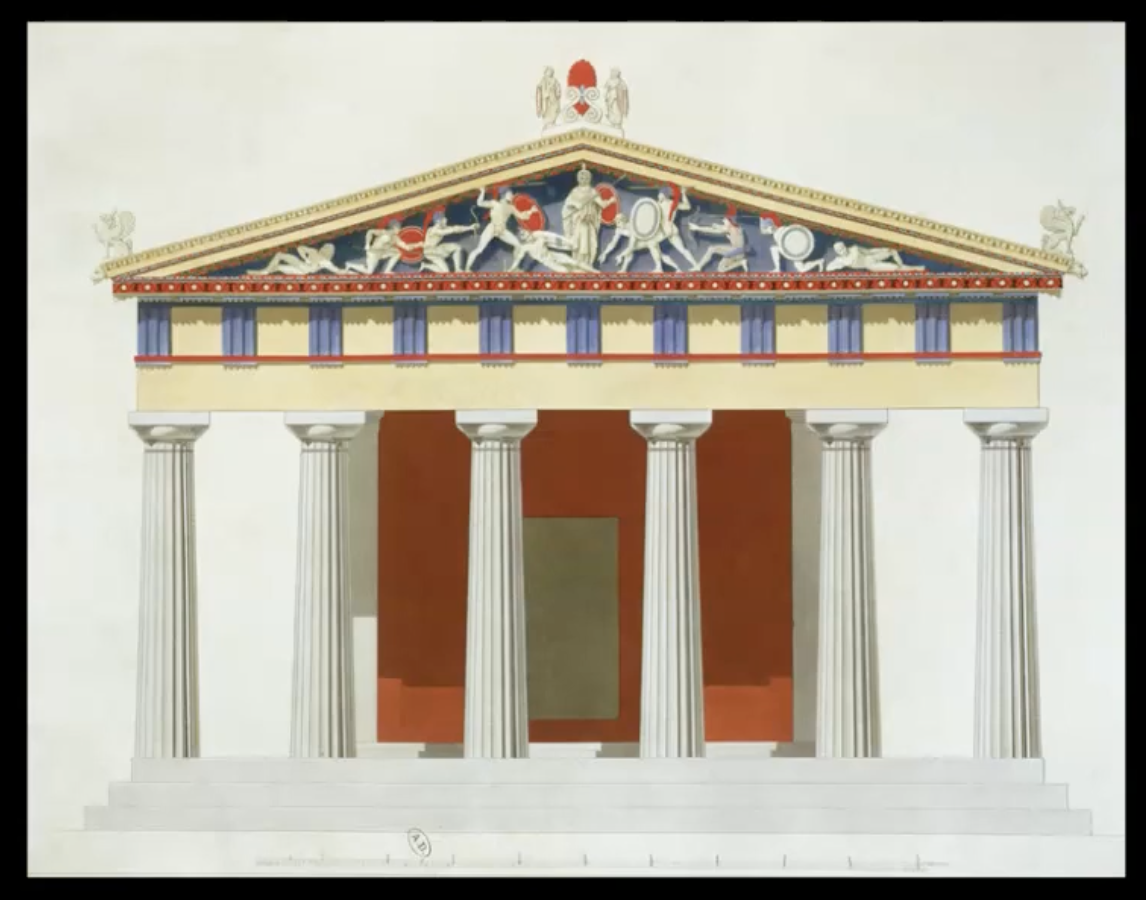
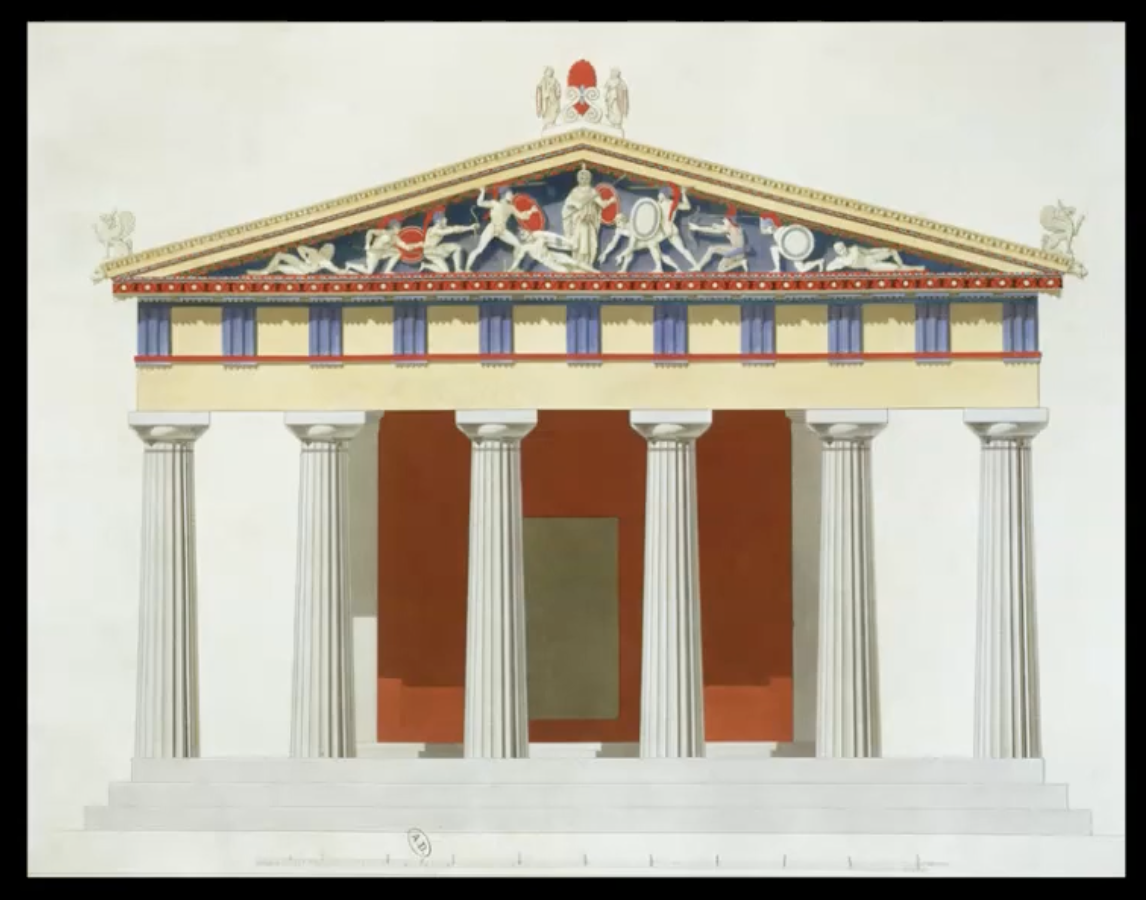
a Doric temple: the disc shaped capitals on those fluted columns that form the porch to the entrance of the sanctuary and then the alternating triglyphs and metopes that sit below this pediment element part of the kind of peaked roof of Greek temples
sculpture--whether freestanding sculpture or sculptural
reliefs that decorates either the metopes (cái ô vuông sát bên cái cột nhỏ) in the Doric order, or you find in both the Ionic and Doric orders' pediment sculpture.
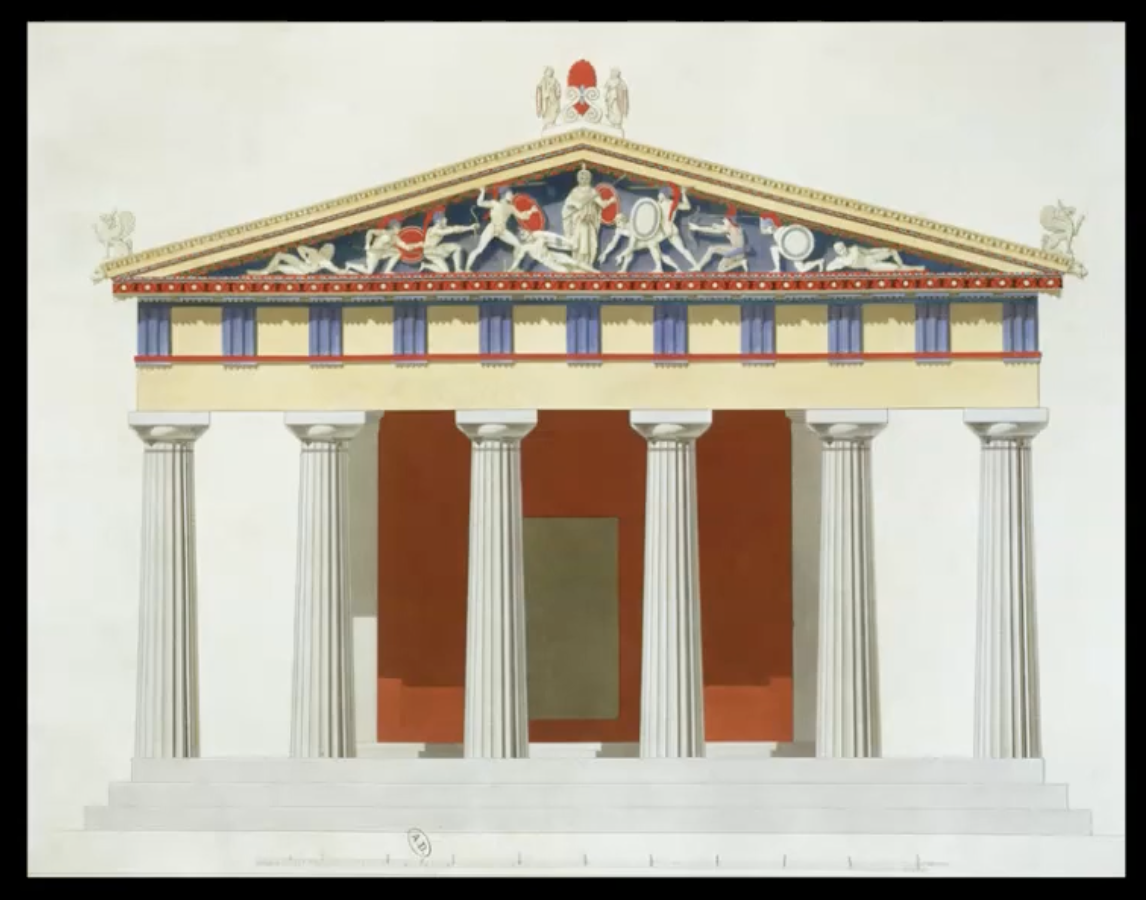
-the idea of balance and harmony exists in the Greek values and that translates into their arts and architecture
->so the front of a Greek temple is going to look like the back as well. -> there will be a colonnade of columns, and then above it a pediment that faces both the east and west sides of the Temple of Aphaia.
What is Aipha?
Aphaia was a nymph--so nymphs are more like demigods that are associated as female deities of forests and rivers that kind of thing.
-the challenge of pediment is its triangular shape.
- It's [theme is] the battle of the Greeks and the Trojans-- Athena, the star of the show, gets center place--she gets to stand up-at the tallest positioning on that pediment but
- the pediment tapers downward things get a little bit more cramped. -They do start to show them very crouching, fighting poses that's for sure.
![<p>What is Aipha?</p><p>Aphaia was a nymph--so nymphs are more like demigods that are associated as female deities of forests and rivers that kind of thing.</p><p>-the challenge of pediment is its triangular shape.</p><p>- It's [theme is] the battle of the Greeks and the Trojans-- Athena, the star of the show, gets center place--she gets to stand up-at the tallest positioning on that pediment but</p><p>- the pediment tapers downward things get a little bit more cramped. -They do start to show them very crouching, fighting poses that's for sure.</p>](https://assets.knowt.com/user-attachments/04016e00-3ea7-47be-9dd3-4e99c0d9b930.png)
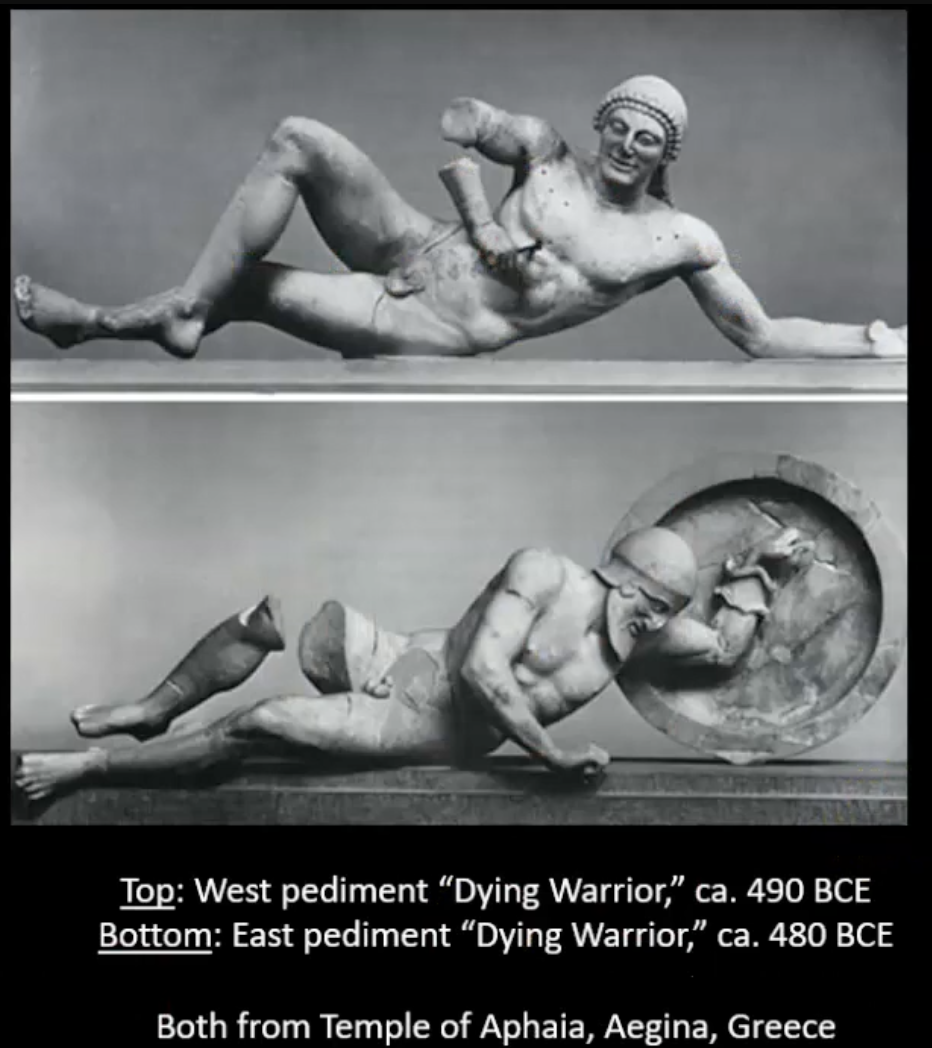
What do you do with the corner of the pediment triangle shape?
Front and back, both sides:
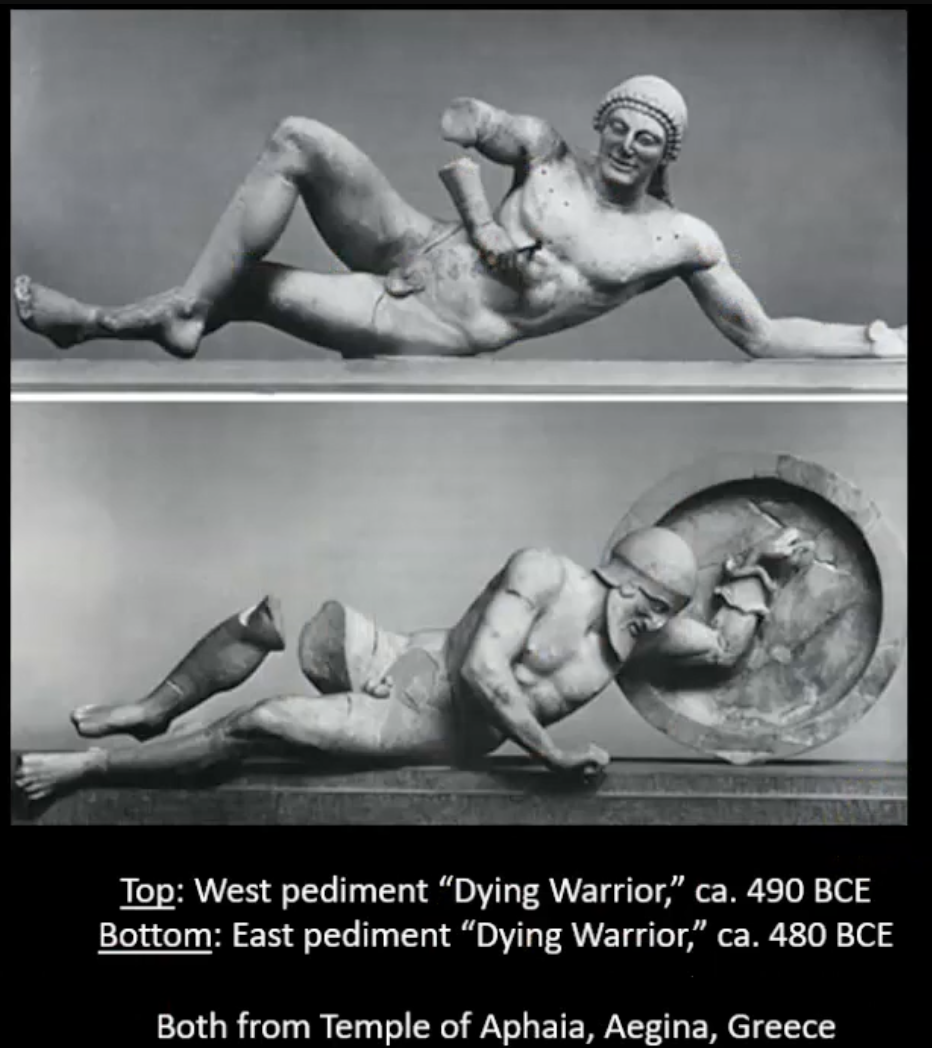
depict "dying warriors."
-a battle scene between the Greeks and the Trojans here so the image on the top is the dying warrior executed for the older west pediment side of the Temple of Aphaia
-a marble sculpture, an actual sculpture versus a sculptural relief which would have been more common on a metope for instance,
-life-sized sculptures, a believability with naturalism: his body is in proportion; don't have arms that are too long, or head that's too large,
->believable and part of the naturalism we saw in the Archaic world and pretty rapidly moving away from the very strictly geometric shaped bodies to bodies that look like they have an anatomical structure bones, with musculature; kind of this mix of suppleness
and firmness that makes up the human body.
(The top) he grips with his right hand something that has impaled him -> fatal wound righht: An arrow or a staff something has happened and he props himself on one elbow as he has collapsed and was wounded in battle.
-his body: sort of connect the dots between the tops of his toes to the kneecap to the top of the head and there you can see how he would fit nicely into that tight triangular shape of a temple pediment. The only thing that's a little bit
(West)
very common to Archaic period sculpture : patternized hair.
->lots of pattern forming the coiled long hair that was typical of that era as well as that Archaic smile.
-> the Archaic smile isn't really meant to convey laughter or joy--it's just a slight upturn to the mouth to enliven the face, to make it look more like a human that's alive
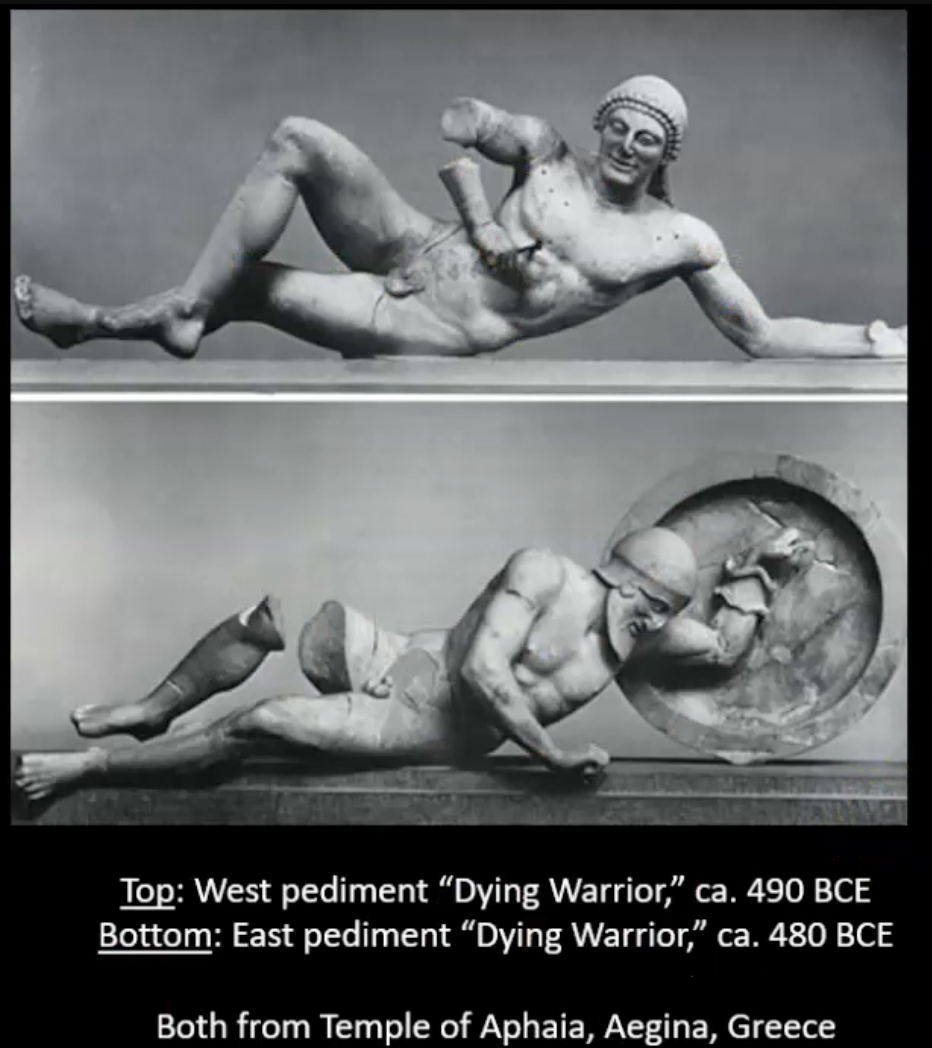
(East) -that same corner you have another dying warrior.
-a naturalism in anatomy: muscle groupings and proportions
-more of a believability...of an instantaneous kind of trauma or wound that befell this warrior from Antiquity
-his arm is still trapped in his shield, the warrior is helmeted--> there are the accoutrements of battle accompanying this depiction of a fallen warrior.
-He uses his arm in a believable way aswell to kind of keep himself propped up but of course weakness is overtaking him and gravity is pulling him downward( a sense of that inevitability, of the finality of his death coming soon with his downward gaze.)
-it's not the face looking out brightly at you the viewer but downcast as if to collect his final thoughts.
It's a statue that invites more of the viewer's empathy and sympathy of the cost of war-
Transition between the Archaic and Early Classical to High Classical periods in sculpture
Archaic period: we started to see the description of human anatomy with accurate proportions--
- now we're gonna start to see the description of the human body with naturalistic looking behavior, how our bodies respond to standing
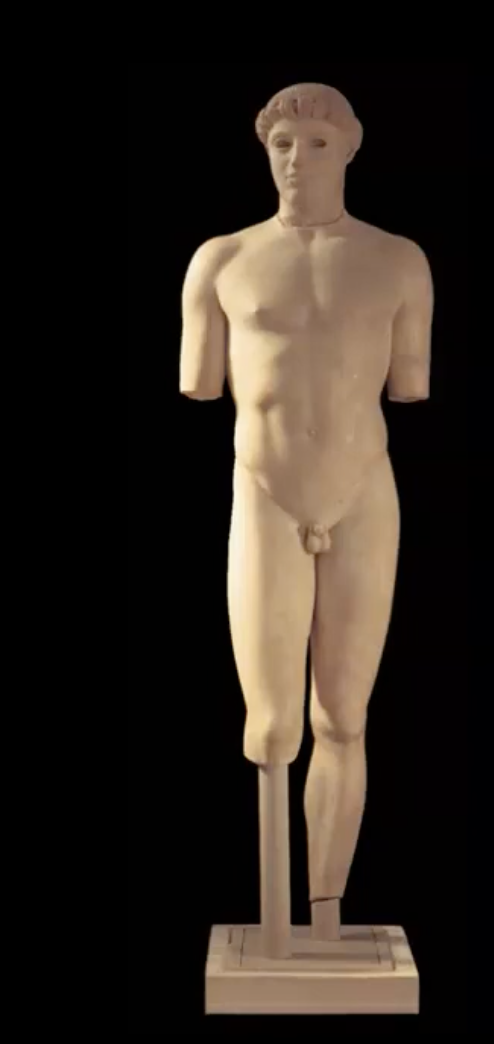
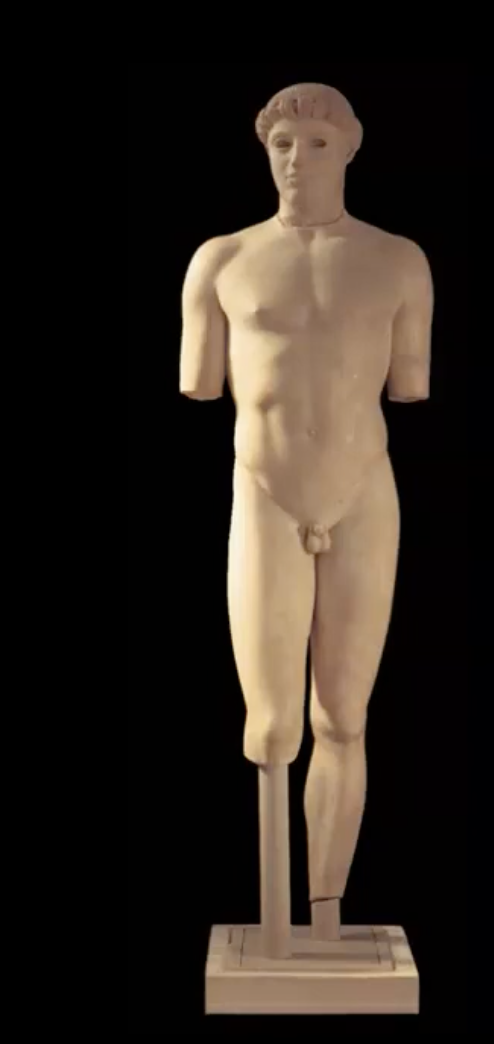
Kritios Boy, from the Acropolis, Athens, Greece, ca. 480 BCE
Early Classical period
Contrapposto= weight shift from one leg to the other
-a marble sculpturet, 3ft ,
-demonstrate all of the naturalism gaining momentum and accuracy in the Archaic period;
Diiference with kouro from Attica
-this sculpture in marble that doesn't nearly come close to the naturalism of the Kritios Boy.
-relatively stiff with arms bound to the sides, a very rigid, almost soldier-like frontal presentation right of the torso in head, a description of the pectoral muscles and the abdominal muscles, the face extremely generic
the hair very kind of abstract, stylized, patternized not looking like real human hair-- and then this strange foot slid forward
thing...it's not like it's taking a step forward We don't see a bend of the knee.
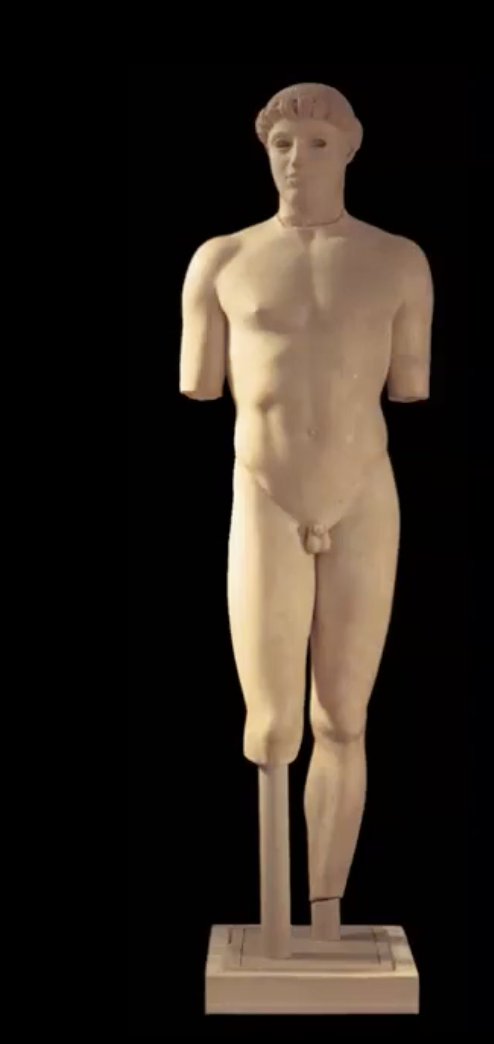
-it's a weight shift: he's taking a little bit of a load off one leg, this leg, the knee remains locked.
-This knee: a bend of the knee showing that it is more relaxed compared to the other working leg, so this is the leg that's supporting the body
-the weight of the body is then kind of thrust into one hip and this is called the "contrapposto stance." - a Greek innovation-a weight shift that describes this pivot in weight from one leg to the other.
->getting the naturalism of the human body right, believable skeletal structure that's in proportion, muscle groupings, the firmness, the fleshiness-how the body behaves.
-the knees are no longer aligned side by side as they were in that earlier Archaic period kouros; the hips are no longer aligned, there's a slight diagonal to them, and the whole spine
-with the slight turn of the head instead of a forward facing head you have something much more believable and naturalistic in describing the behavior of the human body.
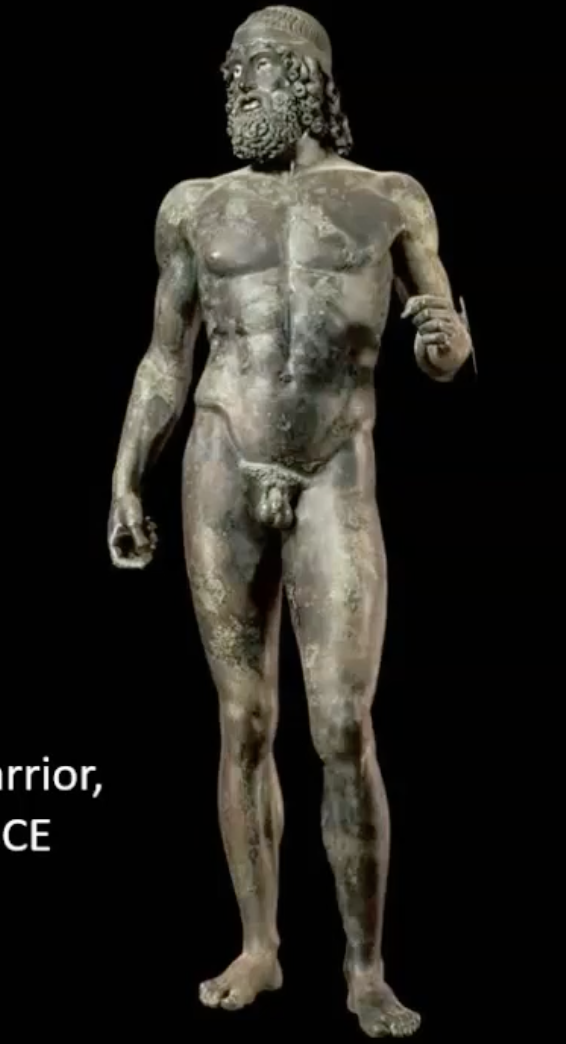
Rice Warrior, ca 460 BCE
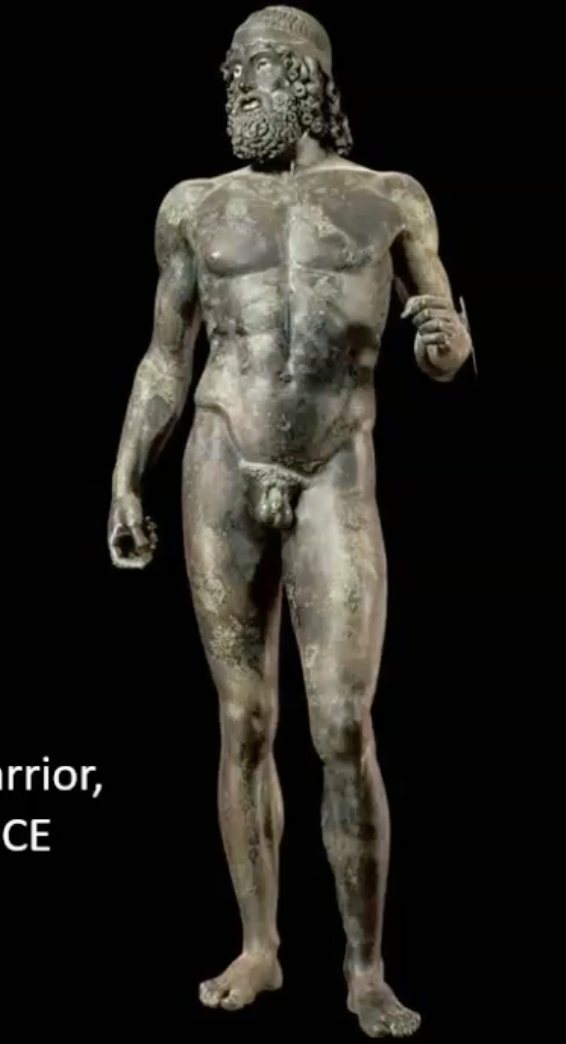
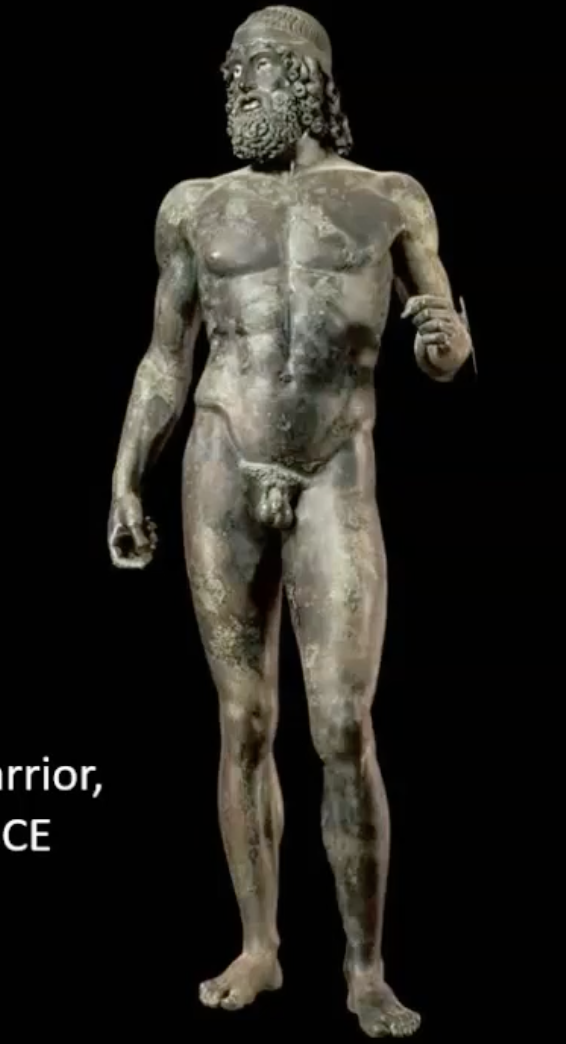
-bronze statue, a warrior, 6'5 ft height,weigh as much as a car
-he would have originally been holding a shield and a sword in his clenched hands, wearing a helmet on his head.
-representative of a mature powerful male.
-the physique is a bit more buffed out, he's got a full beard, but look at that contrapposto stance.
->it's been fully integrated into Greek arts by the time we're at this Early Classical period here post sacking of Athens
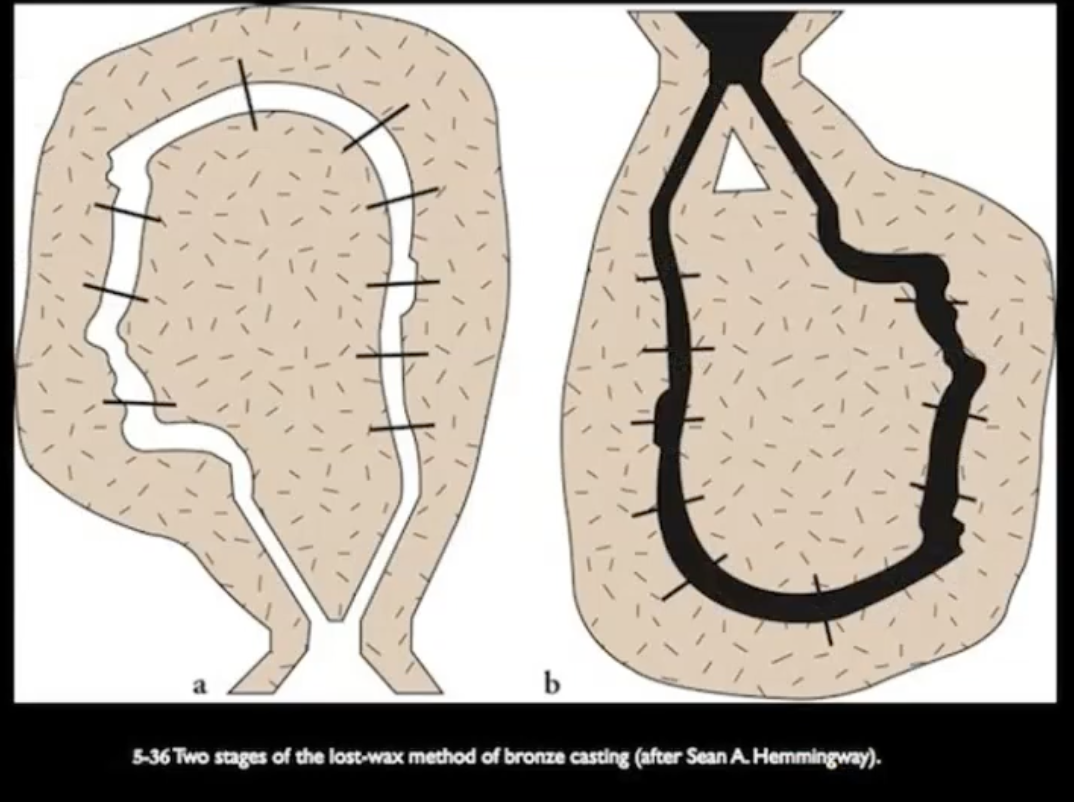
Wax model melted out and molten bronze poured into mold
- "lost wax method"-that really saves the day in terms of making
bronze sculptures that large affordable or cost-effective but also not weigh so much.
-it allowed sculptors in this age to create a work of art that had incredible strength and was malleable enough to add fine details to again
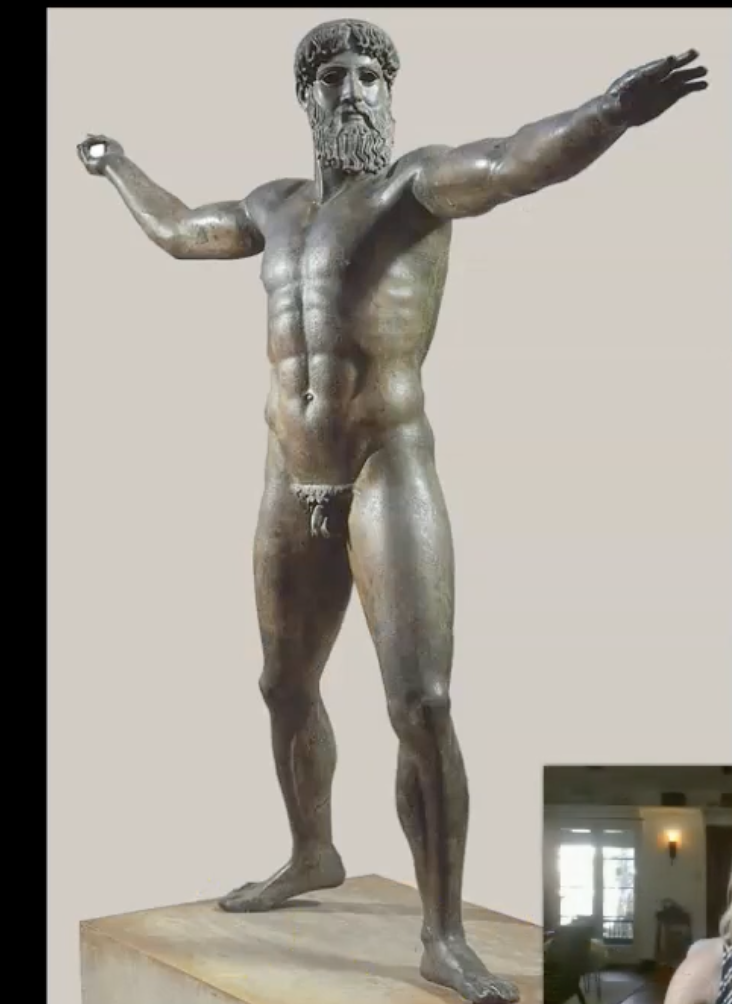
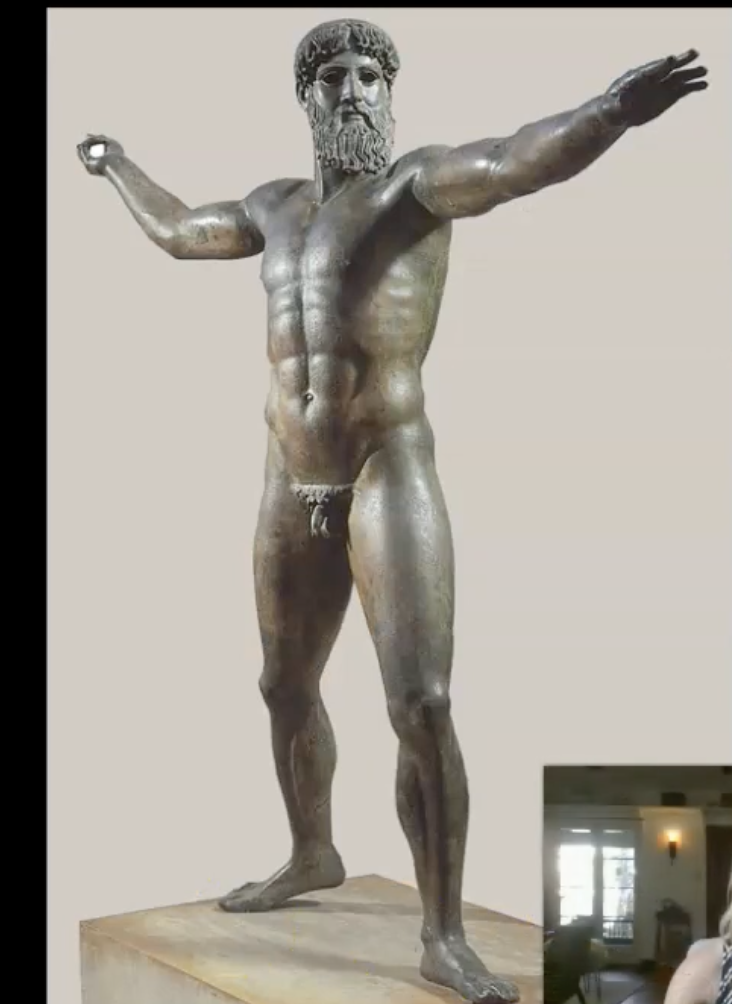
Zeus ( or Poseidon?). ca 450 BCE
relatively large: approx 6 ft, bronze
because of the lost wax method, its hollow core.
-position: no contrapposto stance, one foot elevated on a set of toes there in this athletic, open, dynamic pose.
Transition from Early Classical to High Classical Period
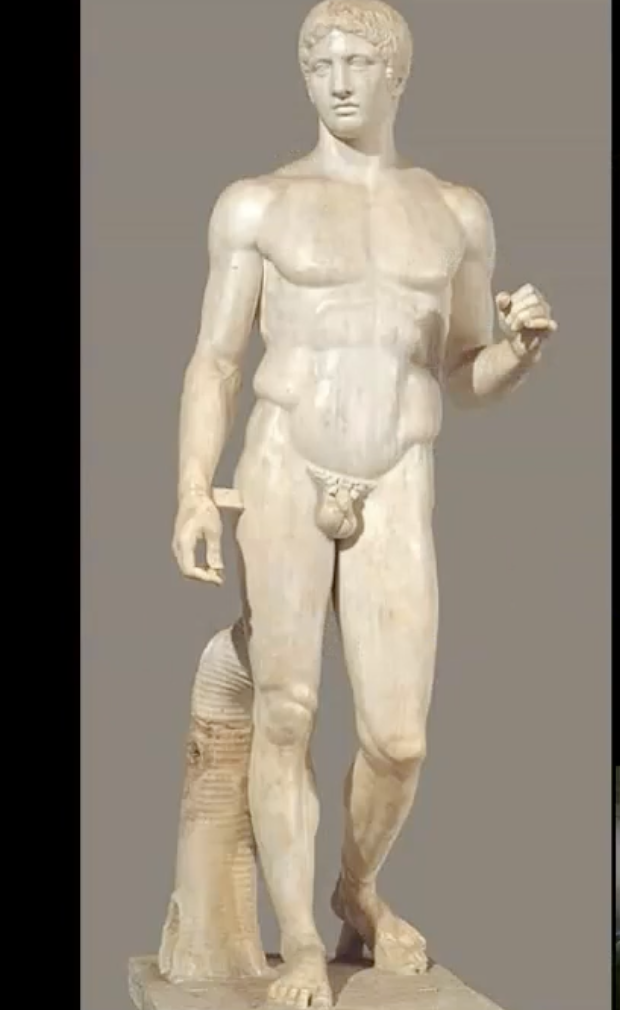
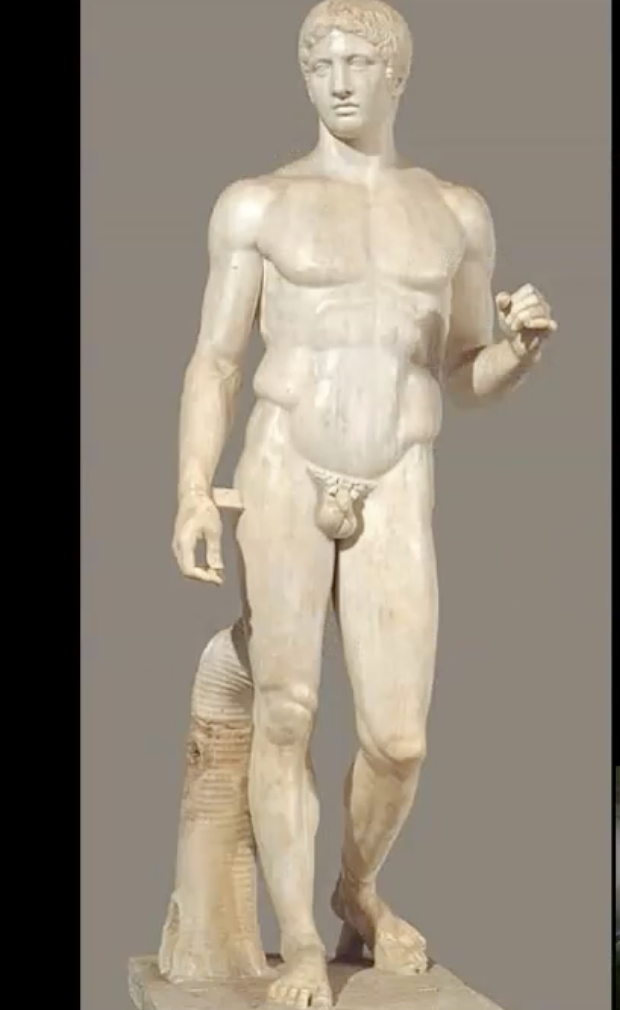
The “Spear Bearer” Roman marble copy of bronze original by Polykleitos from 450 BCE
--seeing all of the accuracy of proportions, contrapposto stance. -Polykleitos brought to the table is something called the system of cross balance.
-it's kind of a behavior of opposites that you see here so along with the formula of the contrapposto stance (and the head's slightly turned right), and the believability of the physiology of the human body,
- not only does he have the behavior of a working leg and a resting leg, but then he has the behavior of opposites on the same side of the body: the arm on the same side w the leg is also at rest, the other one is also working
-in a standing figure so it's combining both the figure that's working but at rest at the same time and this appearance of motion while at rest
-> describing this harmony of of opposites as well as the perfection of proportions in Greek art.