chapter 1
 Call Kai
 Learn
Learn Practice Test
 Spaced Repetition
 Match
Match Flashcards
 Knowt Play
1/73

There's no tags or description
Looks like no tags are added yet.
Name | Mastery | Learn | Test | Matching | Spaced | Call with Kai | Chat |
|---|
No analytics yet
Send a link to your students to track their progress
74 Terms
Anatomy
studies the form & structure of the body
* think shape
Physiology
examines how the body functions
* think how it works
Scientific method
refers to a systematic & rigorous process by which scientists
examine natural events through observation
develop a hypothesis for explaining phenomenon
experiment & test hypothesis by collecting data
determine if the data support the hypothesis or if the hypothesis should be rejected/modified
Microscopic anatomy
examines structures that cannot be observed by unaided eye
specimens examined under microscope
divisions: cytology & histology
cytology
the study of body cells & their internal structures
histology
the study of tissues
gross anatomy / macroscopic anatomy
investigates structures visible to the unaided eye
specimens dissected for examination
divisions: systemic anatomy, regional anatomy, surface anatomy, comparative anatomy, embryology
systemic anatomy
studies the anatomy of each body system
regional anatomy
examines the structures in a body region
surface anatomy
focues on superfiical anatomic markings and internal body structures
comparative anatomy
examines anatomical similarities & differences in diff species
embryology
studies developmental changes from conception to birth
Pathologic anatomy
examines macroscopic & microscopic anatomic changes resulting from diseases
Radiographic anatomy
Investigates internal structures visualized by scanning procedures
Physiologists
examine the function of body structures focusing on the molecular & cellular level
subdisciplines include: cardiovascular physiology, neurophysiology, respiratory physiology, reproductive physiology, pathophysiology
Cardiovascular physiology
examines functioning of the heart, blood vessels, & blood
Neurophysiology
studies functioning of nerves & nervous system organs
Respiratory physiology
explores functioning of respiratory organs
Reproducive physiology
investigates functioning of reproductive hormones & the reproductive cycle
Pathophysiology
focuses on the function of a body system during disease or injury to the system
How are anatomy & physiology interrelated
Both must use information from the other field
Form follows function (anatomical structures are designed to perform their specific function)
Without a thorough knowledge of anatomical structures, the physiologist can not truly understand the structure’s function
Characteristics that describe living things
organization
all organisms exhibit a complex structure & order
metabolism
anabolism
catabolism
growth & development
organisms assimilate materials from enivronment, grow/develop
responsiveness
regulation/ homeostasis
reproduction
Metabolism
the sum of all chemical reactions that occur within the body
Anabolism
small molecules joined to form larger ones
Catabolism
large molecules broken down into smaller ones
Responsiveness
ability to sense & react to stimuli
regulation
ability to adjust internal bodily functions to accommodate environmental changes
homeostasis
ability to maintain body structure & function
reproduction
produce new cells for growth, maintenance & repair
with sex cells (gametes, made by everyone) can develop into new organisms
Chemical level of organization
composed of atoms & molecules
simplest level of organizaton
Levels of organization in the human body (simplest to most complex)
chemicals (not alive): atoms, molecules, macromolecules
cell (smallest unit of life): basic unit of life
tissue: similar cells performing common functions
organ: multiple tissues working together
organ system: related organs work together
organism (you!): organ systems function together
more detailed
NOT alive
atom
molecule
macromolecule (ex. dna)
organelle (golgi appartus)
IS alive
cells
tissue
organ
organ system
organism
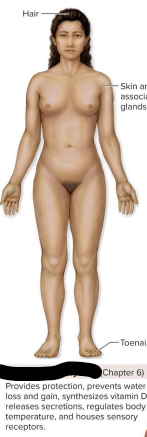
Integumentary system
skin
provides protection
reulates body temp
prevents water loss
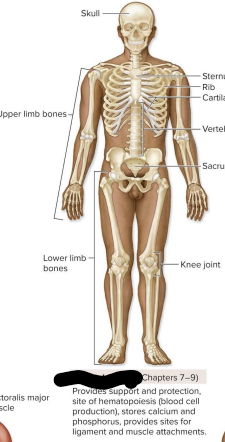
Skeletal system
bones
provides support, protection
site of hemopoiesis

Muscular system
produces body movement/heat

Nervous system
brain & nerves
controls body movement & conducts impulses for internal communication
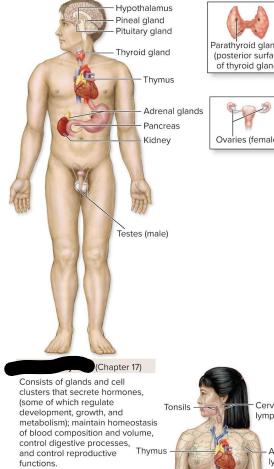
Endocrine system
hormones
regulate growth & chemical levels in the blood
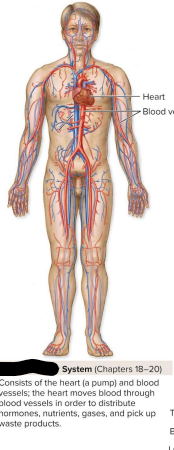
Cardiovascular system
heart, blood, vessels

Lymphatic system
extra fluids & immune system
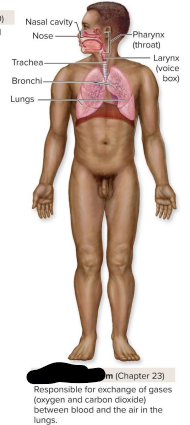
Respiratory system
lungs, O2, CO2
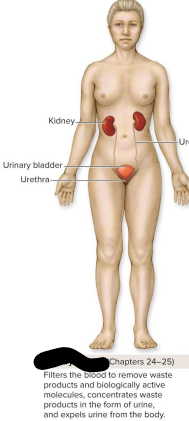
Urinary system
filters/ removes the waste products of the blood in the form of urine
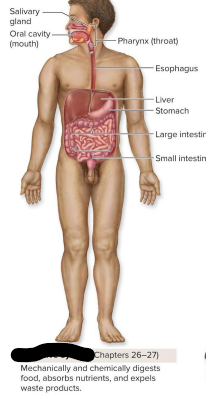
Digestive system
nutrients from what we eat
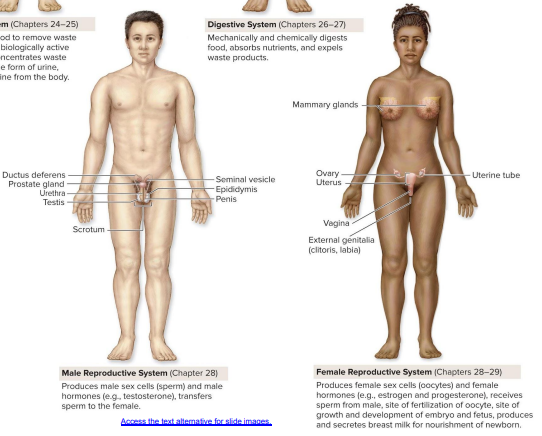
Male & female reproductive systems
pass on genetic code
Anatomic position
upright stance
feet parallel & flat on floor
upper limbs at the sides of the body
palms face anteriorly (toward front)
head is level
eyes look forward
Section
actual cut or slice that exposes internal anatomy
Plane
imaginary flat surface passing through body
types: coronal/frontal plane, transverse/cross-sectional plane. midsagittal/median plane, sagittal plane, oblique plane
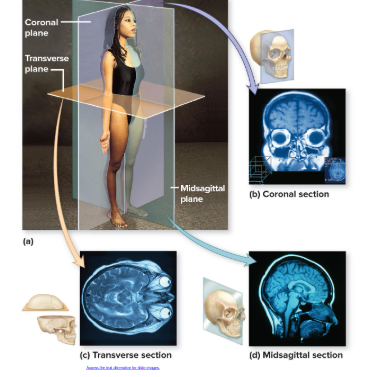
Coronal / frontal plane
vertical plane dividing the body into anterior (front) & posterior (back)

Transverse / cross-sectional
horizontal plane dividing the body into superior (top) and inferior (bottom) parts
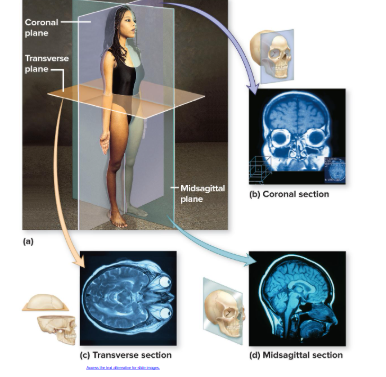
Sagittal plane
splits left & right
mid= middle/halves
para= unequal parts
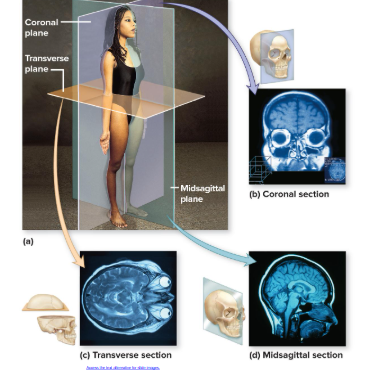
Midsagittal / median plane
vertical plane dividing the body into equal left & right
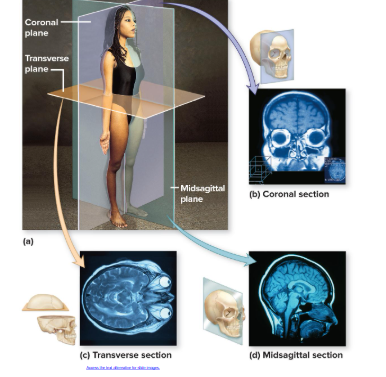
Parasagittal plane
parallel to midsagittal but left or right of midsagittal; divides structure into unequal portions

Oblique plane
passes through structure at an angle
Anterior
front
Posterior
back
Dorsal
toward the back side of the human body
Ventral
toward the belly side of the human body
Mid
middle/halves
Para
unequal parts
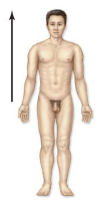
Superior
closer to the head
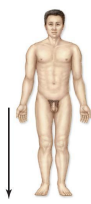
Inferior
closer to the feeet
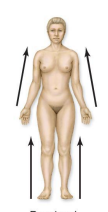
Proximal
closer to the center of the body or the point of attachment (to trunk)

Distal
farther away from center of body (to trunk)
Medial
toward the mid-line of the body
Lateral
away from the mid-line of the body
Cranial /cephalic
toward the head end
Caudal
toward the rear/tail end
Rostral
toward the nose/mouth
Ipsilateral
on the same side
Contralateral
on the opposite side
Deep
closer to the inside, internal to another structure
Superficial
closer to the outside, external to another structure
Axial region
head, neck, trunk
forms the main vertical axis of the body
Appendicular region
upper & lower limbs
Growth
increase in body size
Development
increased specialization as related to form & function