Sugery Lecture Exam 2
 Call Kai
 Learn
Learn Practice Test
 Spaced Repetition
 Match
Match Flashcards
 Knowt Play
1/199

There's no tags or description
Looks like no tags are added yet.
Name | Mastery | Learn | Test | Matching | Spaced | Call with Kai | Chat |
|---|
No analytics yet
Send a link to your students to track their progress
200 Terms
How should the patient be positioned when you begin clipping hair?
the same position the patient will be in for the procedure
What grip do we use for hair clippers?
pencil grip
What number blade should we use in the clippers?
#40
Should you use clippers against the grain or in the direction of the hair growth?
Both to get the closest shave
How much hair should you remove for a surgical procedure?
At least 2 clipper blade widths from the area of the proposed incision, preferably more to allow for changes during the surgical procedures.
If you are prepping an orthopedic procedure and are using the “hanging leg” technique, how will you remove the hair from the sirgical site?
circumferentially (circles going around the leg)
T or F: You should always clip and prep the patient in only your scrubs.
False, always wear a lab coat to prevent the tracking of hair into the surgical suite
Why do we use a #40 blade instead of a #10 blade?
#40 gives us a finer and closer cut
How should you hold the vacuum when removing hair?
With at least one finger over the suction hole so as not to grab at the skin and cause damage or irritation
Why is it important to make clean, crisp edges when clipping a patient?
Because this is the only part of the procedure that the client sees. We want to make it as professional-looking as possible
____ suture - applied around the anal opening to prevent leakage of fecal material during surgery.
purse-string suture
When would we use a purse-string suture?
perineal surgery or hind-limb orthopedic procedures
How often should clipper blades be brushed, disinfected, and lubricated?
After each use
T or F: Skin cannot be “sterilized” but is made “antiseptic” with the use of antiseptics.
True
What are the most commonly used antiseptics? (2)
Chlorhexidine
Providone-iodine
The skin is made antiseptic in two stages. What are they?
“rough” prep
“sterile” prep
Where is the rough prep performed?
in the surgical preparation area (induction)
Where is the sterile prep performed?
in the surgical suite
What are the desirable properties of antiseptics? (5)
wide spectrum of antimicrobial activity
low tissue toxicity
inexpensive
residual activity
works well in the presence of organic activity
For abdominal surgeries where the prepuce will be “draped in,” the prepuce should be flushed with what?
dilute betadine
What type of gloves do we use for the intial scrub?
exam gloves
What type of gloves do we use for the final scrub?
sterile gloves
What technique should be used during the final scrub?
clean hand, dirty hand
How should you scrub a patient?
center out and in circular motions
T or F: Once the sponge has touched hair, you do not go back over the incision area; you should discard the sponge.
True
How long is the general contact time for a scrub solution?
5 minutes, or until the sponges come away clean with no residue or dirt
T or F: When using a huck towel to remove scrub solution, you should use circular motions and move from the center out.
False, huck towels should be used to pat dry; do not rub
T or F: You can use dry gauze to remove scrub solution.
True
When a surgeon “paints” the surgical site, what are they doing?
Usually a providone-iodine solution without detergent and slightly high concentration. It is allowed to dry on the skin and is usually applied with a spray bottle
T or F: You generally should not mix chlorhexidine and iodine products.
True
Which scrub solution has “okay” residual activity?
Iodine
Which scrub solution has low tissue toxicity everywhere?
Iodine
Which scrub solution has low tissue toxicity everywhere except mucous membranes?
chlorhexidine
Which scrub solution will stain clothing and fur?
Iodine
Which scrub solution will not stain clothing or fur?
Chlorhexidine
Which scrub solution is inactivated by inorganic debris?
Iodine
Which scrub solution has good activity in organic debris?
Chlorhexidine
How do you generally dilute Iodine?
50:50 with water
How do you generally dilute chlorhexidine?
60:40 with water
Which scrub solution more commonly produces an adverse reaction?
Iodine
Which rinsing agent is antibacterial and dries quickly?
alcohol
Why must we be careful when using alcohol as a rinsing agent?
we must be cautious when using cautery because alcohol is flammable
Which rinsing agent has no antimicrobial activity and is not flammable?
water
What position should the patient be in for an abdominal surgery?
dorsal
What position should the patient be in for a castration?
dorsal
What position should the patient be in for an orthopedic and extremity surgery?
lateral recumbency
What position should the patient be in for a tail and perianal surgery?
ventral recumbency
What position should the patient be in for a back surgery?
ventral recumbency and in a V trough
What position should the patient be in for a thoracic surgery?
lateral or dorsal recumbency depending on the surgeon’s intent
When is the hanging led technique most commonly used?
extremity orthopedic or soft tissue procedures
What is the advantage of the hanging leg technique?
Allows the entire extremity to be draped in and manipulated during surgery. Fatigue of muscles for fracture reduction
____ - the complete elimination of microbial viability
sterilization
____ - the destruction of most pathogenic organisms on inanimate objects
disinfection
____ - prevents growth or action of microorganisms on living tissue by inhibiting activity or killing them (not sterile)
antisepsis
____ - living organism too small to be seen with the unaided eye
microbe/microorganism
____ - microbe capable of causing disease
pathogen
____ - the detrimental result of invasion by pathogens
infection
____ - infection acquired during hospitalization or during attendance at any veterinary medical facility
nosocomial
What surgical preparations begin the day before surgery?
giving the animal a bath and withholding food and water
How long should solid food be withheld before surgery?
at least 6 hours
Why do we withhold food and water before surgery?
decrease the risk of regurgitation and aspiration while under anesthesia
What does NPO stand for?
nothing per os (by mouth)
What should be included in a pre-op exam?
signalment
history
physical exam
consent form
weight
BCS
head and neck
skin
lungs
heart
What should be included in the history?
signalment
reason for visit
specific history of presenting complaint
current medications
What should be included in the physical exam?
weight, BCS, TPR
head and neck
abdomen and chest
skin
lymph nodes
orthopedic exam
neurological exam
What should be included in a consent form?
identifies the patient
specific procedures to be performed
potential risks
veterinarian’s name
estimate
signature of owner
owner contact info
How should you record the weight of your patient pre-op?
in kg and the current weight for that day
On a 1-5 BCS, 1 means what? And 5 means what?
1 means emaciated
5 means obese
What do we test within the head and neck exam?
PLR (pupillary light response)
CRT (capillary refill time)
Lymph nodes
skin tent
neck (flex for pain)
What are we checking for with a skin exam?
alopecia
coat quality
palpation
external parasites
How should we auscultate the lungs in a pre-op exam?
both sides: cranial, middle, and caudal areas over the ribs
Where should you auscultate the heart?
left cranial side below the elbow
A minimum database for a young healthy surgical candidate should include what?
packed cell volume (PCV)
total solids (TS)
blood glucose (BG)
blood urea nitrogen (BUN)
alanine aminotransferase (ALT)
What are the four components of the pain pathway in order?
Transduction - pain is recognized and sent to the CNS
Transmission - impulses are sent toward the spinal cord
Modulation - pain signals are processed in the spinal cord
Perception - pain signals are recognized by the brain, and a reaction occurs
How do opioids manage pain?
opioids work at several locations along the pain pathway, affecting nociceptive signal transduction, modulating signals at the spinal level, and inhibiting perception of pain.
What receptors are involved with opioid pain management?
The Mu and Kappa receptors
How do NSAIDs provide pain relief?
They block COX1 and COX2 enzymes
How do Alpha2-Adrenergic Agonists provide pain relief?
by inhibiting transduction and transmission of nerve impulses and modifying the signals at the spinal cord
Which wound classification is this: Nontraumatic, uninfected, no break in aseptic technique, no inflammation encountered, elective, primary closed, no drains.
Clean
Which wound classification is this: Controlled entry into hollow viscus, minor break in aseptic technique.
Clean-contaminated
Which wound classification is this: Open, fresh traumatic wound, incision into a site with acute non-purulent inflammation, major breaks in aseptic technique.
Contaminated
Which wound classification is this: Pus encountered during surgery, perforated viscus found, traumatic wound with devitalized tissue, foreign material or fecal contamination, or of more than 4 hours duration, perforated viscus, acute bacterial infection with purulent exudates encountered during surgery.
Dirty
Which wound classification is this: surgically created wound, no hollow viscus opened, aseptic technique maintained, no infection encountered.
Clean
Which wound classification is this: surgical wounds that enter hollow viscus, minor break in technique occurs
Clean-contaminated
Which wound classification is this: major break in technique, hollow viscus is opened with gross spillage, traumatic wounds
Contaminated
Which wound classification is this: conatins purulent material, contains contents of perforated hollow viscus, more than 100,000 per gram of tissue.
Dirty or Infected
Primary wound closure is used for what kinds of wounds?
Clean and clean-contaminated
What kind of wound closure is this: the wound is left open for 2-5 days and is closed prior to granulation tissue formation. Permits repeated lavage and debridement to convert the wound to clean-contaminated status appropriate for closure.
delayed primary
How are contaminated wounds closed?
delayed primary
What kind of wound closure is this: granulation tissue is allowed to form in the wound prior to closure. Deep narrow wounds-direct apposition over granulation tissue
Secondary
How do we close dirty or infected wounds?
second intention closing
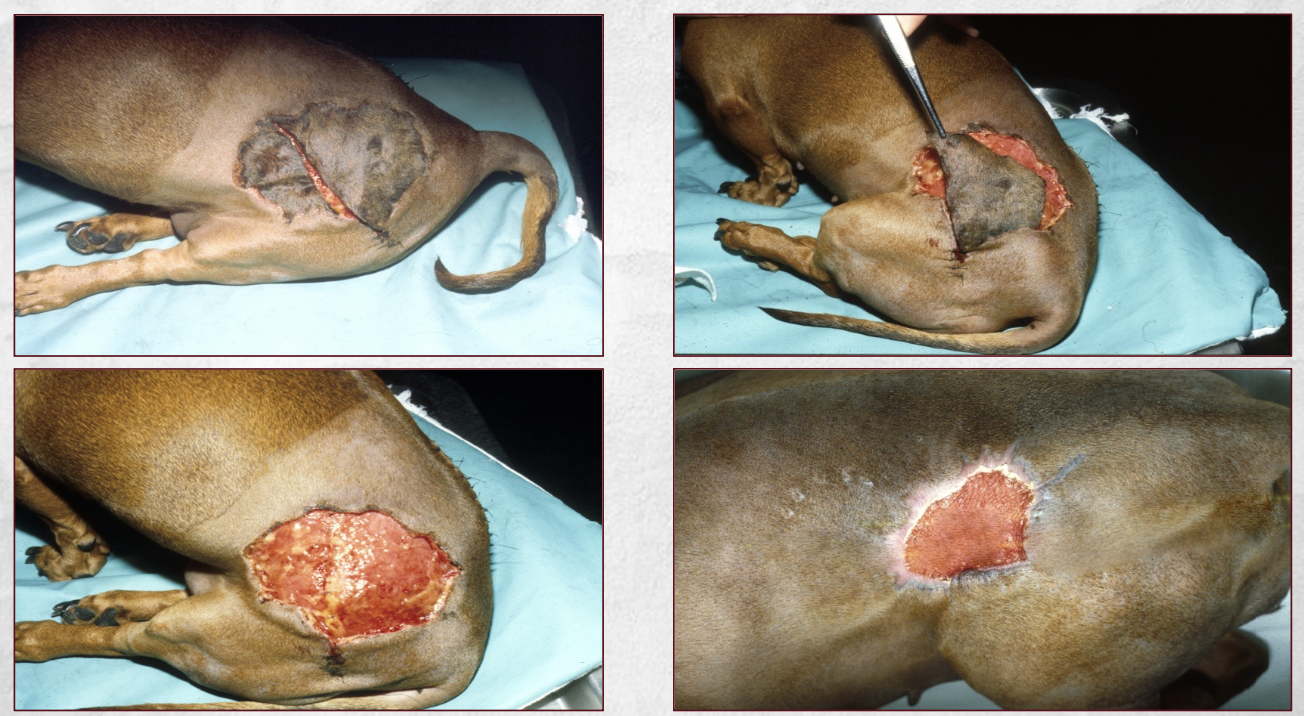
What kind of closure is this?
second intention
____ - taking steps to prevent disease
prophylaxis
____ - taking antibiotics after surgery
postoperative
____ - taking antibiotics just before and during surgery
perioperative
When do we need to give antibiotics?
long surgery (more than 2 hours)
Orthopedic implants
break in asepsis
entering GI tract
What is the best prevention of infection?
good surgical technique
When there is a gross contamination during surgery, what should you do?
lavage and repair the break is asepsis
When should you give perioperative antibiotics?
30 minutes before skin incision and every 90 minutes during surgery
____ - also known as bed sores or pressure sores.
decubital ulcers