Honors Chemistry Midterm Exam Review
 Call Kai
 Learn
Learn Practice Test
 Spaced Repetition
 Match
Match Flashcards
 Knowt Play
1/62

Earn XP
Description and Tags
Unit 1, 2, 3, 4.1, and 4.2
Name | Mastery | Learn | Test | Matching | Spaced | Call with Kai | Chat |
|---|
No analytics yet
Send a link to your students to track their progress
63 Terms
Mass
Number of particles
M= DxV
Volume
The space the particles take up
V= M/D
Law of Conservation of Mass
When a system changes macroscopically the mass will increase when a substance is added, decreases when the original substance is removed or stay the same if nothing + or -
Surrounding
Everything outside the system/the stuff that isn’t measured
System
Anything included in the measurement
Density
The spacing of particles
D=M/V
Chemical Change
A new substance is formed
Can increase and decreases mass
Physical Change
The partical identity is the same
Slope
Rise/Run
For Every 1 ____________________.
ex.) For Every 1 mL Corn Syrup has an additional 1.49g
Random Errors
Can affect measurements in both directions unpredictably
ex.) Doing your math wrong
Different students reading the measurements wrong
Systematic Errors
Affect all measurements in same direction
Ex.) Using Inches instead of cm
Measuring from the end of the ruler instead of zero
Not tearing the graduated cylinder on the scale
Precision
Is consistent/the clumpiness of your data
Accuracy
Is correctness to the expected value
Vibrating
Motion of solid particles
Sliding
Motion of liquid particles
Bouncing
Motion of gas particles
Higher average energy/motion of particles
What happens in higher temperature?
Heating the lid caused the particles in the metal to move faster and mover farther apart. Thus, the lid became “larger” so it could be more easily removed from the jar.
A pickle jar lid is really hard to open, and a girl puts the pickles under hot water. The lid is now easy to open, why?
Thermal Expansion
An increase in a material's volume when temperature increases
occurs in solids, liquids, and gases
Temperature
Degree of hotness
Heat
Quality of hotness
Takes mass into consideration
Law
What happens/happened/will happen
Theory
How or why something happens/happened/will happen
both equally weighted; theories never become law
Pressure
The force of particle collisions on a surface
Atmospheric pressure
Total force from collisions of atmosphere particles on a surface
relationship between altitude and atmosphere pressures
76 mmHg, 101.3 kPa, 14.7 psi, 1 atm
Manometer
Used for determining internal pressure by comparing w/ known atmospheric pressure
determine the difference, which is pushing harder?, Room ±/- difference = pressure
Barometer
Used to measure atmospheric pressure
A tube is filled with mercury and the tube sits in a pool of mercury. The atmosphere pressure pushes down on the mercury and pushes the it up the tube. mm is used to measure.
Solid
Space: Fixed
Volume: Fixed
Density: Highest (>1g/cm3)
Compressibility: No
Particle: Lowest
Diffusion: No
Liquid
Space: Variable
Volume: Fixed
Density: Middle (~1 g/mL)
Compressibility: No
Particle Motion : Middle
Diffusion: Yes
Gas
Space: Variable
Volume: Variable
Density: Lowest (1000x less dense)
Compressibility: Yes
Particle Motion : Highest
Diffusion: Yes
Warmer air particles collide with glass particles of thermometer, transfer their energy, and glass particles begin moving faster
Warmer glass particles collide with alcohol particles inside thermometer, transfer their energy, and alcohol particles begin moving faster
Alcohol particles collide more energetically and spread out
Explain why the level in a thermometer rises when placed in warm fluid
Kelvin is superior because 0 Kelvin is 0 particle motion while 0 Celsius is the freezing point of water not particle motion.
Why is the Kelvin scale superior than Celsius for describing the behavior of particles?
Increases
As temperature increases, volume ______________
Increases
As temperature increases, pressure ______________
Decreases
As volume increases, pressure ________
Increases
As number of particles increases, pressure ___________
Diffusion
random particle collions
Melting
Solid —> Liquid
Evaporation
Liquid —> Gas
Sublimation
Solid —> Gas
Condensation
Gas —> Liquid
Freezing
Liquid —> Solid
Deposition
Gas —> Solid
Vaccum
Means there are no particles (or a small number of particles so small that its negligible)
Energy
Can be stored and transferred into/out of different '“accounts” but is not itself changed. It causes changes in systems
Eth / Thermal Energy (Kinetic)
Energy associated with particle motion
Diagonal part on the cooling/heating curve
Eph / Phase Energy (Pontential)
Energy associated with particle spacing
Flat part on the cooling/heating curve
Ech / Chemical Energy
Energy associated with Chemical bonds
The 3 types of Energy “accounts
Calorimetry
Metal —> Water (Energy out —> Energy In)
- Q = Q
M*C*T = M*C*T
Calorimeter
Can be used to measure the heat capacity of a specific object
The quantity of heat released by an object is equal to the quantity of heat absorbed by the water
Pure Substance
All one type of particle
Element
Any substances on the periodic table
All elements are pure substances, but not all pure substance are an element
Mixture
More than 1 particle in the same space but still separate from one another
Can be physically separated
Components retain original properties
Compound (Molecule)
More than 1 element type bounded together
Has different properties than components
Cannot be physically seperated
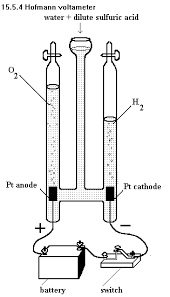
Hoffman Apparatus
When we turn on the electricity bubbles form on each side. One of it is Hydrogen the other is oxygen
It is breaking the bonds of water
Hydrogen is positively charged so it is attracted to the negative electricity
Oxygen is negatively charged so it is attracted to the positive
Mass - # of particles
Volume - total space occupied by particles
Density - spacing between particles
Specific heat capacity - energy required to raise 1g of a substance by 1°C
Boiling point - temperature at which liquid turns to gas
Melting point - temperature at which solid turns to liquid
Identify the properties of matter we've investigated so far and define them
Will not change - mass, specific heat capacity, melting and boiling points
Could change - volume, density
What will not change in a closed system? What could change in a closed system?
Temperature
Hotter temperature = faster particles
Colder temperature = slower particles
The warmer particles from the hot chocolate collide with the cooler particles in the air and transfer their energy. The less "hot" hot chocolate particles get slower and closer together.
Describe what happens (at the particle level) when a glass of hot chocolate cools down to room temperature
Magnet - iron and sulfur - magnetism
Dissolve and filter - sand and salt - particle size
Chromatography - black ink - solubility (how easy something dissolves)
Centrifuge - blood - density (that spinning device like a washing machine)
Distillation - rubbing alcohol - boiling point
Describe the various ways in which a mixture could be physically separated, and the physical property being used to perform the separation
This is a chemical separation, chemical bonds were broken. The others were just mixtures that can be physically separated
Describe how the separation of hydrogen from oxygen in water is different than the previous examples of separation
5% Rule
(Y-intercept/Highest measured Y value) * 100
The percentage should be between 5% and -5%
Q - heat capacity (energy J)
M - mass of substance
C - identity (J/g°C)
∆T - change in temperature
Hv - heat of vaporization
Hf - heat of fusion
Energy transfers variables
Sigfig rules
1) All non zeros are significant
2) If a 0 is between 2 non zeros, it is significant
3) a 0 is insignificant if it is at the end of a number and there is no decimal present
4) The first zeros are not significant (Everything to the left is not significant)
5) everything in front of notation is significant (scientific notation)
Electrolysis
A process by which an electric current breaks chemical bonds.