UNIT 6: ERYTHROCYTE MEMBRANE STRUCTURE
 Call Kai
 Learn
Learn Practice Test
 Spaced Repetition
 Match
Match Flashcards
 Knowt Play
1/122

There's no tags or description
Looks like no tags are added yet.
Name | Mastery | Learn | Test | Matching | Spaced | Call with Kai | Chat |
|---|
No analytics yet
Send a link to your students to track their progress
123 Terms
oxygen-carbon dioxide transport
The Biconcave disc shape of RBCs facilitates its _ function
90 fL (80-100 fL)
Average volume
Mean Cell Volume (MCV)
Average volume as one of your RBC indices, refers to _
140 um2
Average surface area
40%
The RBC has a _ excess surface area that facilitates easy contact to the tissue hence easier diffusion of oxygen = deformability
5 um thick
RBC Plasma Membrane thickness
Deformability
Allows RCs to adjust to small vessels in the microvasculature and still maintain a constant surface area to volume ratio.
resting diameter
2.5 times
Deformability, it is the capability of RBCs to stretch themselves many more times than their __ with an approximately _
surface area to volume ratio
this significantly affects RBC deformability
↑ surface area ↓ volume
normal surface area to volume ratio of deformable RBC
swelling & lysis
↓ surface area ↑ volume causes RBC _
fragmentation (↓ SA)
lysis (↑ volume)
Changes in the SA : Volume ration causes RBC __ & _
RBC Geometry
Relative cytoplasmic (hemoglobin) viscosity → MCHC: 32%-36%
Membrane elasticity (pliancy)
ENUMERATE
Factors affecting RBC Deformability
low viscosity (fluid)
Normal erythrocyte Hgb concentration has a _
Heinz Bodies
Precipitated hemoglobin
Hb S
Polymerized hemoglobin
Hb C
Crystallized hemoglobin
relative cytoplasmic viscosity
Refers to the HgB concentration relative to the size of the cell
Mean Cell Hemoglobin Concentration (MCHC)
Relative cytoplasmic viscosity, as one your RBC indices, refers to _
↑ aging
↓ ATP & Glycolytic enzymes
no new proteins
↓ SA
Cell volume retained
↑ MCHC
Factors affecting ↓ RBC membrane integrity = ↓ Deformability
T
T or F
RBC membrane is 100% more elastic than latex.
T
T or F
RBC membrane has a higher tensile strength than steel
membrane composition
lipids, carbohydrates, & proteins
Membrane elasticity (pliancy) is attributed the RBC __ (i.e., _ )
Serve as a barrier separating the cytoplasm and plasma
Allows selective nutrient & ion passage
Allows cell deformability when required
3 Basic Functions of the RBC Membrane
function
RBC membrane _ depends on the structure & composition of the membrane.
40%
Lipids account for _ of the membrane composition
phospholipids & cholesterol
Most predominant lipids in the RBC membrane
lipid bilayer leaflet
membrane fluidity
Phospholipids are arranged in a double layer called _ that provides _
liquid sealer
Lipid bilayer leaflet allows the membrane to act as a _
Phosphatidylcholine
Sphingomyelin
Glycolipid (5%)
Phosphatidylinositol
Cholesterol
Lipid composition of the outer PM
Phosphatidylcholine
Sphingomyelin
Predominant lipids in the external surface (outer PM)
Glycolipid (5%)
sugar bearing lipids; support carbohydrate side chains; anchor glycocalyx; bears blood group antigens.
F
Glycolipids are only found on the OUTER PM
T or F
Glycolipids are present in small amounts in the inner and outer plasma membranes.
Glycocalyx
_ coats the outer membrane
Glycolipids
_ bear different blood group antigens
Phosphatidylethanolamine
Phosphatidylserine
Phosphatidylinositol
Cholesterol
Lipid composition of the inner PM
Phosphatidylethanolamine
Phosphatidylserine
Most predominant phospholipids in the inner membrane
Phosphatidylserine
the ONLY negatively charged phospholipid
ATP dependent.
The ASYMMETRICAL DISTRIBUTION OF PHOSPHOLIPIDS in the RBC membrane is _
T
T or F
Once the ATP generation is compromised, the asymmetrical distribution of phospholipids also become compromised.
Maldistribution of phospholipids
_ in the RBC membrane contribute to the susceptibility of the cell to damage.
1. Scramblases
2. Flippases
3. Floppases
ENUMERATE
These enzymes are ATP dependent and responsible in maintaining the asymmetrical distribution of the cell membrane
Inner PM (containing Phosphatidylserine)
Which PM layer surrounds the nucleus to be expelled during the Orthochromic normoblast stage
cell stress
inflammation
other pathological conditions
Conditions that trigger the phosphatidylserine to be redistributed from the inner to the outer leaflet
CHOLESTEROL
regulates membrane fluidity and membrane permeability
maintains surface area:volume ratio
T
T or F
Cholesterol is present & equally distributed in both layers of the RBC membrane;
and is evenly distributed between the inner and outer leaflets.
Plasma cholesterol
bile acids
activity of LCAT (Lecithin-Cholesterol Acyltransferase)
ENUMERATE
Factors affecting RBC Membrane Cholesterol content
Acanthocyte
Codocyte
Ovalocyte
ENUMERATE
Abnormal RBCs related to Abnormal membrane lipids
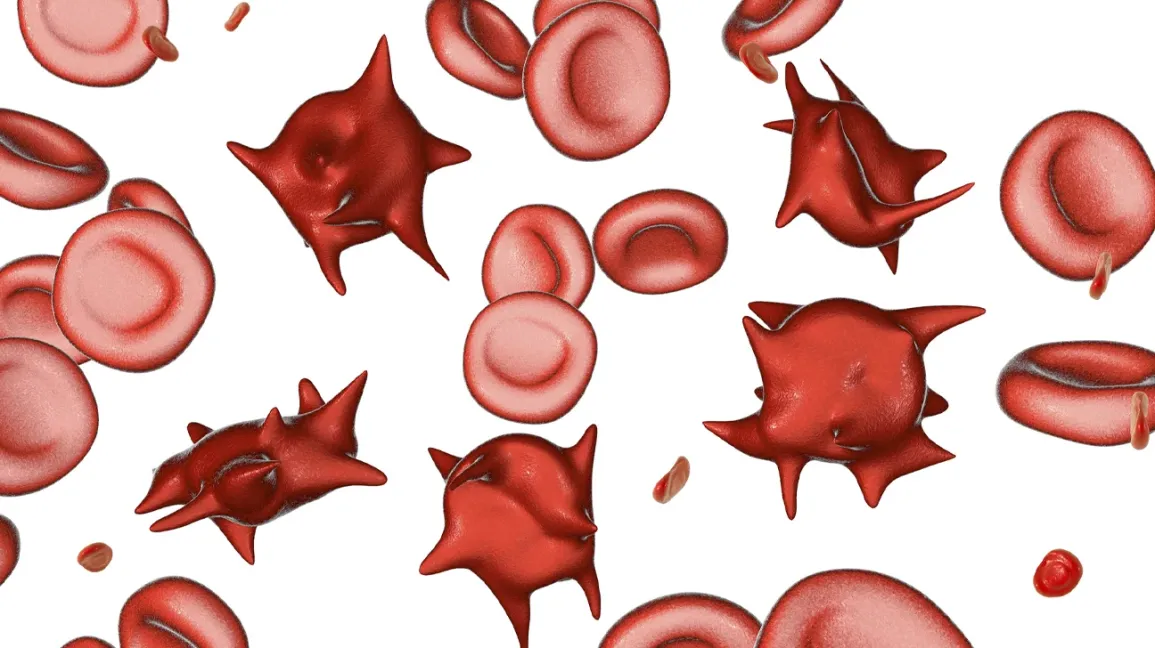
Acanthocyte
Abnormal RBC formed due to abnormal lecithin : sphingomyeline ratio
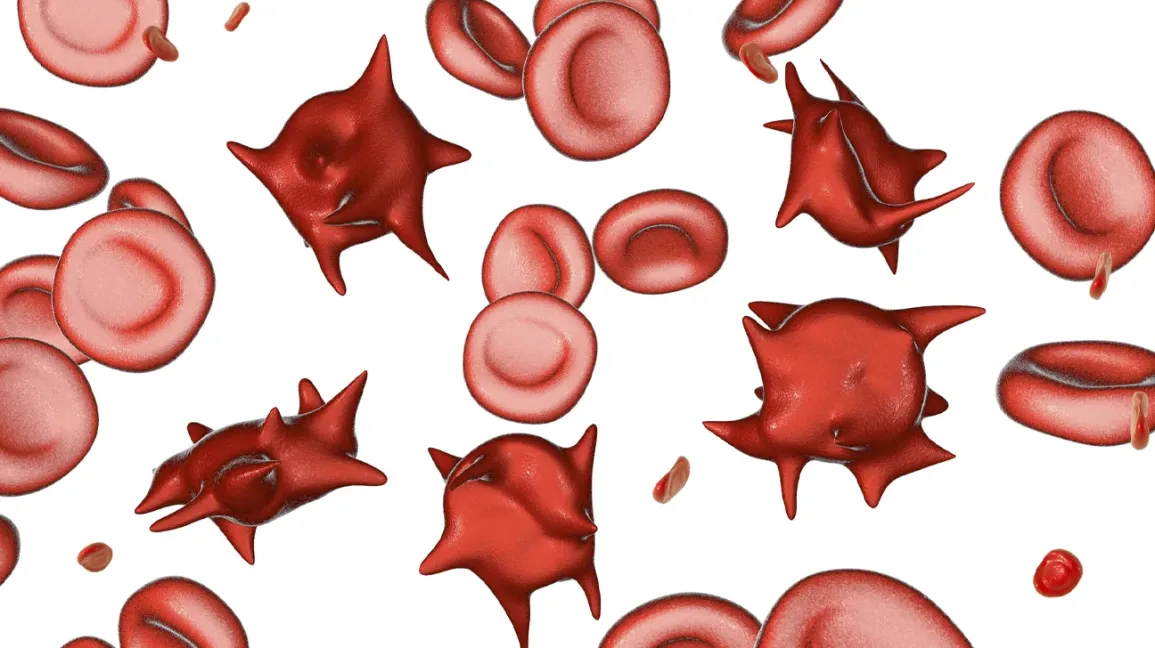
Acanthocyte
→ Few, irregularly distributed projections
→ Spikes have different sizes and shapes
→ Projections are unevenly distributed
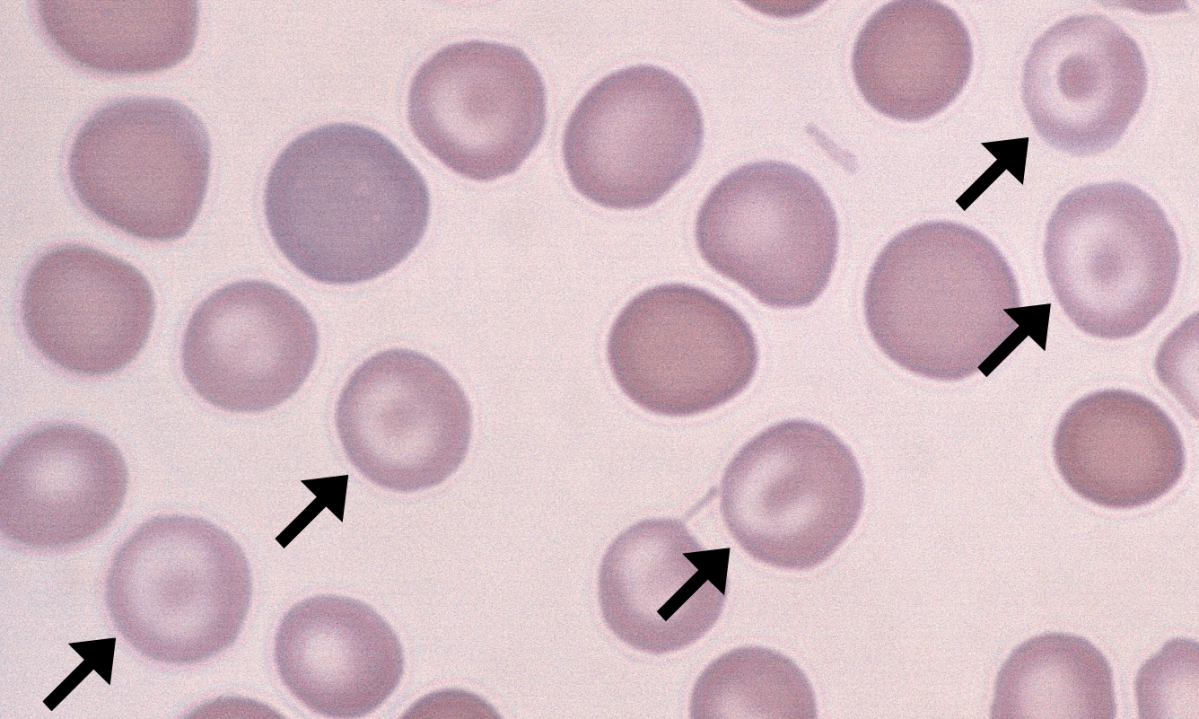
Codocyte (Target cell)
contains a characteristic central hemoglobinized area surrounded by pallor and an outer rim
Increased membrane surface area relative to cell volume
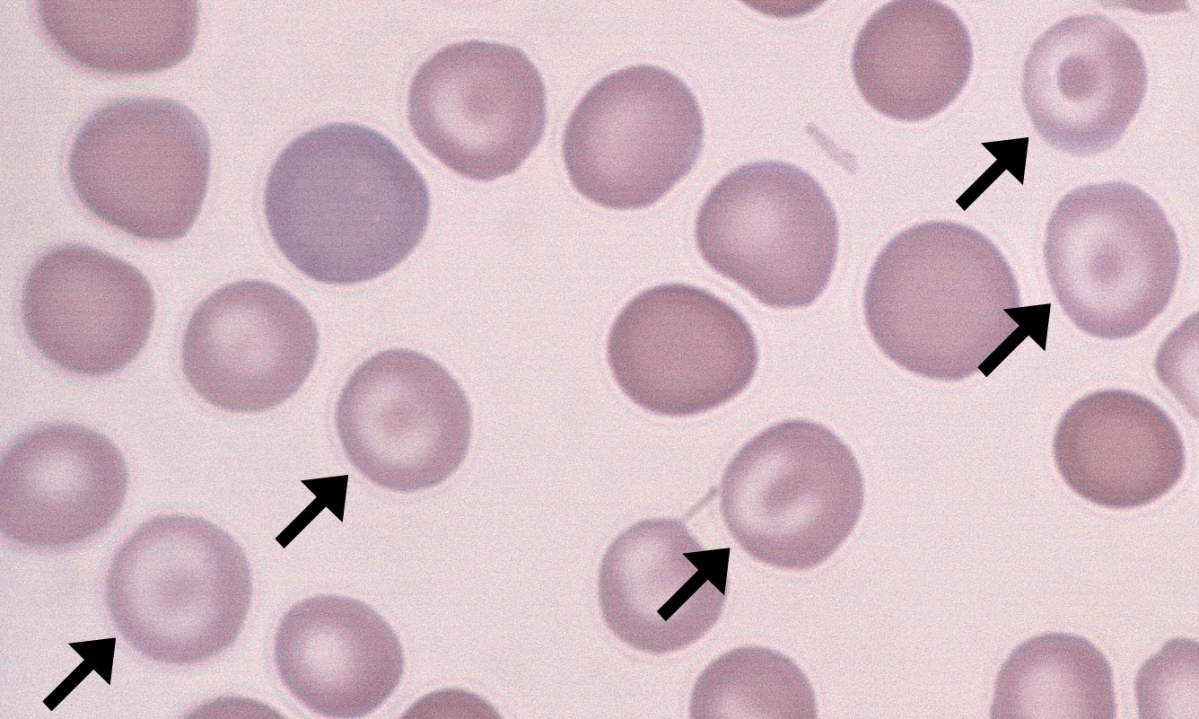
Codocyte (Target cell)
Abnormal RBC formed due to ↑ cholesterol and phospholipids
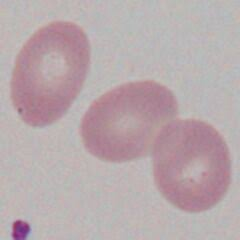
Ovalocyte / Elliptocyte
Abnormal RBC formed due to ↓ cholesterol
Defects in RBC membrane proteins (pectrin and protein 4.1.)
tensile strength
↑ cholesterol ↑ membrane strength ↓ elasticity
Cholesterol confers _ to the lipid bilayer
GLYCOCALYX
layer of carbohydrates whose net negative charge prevents microbial attack and protects the RBC from mechanical damage— particularly once in the circulation
Glycocalyx
_ are surface carbohydrates joined with glycolipids
8%
% composition of carbohydrates in RBC membrane
52%
% composition of proteins in RBC membrane
sialic acid
Integral Proteins/ Transmembrane Proteins contains _ which gives RBCs a negative charge
Integral Proteins/Transmembrane Proteins
Proteins that penetrate the phospholipid bilayer.
Provides vertical membrane structure
zeta potential
the repulsive force that repels RBC from each other
Transport sites
Adhesion sites
Signaling receptors
ENUMERATE
Functions of Integral Proteins/Transmembrane Proteins
Band 3
Principal (most abundant) integral protein
Ankyrin complex
Protein 4.1 complex / Actin junctional complex
ENUMERATE
2 macromolecular complexes of integral proteins
band 3 (multimers)
protein 4.2
ENUMERATE
Major components of Ankyrin complex
spectrin cytoskeleton
ankyrin protein
Ankyrin complex anchor the phospholipid bilayer to the __ through the _.
band 3 (dimers)
protein 4.2
adducin
actin
ENUMERATE
Major components of Protein 4.1 complex / Actin Junctional Complex
protein 4.1.
Protein 4.1 complex anchor the phospholipid bilayer to the spectrin cytoskeleton through the _
T
T or F
Both protein complexes prevent loss of the lipid bilayer.
They serve as the bridge between the lipid bilayer and the cytoskeleton proteins, particularly the spectrin.
spectrin cytoskeleton
Protein 4.1 complex
The cross linking of the __ and the protein _ makes the shape of the RBC intact in order to maintain its biconcave shape.
Aquaporin 1
Band 3
Ca2+-ATPase
Glut-1
ICAM-4
NA+,K+-ATPase
Enumerate
MUST KNOWS TRANSMEMBRANE RBC PROTEINS
Aquaporin 1
TRANSMEMBRANE RBC PROTEINS
Water transporter
Aquaporin 1
TRANSMEMBRANE RBC PROTEINS
Colton antigen
Band 3
TRANSMEMBRANE RBC PROTEINS
Anion transporter
Band 3
TRANSMEMBRANE RBC PROTEINS
location of ABH antigens
Ca2+-ATPase
TRANSMEMBRANE RBC PROTEINS
Ca2+ transporter
Glut-1
TRANSMEMBRANE RBC PROTEINS
Glucose transporter
Glut-1
TRANSMEMBRANE RBC PROTEINS
location of ABH blood group antigens
ICAM-4
TRANSMEMBRANE RBC PROTEINS
Integrin adhesion
Na+, K+-ATPase
TRANSMEMBRANE RBC PROTEINS
Na+, K+ transporter
Peripheral Proteins/Cytoskeletal Proteins
Proteins that do not penetrate the phospholipid bilayer.
Only present on the inner side/layer of the PM
Peripheral Proteins/Cytoskeletal Proteins
Provides lateral/horizontal membrane stability
α-spectrin → Band 1
β-spectrin → Band 2
Principal cytoskeletal protein
20
16
The cytoskeleton is mainly composed of __ alpha-spectrin and _ beta-spectrin
T
T or F
Spectrins can fold & unfold, change its conformation, allowing the cytoskeleton to stretch and recoil = Flexibility
Spectrin stabilization
Membrane deformation
ENUMERATE
Functions of cytoskeletal proteins
α-spectrin
β-spectrin
Adducin
Ankyrin
Dematin
β-actin
G3PD
Protein 4.1
Protein 4.2
Tropomodulin
Tropomyosin
ENUMERATE
CYTOSKELETAL RBC PROTEINS
α-spectrin, β-spectrin
CYTOSKELETAL RBC PROTEINS
Filamentous antiparallel heterodimer
α-spectrin, β-spectrin
CYTOSKELETAL RBC PROTEINS
Primary cytoskeletal proteins
Adducin
CYTOSKELETAL RBC PROTEINS
Caps actin filament
Adducin
CYTOSKELETAL RBC PROTEINS
Binds Calcium ions / Calmodulin
Ankyrin
CYTOSKELETAL RBC PROTEINS
Anchors band 3, protein 4.2, and other proteins in the ankyrin complex to spectrin
Dematin
CYTOSKELETAL RBC PROTEINS
Actin bundling protein
β-actin
CYTOSKELETAL RBC PROTEINS
Binds β-spectrin
G3PD
CYTOSKELETAL RBC PROTEINS
Carbohydrate metabolism
G3PD
CYTOSKELETAL RBC PROTEINS
Phosphorylates G3P
Protein 4.1
CYTOSKELETAL RBC PROTEINS
Anchors the actin junctional complex to spectrin tetramers
Protein 4.1
CYTOSKELETAL RBC PROTEINS
RBC skeleton shape
Protein 4.2 (Protein kinase)
CYTOSKELETAL RBC PROTEINS
Part of ankyrin complex
ATP binding protein
Tropomodulin
CYTOSKELETAL RBC PROTEINS
Caps actin filament