Pedigrees

0.0(0)
Studied by 0 people
call kaiCall Kai
Locked
learnLearn
examPractice Test
spaced repetitionSpaced Repetition
heart puzzleMatch
flashcardsFlashcards
GameKnowt Play
Card Sorting

1/19

encourage image

There's no tags or description

Looks like no tags are added yet.

Last updated 11:37 AM on 8/23/26
Name
Mastery
Learn
Test
Matching
Spaced
Call with Kai
Chat

No analytics yet

Send a link to your students to track their progress

20 Terms

1
New cards

What is a pedigree and what can they be used for?

Pedigree:A diagram showing family relationships

  • Shows how a trait is inherited over generations

  • Used to trace the inheritance of one particular trait

  • Analysing pedigrees helps determine the mode of inheritance: dominant/recessive, autosomal/X-linked


2
New cards

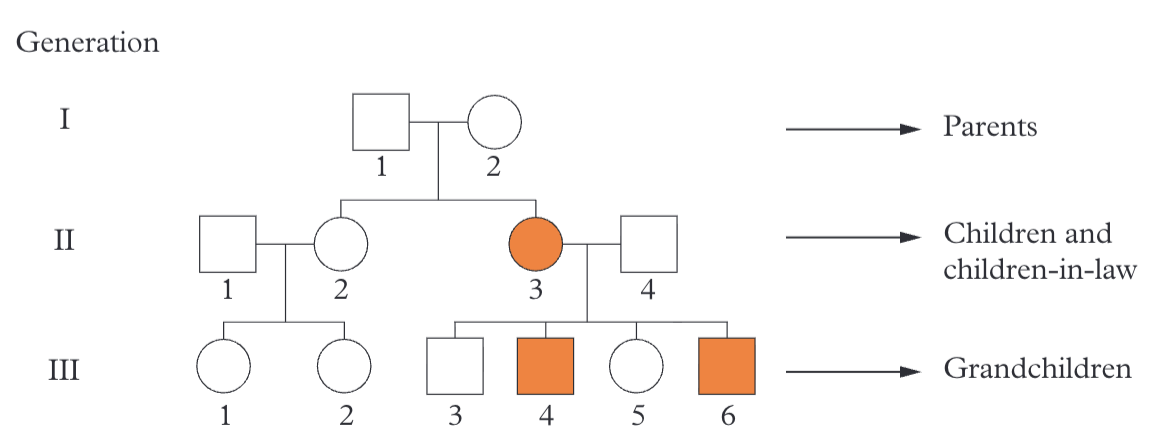
How can you identify certain indivduals in a pedigree?

  • Roman numerals = generation number, left of each row

  • Numbers across = individual's position within that row

  • ID = generation-individual, e.g. II-4 (2nd generation, 4th individual)

<ul><li><p><span>Roman numerals = generation number, left of each row</span></p></li><li><p><span>Numbers across = individual's position within that row</span></p></li><li><p><span>ID = generation-individual, e.g. II-4 (2nd generation, 4th individual)</span></p></li></ul><p></p>
3
New cards

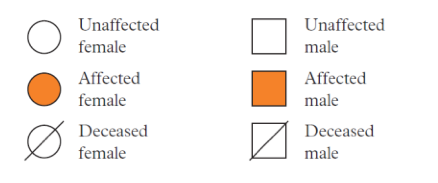
What do pedigree symbols represent? How do you determine who is affected and what gender?

  • Phenotype shown by symbol; genotype inferred from relationships

  • Affected (coloured) vs unaffected (uncoloured) shows if trait is present

  • Circles = females; squares = males


<ul><li><p><span>Phenotype shown by symbol; genotype inferred from relationships</span></p></li><li><p><span>Affected (coloured) vs unaffected (uncoloured) shows if trait is present</span></p></li><li><p><span>Circles = females; squares = males</span></p></li></ul><p></p>
4
New cards

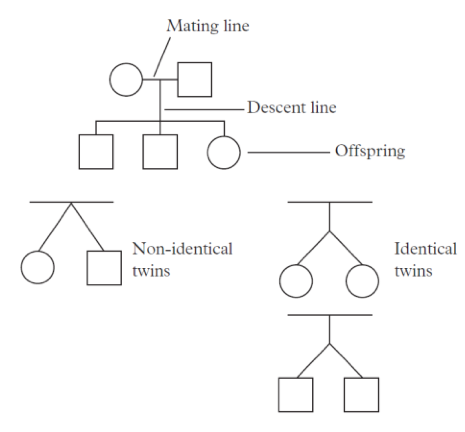
How are non-identical vs identical twins shown on a pedigree?

Non-identical twins: Separate eggs and sperm, sharing the womb

  • Each linked separately to the mating line

Identical twins: Arise from a single fertilisation event (identical genetic material)

  • Shown connected to each other by a short line from a single point on a pedigree


<p>Non-identical twins: Separate eggs and sperm, sharing the womb</p><ul><li><p><span>Each linked separately to the mating line</span></p></li></ul><p>Identical twins: Arise from a single fertilisation event (identical genetic material)</p><ul><li><p><span>Shown connected to each other by a short line from a single point on a pedigree</span></p></li></ul><p></p>
5
New cards

What are the key conventions used when drawing a pedigree?

  • Birth order: Oldest on left, youngest on right

Mating line (or breeding/marriage line: Line connecting a couple

  • Stillbirths/infant deaths included as they may be linked to genetic disorders

  • Descendant line: Offspring below the mating line

<ul><li><p><span><mark data-color="#ffffff" style="background-color: rgb(255, 255, 255); color: inherit;">Birth order: Oldest on left, youngest on right</mark></span></p></li></ul><p><span style="background-color: rgb(229, 224, 236);"><mark data-color="#ffffff" style="background-color: rgb(255, 255, 255); color: inherit;">Mating line (or breeding/marriage line: Line connecting a couple</mark></span></p><ul><li><p><span><mark data-color="#ffffff" style="background-color: rgb(255, 255, 255); color: inherit;">Stillbirths/infant deaths included as they may be linked to genetic disorders</mark></span></p></li><li><p><span style="background-color: rgb(229, 224, 236);"><mark data-color="#ffffff" style="background-color: rgb(255, 255, 255); color: inherit;">Descendant line: Offspring below the mating line</mark></span></p></li></ul><p></p>
6
New cards

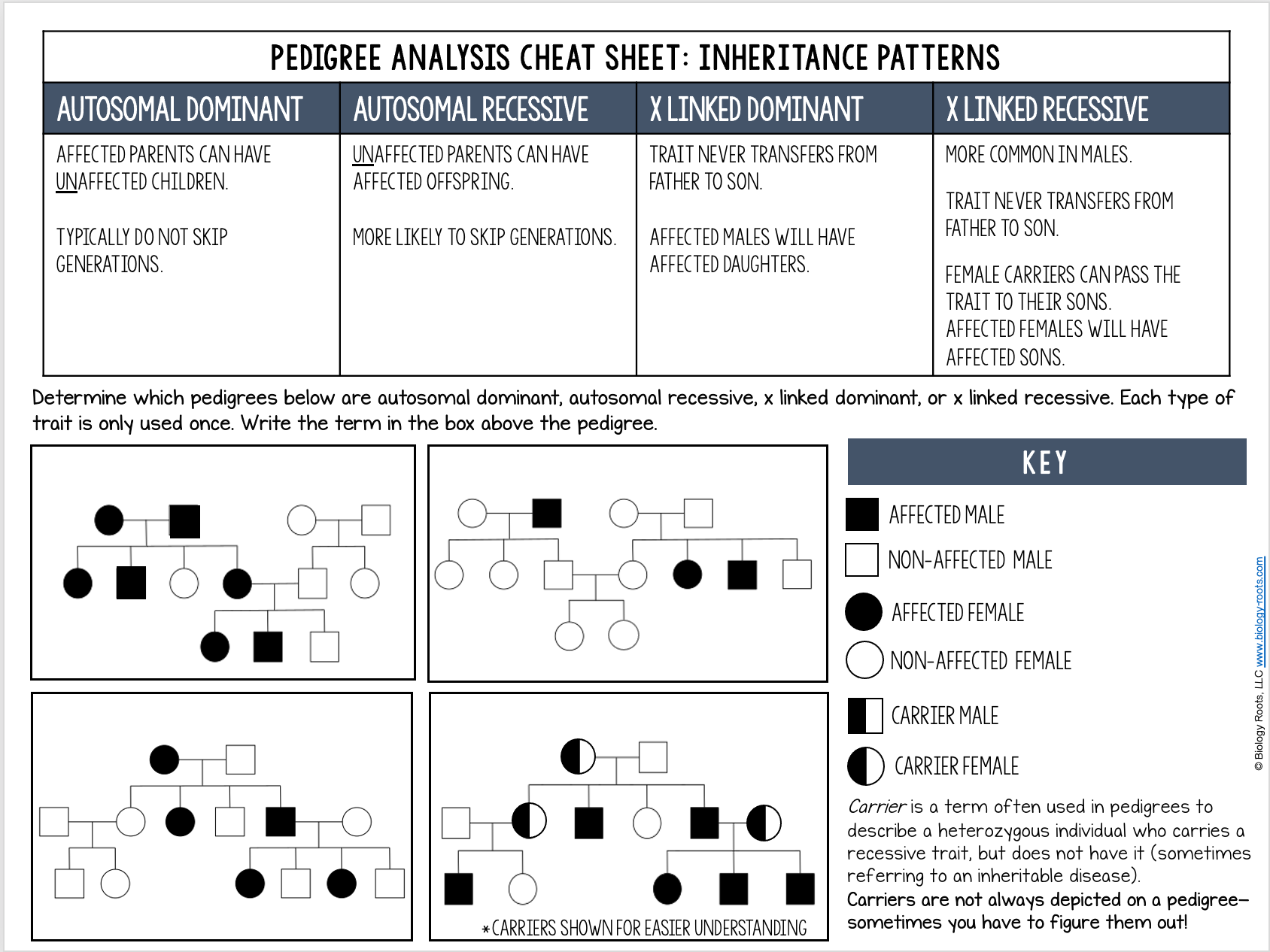
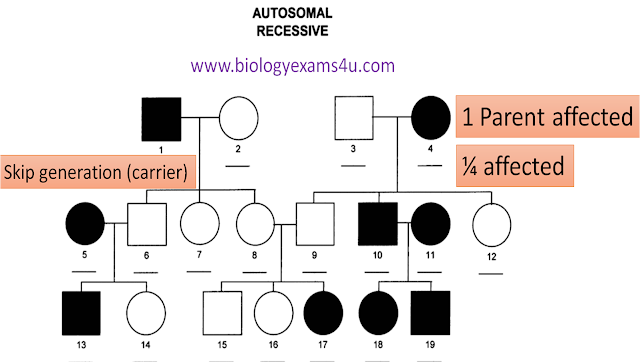
What are the features of autosomal recessive inheritance?

Exam evidence:

  • If both parents are affected, all offspring affected

  • Two unaffected (carrier) parents can have an affected child


  • Small samples can misrepresent the true pattern

  • Large samples: males and females affected equally

  • Carriers let the trait skip generations

  • Two carriers → 25% chance of affected child

  • Actual ratio in one family may differ, since probability resets each birth

<p>Exam evidence:</p><ul><li><p><span>If both parents are affected, all offspring affected</span></p></li><li><p><span>Two unaffected (carrier) parents can have an affected child</span></p></li></ul><p></p><ul><li><p>Small samples can misrepresent the true pattern</p></li><li><p>Large samples: males and females affected equally</p></li></ul><ul><li><p><span>Carriers let the trait skip generations</span></p></li><li><p><span>Two carriers → 25% chance of affected child</span></p></li><li><p><span>Actual ratio in one family may differ, since probability resets each birth</span></p></li></ul><p></p>
7
New cards

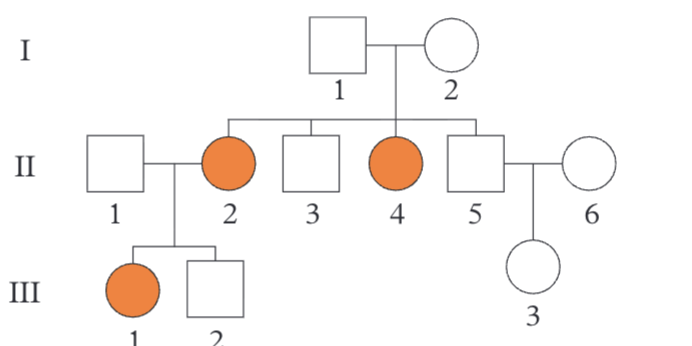
What are the key pieces of evidence for autosomal recessive inheritance?

  • If both parents are affected, all offspring affected

  • Two unaffected (carrier) parents can have an affected child

<ul><li><p>If both parents are affected, all offspring affected</p></li><li><p>Two unaffected (carrier) parents can have an affected child</p></li></ul><p></p>
8
New cards

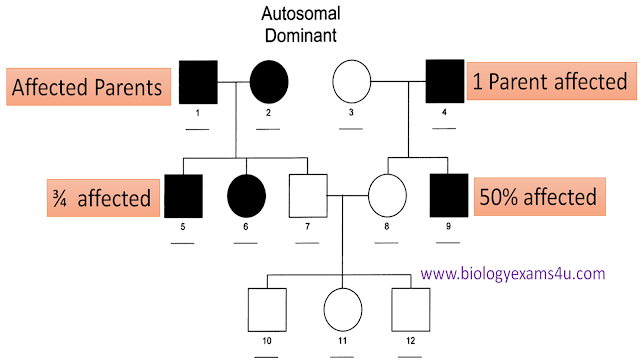
What are the features of autosomal dominant inheritance?

Exam evidence:

  • Every affected individual must have at least 1 affected parent

  • Two affected (carrier) parents can have an unaffected child


  • Males and females affected equally (approx.)

  • Two unaffected parents can't have an affected child

  • Trait appears in most/all generations

  • Trait doesn't return once it leaves a branch

<p>Exam evidence:</p><ul><li><p><span>Every affected individual must have at least 1 affected parent</span></p></li><li><p><span>Two affected (carrier) parents can have an unaffected child</span></p></li></ul><p></p><ul><li><p>Males and females affected equally (approx.)</p></li><li><p>Two unaffected parents can't have an affected child</p></li></ul><ul><li><p><span>Trait appears in most/all generations</span></p></li><li><p><span>Trait doesn't return once it leaves a branch</span></p></li></ul><p></p>
9
New cards

What are the key pieces of evidence for autosomal dominant inheritance?

  • Every affected individual must have at least 1 affected parent

  • Two affected (carrier) parents can have an unaffected child

Example left: Huntington’s disease


<ul><li><p>Every affected individual must have at least 1 affected parent</p></li><li><p>Two affected (carrier) parents can have an unaffected child</p></li></ul><p>Example left: Huntington’s disease  </p><p></p>
10
New cards

What are the features of X-linked recessive inheritance?

Eam evidence:

  • More males than females affected over generations

  • All daughters of an affected father are carriers


  • As affected daughters need the recessive allele from both parents, so dad must carry/express it

  • Affected sons often from unaffected carrier mothers, thus the trait can skip generations

  • Trait never passed from father to son ( as males hemizygous for X; sons get Y (not X) from dad, so can't inherit it from him)
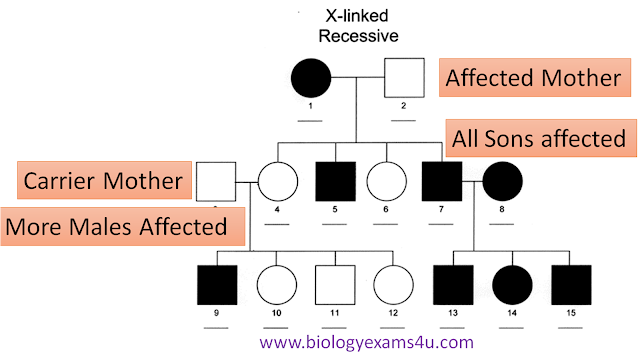

<p>Eam evidence:</p><ul><li><p><mark data-color="#ffffff" style="background-color: rgb(255, 255, 255); color: inherit;">More males than females affected over generations</mark></p></li><li><p><mark data-color="#ffffff" style="background-color: rgb(255, 255, 255); color: inherit;">All daughters of an affected father are carriers</mark></p></li></ul><p></p><ul><li><p>As affected daughters need the recessive allele from both parents, so dad must carry/express it</p></li><li><p>Affected sons often from unaffected carrier mothers, thus the trait can skip generations</p></li><li><p>Trait never passed from father to son ( as males hemizygous for X; sons get Y (not X) from dad, so can't inherit it from him)</p></li></ul><p></p>
11
New cards

What are the key pieces of evidence for X-linked recessive inheritance?

  • More males than females affected over generations

  • All daughters of an affected father are carriers

Example left: Red-green colour blindness

<ul><li><p>More males than females affected over generations</p></li><li><p>All daughters of an affected father are carriers</p></li></ul><p>Example left: Red-green colour blindness </p>
12
New cards

What are the features of X-linked dominant inheritance?

Exam evidence:

  • More females than males affected over generations

  • If all daughters (no sons) of affected male show trait → most likely X-linked dominant


  • Unaffected parents can't have an affected child (doesn't skip generations)

  • Affected sons must have an affected mother (as she gives X)

  • Affected daughters must have an affected mother or father

  • Needs large samples across generations

  • Compare affected parents to affected children as a key clue


<p>Exam evidence:</p><ul><li><p><span>More females than males affected over generations</span></p></li><li><p><span>If all daughters (no sons) of affected male show trait → most likely X-linked dominant</span></p></li></ul><p></p><ul><li><p><span>Unaffected parents can't have an affected child (doesn't skip generations)</span></p></li><li><p><span>Affected sons must have an affected mother (as she gives X)</span></p></li><li><p><span>Affected daughters must have an affected mother or father</span></p></li></ul><ul><li><p>Needs large samples across generations</p></li><li><p>Compare affected parents to affected children as a key clue</p></li></ul><p></p>
13
New cards

What are the key pieces of evidence for X-linked dominant inheritance?

  • More females than males affected over generations

  • If all daughters (no sons) of affected male show trait → most likely X-linked dominant

Example left: Rett syndrome
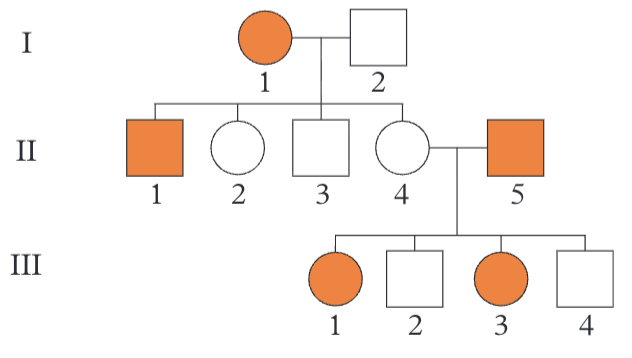

<ul><li><p>More females than males affected over generations</p></li><li><p>If all daughters (no sons) of affected male show trait → most likely X-linked dominant</p></li></ul><p>Example left: Rett syndrome </p><p></p>
14
New cards

What are the features of Y-linked inheritance?

Exam evidence:

  • If all affected fathers have affected sons → most likely Y-linked


  • Sons inherit Y chromosome from father

  • Females never affected/carriers, since they lack a Y

  • Trait appears in every generation with males
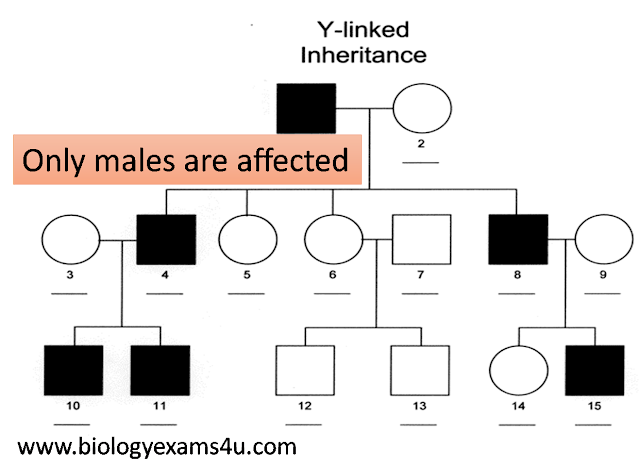

<p>Exam evidence:</p><ul><li><p>If all affected fathers have affected sons → most likely Y-linked</p></li></ul><p></p><ul><li><p>Sons inherit Y chromosome from father</p></li></ul><ul><li><p>Females never affected/carriers, since they lack a Y</p></li><li><p>Trait appears in every generation with males</p></li></ul><p></p>
15
New cards

What is the key piece of evidence for Y-linked inheritance?

If all affected fathers have affected sons, then the trait is most likely Y-linked

Example left: Hairy ears
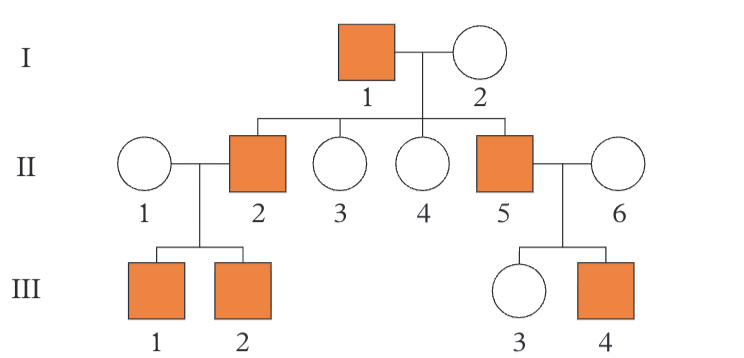
<p>If all affected fathers have affected sons, then the trait is most likely Y-linked </p><p>Example left: Hairy ears</p>
16
New cards

What are the 2 methods for determing the mode of inheritance of a pedigree?

  1. Method 1: Trial and error/hypothesis

  2. Method 2: Quick Questions


<ol><li><p>Method 1: Trial and error/hypothesis </p></li><li><p>Method 2: Quick Questions </p></li></ol><p></p>
17
New cards

What is the Trial and error/hypothesis method for determining the mode of inheritance for a pedigree?

  • Guess a mode of inheritance, then check for exceptions

  • Assign genotypes to test each mode of inheritance:

    • X-linked dominant

    • X-linked recessive

    • Autosomal dominant

    • Autosomal recessive


<ul><li><p><span>Guess a mode of inheritance, then check for exceptions</span></p></li><li><p><span>Assign genotypes to test each mode of inheritance:</span></p><ul><li><p><span>X-linked dominant</span></p></li><li><p><span>X-linked recessive</span></p></li><li><p><span>Autosomal dominant</span></p></li><li><p><span>Autosomal recessive</span></p></li></ul></li></ul><p></p>
18
New cards

What is the quick questions method for determining the mode of inheritance for a pedigree?

  • Use once confident with Method 1; still check with genotypes

Q1: Anyone different to both parents? (dominant vs recessive)

  • Unaffected parents, affected child → recessive

  • Affected parents, unaffected child → dominant

Q2: Any recessive daughters differing from father/sons?

  • Yes → X-linked

  • No → autosomal


<ul><li><p><span>Use once confident with Method 1; still check with genotypes</span></p></li></ul><p><span><strong>Q1: Anyone different to both parents? (dominant vs recessive)</strong></span></p><ul><li><p><span>Unaffected parents, affected child → recessive</span></p></li><li><p><span>Affected parents, unaffected child → dominant</span></p></li></ul><p><span><strong>Q2: Any recessive daughters differing from father/sons?</strong></span></p><ul><li><p><span>Yes → X-linked</span></p></li><li><p><span>No → autosomal</span></p></li></ul><p></p>
19
New cards

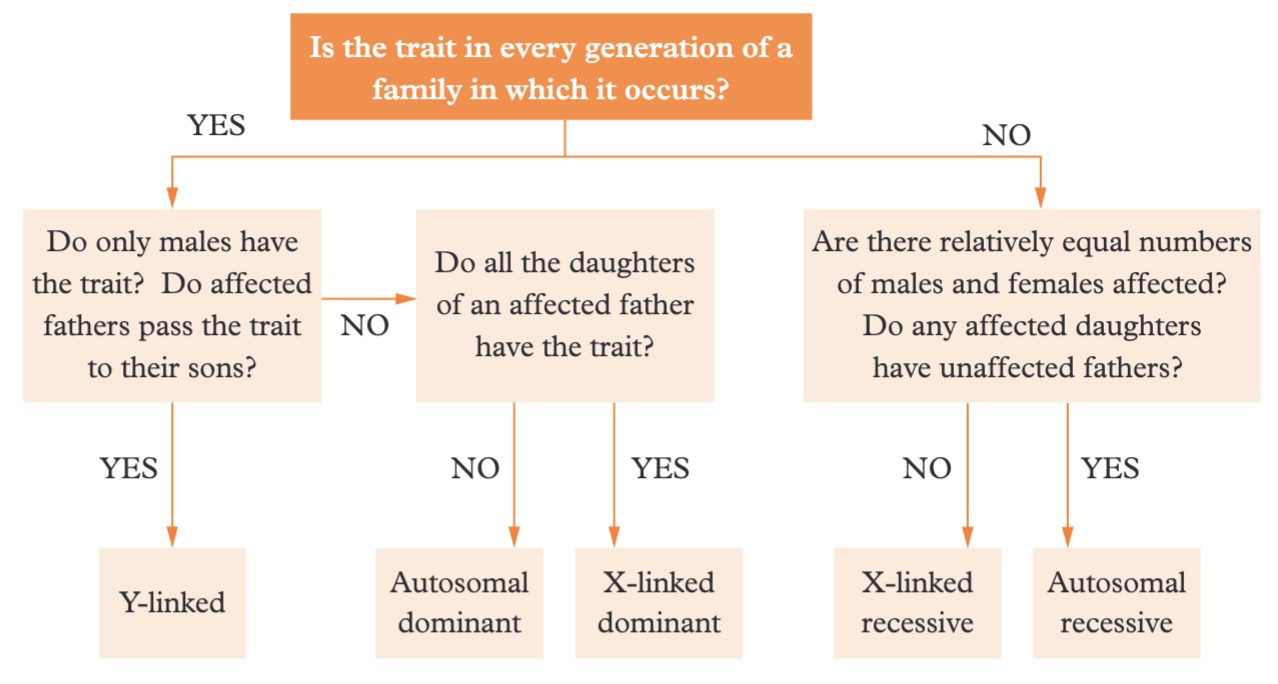
How do you use a decision-tree method to determine a pedigree's mode of inheritance?


Step 1: Is the trait in every generation of a family in which it occurs?

  • YES

    • Do only males have the trait? Do affected fathers pass the trait to their sons?

      • YES → Y-linked

      • NO → Do all the daughters of an affected father have the trait?

        • NO → Autosomal dominant

        • YES → X-linked dominant

  • NO

    • Are there relatively equal numbers of males and females affected? Do any affected daughters have unaffected fathers?

      • NO → X-linked recessive

      • YES → Autosomal recessive


<p></p><p></p><p><strong>Step 1: Is the trait in every generation of a family in which it occurs?</strong></p><ul><li><p><strong>YES</strong> →</p><ul><li><p>Do only males have the trait? Do affected fathers pass the trait to their sons?</p><ul><li><p><strong>YES</strong> → Y-linked</p></li><li><p><strong>NO</strong> → Do all the daughters of an affected father have the trait?</p><ul><li><p><strong>NO</strong> → Autosomal dominant</p></li><li><p><strong>YES</strong> → X-linked dominant</p></li></ul></li></ul></li></ul></li><li><p><strong>NO</strong> →</p><ul><li><p>Are there relatively equal numbers of males and females affected? Do any affected daughters have unaffected fathers?</p><ul><li><p><strong>NO</strong> → X-linked recessive</p></li><li><p><strong>YES</strong> → Autosomal recessive</p></li></ul></li></ul></li></ul><p></p>
20
New cards

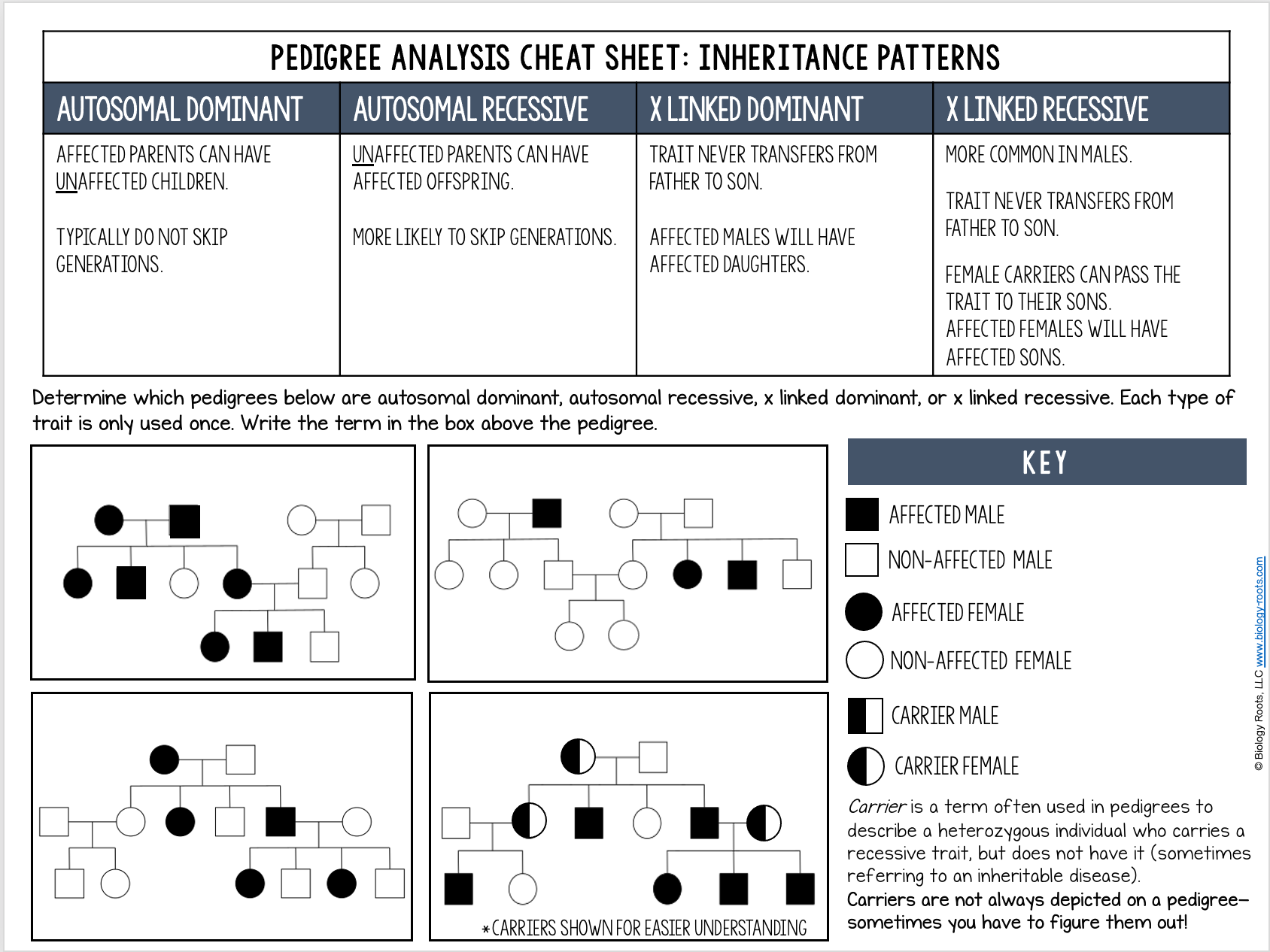
What is the checklist for confirming a pedigree's mode of inheritance?

  • Check whether both sexes are affected — if roughly equal, likely autosomal

  • Assign genotypes to individuals using logic

  • See if the genotypes fit naturally, without forcing them

  • Base your final answer on the observed inheritance pattern as evidence

  • Use large sample sizes for reliability, and combine with trial and error to confirm

Note: Always reference individuals by generation-number, e.g. II-4

<ul><li><p><span>Check whether both sexes are affected — if roughly equal, likely autosomal</span></p></li><li><p><span>Assign genotypes to individuals using logic</span></p></li><li><p><span>See if the genotypes fit naturally, without forcing them</span></p></li><li><p><span>Base your final answer on the observed inheritance pattern as evidence</span></p></li><li><p><span>Use large sample sizes for reliability, and combine with trial and error to confirm</span></p></li></ul><p><span><strong>Note:</strong></span> Always reference individuals by generation-number, e.g. II-4</p><p></p>