biology final MSU dr. welch final:
 Call Kai
 Learn
Learn Practice Test
 Spaced Repetition
 Match
Match Flashcards
 Knowt Play
1/216

There's no tags or description
Looks like no tags are added yet.
Name | Mastery | Learn | Test | Matching | Spaced | Call with Kai | Chat |
|---|
No analytics yet
Send a link to your students to track their progress
217 Terms
biodiversity is organized into three
domains; Bacteria, Archaea, and Eukarya
Some Eukarya areas include:
fungi, animals, plants, protist
Charles Darwin (1809-1882) was best known for:
naturalist with an empirical approach
- second model of evolution
- natural selection
Jean Baptiste Lamarck (1744-1829) was known for:
naturalist with a philosophical approach
- first model of evolution(1809)
- inheritance of acquired characteristics
voyage of the HWS Beagle
(1831-1836)
ecosystem
a community of living organisms (biotic factors) interacting with each other and their nonliving environment (abiotic factors) as a system
producers
organisms that can make, or produce, their own food
consumers
organisms that must eat other organisms for food
decomposers
organisms that break down dead organic matter
coevolution
the joint evolution of two species wherein ecological interactions exert selective pressures over generations that leads to a change in one species prompting a reciprocal change in the other species
Mutualism (+,+)
a type of symbiotic relationship where two different species benefit from their interaction
Predation (+,-)
an interspecific interaction between species in which one species feeds on and kills the other.
Herbivory (+,-)
an interaction between species in which herbivores feed on plants
Parasitism (+,-)
an interaction between species in which one species feeds off another species but does not normally kill it
How do the producers, consumers, decomposers, and abiotic, components of an ecosystem interact with each other
next slide
Producers:
- Directly transfer energy absorbed from the sun and turn it into organic matter like carbohydrates (they make their own food using energy from the sun)
-
Consumers:
eat producers or other consumers in order to obtain energy
Decomposers:
Break down deceased producers and comsumers, typically resulting in increased nutrients in the ground/soil.
Abiotic:
nonliving physical and chemical components:
sunlight, water, air, pH, temperature, minerals
Describe the "coevolutionary arms race." between the common garter snake and rough skinned newt in costal regions of the Western US
- Predator Prey Evolution is when the newt produces a strong neurotoxin called tetrodotoxin which causes paralysis and death in most predators.
- The garter snake is a predator to the newt, has evolved a genetic resistance to the toxin thriugh mutations in its DNA
the cycle keeps evolving and selective pressure on the newt population. This process would eventually put pressure on the snake population
Biophilia
the connectedness that humans feel to nature
Conservation Biology
a branch of ecology that works to preserve biodiversity; they advocate for the preservation of biodiversity hotspots and the creation and maintenance of nature preserves
Resortation Ecology
focuses on restoring degraded habitats by using ecological principles
The International Union for the Conservation of Nature (IUCN)
volunteer group of biologists who study populations of species of concern throughout their geographic range, and, if necessary, declare species as threatened, vulnerable, or endangered
Biodiversity
encompasses the genetic diversity of a species, the variety if a species in an area, and the variety of ecosystems in a landscape
Biodiversity Hot Spots
relatively small areas with unusually high concentrations of endemic species and endangered species
Fragmentation:
the splitting of habitats that causes populations to become isolated from each other
Bioremediation
the use of living organisms to detoxify polluted ecosystems
Why do you think that conservation biologists recommend preserving habitat diversity in hot spots?
Because they contain populations that are endemic (not found anywhere else) and are endangered. If these species die off in these hot spots, they may not be found anywhere else in the world and will go extinct.
Describe a sustainable lifestyle.
Anything that reduces your carbon footprint: using less plastic, recycling, eating less red meat, using public transportation, etc.
What are the four conservation strategies discussed in this unit?
1. Identifying biodiversity hotspots and preserving the habitats in these regions
2. The formation of nature preserves
3. Restoring degraded habitats (EX. through bioremediation)
4. Working to conserve the population or habitat of a single species
Explain the importance of nature preserves and their components.
Nature preserves play a crucial role in protecting biodiversity, maintaining ecosystem services, and providing spaces where natural processes can occur with minimal human disturbance. They contain patches and corridors:
Patches - discrete areas of natural habitat within a larger landscape
Corridors - strips of habitat that connect patches, allowing organisms to move between them
Explain why evolution and ecology are linked.
Evolution in an organism likely happens because of advantageous adaptations to their environment. This demonstrates that biotic and abiotic interactions affect the evolution of organisms. This is to say that climate, water availability, light, food availability, and so much more that is studied by ecologists affects the evolution of species.
*** Populations of species can adapt during environmental changes if the rate of change is slower than the reproductive rate of the species. ****
Which of the following contributes to genetic variation in asexually reproducing species?
mutations
Which of the following contributes to genetic variation in sexually reproducing species?
Mutations, Crossing Over, Independent Assortment, Random Fertalization
Which of the following is an example of heterozygous genotype?
Aa
What is the difference between a genotype and a phenotype?
The phenotype is the expression of the genotype
Which of the following is NOT a requirement for Hardy-Weinburg Equilibrium to occur?
Non-random mating
Write the Hardy Weinburg Equilibrium equation and label each variable.
Equation: p2 + 2pq + q2 = 1
p = frequency of dominant allele
q = frequency of recessive allele
p2= frequency of homozygous dominant genotype
q2= frequency of homozygous recessive genotype
2pq = frequency of heterozygous genotype
If the frequency of the recessive allele is 0.3, what is the frequency of the dominant allele ?
0.7
If the frequency of the dominant allele is 0.4, what is the frequency of the heterozygous genotype.
0.48
The graph to the right demonstrates what type of selection?
Directional
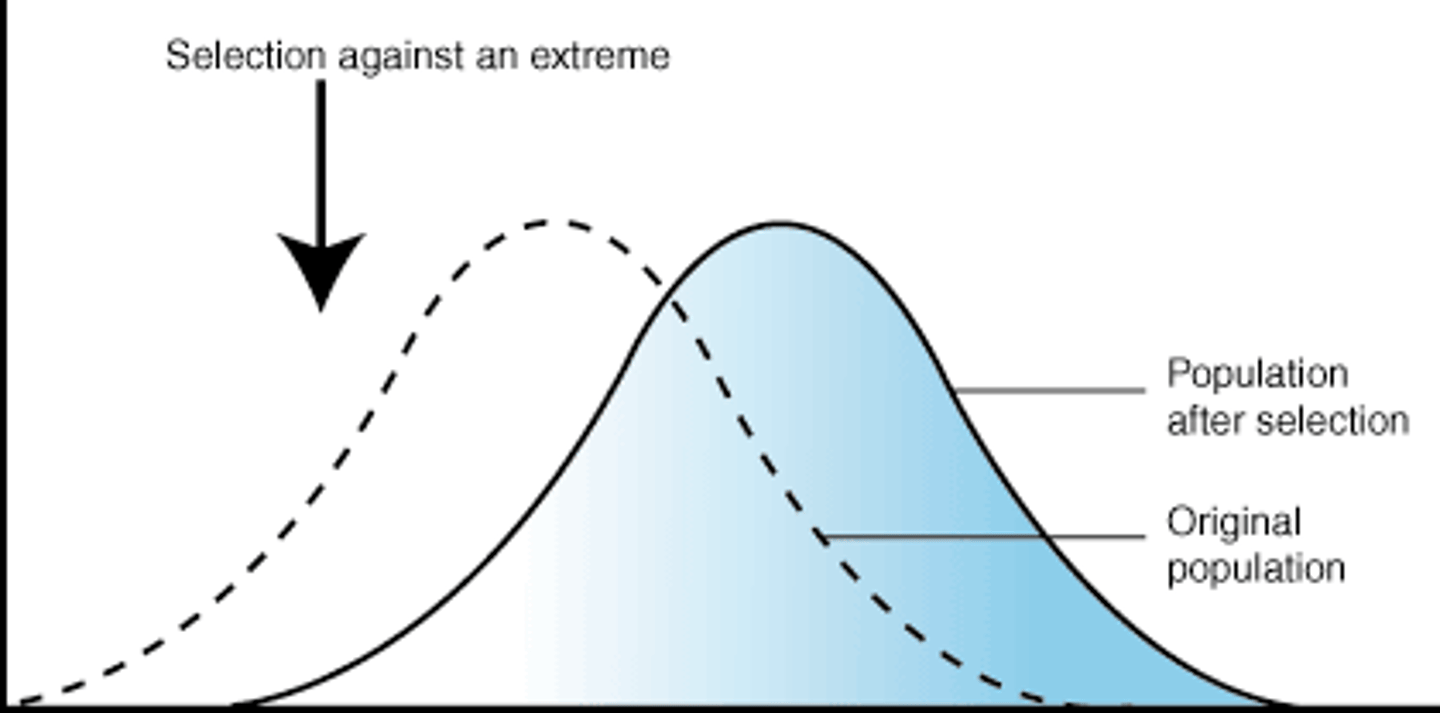
Of the different types of selection, which of them maintains genetic variation?
Diversifying selection
A catastrophic earthquake killed about 90% of the maple trees in a river valley. There is no known genetic variation in maple trees that confers a survival advantage in the face of an earthquake. Eventually, the maple tree population recovered to its original numbers, but researchers have determined that certain traits, such as resistance to the damaging effects of some herbivores, have been lost from the rebounded population. The most likely explanation for this observation is that the earthquake caused __________ and then __________ eliminated certain alleles from the population.
a bottleneck effect, genetic drift
Which of the following statements regarding mutations is true?
Mutations provide the original source for genetic variation, but other evolutionary factors are more important in determining allele frequencies in a population.
T/F Natural selection is a mechanism of evolutionary change.
true
Which of the following observation(s) provide(s) evidence for evolution?
- DNA sequences of homologous genes are similar to each other among different species.
- Different species with similar traits are often found in geographically adjacent regions.
- Mammals that live in cold climates tend to have thicker fur than those found in warmer climates.
- Fossils of related species, such as those that gave rise to the modern whale, often show a progression of changes over time.
Let's suppose that a species of bacterium, Salmonella typhimurium, has acquired an antibiotic resistance gene from a different species, such as Klebsiella pneumonia. This event is the outcome of:
horizontal gene transfer.
Lamarck's vision of evolution differed from Darwin's and Wallace's in that Lamarck proposed:
- Individuals can adapt to their environment.
- Behavioral changes modify heritable traits.
Artificial selection is...
performed by humans
Macroevolution comprises evolutionary changes that
produce new species and groups of species.
The key difference between allopatric and sympatric speciation is
whether the speciation process involves geographic separation.
Which of the following could be used to classify species according to the biological species concept?
the ability of frogs to interbreed with each other
Which of the following is an example of a postzygotic isolating mechanism?
the failure of fertilized eggs to develop normally
Let's suppose one species of fish found in freshwater lakes in the midwestern U.S. evolved into two different species because some members tend to eat insect larvae that are near the surface of the water, whereas other members eat algae growing along the shore. This would be an example of __________ speciation due to __________.
sympatric, adaptation to local environments
Over millions of years, a certain species has acquired small adaptations to its environment. This is an example of what?
the gradual time model of speciation
The eastern skunk and the western skunk live in the same geographic region. However, they do not interbreed because the western species breeds in the fall, while the eastern species breeds in late winter. This is an example of ___________, which is a type of________.
temporal isolation, prezygotic isolating mechanisms
Which of the following characteristics are commonly used to identify the terrestrial biomes of the Earth?
temperature, precipitation, and vegetation
You have come across an old dataset in your research lab. The researcher recorded temperature, precipitation, and plant species over a time span of 5 years but apparently forgot to record the location! Upon further examination, you find that the average temperature in the mystery location is 38°C, the average precipitation is 25 cm, and plant matter is sparse, made up mostly of short, scrubby species. From what biome was the dataset most likely recorded?
desert
Ecology and environmentalism are the same thing.
false
An ecologist is studying the adaptations of the grey wolf species. What kind of ecology does this demonstrate?
organismal ecology
Which of the following is NOT true about the life history of a species?
Some adaptations developed are not heritable.
What is the characteristic of a K-selected species?
They have very strong competitors
Which of the following is NOT an abiotic factor that influences ecosystems?
decomposers
Which of the following has dry, descending air and contains the rain shadow region on a mountain?
leeward side
The amount of land necessary for survival for each person in a sustainable world is known as the
ecological footprint
Invasive species come from
agricultural introductions, accidental transportation via ships, introduction of landscape plants with their pests.
What would be the main goal of a conservation biologist?
to preseve biodiversity
Where would you be most likely to find biodiversity hotspot?
in tropical areas around the equator
Which of the following sums up the goals of the IUCN?
to conserve biodiversity, ensure sustainable use of resources, and influence environmental policy
The environment does the selecting in natural selection.
true
Populations of species can adapt during environmental changes if the rate of change is slower than the reproductive rate of the species.
true
The evolutionary arms race between the rough-skinned newt and the garter snake is an example of predator-prey coevolution. Which of the following best explains why newts evolved to produce increasingly higher levels of tetrodotoxin (TTX)?
Mutations in garter snakes conferred resistance to TTX, creating selective pressure on newts to increase toxin levels for survival.
________ speciation arises by geographic isolation of a few members of the original population or species
Allopatric
A _______ is a group of individuals who can interbreed and produce viable, fertile offspring.
species
The Biological Species Concept applies to _____ reproducing species
sexually
source of new geneotypes and phenotypes in a population and violation of HW Equilibrium
mutation
_________ selection violates the random mating condition of HW Equilibrium
sexual
All of the alleles for every gene in a popualtion is known as the _________
genepool
The level of biological organization subject to natural selection
population
Inheritance of acquired characteristics very rarely occurs in _____ cells
germ
Humans shape the phenotypes of domesticated species over time through _______ ________?
Artificial Selection
Biodiversity is unified by the process of ________.
evolution
________ selection occurs when indiiduals with intermidiate phenotype have higher fittness.
stabilizing
Natural selections acts upon the _____in a population.
Phenotypicvariation
Temporal isolation is a _______ isolating mechanism of the Biological Species Concept.
prezygotic
Genetic drift ________ genetic variation in small populations
decreases
Traits (genes) subject to natural selection must be
heritable
An interspecies hybrid survives, but it is sterile. This is an example of a ______ isolating mechanism of the Biological Species Concept.
postzygotic
Members of a specises often identify each other through spesific rituals. This explains the ____ isolating mechanism of the Biological Specises Concept.
behavioral
Anotomical ________, such as similarites in limb bone structure in vertebrates, is a form of evidence for biological evolution.
homologies
______ _____ occurs when individuals migrate between populations with different allele frequencies
gene flow
The ______ shapes the phenotypes of specises over time through natural selection
enviorment
Comparisons of continental and _______ species informed Darwin and Wallace's concept of natural selection.
island
Natural selection, the mechanism of Darwinian evolution, operates to produce changes in
populations
Which of the following provides evidence for biological evolution?
studies of natural selection, anatomical homologies, and fossil record
New combinations of genes in a sexually reproducing species may be produced by
crossing over, independent assortment, and random fusion of gamates at fertilization.
Members of an animal population would be least likely to have which of the following in common?
genotypes
Sexual dimorphism (males and females of a species having different phenotypes) has arisen as a result of
sexual selection
Speciation occurs
after populations become reproductively isolated and diverge.