Chapter 7 Neuronal Signaling
 Call Kai
 Learn
Learn Practice Test
 Spaced Repetition
 Match
Match Flashcards
 Knowt Play
1/175

There's no tags or description
Looks like no tags are added yet.
Name | Mastery | Learn | Test | Matching | Spaced | Call with Kai | Chat |
|---|
No analytics yet
Send a link to your students to track their progress
176 Terms
neurons are
excitable cells in the nervous system
What are glial cells
aka neuroglia, support cells in nervous system

components of a neuron
contains nucleus and most organelles
soma

components of a neuron
bring info into neuron
input areas
dendrites
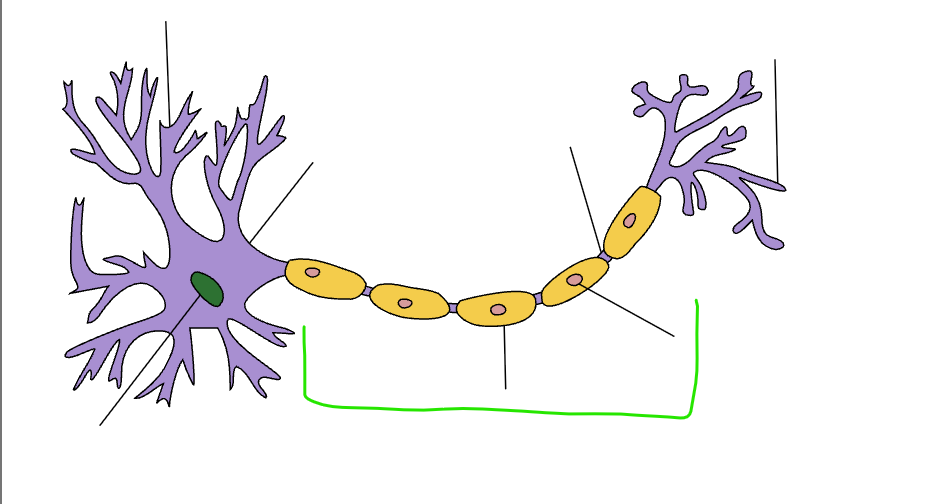
components of a neuron
transmits electrical impulses called action potentials
output arm of the neuron
signals leave the cell body
axon

components of neuron
where axon originates and action potentials are generated
located where axon & cell body join
axon hillock

components of a neuron
releases neurotransmitter
axon terminal

Functional classes of neuron
neural info flows into the CNS
afferent neurons

functional classes of neurons
neural info flows away from CNS
send info to effector organs like
muscles 💪
glands
efferent neurons

functional classes of neurons
neural info remains within CNS
communicated from neuron to neuron
most are these
interneurons
What are a neuron’s integral membrane proteins?
signal receptors and ion channels
Ion channels: Neurons
receptors receive signals and ________
ion channels ________ ion flow to generate ________
transduce; control; electrical impulses
Ion channels in neurons are usually ______ to certain ion(s)
specific
Types of ion channels
always open- don’t have a gate
located throughout entire neuron
allow one or more type of ion
main job is to establish resting membrane potential (when neuron is not excited)
leak channels
Type of ion channels
open or close in response to ligand binding
found on dendrites and soma
create synaptic potentials
ligand-gated channels
Type of ion channels
open or close in response to changes in membrane potential
change in charge level across membrane
called membrane potential
voltage-gated channels
This type of voltage gated channel
is found all around neuron
more in the axon/ axon hillock
generates action potentials
sodium and potassium channels
This type of voltage gated channel
is located at the axon terminal
help release neurotransmitters
calcium channels
Electrical potentials in neurons
written as = E
difference in voltage between two points
potential difference
Electrical potentials in neurons
written as = Vn
difference of charge across membrane at any place
membrane potential
Electrical potentials in neurons
difference in membrane potential when cells is at rest
not receiving or sending signals
resting membrane potential
when cell sis not excited it means that there is an electrochemical ___________ point of the cell
equilibrium
resting membrane potential (Vm) depends on ____________ of all ions that cross the membrane
equilibrium potentials
True or false all cells have a resting membrane potential
true
neurons maintain a resting membrane potential of approx ______
-70 mV
What are the 3 factors that help determine resting membrane potential
ion concentration gradients, membrane permeability, Na+/K+ pump

Which direction will Na+ go?
will cross through a sodium leak ion channel
inside the cell

Which direction will K+ go?
will cross through a potassium leak ion channel
outside the cell
main function of the Na+/K+ pump
pump 3 sodium out of cell and 2 potassium into cell using 1 ATP
energy source for the Na+/K+ pump
adenosine triphosphate (ATP)
net charge moved per pump cycle
net +1 charge removed from inside cell
direct effect of Na+/K+ pump on resting membrane potential
creates 20% charge difference by pumping out more positive ions than it brings in
The Na+/K+ pump moves from _____ to ______ gradient concentration
low to high
indirect effect of Na+/K+ pump on resting membrane potential
creates 80% charge difference by creating concentration gradients
What is the Sodium (Na+) concentration gradient?
higher outside, lower inside cell
What is the potassium (K+) concentration gradient
lower outside, higher inside cell
why potassium leaking out creates a negative charge inside
potassium carries positive charge out, leaving negative charged proteins inside

Step 1 of Na+/K+ pump cycle
3 sodium ions and 1 ATP molecule bind to pump from inside cell

Step 2 of Na+/K+ pump cycle
ATP splits and provides energy to change shape of channel so it opens to outside

Step 3 of Na+/K+ pump cycle
3 sodium ions are released outside, and 2 potassium ions bind from outside

Step 4 of Na+'/K+ pump cycle
phosphate releases, pump gets back to original shape, 2 potassium released inside
Location of higher Na+ concentration at rest
outside the cell
Location of higher K+ concentration at rest
inside the cell
Meaning of the suffix -ase in Na+/K+-ATPase
is an enzyme
what is the role of Na+/K+ pump in nerve cell signaling
maintains resting state so neurons can fire action potentials
number of Na+ ions moved per cycle
3
number of K+ ions moved per cycle
2
Equilibrium potential describes the
exact electrical voltage where 2 competing forces on an ion channel cancel each other out, so there is no net movement
What does sum of electrochemical forces = 0mV mean?
an equal number of ions are crossing in both directions
made up cell
initially has 0 mV membrane potential
no electrical driving force
membrane is only permeable to potassium
hypothetical cell
the ion distribution of both hypothetical cells is….
what ion concentrations are higher inside/ outside cell
higher concentration of sodium and chloride outside cell, higher concentration of potassium and organic anions inside cell
In a hypothetical cell the chemical driving force of potassium is driving it ?
outside the cell
In a hypothetical cell the electrical driving force of potassium is driving it ?
into the cell

In the hypothetical cell that is only permeable to potassium which driving force is higher?
electrical or chemical?
chemical, so potassium diffuses out of the cell
if the driving forces are in opposite directions which one wins?
the stronger force
Since the chemical force is diffusing potassium (K+) out the cell the inside of the cell becomes more_________?
negative
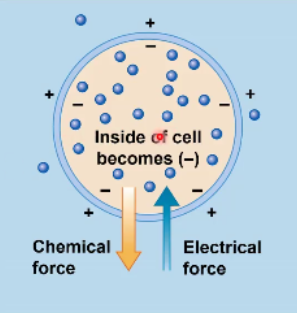
Now that there is a electrical gradient difference in the hypothetical cell that is only permeable to potassium
inside cell is more negative
causing electrical force to do what with Potassium?
remember opposites attract
pull potassium back inside cell
when chemical and electrical forces are equal
cell reaches equilibrium
When hypothetical cell reaches equilibrium the equilibrium potential for potassium is?
Ek=
-94 mV
In the hypothetical cell that is only permeable to potassium the chemical and electrical driving forces are at equilibrium but
opposite in ________
equal in _________
direction; magnitude
made up cell
initial membrane potential of 0 mV
permeable only to sodium ions
hypothetical cell
in the hypothetical cell that is only permeable to sodium the chemical driving force is driving it at which direction?
into the cell
in the hypothetical cell that is only only permeable to sodium the electrical force is driving it at which direction?
into the cell
Since the chemical and electrical driving forces are in the same direction in the hypothetical cell that is only permeable to sodium → Na+ diffuses _________
into the cell

In the hypothetical cell that is only permeable to sodium
as it diffuses into cell the inside of the cell becomes?
less negative
In the hypothetical cell that is only permeable to sodium
now that the inside of the cell is more positive
the electrical driving force begins to push Na+ ________ of cell
remember like charges repel each other
out
When hypothetical cell reaches equilibrium the equilibrium potential for sodium is?
ENa=
+60 mV
When the hypothetical cell that is only permeable to sodium reaches equilibrium the chemical and electrical driving force are:
opposite in ________
equal in ________
opposite; magnitude
Membrane is 25x more permeable to ____ than _____
K+; Na
the membrane is more permeable to potassium because?
there are more potassium leak channels than sodium leak channels
In resting potential more positives are leaving cell so inside of the cell becomes _______
negatively charged
Since the cell during resting potential is negatively charged the electrical driving forces are
driving Na+ ____ cell
driving K+ _____ cell
into
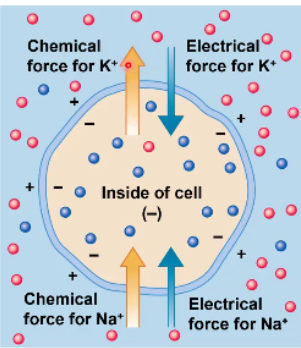
As the electrical force grows the chemical force is affected causing
the K+ outflow to _____
the Na+ inflow to ______
slow down; speed up

Resting potential: neuron
What is this state called
equilibrium develops
membrane potential stops changing/ ions still flow equally
inflow of Na+ is balanced by outflow of K+
steady state
during the resting potential of a neuron the ____________ equal the __________
outflow of potassium; inflow of sodium

resting membrane potential: Neuron
what is the resting membrane potential?
-70mV

the resting membrane potential is closer to the ___________ equilibrium potential
resting Vm = -70mV
potassium
the strength of the force trying to move the ion _____ as the membrane potential moves __________ from the equilibrium potential
grows; away
the resting potential of a cell Vm is ____ mV less negative than Ek
24
During resting membrane potential of a cell, the ___________ drives K+ into the cell therefore, _________ membrane potential
remember cell is negative inside
electrical force; raising
During resting membrane potential of a cell, the __________ drives K+ out of the cell therefore, __________ membrane potential
remember concentration is higher inside than outside
chemical; lowering
During resting potential of a cell, the net force is ________
chemical and electrical force are almost equal
weak
the resting potential of a cell Vm is ____ mV less negative than ENa
130
V, is 130 mV less negative than ENA
Electrical force is ______ the cell
Chemical force is _______ the cell
net force is _________
into; into; strong
The net force is strong because Na+ flows into the cell, but the resting membrane has _________ to Na+, so influx of Na+ is _______
low permeability; slow
The net force is weak because K+ flows out of the cell, but the resting membrane is __________ to K+
highly permeable

there is a _____ Na+ leak when a neuron is at rest
a high force but a _____ permeability
small; low

there is a ______ K+ when a neuron is at rest
a low force but a _________ permeability
small; high
the _______ helps to maintain the resting potential
Na+/K+ pump
The Na+/K+ pump
pumps Na+ back ________
pumps K+ back _________
out of cell; into cell; against
The Na+/K+ pump uses _____________
Na+ and K+ pumps _______ their concentration using ATP
primary active transport; against
the Na+/K+ pump is an example of?
homeostasis
State the relative “leak permeabilities” of K+ and Na+ in neurons at rest & why they cause a -70mV membrane potential
the membrane is x25 more permeable to K+ than Na+, high leakage makes the inside more negative driving it towards equilibrium but a slight trickle of incoming Na+ makes the membrane more positive
The membrane does ‘t reach Ek because _____ is flowing in through its leak channels
sodium
membrane potential changes Δ V happen because of?
gated ion channels that open or close in response to stimulus
The opening and closing of gated ion channels affects _________
movement of ions
The movement of ions through opened or closes gated channels creates an ________
ex: sodium rushing in when gate is open
hint: can become more positive or negative
electrical signal
What does gated mean?
able to be opened/closed by some stimulus
what are the 3 types of gated channels
voltage gated, ligand gated, mechanically gated