Biology OCR A A-LEVEL ; Transport in animals
 Studied by 0 people
 Call Kai
 Learn
Learn Practice Test
 Spaced Repetition
 Match
Match Flashcards
 Knowt Play
1/203

There's no tags or description
Looks like no tags are added yet.
Name | Mastery | Learn | Test | Matching | Spaced | Call with Kai |
|---|
No analytics yet
Send a link to your students to track their progress
204 Terms
What is a double circulatory system?
A system where the blood flows through the heart twice for each cycle of the body
What is a single circulatory system?
A system where the blood flows through the heart once for each cycle of the body
Why do animals need a transport system?
Complex large animals need transport system due to:
- Large size
- Small surface area to volume ratio
- Large levels of metabolic activity
- Long diffusion distance
How does a large size contribute to the need for a transport system?
- Diffusion pathway is increased as cells are further away from the surface of the organism
- Therefore diffusion rate is reduced and diffusion is too slow to supply all of the requirements.
- Outer cells use up the supplies of nutrients
What are features of a transport system?
- Fluid or medium (blood) to carry nutrients, (oxygen, in mammals) and wastes around the body
- Structure that generates pressure that pushes fluid around the body (heart)
- Exchange surfaces enabling substances to enter the blood and leave again (capillaries)
- Tubes, vessels or a body cavity to carry blood by mass flow
- A circulatory system
What is an example of a single circulatory system? Describe the process
Fish;
1) Heart
2) Gills
3) Body
4) Heart
What is an example of a double circulatory system? Describe the process
Mammals;
1) Heart
2) Lungs
3) Heart
4) Body
5) Repeat
What are the two different circulations in a double circulatory system?
1) Pulmonary circulation
2) Systemic circulation
What is pulmonary circulation?
Blood goes from the heart to the lungs to pick up oxygen
What is systemic circulation?
Blood carries oxygen and nutrients around the body to respiring tissues and collects waste products
What are the features of a single circulatory system?
- Blood pressure drops as blood passes through tiny capillaries
- Blood has a relatively lower pressure as it flows towards the body (compared to double circulatory)
- Rate at which reactants are delivered to respiring tissues and waste products is removed is slow (compared to double circulatory)
- Sufficient oxygen and nutrients are still delivered
What are the features of a double circulatory system?
- Blood pressure drops as blood passes through tiny capillaries
- Blood has a relatively higher pressure as it flows towards the body (compared to single circulatory)
- Rate at which reactants are delivered to respiring tissues and waste is removed is fast (compared to single circulatory)
- Sufficient oxygen and nutrients are still delivered
What are the differences between pulmonary and systemic blood circulation in a double circulatory system?
- Blood pressure must not be too high in the pulmonary circulation (otherwise it could damage delicate capillaries)
- Heart can increases pressure of the blood after it passes through the lungs and through the heart (towards the body)
- Systemic circulation carries blood at a higher pressure than pulmonary circulation
What is the exchange of substances in blood as it passes through the body
- Supply of nutrients and oxygen
- Removal of waste products (such as CO2)
What are arteries?
Vessels that can carry blood away from the heart
What are arterioles?
Small blood vessels that distribute blood from an artery to the capillaries
What are capillaries?
Very small vessels with very thin walls
What is a closed circulatory system?
System where blood is held in vessels
What is an open circulatory system?
System where blood is not held in vessels but travels through a body cavity
What are veins?
Vessels that carry blood back to the heart
What are venules?
Small blood vessels that collect blood from capillaries, leading into the veins
How does an open circulatory system work in insects?
- Blood circulates through the body's cavity
- Tissues and cells are bathed directly in blood
In some insects, what must animals do in order to circulate the blood?
Move;
Otherwise transport of nutrients stop and they die
Do insects transport oxygen through blood?
NO;
They use their tracheal system to transport oxygen
What is the process of blood circulation in other insects who do not need to move?
1) Blood enters the muscular heart-like tube through pores called Ostia
2) Long muscular tube pumps blood towards head by peristalsis
3) Near the head, blood simply pours out into body cavity
What can larger and more active insects do with direction of blood from the heart?
Direct blood towards active parts of the body.
What are the active parts of the body in an active and large insect?
I.e.
- Leg muscles
- Wing muscles
What are the disadvantages of an open circulatory system?
- Blood pressure is low and blood flow is low
- Circulation of blood can be affected by body movements or lack of body movements
What is the fluid called that bathes tissues and cells in a closed circulatory system?
Tissue fluid
What are the advantages of tissue fluid in a closed circulatory system? (compared to insects' open circulatory system)
- Higher pressure, tissue fluid flows more quickly
- Faster delivery of oxygen and nutrients
- Faster removal of carbon dioxide and waste products
- Faster diffusion rate overall
- Transport is independent of body movements
What factor can be used to predict how a blood vessel is structured?
The distance from the heart.
How is an artery wall structured compared to veins?
1) Smaller lumen (compared to veins)
2) Thicker endothelium that is folded (compared to veins which are thinner)
3) Lots of elastic fibres (compared to veins)
4) Thicker layer of smooth muscle (compared to veins)
5) Thicker collagen fibres (compared to veins)
How is a vein wall structured compared to arteries?
1) Larger lumen than arteries
2) Thinner endothelium than arteries
3) Less elastic fibres than arteries
4) Less smooth muscle than arteries
5) Less collagen fibres than arteries
How is a capillary structured relative to arteries and veins?
1) Small lumen
2) Very thin endothelium wall
Is the blood pressure of arteries low or high?
High blood pressure
What must the artery wall therefore be to withstand the high blood pressure?
- Have a thick artery wall
- Have the inner endothelium wall to be folded
Why is the inner endothelium wall of arteries folded?
To allow lumen of the artery to expand helping main high blood pressure
What does the artery wall consist of?
- Inner layer, tunica intima
- Middle layer, tunica media
- Outer layer tunica adventitia
What is the function of the tunica intima?
Thin elastic tissue; allows stretch and recoiling to help maintain blood pressure.
What is the structure of the tunica media?
Thick layer of smooth muscle
What is the structure of the tunica adventitia?
Relatively thick layer of collagen and elastic tissue; provides strength to withstand high pressure
What do arterioles consist of structurally? How is this different to arteries?
- Layer of smooth muscle like arteries
- Less elastic tissue than arteries
What does contraction or expansion of the smooth muscle in arterioles do?
1) Change the diameter of the arteriole
2) Increase or decrease resistance to blood changing the rate of blood flow
3) Divert the flow of blood to regions of the body that are demanding more oxygen
What is the structure of capillaries? How does this relate to their primary function? (not asking for features)
- Narrow lumen (7 micrometers)
- Single layer of flattened endothelial cells
- Allows the walls to be more permeable to blood plasma and dissolved substances
What are the specific features of the blood capillary that increases diffusion rate?
- Red blood cells are squeezed against the walls of the capillary
- Thin blood capillary wall increases surface area to volume ratio
- Thin blood capillary wall shortens diffusion distance
- These three parameters helps the diffusion rate of oxygen
How does the permeability of the capillary wall relate to its function? (repeated question)
Blood plasma and dissolved substances can leave the capillary and form tissue fluid
Where do venules collect blood from and where do they transport the blood cell to?
Collect the blood from the capillary bed and transport the blood to the veins.
What is a capillary bed?
Network of capillaries in a tissue
What does the venule consist of structurally?
- Small lumen
- Thin endothelium
- Thin layer of smooth muscle
- Thin layer of elastic tissue
- Thin outer layer of collagen
Is there low or high blood pressure in the veins?
Low blood pressure
Do the walls of veins need to be thick or thin? Is the lumen large or small?
Thin walls with a large lumen
What are the features of the vein? (compared to an artery)
- The lumen is larger
- The walls have thinner layers of collagen, smooth muscle and elastic tissue than arteries
- Veins do not need to stretch or recoil
- Contain valves to prevent back flow of blood
Why does the lumen need to be large in veins?
To ease blood flow
Why don't veins need to stretch or recoil?
- Low blood pressure
- Therefore there is no need to constrict and reduce blood flow
Why do veins have valves?
To prevent back flow and help blood flow to the heart
Why is it important that the veins' walls are thin?
Veins can be flattened by surrounding skeletal muscle
Why is contraction of the surrounding skeletal muscle important?
- Pressure forces blood to move along a direction faster during numerous contractions of skeletal muscle
- Provides room for skeletal muscle
What it hydrostatic pressure?
Pressure that a fluid exerts when pushing against all sides of a vessel or container
What system is lymph part of (yes it is as obvious as you think)
The lymphatic system
What is the lymphatic system?
A system of tubes that returns excess tissue fluid to the blood system
What is oncotic pressure?
The pressure created by the osmotic effects of solutes
What is plasma?
Fluid portion of the blood
What is tissue fluid?
A fluid surrounding the cells and tissues
What are the contents of blood?
- Plasma
- Dissolved substances (oxygen, carbon dioxide, minerals, glucose, amino acids, hormones, plasma proteins)
- Erythrocytes
- white blood cells
- Platelets
How is tissue fluid formed? (step by step process of pressure filtration)
Hydrostatic pressure inside the capillaries is very high and forces tissue fluid out of capillaries into spaces around cells
As tissue fluid forms out of the blood capillary, hydrostatic pressure of the blood capillary reduces and becomes evenly distributed
High oncotic pressure of the blood remaining in the blood capillary is more negative than the tissue fluid therefore some water moves back into the blood capillary by osmosis
What remains in the blood capillary and doesn't move with tissue fluid out of the blood capillary? Why?
- Red blood cells stays in the blood capillary
- Most white blood cells stays in the blood capillary
- Most proteins stays in the blood capillary
This is as most of these substances are too big to diffuse out of the blood capillary
What does tissue fluid do?
- Surrounds cells in the tissue, supplying them with oxygen and nutrients
- Returns to capillary with waste products such as carbon dioxide
What flow force does tissue fluid move as?
Mass flow (not diffusion)
Next three steps of how tissue fluid passes through the cells?
5) Tissue fluid surrounds the cells, bathing them.
6) Exchange of gases and nutrients occurs via simple diffusion, facilitated diffusion and active uptake.
7) Concentration of nutrients in tissue fluid decreases and concentration of waste products increases
Steps of how tissue fluid returns to the blood? (Route a)
8a) Hydrostatic pressure at the venous end is much lower than tissue fluids' hydrostatic pressure
9a) Only some tissue fluid returns to the capillary carrying carbon dioxide and waste products into the blood
10a) However, oncotic pressure of tissue fluid is less negative than the venue end so some water moves back into the venue end via osmosis
Steps of how tissue fluid enters lymphatic system? (Route b)
8b) Most tissue fluid directed into the lymphatics' system of lymph capillaries
9b) Excess tissue fluid drained out of tissue through the lymph vessels
10b) Lymph (excess drained tissue) fluid returns to the blood system in the subclavian vein
Where is the subclavian vein located?
In the chest cavity
What is the fluid in the lymph system called?
Lymph
What features part of the lymph vessels prevents lymph going backwards?
Valves in the lymph vessels
How does the composition of lymph differ to tissue fluid?
Contains more lymphocytes (white blood cell)
Where are lymphocytes produced?
Lymph nodes
What are all of the features that relates blood plasma, tissue fluid and lymph fluid?
- Hydrostatic pressure
- Oncotic pressure
- Red blood cells
- White blood cells
- Protein concentration
- Fat concentration
What are the specific features of blood plasma?
- High hydrostatic pressure
- Negative oncotic pressure
- Has red blood cells, neutrophils and lymphocytes
- High concentration of plasma proteins
- High concentration of lipoproteins transporting plasma proteins
What are the specific features of tissue fluid?
- Low hydrostatic pressure
- Less negative oncotic pressure
- Some neutrophils only
- Few proteins
- Few fats
What are the specific features of lymph fluid?
- Low hydrostatic pressure
- Less negative oncotic pressure
- Only has lymphocytes
- Few proteins
- More fats than tissue fluid
How does blood plasma and tissue fluid compare?
Both;
- Have neutrophils
- Carry oxygen, carbon dioxide and important nutrients
Different:
- Blood plasma has higher hydrostatic pressure than tissue fluid
- Blood Plasma has a more negative oncotic pressure than tissue fluid
- Blood plasma has more plasma proteins
- Blood plasma has plasma proteins transported in lipoproteins
- Blood plasma has more white blood cells than tissue fluid
How does tissue fluid and lymph fluid compare?
Both;
- Have low hydrostatic pressures
- Have less negative oncotic pressure than blood plasma
- Have fewer proteins than blood plasma
Differ:
- Lymph has lymphocytes whereas tissue fluid has only some neutrophils
- Lymph has more fats than tissue fluid
- Tissue fluid has more nutrients and oxygen concentration than lymph fluid
- Lymph fluid has more carbon dioxide and waste products than tissue fluid
How does Lymph fluid compare to blood plasma?
Both;
- Contain lymphocytes
- Contain carbon dioxide
Differ;
- Lymph fluid has a lower hydrostatic pressure
- Lymph fluid has a less negative oncotic pressure
- Lymph has fewer proteins than blood plasma
- Lymph has more fats than Blood plasma
What does hydrostatic pressure tend to do to the fluid in the capillaries just after passing the arterioles? (repeated question)
Push blood plasma out into tissues
What does the oncotic pressure of the blood do to water in tissue fluid just after the formation of tissue fluid?
Blood capillary pulls water back into the capillary from tissue fluid
What are valves?
Structures that;
- Close a passage
- Permit flow in one direction only
What are the atrioventricular valves? What do they ensure?
1) Tricuspid valves that are on the right side of the heart
2) Bicuspid valves that are on the left side of the heart
The valves ensures blood flows in the correct direction.
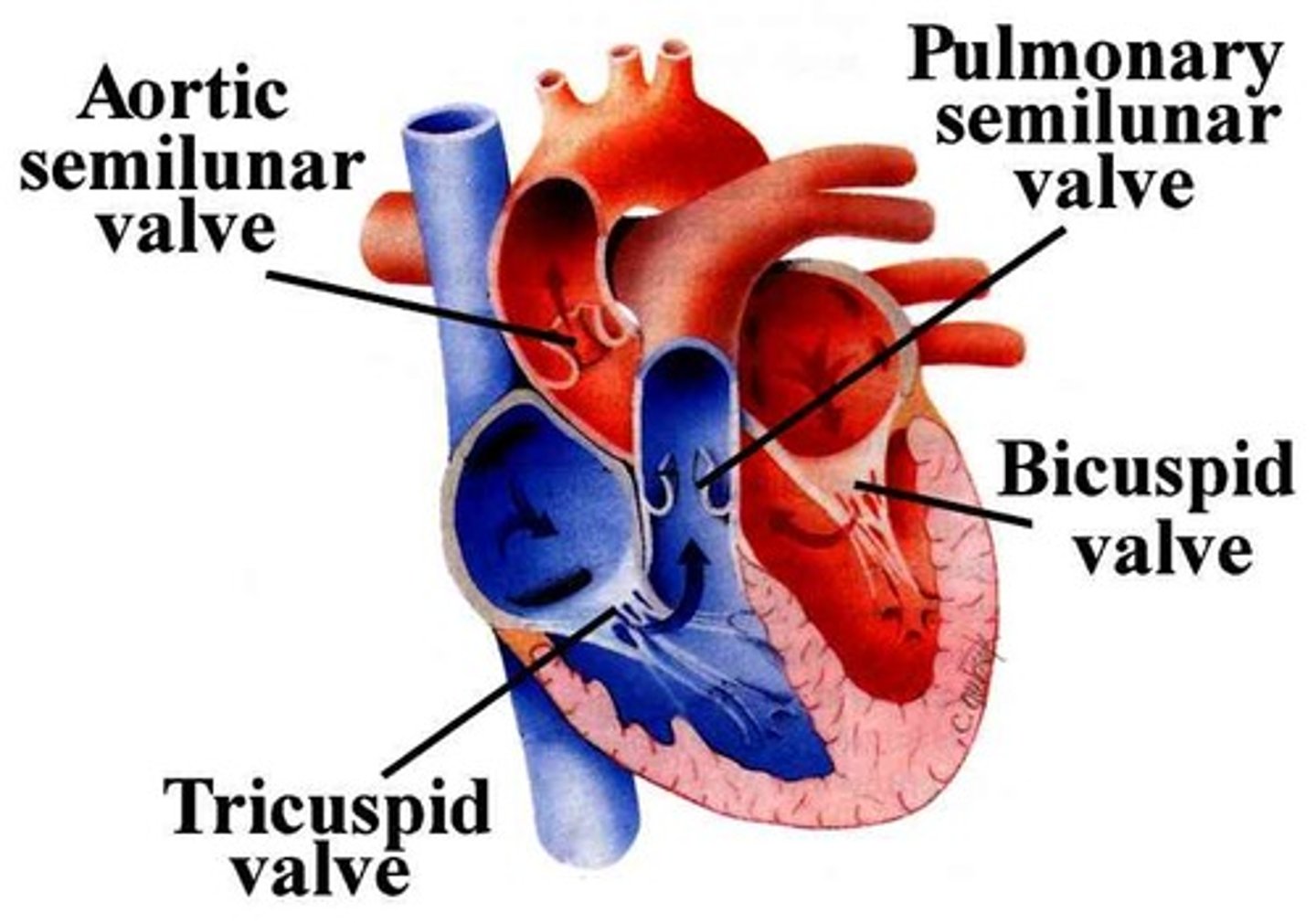
What are semilunar valves?
Valves that prevent blood from re-entering the heart from the arteries
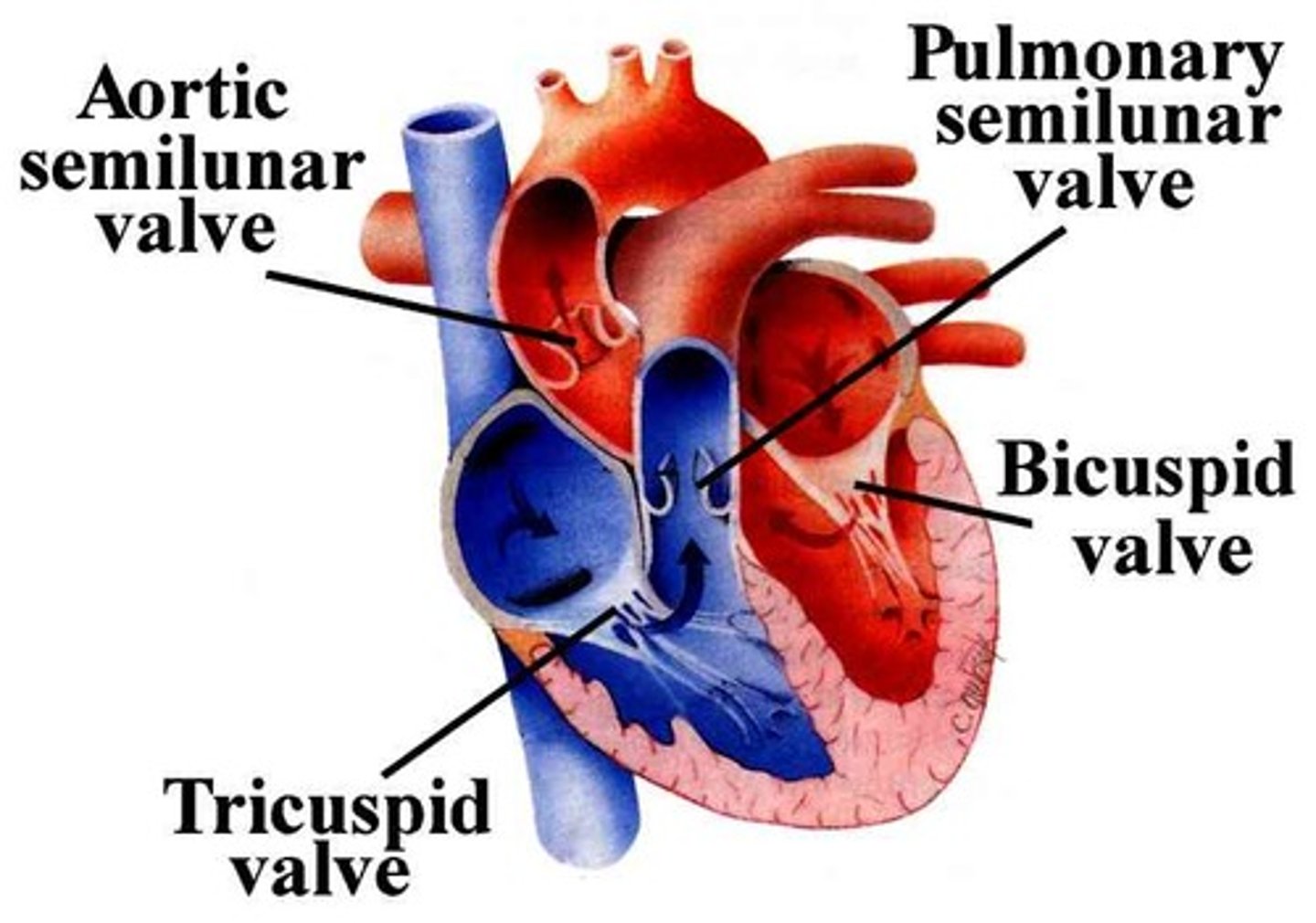
How exactly does the valves in the heart work? What do the valves depend on?
- Valves only open one way and in the heart depend on the relative pressures of the heart chambers
- If there is a higher pressure behind the valve, the valve is forced open
- If there is a higher pressure in front of a valve, the valve is forced shut
What is the cardiac muscle?
Specialised muscle found in the walls of the heart chambers
What side of the heart pumps deoxygenated blood?
Right side
What side of the heart pumps oxygenated blood?
Left side
What are the two main pumping chambers?
Right and left ventricles
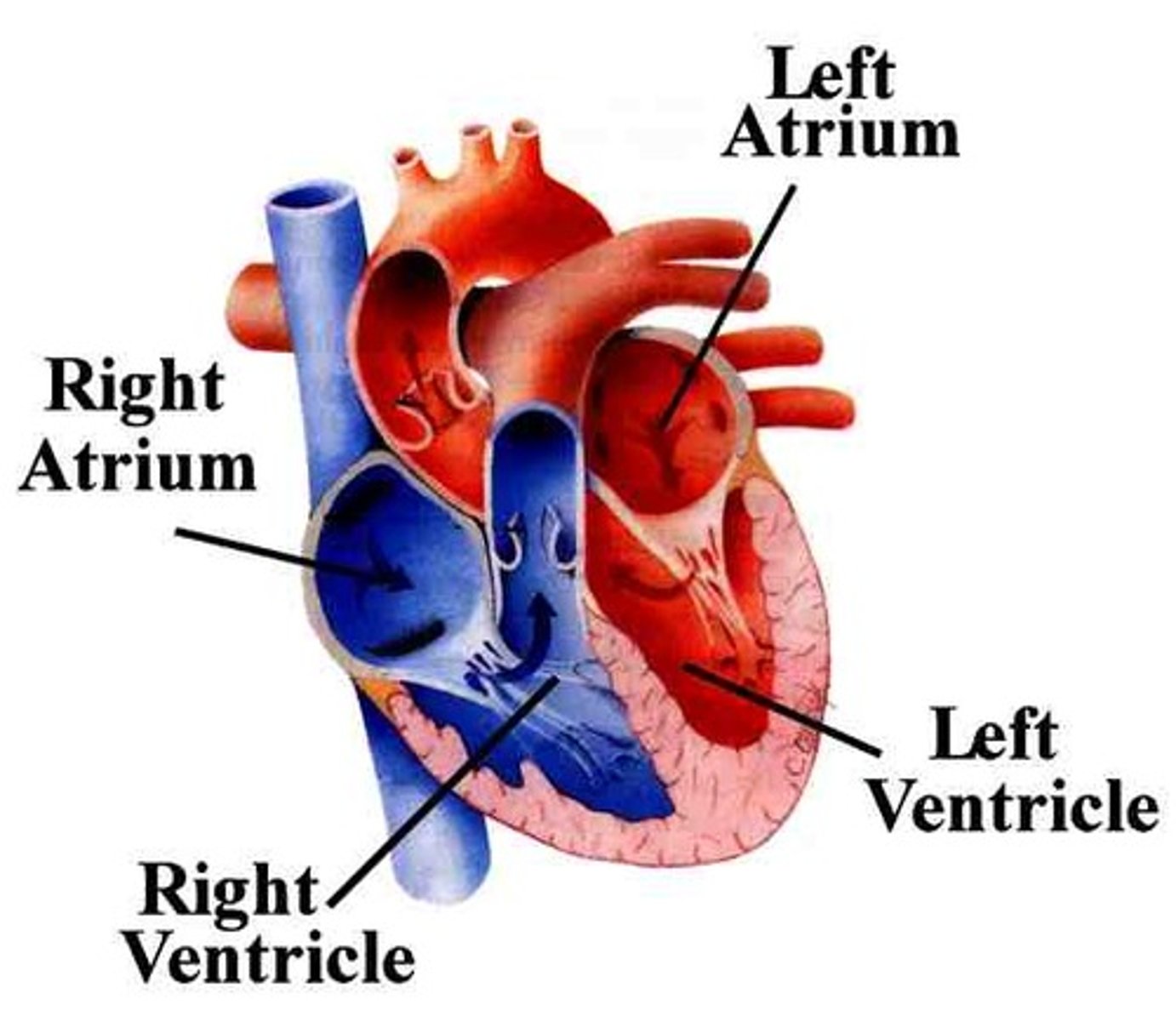
What are the two thin-walled chambers?
The right and left atria
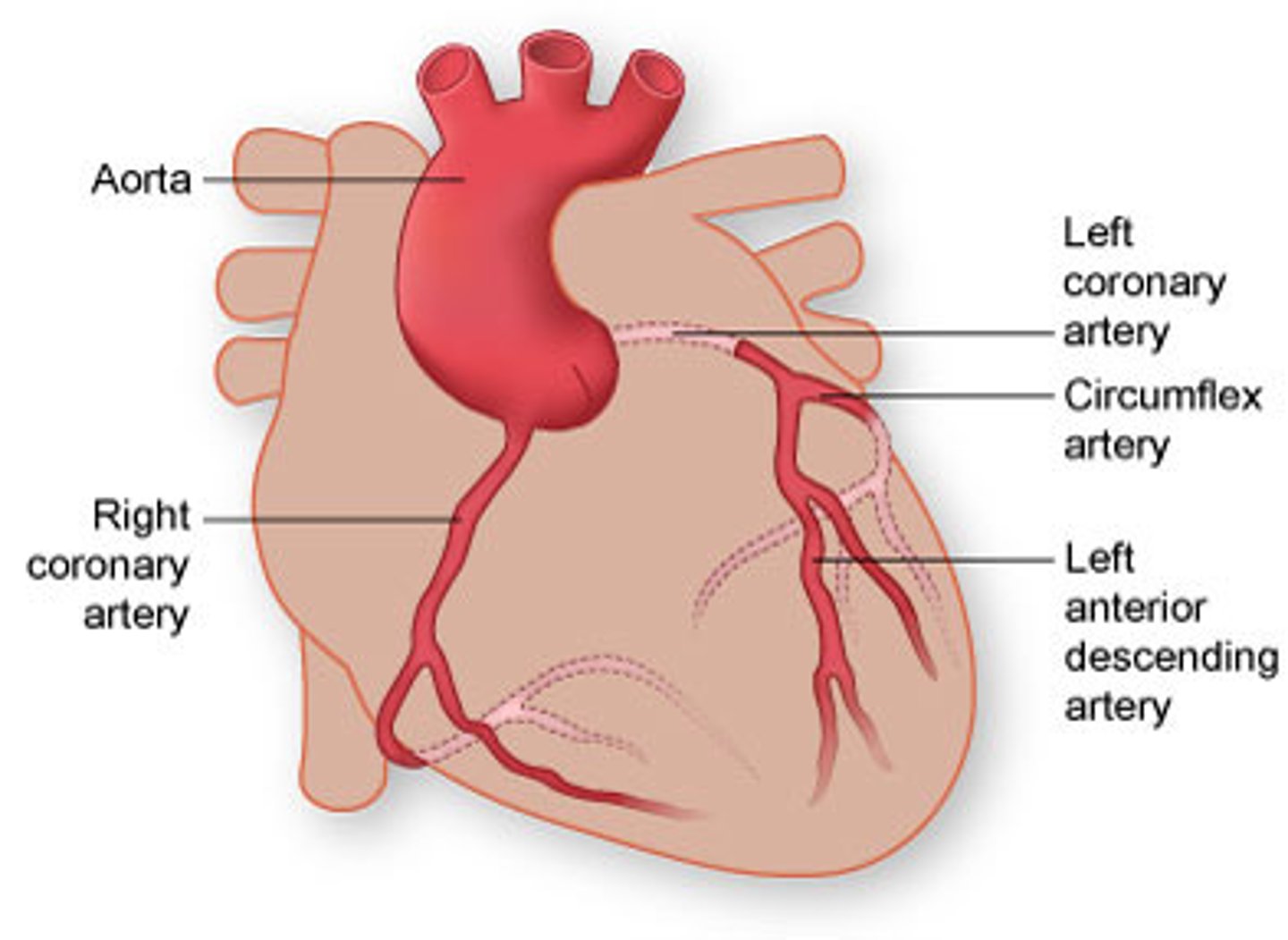
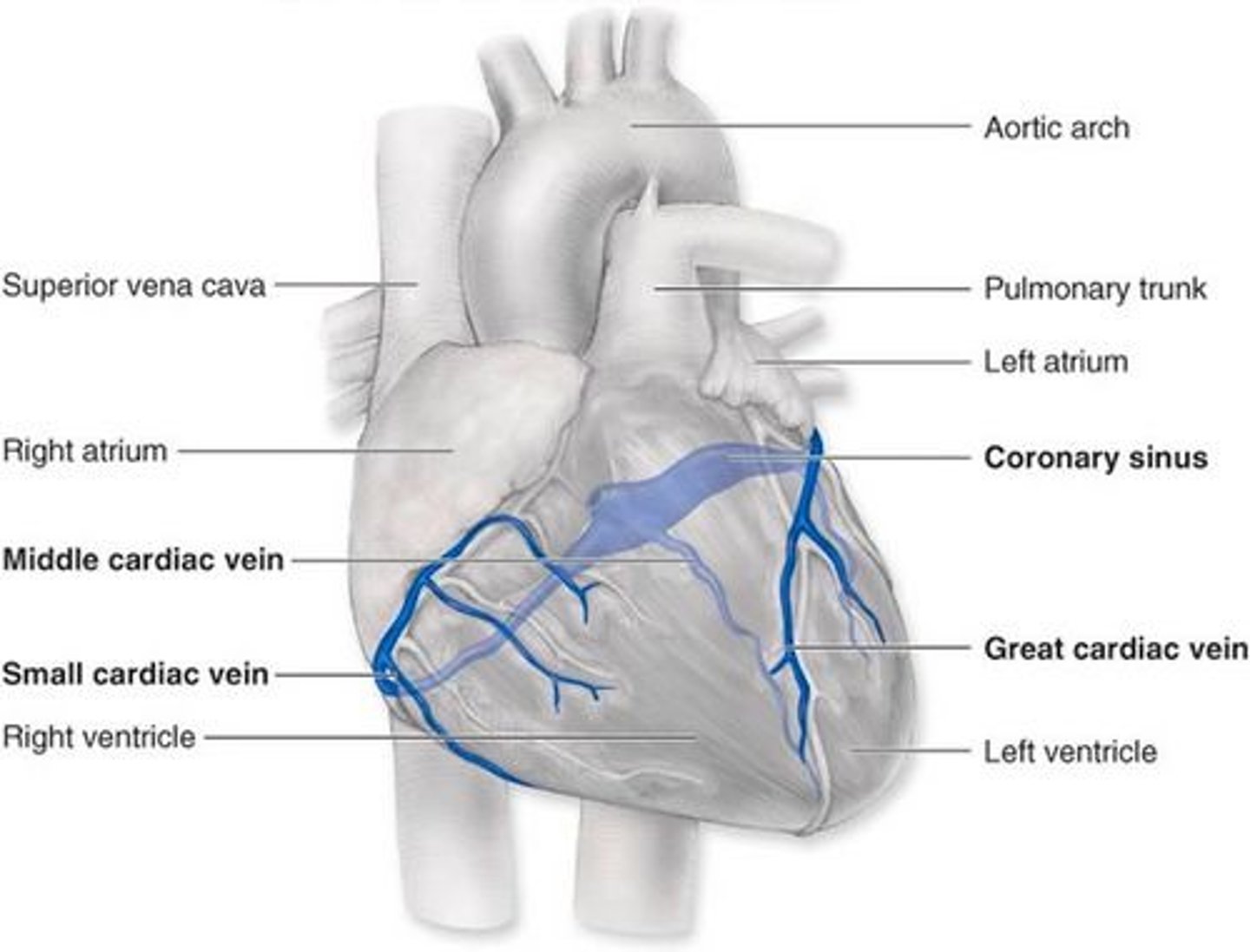
What vessels are over the surface of the heart?
Coronary arteries
Cardiac veins
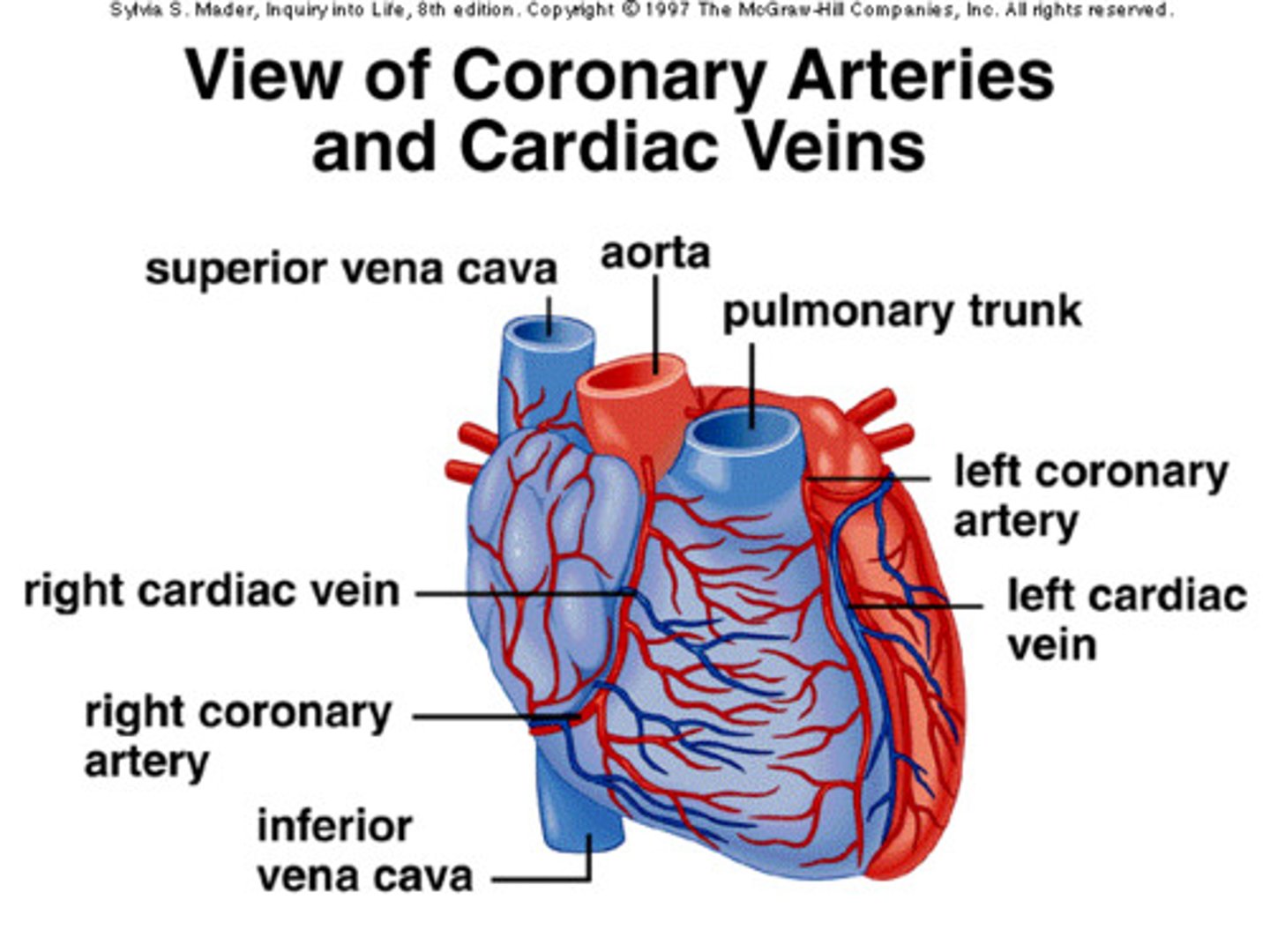
What structure is also over the surface of the heart?
Inelastic pericardial membranes
What do the inelastic pericardial membranes do?
Prevent the heart from over distending itself with blood
More coronary artery pictorial representation
More cardiac vein pictorial representation
What can restricted blood flow to the heart muscle cause?
- Reduces delivery of oxygen and nutrients
- Angina can occur or;
- Myocardial infarction/heart attack
 Note
Note  Flashcards (154)