Chapter 1 Introduction to Operations Management
 Call Kai
 Learn
Learn Practice Test
 Spaced Repetition
 Match
Match Flashcards
 Knowt Play
1/15

There's no tags or description
Looks like no tags are added yet.
Name | Mastery | Learn | Test | Matching | Spaced | Call with Kai | Chat |
|---|
No analytics yet
Send a link to your students to track their progress
16 Terms
Operations Management
the management of systems or processes that create goods and/or provide services
OM relation with marketing
Demand data
Product and service design
Competitor analysis
Lead time data
OM relation with Finance
Budgeting
Economic analysis of investment proposals
Provision of funds
Transformation process, value added
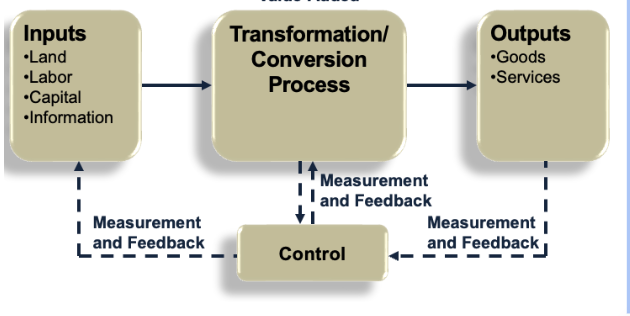
Feedback
Measurements taken at various points in the transformation process
Differences between manufacturing and service operations
Degree of customer contact
Labor content of jobs
Uniformity of input
Uniformity of output
Measurement of productivity
Production and delivery
Quality assurance
Amount of inventory
Evaluation of work
Ability to patent design
Four basic sources of variation
variety of goods or services being offered
structural variation in demand
random variation
assignable variation
Variety of goods or services being offered
The greater the variety of goods and services offered, the greater the variation in production or service requirements
Structural variation in demand
These are generally predictable. They are important for capacity planning.
Random Variation
Natural variation that is present in all processes. Generally, it cannot be influenced by managers
Assignable Variation
Variation that has identifiable sources. This type of variation can be reduced, or eliminated, by analysis and corrective action
Benefit of using models in decision making
Generally easier to use and less expensive than dealing with the real system
Require users to organize and sometimes quantify information
Increase understanding of the problem
Enable managers to analyze “What if?” questions
Serve as a consistent tool for evaluation and provide a standardized format for analyzing a problem
Enable users to bring the power of mathematics to bear on a problem
Systems Approach
a set of interrelated parts that must work together
The business organization is a system composed of subsystems
Marketing subsystem
Operations subsystem
Finance subsystem
System Operation
–Management of personnel
–Inventory management and control
–Scheduling
–Project management
–Quality assurance
Job responsibilities of operations manager
guide system by decision-making:
System design decisions
System operation decisions
System design decisions vs system operations decisions
System Design Decisions: These are typically strategic decisions that usually require long-term commitment of resources + determine parameters of system operation
System Operations Decisions: Operations managers spend more time on system operation decision than any other decision area they still have a vital stake in system design