Lecture series 3 - Ion channels and Excitability
 Studied by 3 people
 Call Kai
 Learn
Learn Practice Test
 Spaced Repetition
 Match
Match Flashcards
 Knowt Play
1/38

There's no tags or description
Looks like no tags are added yet.
Name | Mastery | Learn | Test | Matching | Spaced | Call with Kai |
|---|
No study sessions yet.
39 Terms
Lecture 1 - the phospholipid layer
what analogy is used for phospholipid layer?
how permeable is it?
phospholipid layer functions like a dam, separating intracellular and extracellular space
it is impermeable to most things especially iOS
basic structure of phospholipid bilayer in terms of compartments and gradient
2 different compartments with different concentration of ions separated by a membrane
neuron produces ion gradient using ATP
ion channels
movement down or against electrochemical gradient
do they open/close
can movement of ions cause change in membrane voltage
can movement of ions cause change in concentration of ions
what do they need to move across membrane
allow for on demand passive movement of ions down an electrochemical gradient
ion channels open and close in response to specific stimuli to conduct ions = action potential
movement of ions can cause change in membrane voltage of neuron e.g. action potential/post synaptic potential
movement of ions needed to cause a signal isn’t enough to impact concentration of ions
ions can’t move across membrane without specific protein
singular phospholipid draw and label
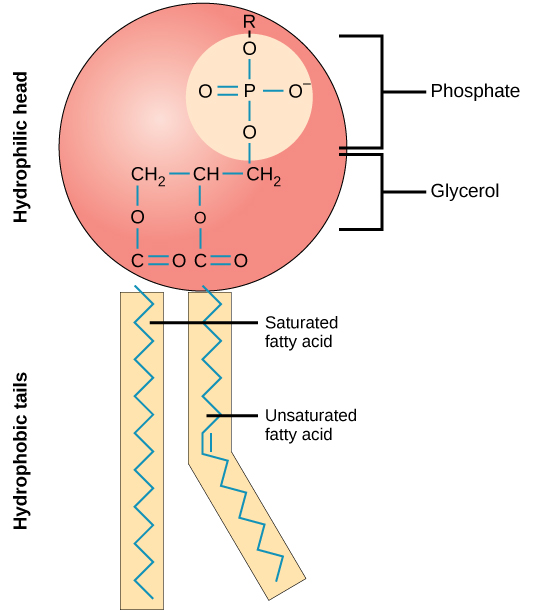
hydrophilic ( water loving) head. = polar - hydrogen bonds with water = charged
glycerol linker = uncharged fatty acid tail = hydrophobic(water fearing) = non polar
usually one tail saturated and one unsaturated creating a kink in the tan
assembly of phospholipid bilayer
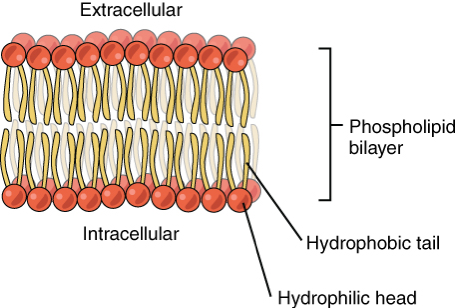
assembly of phospholipid bilayer 2

assembly of phospholipid bilayer continued…
and how to remember
amphiphilic ( both water loving and hating) nature of phospholipid means there is energetic prohibition against free edges
only way this can be avoided s to turn it into a ball which also gives it a self healing property
hospremember like bread butter bread ( bread absorbs water)
phospholipid bilayer resistor or conductor?
because it doesn’t let ions in - it is an electrical resistor
what can cross phospholipid bilaye and how easily?

ion concentration gradient in neurons
cover sodium, potassium, calcium and chlorine
extracellular Na+ conc is high but intracellular is low
extracellular K+ conc is low but intracellular is high
intracellular Ca2+ conc is kept very very low
extracellular Cl- conc is high but intracellular is low
can remember as put salt (NaCl) on outside of chip so extraceullar is high
energy and the brain
neurons generate lots of ATP which required oxygen through oxidative phosphorylation which is very efficient but not always enough oxygen
astrocytes form support network to shuttle lactate into rum to help them produce ATP
primary active transport
use ATP directly through ATP hydrolysis by pump to move an ion across cell membrane against its conc gradient rp
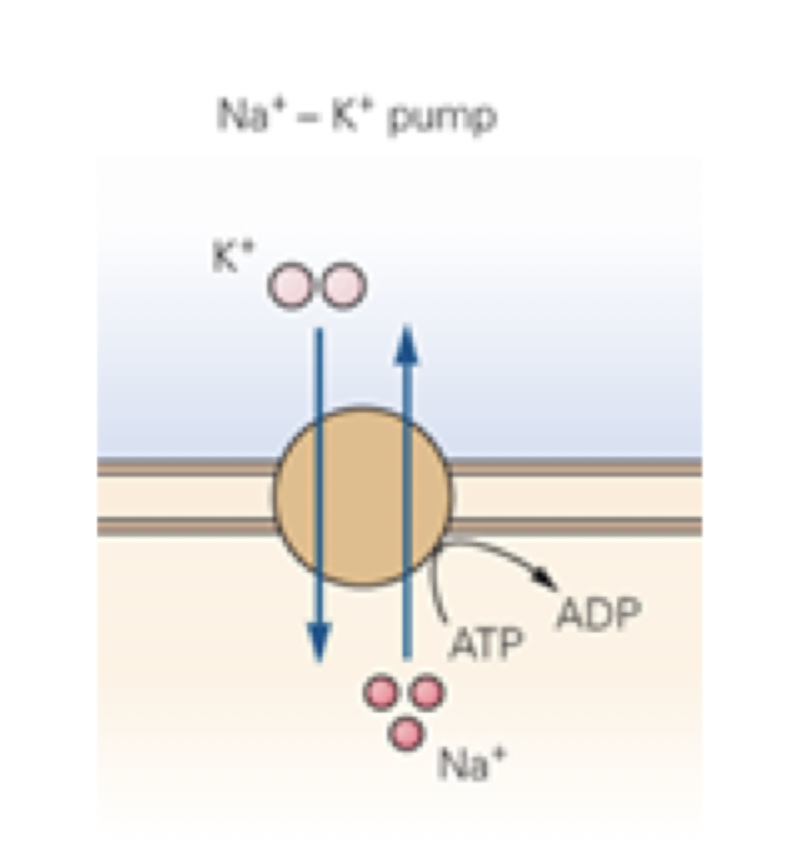
primary active transport - Na+/K+ ATP ase
primary active transport = use of ATP directly through ATP hydrolysis by a pump to move ions across a cell membrane against its concentration gradient
2 K+ go in and 3 Na+ go out.
(catalytic binding sites for Na+ and ATP on intracellular surface and K+ on extracellular)
what is palytoxin?
I dont know if he will test this dont stress if dont know
lethal marine toxins that works by collapsing concentration gradient so pumps Na+/K+ willy nilly
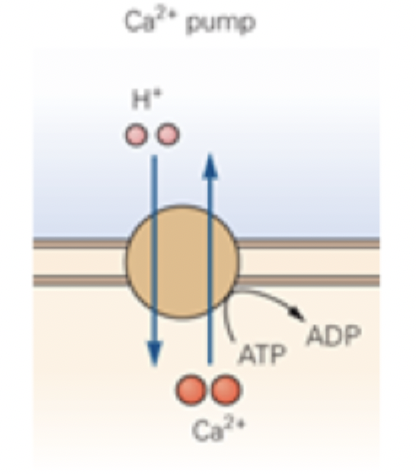
Ca2+ pump/ Ca2+ ATPase
calcium used as an important secondary
maintain a very low cytoplasmic Ca2+ where free calcium is a lot lower than extracellular conc
secondary active transport
what is it
what does active transport allow..
explain Na+-Ca2+ transporter
does NOT directly use ATP hydrolysis. instead uses energy from ion gradient established already from primary active transport (to move another ion across a cell against conc gradient )
active transport allows for storage of energy in form of concentration gradient
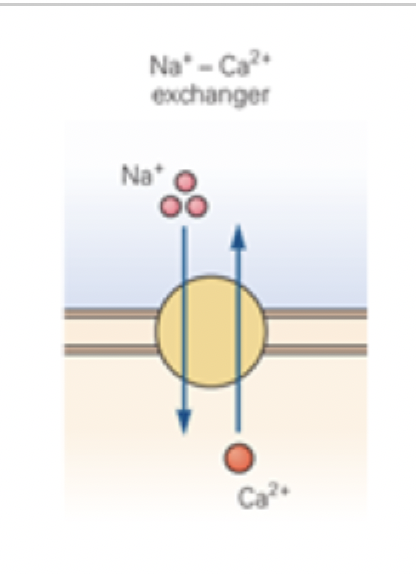
Na+-Ca2+ exchanger
Ca2+ transported out of cell without atp
because Na+and Ca2+ transported in opposite directions, exchanger= antiporter
basically hydrolysis of ATP from na+-K+ pump also provides energy for this because uses Na+ gradient
how does transport of Cl- change upon development
developing neuron
low KCC2
high NKCC1
adult neuron
high KCC2
low NKCC1
note
KCC2 = pumps chlorine out
NKCC1 = pumps chlorine in
Lecture 2
what is ohms law
I = V/R
I= current ( amount of charge moved per unit time)
V=voltage (potential energy that can be exerted on a charge carrier)
measure between 2 points^^
R= resistence
what does membrane voltage mean ?
what charge is inside of neuron?
membrane voltage is difference in potential between the inside and the outside of a neuron
inside of a neuron is negative
what is RMP of a neuron
resting membrane potential approx = -70mV
extra note( not to memorise) :
if resistance is high, current is low
if voltage is low, current is low
why is brain different to a circuit
when we talk about voltage in the brain what do we mean
different to circuit because instead of electrons being only charge carrier we have ions of different charges and different concentration gradients
voltage is electrochemical gradient (V)of an ion and conductance( 1/resistance of flow of membrane). so each ion can produce its own membrane current
define concentration gradient
if there is a difference in conc of an uncharged chemical species across a permeable membrane then there will be a net directional flow of that species.
net flow : high conc → low conc
Nerst Equation
what is equation
what does each ‘thing’ mean
Eion = electrical potential that counteracts conc gradient for the ion
= equilibrium potential
R= 8.314
T= temp in K ( degrees+273)
Z= charge of ion
F= 96485
[X] = ion conc
^^ may not be tested just understand
![<p>Eion = electrical potential that counteracts conc gradient for the ion</p><p>= equilibrium potential</p><p>R= 8.314</p><p>T= temp in K ( degrees+273)</p><p>Z= charge of ion</p><p>F= 96485</p><p>[X] = ion conc</p><p></p><p>^^ may not be tested just understand</p>](https://knowt-user-attachments.s3.amazonaws.com/7917c6c1-3f77-4135-81d0-fa1e122ed0ab.png)
what is the equation of driving force in context of ohms equation
*confirmed to be in assessment
I = V/R
I ion = (Vm-Eion)/R
driving force = (Vm-Eion)
the driving force is the difference between membrane potential of cell and equilibrium potential of ion
key equilibrium potential takeaways of following ions:
na+
K+
Ca2+
Cl-
Na+ Eion (equilibrium potential) very depolarised relative to rmp
K+ Eion hyper polarised relative to RMP
Intracellular Ca2+ conc kept very low
Eion for Cl- close to RMP
lecture 3
what do each of these mean
driving force =0
driving force<0
driving force>0
driving force = 0
no net movement of ions
so at equilibrium potential, no net movement ( current) of ions
driving force<0
for positive ion , it will want to flow into cell
for negative ion, it will want to leave cell
driving force>0
for positive ion, it will want to leave cell
for negative ion, will want to flow into cell
what does g stand for in R=1/G
what values are a depolarising current
what values are a hyperpolarizing current
g = conductance
depolarising current = -70 to more POSITIVE value
hyper polarising current = -70 to more NEGATIVE value
what is an inward current
what is an outward current
inward current = net entry of a positively charged ion into the cell causing depolarisation or net exit of negatively charged ion
outward current = net exit of a positively charged current out of cell causing hyperpolarisation or net entry of negatively charged ion
are these currents ( inwards and outwards) requiring ATP ?
these currents are passive and do not directly require ATP. ions flow due to driving force( flowing down electrochemical gradient)
what are the requirements for a working membrane current
driving force AND conductance
because phospholipid bilayer is a resistor, current in form of ion movement cannot free flow
therefore ion channels are transmembrane proteins that allow ions to flow across all membrane
what are the 3 important properties of ion channels
most open and close in response to specific stimuli e.g. voltages gated ion channels
recognise and select specific ions
conduct ions across a membrane
what is the exception to this rule?
leak potassium channels
dont need stimuli to be opened
open at rmp and are reason for higher resting k conductance
but they do recognise and select specific ions ( k only ) and conduct ions across channels
*RMP is closer to Ek because of these leak potassium channels
voltage gated ion channels
have voltage sensor often containing positively charged amino acids acid residue
this ‘senses’ membrane voltage of cell
at given membrane voltage , voltage sensor is translocated inducing conformational change in protein that enables opening of activation gate of ion channel pore
mostly channel opening favours making inside of membrane more positive ( depolarisation)
lecture 4
what is action potential?
action potential = rapid depolarisation followed by an almost equally rapid depolarisation and an even longer afterhyperpolarisation

dont memorise but be familiar with fundamentals of Hodgkin - Huxley study 5 steps
dissect out squid giant axon
peel axon from surrounding tissue
cut axon and insert cannula
suspend axon vertically in sea water
insert microelectrode through cannula into axon
I membrane equation

function of voltage gated sodium channels
positive feedback loop - likely on exam
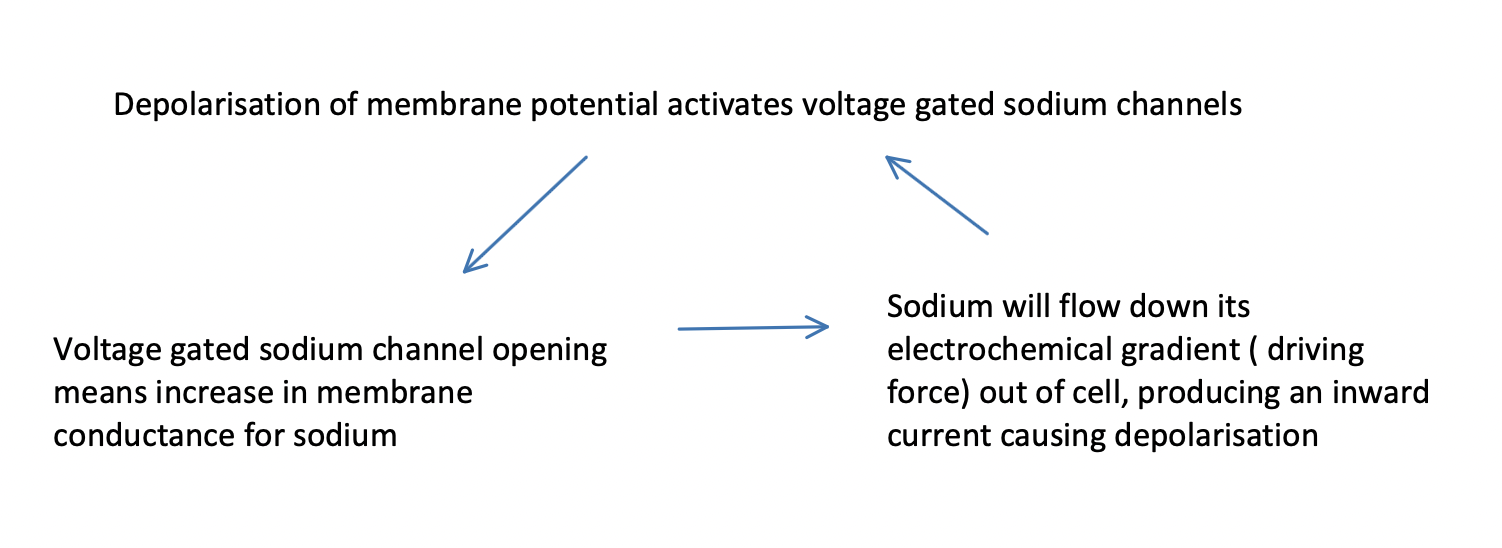
key things to remember abound sodium conductance (GNa)
low Na conductance at rmp
but massive increase in conductance due to positive feedback loop
voltage gated Na channels activated by depolarisation
this activates more sodium channels causing more sodium conductance and depolarisation
these depolarisations are always explosive but short lived because channels deactivate quickly
key things to remember voltage gated k channels
closed at rmp
delayed deactivation after depolarisation and many have slow or no inactivation
voltage gated k channels activated by depolarisation
there is high potassium conductance at RMP due to leak NOT voltage gated k channels