unit two: evolution of populations
 Call Kai
 Learn
Learn Practice Test
 Spaced Repetition
 Match
Match Flashcards
 Knowt Play
1/8

There's no tags or description
Looks like no tags are added yet.
Name | Mastery | Learn | Test | Matching | Spaced | Call with Kai | Chat |
|---|
No analytics yet
Send a link to your students to track their progress
9 Terms
Define population genetics and describe how scientists use population genetics in studying population evolution
population genetics: processes that cause changes in allele and genotypic frequencies in population across generations
scientists definition: how does genetic variation within organisms change over time?
Define the Hardy-Weinberg principle and discuss its importance
allows calculation of allele and genotypic frequencies from one generation to the next
principle: allele and genotypic frequencies stay constant from generation to generation because of the absence of evolutionary influences
Describe the different types of variation in a population
phenotypic variation: diversity in traits
genetic variation: diversity of alleles and genotypes
Explain why heritable variation is necessary for evolution by natural selection
heritable variation: traits that can be passed down from parent to offspring through genes
non-heritable variation: differences in traits that CANNOT BE PASSED DOWN and are caused by external factors
Describe genetic drift and the bottleneck effect
genetic drift
random change in allele frequencies from one generation to the next.
decreases variation within a population, increases among populations
bottleneck effect
when populations are reduced near extinction
Explain how each evolutionary force can influence a population's allele frequencies
directional selection: reduces the abundance of the other genotypes
stabilizing selection: favors the most common phenotype (heterozygous); further reduces the other phenotypes
disruptive selection: favoring phenotypes on either extremes
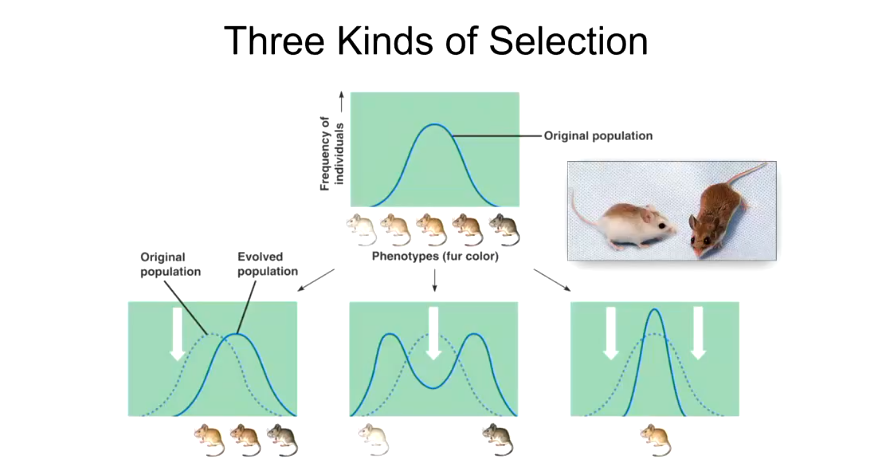
Explain the different ways natural selection can shape populations
directional selection: trait value SHIFTS (you’re new flop era)
disruptive selection: favors the two extremes (mid is bad)
stabilizing selection: favors the average traits (mid is good!)
Describe how different selective forces can lead to different outcomes in terms of population variation
random genetic drift: DECREASES within populations, INCREASES among populations
migration: INCREASES within populations, DECREASES among populations
mutation: INCREASE or MAINTAIN
natural selection: MAINTAIN or DECREASE
Define sexual selection and discuss how/why certain traits may evolve by sexual selection
selection on traits in males and females that increase mating success
intrasexual selection: members of the same sex compete for mates (male against male)
intersexual selection: members of the opposite sex choosing mates (female choosing male)