Intro to psychology - basic processes: Chapter 7 - Human memory
 Call Kai
 Learn
Learn Practice Test
 Spaced Repetition
 Match
Match Flashcards
 Knowt Play
1/152

There's no tags or description
Looks like no tags are added yet.
Name | Mastery | Learn | Test | Matching | Spaced | Call with Kai | Chat |
|---|
No analytics yet
Send a link to your students to track their progress
153 Terms
Memory trace
The physiological basis for memory
Alterations in synaptic transmission
Specific memories depend on biochemical changes that occur at specific synapses
Localized neural circuits
Memories may create unique, reusable pathways in the brain along which signals flow
Long-term potentiation (LTP) [con’t]
Is produced artificially by sending a burst of high-frequency electrical stimulation along a neural pathway
Long-term potentiation (LTP) [III]
Appears to involve changes in both presynaptic (sending) and postsynaptic (receiving) neurons in neural circuits in the hippocampus
Long-term potentiation (LTP) developments
The evidence on LTP has inspired promising work on the development of drugs that might enhance memory in humans
Hebbian learning rule
Lays out the effects of neurons repeatedly stimulating other neurons
Where are new brain cells formed?
In the dentate gyrus of the hippocampus
Organic amnesia
Extensive memory loss due to head injury
Retrograde amnesia
Involves the loss of memories for events that occurred before the onset of amnesia
e.g. A 25-year-old gymnast who sustains a head trauma might find the prior three years, or seven years, or her entire lifetime erased
Anterograde amnesia
Involves the loss of memories for events that occur after the onset of amnesia and makes learning new information nearly impossible.
e.g. The injured gymnast might suffer impaired ability to remember people she meets, where she has parked her car, and so on after the accident
Hippocampal region’s function
Plays a role in long-term memory
What’s the medial temporal lobe memory system?
The broader memory complex
Consolidation
A hypothetical process involving the gradual conversion of new, unstable memories into stable, durable memory codes stored in long-term memory
Consolidation (III)
Memories are consolidated in the hippocampal region and then stored in diverse and widely distributed areas of the cortex
Consolidation process
An effort to retrieve a particular memory leads to hippocampal activity that reactivates a link to a specific cortical area, which reinstates the memory
Consolidation process (con’t)
Memory retrieval appears to depend on activity in many brain circuits and regions, leading to the conclusion that “our ability to remember the past is a whole-brain experience”
Reconsolidation
When unstable memories must be restabilized, where they’re weakened, strengthened, or updated to take into account more recent information
Reconsolidation (con’t)
Can occur even during sleep
Encoding
The process of getting information into memory.
Attention
Focused awareness on a narrow range of stimuli or events that acts as a filter to screen out stimulation.
Attention (con’t)
Is like a filter that screens out most potential stimuli while allowing a select few to pass through into conscious awareness
Cocktail party phenomenon/effect
Occurs when an individual in a crowded room automatically attunes to specific information
e.g. Their own name.
Divided attention
The attempt to split attention across multiple tasks, which effectively divides 100% attention into smaller segments, such as 50% for each task.
Levels of protein
A term used in the transcript to refer to levels of processing, representing how much attention is devoted to stimuli to create shallow, intermediate, or deep memory codes.
Structural encoding
A shallow level of processing that emphasizes the physical structure of the stimuli
e.g. Words written in capital letters (capital letters, lowercase, and so on) or the length of the words (how many letters)
Phonetic encoding
An intermediate level of processing that emphasizes what a word sounds like
e.g. Phonetic primes such as rhyming.
Semantic encoding
A deep level of processing that emphasizes the meaning of verbal input by placing it in a linguistic or meaningful context.
Levels-of-processing theory
Proposes that deeper levels of processing result in longer-lasting memory codes
Elaboration
The process of enriching encoding by linking stimuli to other information at the time of encoding.
e.g. Someone reads that phobias are often caused by classical conditioning, and you apply this idea to your own fear of spiders.
Visual imagery
The use of mental pictures as an aid for memory, providing a second type of memory code to enhance recall.
e.g. If you were asked to remember the word juggler, you could readily form an image of someone juggling balls
Dual-coding theory
A theory suggesting that memory is enhanced by forming both semantic (meaning) and visual codes for information since either can lead to recall
Self-referent encoding
A method of elaborating or enriching the encoding process by determining how information is personally relevant to an individual.
ADHD (Attention Deficit Hyperactivity Disorder)
A condition involving attention problems that are often misidentified as memory problems in children
Serial processing
The concept that human attention is designed to handle tasks one after another rather than in parallel.
Inattention blindness
Periods when we go blind to our environment without realizing it, such as when billboards, cars, kids playing, stop signs, and red lights pass us by unnoticed.
Multitasking
The act of quickly shifting our focus from one activity to another, rather than paying attention to more than one complex task at a time.
Talking on the phone crash risk
A behavior that makes drivers 4 times more likely to crash.
Texting crash risk
A behavior that makes drivers 23 times more likely to crash, and is less productive as it can reduce memory retention
Examples of driving distractions
Activities like applying makeup, arguing with backseat drivers, fumbling for a water bottle, or engaging in conversation that can hijack a driver's focus.
Sensory memory
A storage system that preserves information in its original sensory form for a brief moment in time, usually only a fraction of a second.
Sensory memory (con’t)
Allows the sensation of and reaction to a visual pattern, sound, or touch to linger for a brief moment after the sensory stimulation is over
Sensory memory (III)
For visual information, this brief memory is referred to as iconic memory
For acoustic information, it’s referred to as echoic memory
Iconic memory duration
Traces in this sensory sub-system typically decay within a quarter of a second (1/4second).
Auditory sensory memory duration
Traces in this sub-system typically decay in a short period of time lasting less than 1second.
Short-term memory
A limited capacity storage area that can maintain unrehearsed information for up to about 20seconds.
Rehearsal
The process of repetitively verbalizing or thinking about information to maintain it and elaborate on it within memory.
Maintenance rehearsal
One is simply maintaining the information in consciousness
Elaborative rehearsal
When one is increasing the probability they’ll retain the information in the future
e.g. Focusing on the meaning of the words in the list you are trying to remember.
Decay
The term used to describe the loss of information from a memory store when it is not rehearsed or elaborated upon.
Short-term memory capacity
About 7 items (plus or minus 2) in tasks that required them to remember unfamiliar material.
Chunking
The process of grouping familiar stimuli into a single unit based on familiarity or complexity to increase the capacity of short-term memory.
Chunking (con’t)
Familiar chunks consume less of the limited capacity of STM than unfamiliar chunks
Working memory
A limited capacity storage system housed within short-term memory that temporally maintains and stores information, providing an interface between perceptions, memory, and actions.
Phonological loop
A component of working memory that involves recitation and sounding out words using language to rehearse information.
Visuospatial sketchpad
A component of working memory that holds and manipulates images or visual representations of information.
Central executive system
The component of working memory that controls the deployment of attention, switching the focus of, and dividing attention as needed
e.g. Dividing your attention between a message you are trying to text to your friend during a lecture and what your professor told the class about next week’s exam
Episodic buffer
A component of working memory that serves as an interface between working memory and long-term memory.
Episodic buffer (con’t)
Allows the various components of working memory to integrate information
Working memory (con’t)
Refers to one’s ability to hold and manipulate information in conscious attention
Long-term memory
A storage system believed to have unlimited capacity that can indefinitely hold information for lengthy periods of time
Long-term memory and forgetfulness
Forgetting occurs only because people sometimes cannot retrieve needed information from LTM.
Flashbulb memories
Unusually vivid and detailed recollections of momentous events, which often enter long-term memory with little rehearsal.
e.g. The Bay of Pigs invasion, the death of Prince or Lady Di, or 911,
Clustering
The tendency to remember similar or related items in groupings based on semantic meanings or sounds.
Conceptual hierarchies
Multi-level classification systems based on common properties among items that help organize information for preservation in memory.
Schema
A mental representation or knowledge cluster used to organize and structure information about a particular object or event abstracted from previous experience with the object or event.
Schema (con’t)
People are more likely to remember things that are consistent with their schemas than things that are not, and vice versa
e.g. If you saw a slot machine in a professor’s office, you would probably remember it
Semantic network
A system for storing information consisting of nodes representing concepts joined together by pathways that link related concepts.
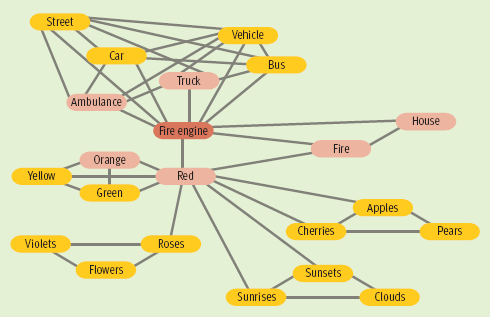
Spreading activation
The process that occurs within a semantic network where triggering one concept activates or lights up a network of related concepts.
e.g. Thinking about one word (such as butter) can make a closely related word (such as bread) easier to remember
Retrieval cues
Stimuli that help gain access to memories stored in long-term memory.
Tip of the tongue phenomenon
A temporary inability to remember something you know, accompanied by the feeling that it is just out of reach.
e.g. A name that one can’t quite recall
Tip of the tongue phenomenon (con’t)
Is a common experience that happens about once a week, although its occurrence increases with age
Tip of the tongue phenomenon statistics
About 40% of people report recurrent experiences of it for the same words
Contextual cues
Environmental factors that accompany memories and help facilitate the retrieval of information from long-term storage.
e.g. When people return after a number of years to a place where they used to live, they typically are flooded with long-forgotten memories
Reinstating events context
The process of facilitating memory retrieval by returning to the scene of a memory or mentally recreating the environment where it occurred.
False memories
A psychological phenomenon where an individual recalls events that did not happen or remembers them differently from how they actually occurred.
Episodic false memories
Events-based false memories often seen in eyewitness testimonies where leading questions can distort recall.
Misinformation effect
An effect proposed by Elizabeth Loftus that occurs when a person's recall of an event they witnessed is altered by misleading information or the way questions are phrased.
e.g People who’d been asked about the cars smashing into each other were more likely to “recall” broken glass, even though there was no broken glass
Source monitoring
The process of making inferences about the origins of memories
Source monitoring (con’t)
Is a crucial facet of memory retrieval that contributes to many of the mistakes that people make in reconstructing their experiences
Source monitoring error
Occurs when a memory derived from one source is misattributed to another source
Leading questions
Specific questioning techniques, such as using the action verb "smashed" instead of "hit," that can alter a participant's memory of an event's intensity.
Semantic false memories (con’t)
A type of false memory based on how information is organized in the semantic space and how we think about the meaning of information.
Decayed memory theory
The theory that information is no longer accessible because it has physically faded or gone away from long-term storage.
Semantic false memory
A type of false memory where activating a semantic network of words or concepts (like fire engine, truck, and red) triggers the belief that a related but absent word (like house) was part of the original list.
Episodic false memories
False memories occurring in episodic events where a schema of what typically happens triggers an idea of an event that was not part of the actual incident.
e.g. Speed being associated with an accident
Ebbinghaus forgetting curve
A graph showing that retention and forgetting over time is steep and rapid, specifically when based on nonsense syllables or meaningless words.
Ebbinghaus forgetting curve (con’t)
Forgetting curves aren’t nearly as steep when it comes to learning meaningful
e.g. Prose or poetry
Retention
The portion or percentage of material that is kept in memory versus what is forgotten.
Retention interval
The length of time between the initial presentation of materials to be remembered and the measurement of forgetting.
Recall
A method of testing retention that requires participants to reproduce information from scratch without cues, as seen in open-ended questions.
e.g. If one were to take a recall test on a list of 25 words you had memorized, you would simply be told to write down on a blank sheet of paper as many of the words as they could remember
Recognition
A method of testing retention that requires participants to select previously learned information from an array of options
e.g. One might be shown a list of 100 words and asked to choose the 25 words that they had memorized
Recognition (con’t)
Tends to yield higher scores than recall measures of memory for the same information
Relearning
A measure of retention requires a participant to memorize information a second time to determine how much time or how many practice trials are saved by having learned it before
e.g. If it takes one 20 minutes to memorize a list the first time and only 5 minutes to memorize it a week later, you’ve saved 15 minutes
Pseudo-forgetting
A lack of memory caused by a lack of attention to information during the initial presentation.
Transience
The simple weakening of a memory over time
Absentmindedness
Refers to a memory failure that is often due to a failure to pay attention because we are perhaps preoccupied with other things
e.g. Losing your keys, misplacing your flash drive
Blocking
An often temporary problem that occurs when we fail to retrieve an item of information such as someone’s name when we meet them
Misattribution
When one assigns a memory to the wrong source
e.g. Mistaking whether the psychology professor or the sociology professor delayed the exam
Suggestibility
When our memory is distorted