Chapter 2.2: Atoms Bond to Form Molecules
 Call Kai
 Learn
Learn Practice Test
 Spaced Repetition
 Match
Match Flashcards
 Knowt Play
1/15

Name | Mastery | Learn | Test | Matching | Spaced | Call with Kai | Chat |
|---|
No analytics yet
Send a link to your students to track their progress
16 Terms
Chemical bond
An attraction between two atoms
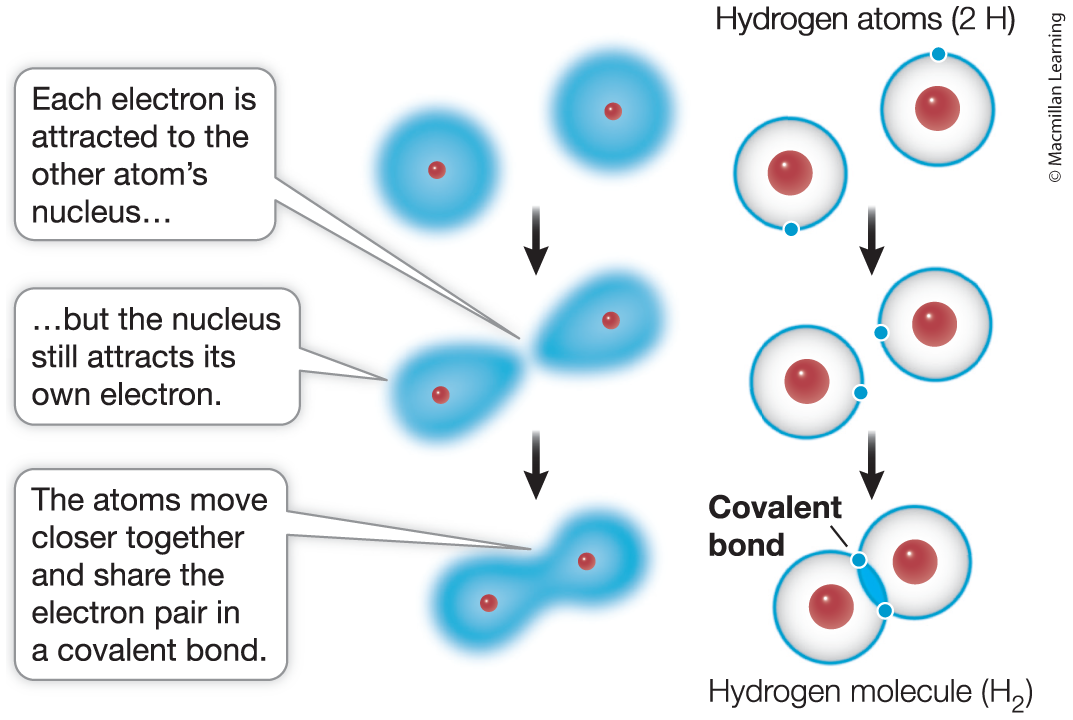
Covalent bond
Strong bonds that result from the sharing of electrons
Forms when two atoms attain more stable configurations by sharing one or more pairs of electrons
Represented in structural formulas by lines drawn between the bonded atoms
Electronegativities cannot be too dissimilar; most common biological molecules have similar electronegativities and form covalent bonds if needed
Orientation
Property of covalent bonds where the length of a covalent bond between a given two elements is the same, and where the angle of each covalent bond with respect to others is also the same
Bond strength
Depends on the atoms involved to determine if a reaction will form
Nonpolar covalent bond
A type of covalent bond that occurs when atoms are shared about equally with the “pull” of each nucleus on the electrons not having a large delta (under a 0.5 difference)
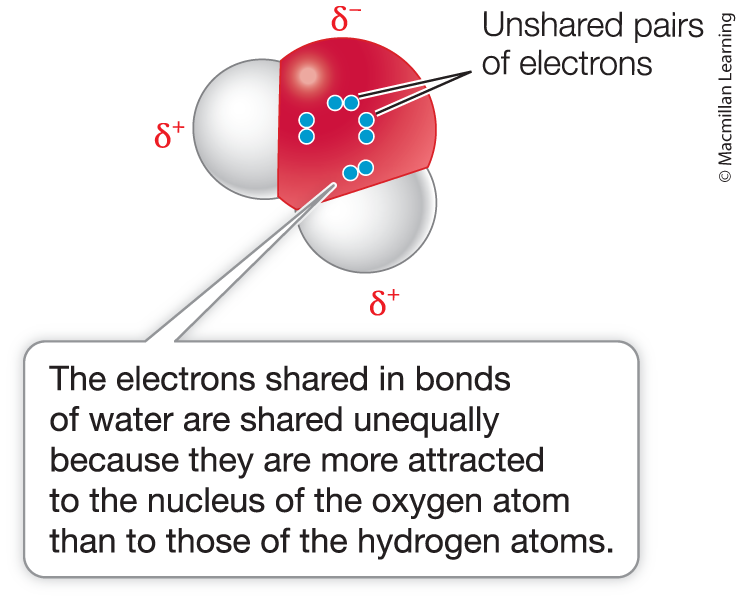
Polar covalent bond
A type of covalent bond where electrons are unequally shared between the two atoms, in a slight charge difference
Seen in H2O, with electrons pulled closer to oxygen due to greater electronegativity
Dipole
A separation of opposite electric charges, such as those in a polar covalent bond
Dipole-dipole interactions
Where a compound can be attracted to slightly oppositely charged atoms in other bonds, creating a weak bond

Ionic bond
Strong bonds that result from the transfer of atoms to another configuration
Occurs between high and low electronegative atoms, creating oppositely-charged ions (greater than 2 difference)
These tend to form crystal lattices with regular, recurring arrangement of the anions and cations (like in table salt)
They also often dissolve in water, rendering the strength irrelevant
Ion
An atom that gains or loses one or more electrons
Cation
The positively charged ion that lost one or more electrons
Anion
The negatively charged ion that gained one or more electrons
Molecule
This is formed when two or more atoms join together chemically
Compound
A molecule formed by at least two different elements
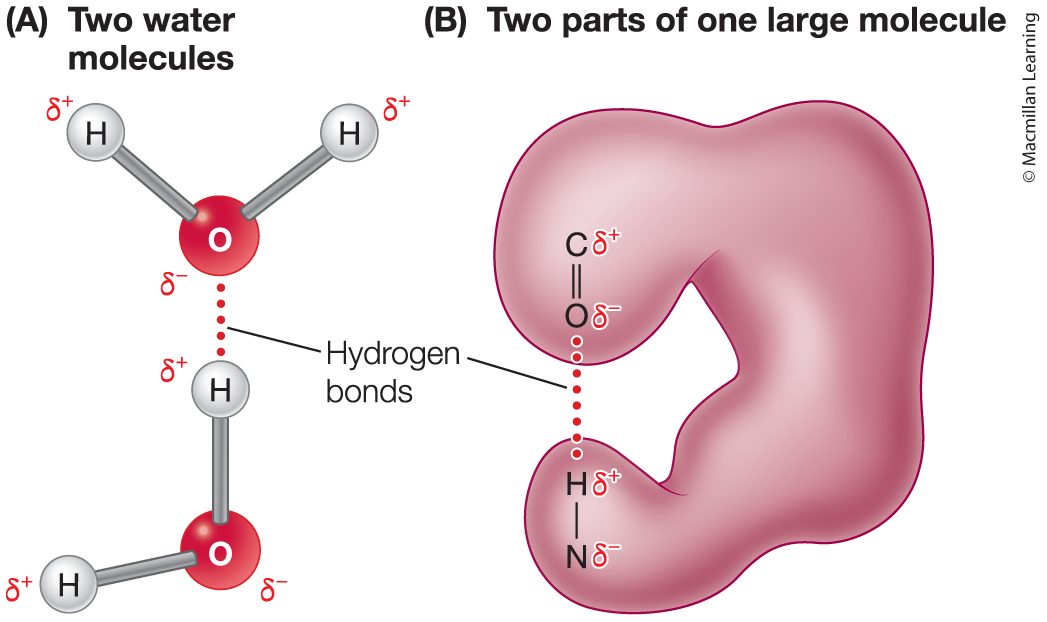
Hydrogen bond
A weak bond caused by electrostatic attractions between slightly-positively charged H and slightly-negatively charged O or N atoms
This is an example of a dipole-dipole interaction
Many can form within one molecule or between molecules, adding strength and determining molecular shape in some cases
van der Waals interactions
Transient electrostatic attraction between two atoms, each of which is in a nonpolar covalent bond
Very small dipoles may form here because of minute asymmetries in electron orbit, which can induce a temporary dipole if close enough